
Araghchi: Khamenei Approved Ceasefire Decision

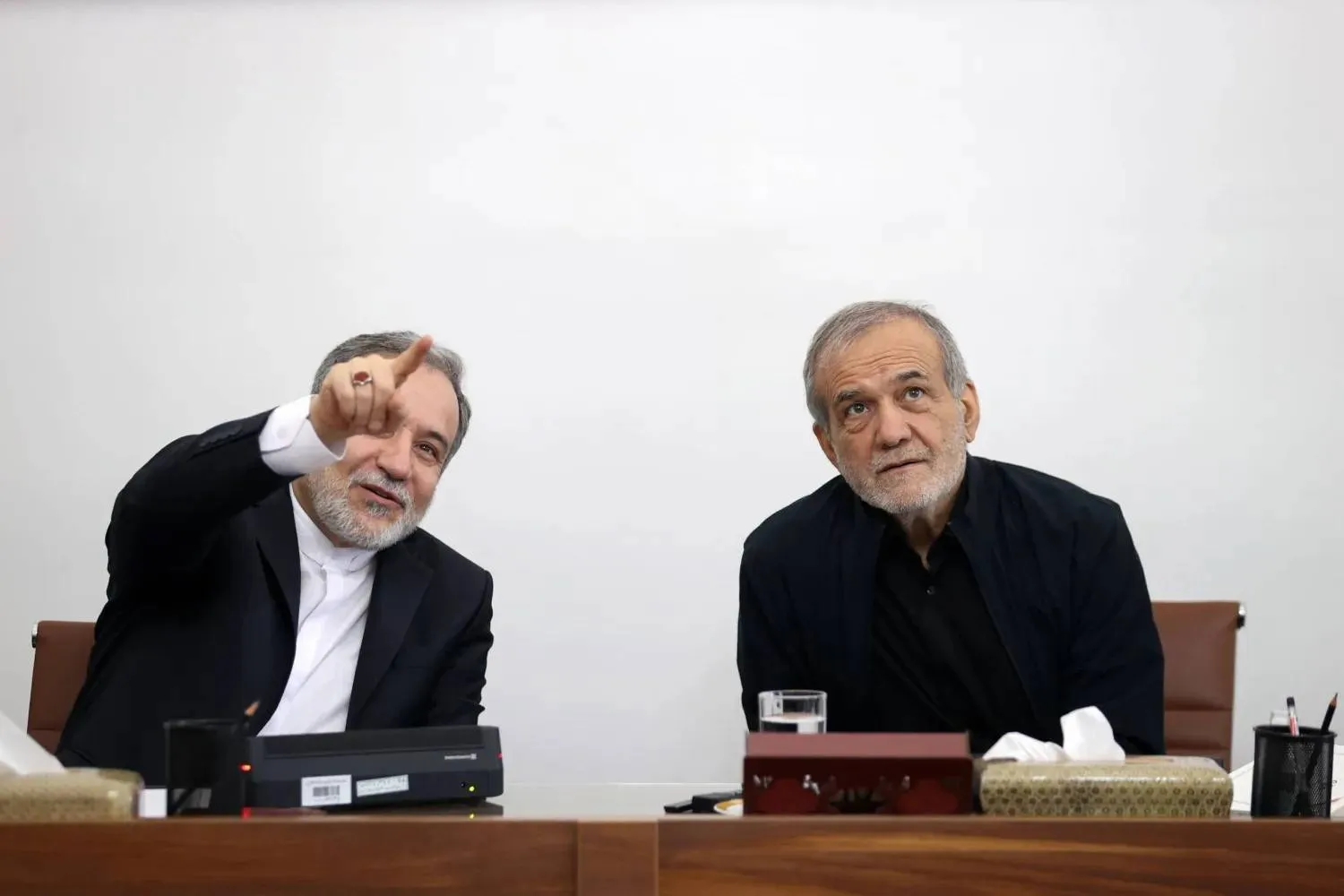
Iranian President Masoud Pezeshkian and Foreign Minister Abbas Araghchi at the Iranian Foreign Ministry headquarters last Saturday (Iranian Presidency) 
TT

Araghchi: Khamenei Approved Ceasefire Decision

Iranian President Masoud Pezeshkian and Foreign Minister Abbas Araghchi at the Iranian Foreign Ministry headquarters last Saturday (Iranian Presidency) 

On the eighth or ninth day of the 12-day war between Iran and Israel, the Iranian Supreme National Security Council made a strategic decision stating that if Tel Aviv were to request a ceasefire without preconditions, Tehran would accept, Iran’s Foreign Minister Abbas Araghchi revealed on Sunday.

In an interview on state television, the FM said the decision was made from “a position of strength,” after Iran had “proven” it was acting in defense, not offense.

Araghchi said that during the 12-day war, he received messages that Israel was “ready for a ceasefire,” and therefore consulted with the commander of the Revolutionary Guards and other relevant officials and, after final approval, announced that Iran was prepared to halt the war on condition that the other side would cease its attacks.

The Iranian diplomat also revealed there had been a “misunderstanding” regarding the timing of the ceasefire and that “confusion” between him and Iranian forces was “resolved by a phone call.”

Araghchi said that on the first day of the ceasefire, “the Zionist entity claimed that Iran had launched missiles and violated the agreement, and therefore sent planes to carry out a strike.”

He added, “I immediately messaged [US envoy Steve] Witkoff, saying that Israel was inventing excuses and falsely blaming Iran.”

“Then you saw that (US President Donald) Trump tweeted, ordered the pilots to turn back and halted the Israeli strike, showing that everything had been coordinated with the Americans from the outset,” the minister said.

On June 24, Araghchi said in post on X that the military operations had ended at 4 am.

Asked about whether he had been subjected to an assassination attempt, Araghchi said that a bomb had been placed outside his house. “But security forces took control of it,” he said.

The Minister had travelled to Türkiye, and then to Geneva where he held talks on June 20 with his counterparts from Britain, France and Germany on Israel's conflict with Tehran.

During the interview on Sunday, he said Iran’s decision to match military resistance with diplomatic engagement is what prevented the war from spiraling into a wider regional catastrophe. “We were on the brink of full-scale war at least three times in recent years...But it was diplomacy, not just arms, that pulled us back.”

Doubts Following Haniyeh’s Assassination

Regarding the assassination of Hamas political chief Ismail Haniyeh in Tehran in July 31, 2024, Araghchi said that a meeting was held in the presence of Iranian Supreme Leader Ali Khamenei following the incident, and a consensus was reached on the necessity of responding to Israel.

The top diplomat said that different opinions occurred between political and military leaders on when and how to respond to Israel.

“The army commanders believed that the attack should be carried out when we has full confidence in our ability to defend the country,” he said.

Araghchi then said at the time, he traveled 17 times to the region where he held diplomatic efforts to prevent the war with Israel.

Diplomacy is always the least risky and costly way to achieve goals, he said, adding, “I conveyed the message to all countries that any confrontation between Iran and Israel will spiral, but that does not mean that we will fight other countries.”

Araghchi said Israel is trying to drag America into the war, warning regional actors hosting US military bases to consider the risks of involvement in a future conflict. “If Iran is forced to defend itself, no hostile base will be spared,” he said.

Hours before the interview aired, Iranian websites had reported that the Republic of Iran Broadcasting (IRIB) had prevented the talk show to host Araghchi.

But the interview was aired a day after President Masoud Pezeshkian visited the headquarters of the Iranian Foreign Ministry.

Ceasefire Talks

Asked whether Iran was deceived in the negotiations with the United States, Araghchi said, “Engaging in talks is a national decision that we must adhere to.”

“This was not a misjudgment by the Foreign Ministry,” Araghchi stressed. “It was a united directive from the country’s top leadership. The truce was approved only after the Zionist side initiated the request—an outcome that highlights the effectiveness of Iran’s resistance strategy.”

The FM said, “The Zionist entity thought Iran would collapse within a week, but that didn’t happen. Within hours, field commanders were appointed and responses were implemented. The enemy requested a ceasefire, and we delivered the final blow.”

He also praised the Iranian people for their unity during the crisis. “The strong cohesion among Iranians reflected their deep trust in the state’s efforts to avoid war while defending the nation’s dignity.”

On the nuclear issue, Araghchi said Tehran has never sought nuclear weapons and that the JCPOA was built on temporary confidence-building measures.

He then rejected proposals like a multinational fuel consortium as violations of Iran’s sovereignty.


Iran FM in Russia with for Nuclear Talks

Iranian Foreign Minister Abbas Araghchi meets with Russian legislators in Moscow. (Iranian Foreign Ministry)
TT

Iran FM in Russia with for Nuclear Talks

Iranian Foreign Minister Abbas Araghchi meets with Russian legislators in Moscow. (Iranian Foreign Ministry)

Iranian Foreign Minister Abbas Araghchi arrived in Moscow on Tuesday amid a crisis in his country’s relations with the International Atomic Energy Agency (IAEA) and ongoing disagreements with the West over a nuclear deal.

Ahead of Araghchi’s arrival, Russian Foreign Minister Sergei Lavrov told Iranian state media that the IAEA needed to be neutral in dealing with Iran.

“The IAEA did not condemn the (US and Israeli) strikes on Iran (in June) even though the agency had a mandate to monitor the bombed sites – these were the sites in question. This omission was a blatant violation of all the rules and norms,” Lavrov said.

“This is why IAEA’s actions did not exactly please anyone in Iran, to say the least, which is more than understandable,” he noted.

Iran passed a law in July to suspend its cooperation with the IAEA, denying UN inspectors access into the country. The suspension came after US and Israeli airstrikes targeted Iran’s nuclear facilities on June 22.

The FM said Russia supported Iran at various stages of the negotiations with the IAEA.

President Vladimir Putin “discussed the current situation with our Iranian friends at various levels. We shared with our Iranian friends our opinion on how to deal with this situation, how to restore relations with the IAEA and with Western countries and on what terms, if they are interested in this. But the final decision remains, of course, with the leadership of Iran,” Lavrov added.

IAEA chief Rafael Grossi had been calling on Iran to allow inspectors access to three key nuclear facilities that enrich uranium and were hit by the US and Israeli airstrikes in June.

But head of the Atomic Energy Organization of Iran (AEOI) Mohammad Eslami said the IAEA has no right to demand inspections of the targeted sites.

In a related development, Egyptian Foreign Minister Badr Abdelatty held telephone talks with Grossi on Monday over the Iranian nuclear file.

Abdelatty underscored the importance of continuing efforts aimed at building confidence and paving the way for sustained cooperation between Iran and the IAEA.

In an interview with Radio France International (RFI) on Monday, Grossi said: “Contact with Iran remains in place. We haven’t yet been able to restore cooperation to the required level, but I believe it is critically important.”

He said dialogue with Iran continues through behind-the-scenes negotiations and confidential contacts.

Last month, Kamal Kharrazi, a top foreign affairs advisor to Supreme Leader Ali Khamanei, said Tehran was ready to consider a Russian and Chinese plan to resume cooperation with IAEA.

In Russia, Araghchi met with Leonid Slutsky, chairman of the international committee of the lower house of parliament, and leader of the Liberal Democratic Party of Russia (LDPR).

He said Russian-Iranian ties are developing across all areas of cooperation.

Araghchi and Lavrov are set to meet on Wednesday.


Trump Adds Seven Countries, Including Syria, to Full Travel Ban List 

Syrian citizens wave their national flags during celebrations marking the first anniversary of the ousting of former President Bashar al-Assad in Damascus, Syria, Monday, Dec. 8, 2025. (AP)
TT

Trump Adds Seven Countries, Including Syria, to Full Travel Ban List 

Syrian citizens wave their national flags during celebrations marking the first anniversary of the ousting of former President Bashar al-Assad in Damascus, Syria, Monday, Dec. 8, 2025. (AP)

US President Donald Trump on Tuesday expanded a list of countries subject to a full travel ban, prohibiting citizens from an additional seven countries, including Syria, from entering the United States.

The White House said in a statement that Trump signed a proclamation "expanding and strengthening entry restrictions on nationals from countries with demonstrated, persistent, and severe deficiencies in screening, vetting, and information-sharing to protect the Nation from national security and public safety threats."

Tuesday's move banned citizens from Burkina Faso, Mali, Niger, South Sudan, Syria and those holding Palestinian Authority-issued travel documents. The action also imposes a full ban on Laos and Sierra Leone, which had previously only been subject to partial restrictions.

The White House said the expanded ban goes into effect on January 1.

The action comes despite Trump's vow to do everything he could to make Syria successful after landmark talks in November with Syrian President Ahmed al-Sharaa.

Trump has backed Sharaa, whose visit capped a stunning year for the opposition fighter-turned-ruler who toppled longtime autocratic leader Bashar al-Assad and has since traveled the world as a leader who wants to unify his war-ravaged nation and end its decades of international isolation.

But in a post on his Truth Social platform on Saturday, Trump vowed "very serious retaliation" after the US military said two US Army soldiers and a civilian interpreter were killed in Syria by a suspected ISIS attacker who targeted a convoy of American and Syrian forces before being shot dead. He described the incident in remarks to reporters as a "terrible" attack.

The White House cited visa overstay rates for Syria in its justification for the ban.

"Syria is emerging from a protracted period of civil unrest and internal strife. While the country is working to address its security challenges in close coordination with the United States, Syria still lacks an adequate central authority for issuing passports or civil documents and does not have appropriate screening and vetting measures," the White House said.

US ADDS MORE NATIONS TO PARTIAL RESTRICTIONS LIST

Trump signed a proclamation in June banning the citizens of 12 countries from entering the United States and restricting those from seven others, saying it was needed to protect against "foreign terrorists" and other security threats. The bans apply to both immigrants and non-immigrants, such as tourists, students and business travelers.

The travel ban remains on those twelve countries, the White House said.

Trump also added partial restrictions and entry limitations on an additional 15 countries, including Nigeria, which is under scrutiny from Trump, who in early November threatened military action over the treatment of Christians in the country.

Since returning to office in January, Trump has aggressively prioritized immigration enforcement, sending federal agents to major US cities and turning away asylum seekers at the US-Mexico border.

The expansion of the countries subject to entry restrictions marks a further escalation of immigration measures the administration has taken since the shooting of two National Guard members in Washington, DC, last month.

Investigators say the shooting was carried out by an Afghan national who entered the US in 2021 through a resettlement program under which Trump administration officials have argued there was insufficient vetting.

Days after the shooting, Trump vowed to "permanently pause" migration from all "Third World Countries," although he did not identify any by name or define the term.


Millions Are Pledged to a Syrian Australian Man Who Stopped a Gunman and Became a National Hero 

Flowers with a note that read "The Bondi Hero" are left outside tobacco shop owned by Ahmed al-Ahmed, the bystander who is hailed as the "Bondi hero" after he charged at one of the gunmen and seized his rifle during the deadly shooting at Bondi Beach, in Sydney, Australia, December 16, 2025. (Reuters)
TT

Millions Are Pledged to a Syrian Australian Man Who Stopped a Gunman and Became a National Hero 

Flowers with a note that read "The Bondi Hero" are left outside tobacco shop owned by Ahmed al-Ahmed, the bystander who is hailed as the "Bondi hero" after he charged at one of the gunmen and seized his rifle during the deadly shooting at Bondi Beach, in Sydney, Australia, December 16, 2025. (Reuters)

Like many Australians strolling at Bondi Beach on long, warm summer evenings, Ahmed al-Ahmed just wanted a cup of coffee with a friend. Around him, a bloody massacre erupted as two gunmen targeted Jews during Hanukkah festivities at a park close to the shore.

Soon al Ahmed was creeping, bent over, between two parked cars, before barreling directly toward one of the unsuspecting shooters. In footage that has been viewed millions of times around the world, the 44-year-old father can be seen tackling one of the gunmen, wrestling the man’s shotgun from his grip and turning it on the attacker.

The story of the Syrian-Australian Muslim shop owner who put an end to the rampage of one of the shooters on Sunday has been seized upon by a country desperately seeking comfort after one of its darkest hours: the slaying of 15 people as they celebrated their Jewish faith.

Millions have been raised for Bondi hero

“At a moment where we have seen evil perpetrated, he shines out as an example of the strength of humanity,” Prime Minister Anthony Albanese said Tuesday, as he left a Sydney hospital where al-Ahmed is being treated for gunshot wounds. “We are a brave country. Ahmed al-Ahmed represents the best of our country.”

A fundraising page established by Australians who had never met al-Ahmed had attracted by Tuesday night donations by some 40,000 people, who gave 2.3 million Australian dollars ($1.5 million). Among the supporters was the billionaire hedge fund manager William Ackman, who pledged AU$99,000.

Father of two faces a long recovery

Al-Ahmed, who is married with two young daughters, faces a long struggle ahead, those who have spoken to him since Sunday’s massacre say. He was shot multiple times in the left arm, apparently by the second gunman in the attack as the man fired indiscriminately from a footbridge.

He has already undergone surgery and more operations are scheduled, said Lubaba alhmidi Alkahil, a spokesperson for the Australians for Syria Association, who visited al Ahmed in a hospital late Monday. The “quiet and humble” man was conscious but frail and faced at least six months of recovery, Alkahil said.

A prime minister and a president are fans

In the days since the attack, a pile of floral tributes and notes of thanks has grown outside the small tobacco store al-Ahmed owns opposite a train station in suburban Sydney. Meanwhile, he has received visits at the hospital from Australia’s leaders, apparently telling Chris Minns, the premier of New South Wales state, that he’d take the same action again.

He has been hailed as a hero by world leaders including US President Donald Trump and Australia’s Governor General, who is the representative of Britain’s King Charles in the country. Minns said al-Ahmed saved “countless” lives in what the premier said was “the most unbelievable scene I’ve ever seen.”

Al-Ahmed was once a police officer

Al-Ahmed lived in the town of Nayrab in Syria’s Idlib region before he arrived in Australia, his cousin Mohammad al-Ahmed told The Associated Press. He left Syria in 2006 after finishing his studies, before the 2011 mass protests against the government of then-President Bashar Assad that were met with a brutal crackdown and spiraled into a nearly 14-year civil war.

Nayrab was heavily bombed by Assad's forces with most of the town’s houses flattened and reduced to rubble. On Tuesday, al-Ahmed was the talk of the town.

“Ahmed did really a heroic job,” his cousin, Mohammad al-Ahmed told The Associated Press. “Without any hesitation, he tackled the terrorist and disarmed him just to save innocent people.”

Ahmed al-Ahmed's parents, who came to Sydney this year to reunite with their son, told Australian Broadcasting Corp. that their son had served with the police and in the central security forces in Syria. Father Mohamed Fateh al-Ahmed said his son’s “conscience and soul” compelled him to act on Sunday.

“I feel pride and honor because my son is a hero of Australia,” the father said.

Tale of heroism gives hope amid tragedy

In the aftermath of the mass killing, a country roiling from one of the worst hate-fueled attacks ever on its soil — allegedly committed by an Australian resident who arrived from India in 1998 and his Australian-born son — looked for hope amid their grief. Stories of heroism have started to emerge.

They included the tale of a married couple, Boris and Sofia Gurman, who were both killed while trying to stop one of the shooters as he climbed from his car and began the massacre, their family has told Australian news outlets.

Reuven Morrison, 62, was also killed while trying to stop the horror, according to his daughter, Sheina Gutnick. After al-Ahmed wrestled the gun from one shooter, a person Gutnick identified as Morrison is seen throwing objects at the gunman before he was shot by the second man.

Acts of courage like these were cited by many on social media and in news outlets as examples of what being Australian should mean.

“When he did what he did, he wasn’t thinking at all about the background of the people he’s saving, the people dying in the street,” Mohamed Fateh al-Ahmed said of his son. “He doesn’t discriminate between one nationality and another, especially here in Australia there’s no difference between one citizen and another.”