


Europe Hopes for 'No Surprises' as US Weighs Force Withdrawals

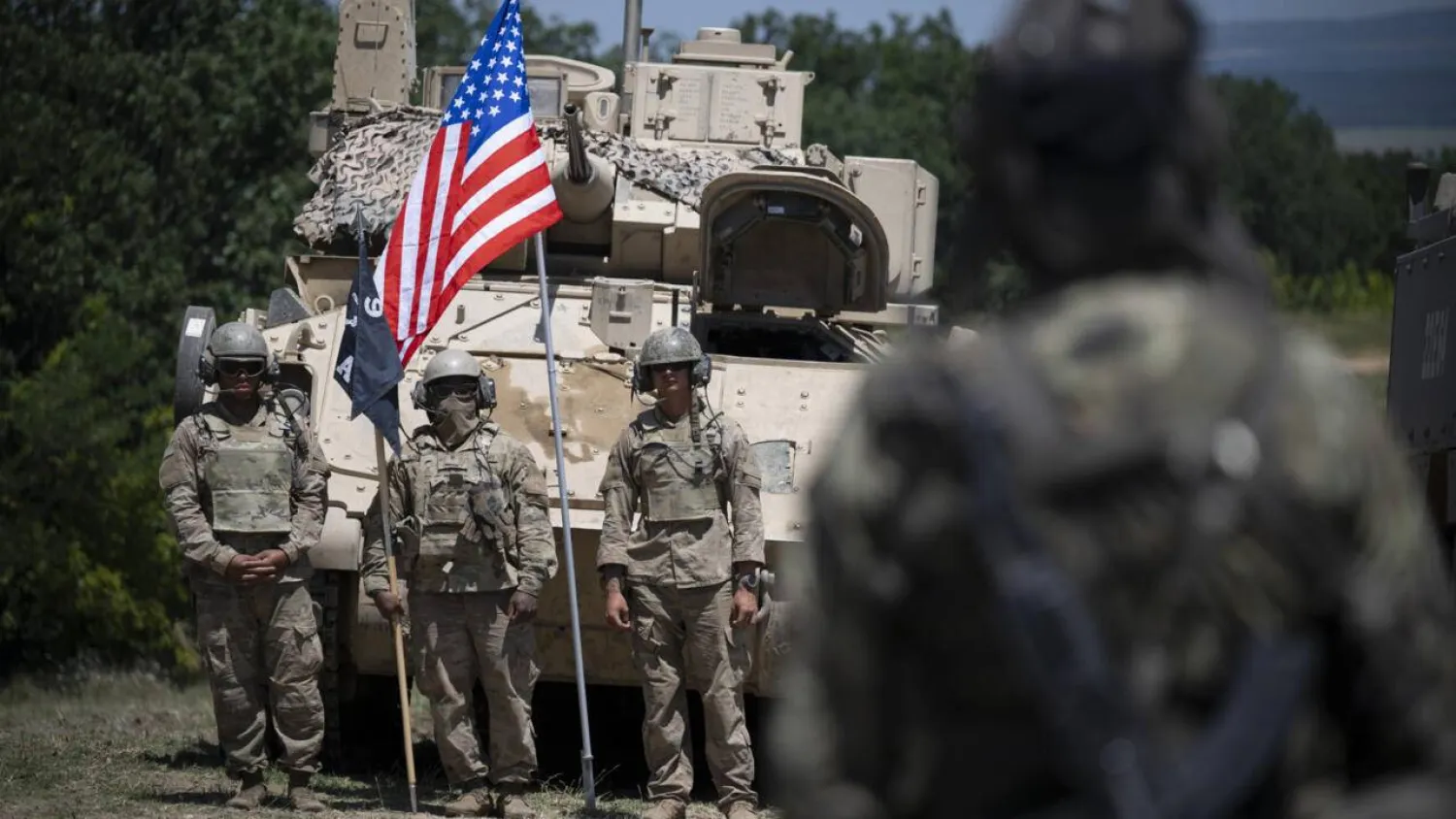
The United States is conducting a review of its military deployments worldwide. Nikolay DOYCHINOV / AFP
TT

Europe Hopes for 'No Surprises' as US Weighs Force Withdrawals

The United States is conducting a review of its military deployments worldwide. Nikolay DOYCHINOV / AFP

After keeping Donald Trump happy with a pledge to up defense spending at NATO's summit, Europe is now bracing for a key decision from the US president on the future of American forces on the continent.

Washington is currently conducting a review of its military deployments worldwide -- set to be unveiled in coming months -- and the expectation is it will lead to drawdowns in Europe.

That prospect is fraying the nerves of US allies, especially as fears swirl that Russia could look to attack a NATO country within the next few years if the war in Ukraine dies down.

However, the alliance is basking in Trump's newfound goodwill following its June summit in The Hague, and his officials are making encouraging noises that Europe will not be left in the lurch.

"We've agreed to no surprises and no gaps in the strategic framework of Europe," said Matthew Whitaker, US ambassador to NATO, adding he expected the review to come out in "late summer, early fall".

"I have daily conversations with our allies about the process," he said.

While successive US governments have mulled scaling back in Europe to focus more on China, Trump has insisted more forcefully than his predecessors that the continent should handle its own defense.

"There's every reason to expect a withdrawal from Europe," said Marta Mucznik from the International Crisis Group. "The question is not whether it's going to happen, but how fast."

When Trump returned to office in January many felt he was about to blow a hole in the seven-decade-old alliance.

But the vibe in NATO circles is now far more upbeat than those desperate days.

"There's a sanguine mood, a lot of guesswork, but the early signals are quite positive," one senior European diplomat told AFP, talking as others on condition of anonymity.

"Certainly no panic or doom and gloom."

'Inevitable'

The Pentagon says there are nearly 85,000 US military personnel in Europe -- a number that has fluctuated between 75,000 and 105,000 since Russia's 2022 invasion of Ukraine.

"I think it is inevitable that they pull out some of their forces," a second European diplomat told AFP.

"But I don't expect this to be like a dramatic overhaul. I think it's going to be gradual. I think it's going to be based on consultations."

Trump's first target is likely to be the troops left over from a surge ordered by his predecessor Joe Biden after Moscow's tanks rolled into Ukraine.

Officials say relocating the rump of that 20,000-strong deployment would not hurt NATO's deterrence too much -- but alarm bells would ring if Trump looked to cut too deep into personnel numbers or close key bases.

The issue is not just troop numbers -- the US has capabilities such as air defenses, long-range missiles and satellite surveillance that allies would struggle to replace in the short-term.

"The kinds of defense investments by Europe that are being made coming out of The Hague summit may only be felt in real capability terms over many years," said Ian Lesser from the German Marshall Fund think tank.

"So the question of timing really does matter."

'Inopportune moment'

Washington's desire to pull back from Europe may be tempered by Trump now taking a tougher line with Russia -- and Moscow's reluctance to bow to his demands to end the Ukraine war.

"It seems an inopportune moment to send signals of weakness and reductions in the American security presence in Europe," Lesser said.

He also pointed to Trump's struggles during his first term to pull troops out of Germany -- the potential bill for relocating them along with political resistance in Washington scuppering the plan.

While European diplomats are feeling more confident than before about the troop review, they admit nothing can be certain with the mercurial US president.

Other issues such as Washington's trade negotiations with the EU could rock transatlantic ties in the meantime and upend the good vibes.

"It seems positive for now," said a third European diplomat.

"But what if we are all wrong and a force decrease will start in 2026. To be honest, there isn't much to go on at this stage."




Iran Opens Trial of Dual National Accused of Spying for Israel 

Iranians go shopping in Tajrish Bazaar in Tehran, Iran, 08 December 2025. (EPA)
TT

Iran Opens Trial of Dual National Accused of Spying for Israel 

Iranians go shopping in Tajrish Bazaar in Tehran, Iran, 08 December 2025. (EPA)

The trial of a dual national holding European citizenship has begun in Iran, the semi-official Tasnim news agency reported on Monday, saying they were indicted for "intelligence cooperation and espionage in favor of the Zionist regime (Israel)."

According to the Alborz provincial attorney general, the defendant - whose identity has not been disclosed - entered Iran about a month before the 12-day war in June, during which Israel and the US struck Iranian nuclear facilities.

They were arrested on the fourth day of the conflict by the elite Revolutionary Guards.

"Sophisticated spy and intelligence items and equipment were discovered in their villa in Karaj," the attorney general said, adding that the charges under investigation carry penalties for "waging war against God" and "corruption on earth" - offences often punishable by death.

In recent years, the Revolutionary Guards have detained dozens of dual nationals and foreigners, mostly on espionage and security-related charges.

Rights groups and some Western countries have accused Tehran of using such arrests to gain leverage in negotiations. Tehran denies arresting people for political reasons.


China Vows to Defend Sovereignty Over Taiwan as Trump Unveils Security Strategy 

08 December 2025, China, Beijing: Guo Jiakun, China's Foreign Office spokesperson, speaks to journalists. (dpa)
TT

China Vows to Defend Sovereignty Over Taiwan as Trump Unveils Security Strategy 

08 December 2025, China, Beijing: Guo Jiakun, China's Foreign Office spokesperson, speaks to journalists. (dpa)

China on Monday pledged to defend its sovereignty and warned against "external interference" after the US unveiled a new security strategy aimed at building up military power to deter conflict with Beijing over Taiwan.

Washington laid out its approach to one of the world's most sensitive diplomatic issues in its official National Security Strategy released on Friday.

The document came as Beijing last week deployed a large number of naval and coast guard vessels across East Asian waters in its largest show of maritime force to date.

Taiwan is the first red line that must not be crossed in China-US relations and China brooks no external interference, Guo Jiakun, a spokesperson for the Chinese foreign ministry, told reporters in Beijing when asked about the document.

"The US side should ... handle the Taiwan question with the utmost prudence, and stop indulging and supporting 'Taiwan independence' separatist forces in seeking independence by force or resisting reunification by force," he said.

Guo added that China was willing to work with Washington to promote stable ties while safeguarding its sovereignty, security and development interests.

China, which views democratically governed Taiwan as its own territory, has never renounced the use of force to take control of the island. Taiwan's government rejects Beijing's sovereignty claims.

The new US document has been warmly welcomed in Taiwan, whose President Lai Ching-te wrote on X on Saturday: "Greatly appreciate that the US National Security Strategy prioritizes deterring a conflict over Taiwan."

Taiwan Defense Minister Wellington Koo told reporters on the same day that the United States still regards maintaining peace and stability in the region as its highest core interest.

"The United States is vigorously promoting that the countries in the Indo-Pacific region work together to establish an effective form of collective deterrence," he said.

"We in Taiwan must also strengthen our self-defense capabilities."

Lai has said Taiwan aims to spend 5% of its GDP on defense by 2030 and last month unveiled $40 billion in extra defense spending to run from 2026-2033.


Trump Says Zelenskyy 'Isn't Ready' Yet to Accept US-authored Proposal to End Russia-Ukraine War

US President Donald Trump poses on the red carpet for the 2025 Kennedy Center Honors at the John F. Kennedy Center for the Performing Arts in Washington, D.C., US, December 7, 2025. REUTERS/Jeenah Moon
TT

Trump Says Zelenskyy 'Isn't Ready' Yet to Accept US-authored Proposal to End Russia-Ukraine War

US President Donald Trump poses on the red carpet for the 2025 Kennedy Center Honors at the John F. Kennedy Center for the Performing Arts in Washington, D.C., US, December 7, 2025. REUTERS/Jeenah Moon

President Donald Trump on Sunday claimed Ukrainian President Volodymyr Zelenskyy “isn't ready” to sign off on a US-authored peace proposal aimed at ending the Russia-Ukraine war.

Trump was critical of Zelenskyy after US and Ukrainian negotiators completed three days of talks on Saturday aimed at trying to narrow differences on the US administration's proposal. But in an exchange with reporters on Sunday night, Trump suggested that the Ukrainian leader is holding up the talks from moving forward.

“I’m a little bit disappointed that President Zelenskyy hasn’t yet read the proposal, that was as of a few hours ago. His people love it, but he hasn’t,” Trump claimed in an exchange with reporters before taking part in the Kennedy Center Honors. The president added, "Russia is, I believe, fine with it, but I’m not sure that Zelenskyy’s fine with it. His people love it. But he isn’t ready.”

To be certain, Russian President Vladimir Putin hasn't publicly expressed approval for the White House plan. In fact, Putin last week had said that aspects of Trump's proposal were unworkable, even though the original draft heavily favored Moscow.

Trump has had a hot-and-cold relationship with Zelenskyy since riding into a second White House term insisting that the war was a waste of US taxpayer money. Trump has also repeatedly urged the Ukrainians to cede land to Russia to bring an end to a now nearly four-year conflict he says has cost far too many lives.

Zelenskyy said Saturday he had a “substantive phone call” with the American officials engaged in the talks with a Ukrainian delegation in Florida. He said he had been given an update over the phone by US and Ukrainian officials at the talks.

“Ukraine is determined to keep working in good faith with the American side to genuinely achieve peace,” Zelenskyy wrote on social media.

Trump's criticism of Zelenskyy came as Russia on Sunday welcomed the Trump administration’s new national security strategy in comments by the Kremlin spokesman published by Russia’s Tass news agency.

Dmitry Peskov said the updated strategic document, which spells out the administration's core foreign policy interests, was largely in line with Moscow’s vision.

“There are statements there against confrontation and in favor of dialogue and building good relations,” he said, adding that Russia hopes this would lead to “further constructive cooperation with Washington on the Ukrainian settlement.”

The document released Friday by the White House said the US wants to improve its relationship with Russia after years of Moscow being treated as a global pariah and that ending the war is a core US interest to “reestablish strategic stability with Russia.”

Speaking on Saturday at the Reagan National Defense Forum, Trump’s outgoing Ukraine envoy, Keith Kellogg, said efforts to end the war were in “the last 10 meters.”

He said a deal depended on the two outstanding issues of “terrain, primarily the Donbas,” and the Zaporizhzhia Nuclear Power Plant.

Russia controls most of Donbas, its name for the Donetsk and neighboring Luhansk regions, which, along with two southern regions, it illegally annexed three years ago. The Zaporizhzhia Nuclear Power Plant is in an area that has been under Russian control since early in Moscow’s invasion of Ukraine and is not in service. It needs reliable power to cool its six shutdown reactors and spent fuel, to avoid any catastrophic nuclear incidents.

Kellogg, who is due to leave his post in January, was not present at the talks in Florida.

Separately, officials said the leaders of the United Kingdom, France and Germany would participate in a meeting with Zelenskyy in London on Monday.

As the three days of talks wrapped up, Russian missile, drone and shelling attacks overnight and Sunday killed at least four people in Ukraine.

A man was killed in a drone attack on Ukraine’s northern Chernihiv region Saturday night, local officials said, while a combined missile and drone attack on infrastructure in the central city of Kremenchuk caused power and water outages. Kremenchuk is home to one of Ukraine’s biggest oil refineries and is an industrial hub.

Kyiv and its Western allies say Russia is trying to cripple the Ukrainian power grid and deny civilians access to heat, light and running water for a fourth consecutive winter, in what Ukrainian officials call “weaponizing” the cold.

Three people were killed and 10 others wounded Sunday in shelling by Russian troops in Ukraine’s Kharkiv region, according to the regional prosecutor’s office.