


Russian Firefighters Extinguish Sochi Oil Depot Blaze After Ukrainian Drone Attack, Authorities Say

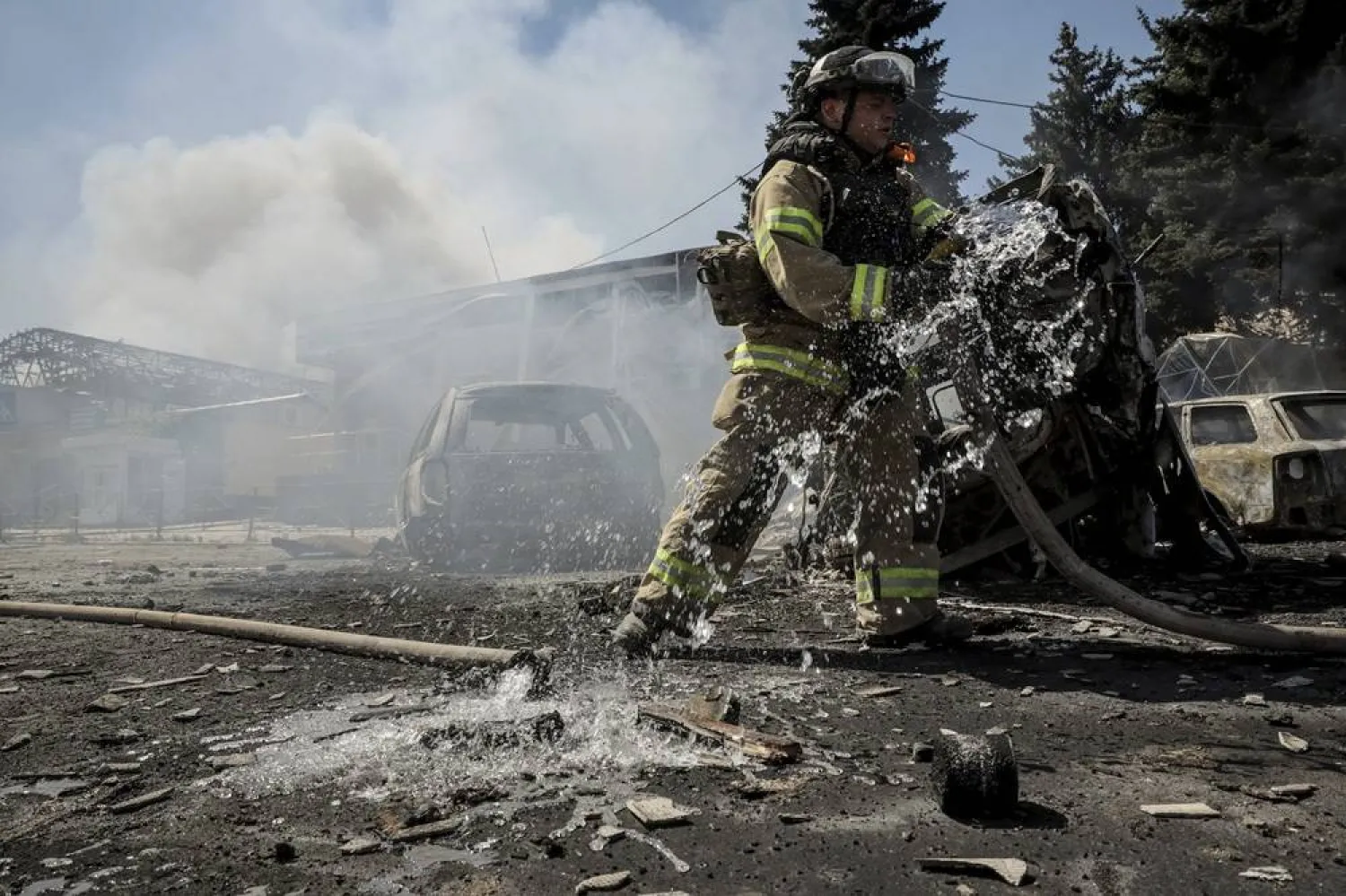
In this photo provided by Ukraine's 24th Mechanized Brigade press service, a firefighter puts out the fire after a Russian drone hit the market in the town of Druzhkivka, Donetsk region, Ukraine, Saturday, Aug. 2, 2025, (Oleg Petrasiuk/Ukraine's 24th Mechanized Brigade via AP)
TT

Russian Firefighters Extinguish Sochi Oil Depot Blaze After Ukrainian Drone Attack, Authorities Say

In this photo provided by Ukraine's 24th Mechanized Brigade press service, a firefighter puts out the fire after a Russian drone hit the market in the town of Druzhkivka, Donetsk region, Ukraine, Saturday, Aug. 2, 2025, (Oleg Petrasiuk/Ukraine's 24th Mechanized Brigade via AP)

A Ukrainian drone attack caused two oil tanks to catch fire at an oil depot in Sochi in southern Russia, but the blazes were later extinguished, local authorities said on Sunday. 

Veniamin Kondratyev, the governor of the surrounding Krasnodar region, said more than 120 firefighters were deployed. 

The Russian defense ministry said its air defence units destroyed 93 Ukrainian drones overnight, including one over the Krasnodar region and 60 over the waters of the Black Sea. 

The ministry reports only how many drones its units destroy, not how many Ukraine launched. 

Rosaviatsia, Russia's civil aviation authority, briefly halted flights at Sochi's airport before resuming them. 

There was no immediate comment from Ukraine, which has staged frequent attacks on infrastructure inside Russia that Kyiv deems key to Moscow's war efforts. 

A woman was killed in the Adler district of Sochi in a Ukrainian drone attack late last month, but attacks on the city, which hosted the 2014 Winter Olympic Games, have been infrequent in the war that Russia launched in February 2022. 

The Krasnodar region is home to the Ilsky refinery near the city of Krasnodar, among the largest in southern Russia and a frequent target of Ukraine's drone attacks. 

Also on Sunday, the governor of Voronezh region in southern Russia said four people were injured in a Ukrainian drone strike that caused several fires, while Russia launched a missile attack on Kyiv, according to the military administration of the Ukrainian capital. 

The Russian defense ministry said that its units destroyed 18 Ukrainian drones over the Voronezh region that borders Ukraine. 



Truck Accident Kills 18 in Afghanistan

 A general view of a road commonly used by cargo trucks entering eastern Kabul, Afghanistan, Wednesday, May 13, 2026. (AP)
A general view of a road commonly used by cargo trucks entering eastern Kabul, Afghanistan, Wednesday, May 13, 2026. (AP)
TT

Truck Accident Kills 18 in Afghanistan

 A general view of a road commonly used by cargo trucks entering eastern Kabul, Afghanistan, Wednesday, May 13, 2026. (AP)
A general view of a road commonly used by cargo trucks entering eastern Kabul, Afghanistan, Wednesday, May 13, 2026. (AP)

A truck overturned in eastern Afghanistan on Saturday, killing 18 people on board including 10 children, a provincial official told AFP.

Deadly traffic crashes are common in Afghanistan, due in part to poor roads after decades of conflict, dangerous driving and a lack of regulation.

The vehicle was carrying Afghan families returning from Pakistan, where they had been living, according to Abdul Malik Niazay, spokesperson for the governor of Laghman province.

"Eighteen people (have died), including 10 children, five women and three men. In addition, 29 people have been injured," the spokesperson said.

The accident happened on the road between Jalalabad in eastern Afghanistan and capital Kabul.

Authorities in Pakistan have toughened their stance on Afghan migrants and refugees in their country, causing an outflow that often includes families travelling with their belongings in trucks.

Since the start of the year, 447,400 Afghans have returned from Pakistan, according to figures from the United Nations High Commissioner for Refugees and the International Organization for Migration.

Last August, a collision between a bus carrying Afghan migrants returning from Iran and two other vehicles in western Afghanistan killed 78 people, including 19 children.


As Ebola Scourges Congo, Experts Warn of Link to Eating Wild Animals

A healthcare worker takes a visitor's temperature at Rwampara Hospital in Ituri, in the eastern Democratic Republic of the Congo, on May 26, 2026. (Photo by Glody MURHABAZI / AFP)
TT

As Ebola Scourges Congo, Experts Warn of Link to Eating Wild Animals

A healthcare worker takes a visitor's temperature at Rwampara Hospital in Ituri, in the eastern Democratic Republic of the Congo, on May 26, 2026. (Photo by Glody MURHABAZI / AFP)

The vendors of wild meat at the sprawling Masina Market in the Congolese capital don’t always display their goods openly. Customers must ask for whatever they're looking for, whether it is a giant swamp rodent or the severed parts of an antelope.

Others occasionally sell in the open, like the women who preside over impossibly large baskets of squirming caterpillars at the market in Kinshasa.

For many in Congo and elsewhere in Central and West Africa wild meat is a craving and a key part of the cultural milieux. Even a disease as punishing as Ebola, currently ravaging a remote part of eastern Congo, has failed to stem demand for wild meat from the Congo Basin, an expansive forested ecosystem sometimes called Earth’s second lung.

The Congo Basin is rich in all kinds of wildlife, from great apes to serpents — both of which are hunted for their meat. One consequence for locals is exposure to zoonotic diseases such as Ebola, The Associated Press said.

Although Ebola is generally not spread by food, cases in Africa have been associated with hunting, butchering and processing meat from infected animals, the US Centers for Disease Control and Prevention has said.

“Once there is human, animal and environment interface. We have these kinds of outbreaks on a frequent level,” said Dr. Tolbert Geewleh Nyenswah of the Africa Centers for Disease Control and Prevention. “And this is why one health approach in dealing with virus outbreaks is important, because we still interact with the bats, and our hunters are still killing monkeys, and we are close to the environment.”

The link between wild meat and Ebola

The Congolese government has confirmed more than 1,000 suspected cases, with at least 220 deaths, since it declared an outbreak of Ebola on May 15. It appears the virus spread undetected for weeks, and the World Health Organization suspects it is much larger than what has been reported.

Ebola, named for a tributary of the Congo River, was first discovered in 1976 in simultaneous outbreaks in Congo and present-day South Sudan. Outbreaks are believed to start with the virus spilling over into humans from an infected animal such as a fruit bat. These cross-species infections often happen when people handle and eat wild meat, experts say.

But since Ebola outbreaks happen only sporadically in communities that regularly eat wild meat, some people “don't believe the linkage” and others are “totally ignorant” of the health threat from eating wild meat, said Dr. Misaki Wayengera, a microbiologist who advises Uganda's Ministry of Health on epidemics.

“It is very difficult to change some of these core practices,” he said.

Locals have paid a heavy price for occasional outbreaks of Ebola, whose bloody symptoms can terrorize entire villages and cause many to believe they are under an evil spell.

The Ebola virus is responsible for 17 outbreaks in Congo and many others elsewhere in the region. The deadliest outbreak, in West Africa between 2014 and 2016, infected an estimated 28,000 people and killed more than 11,300.

According to the Food and Agriculture Organization — which studied the Ebola risk stemming from the eating and handling of wild meat after West Africa’s epidemic — animal-to-human spillovers of Ebola are rare, but "their consequences are nonetheless disastrous.”

Once Ebola has infected one person, the virus then spreads through close contact with sick or deceased patients’ bodily fluids, such as sweat, blood, feces, or vomit. Health workers without sufficient protective gear are seen as highly vulnerable.

The current outbreak in eastern Congo is caused by the Bundibugyo virus, a rare type of Ebola that has no approved medicines or vaccines.

The outbreak is occurring in a part of Congo that also faces armed violence by rebel groups and the displacement of large numbers of people fleeing the violence.

A need for education While Congolese authorities have prohibited hunting endangered wildlife, including great apes sent to the brink of extinction by poachers, there is no blanket ban on the wildlife trade and illegal hunting persists for totemic creatures like the bonobo.

Many in and around the Congo Basin have wild meat as their primary source of animal protein. The yearly extraction rate of wild meat from the Congo Basin is estimated at 4.5 million tons, according to the Center for International Forestry Research.

Viande de brousse, as wild meat is known in French, is a popular food, even served in trendy restaurants. That's intensified pressure on the dwindling resources of the Congo Basin. Despite the ongoing biodiversity losses, the Congo Basin remains the world's largest carbon sink, surpassing the Amazon in its ability to capture and store carbon.

Public health campaigners need to step up education campaigns on how Ebola starts and is spread among communities that face recurring outbreaks, said Gladys Kalema-Zikusoka, founder of the Uganda-based Conservation Through Public Health group.

People need to be told that “eating meat from an unknown source, or a dead animal, is a no-no,” Kalema-Zikusoka said. “It’s a very cultural thing.”

Some fruit bats are believed to be natural hosts of the viruses that cause Ebola, according to the WHO. Yet bats are known to be a delicacy in many parts of Central and West Africa. The soup of a roasted fruit bat is highly sought after, as are the parts of a wide range of monkeys.

In Kinshasa’s Masina Market one recent morning, before the latest Ebola outbreak, traders said they sold antelope, rodent and snake meat sourced from the Congo Basin.

They said they long ago stopped selling the meat of monkeys, possible reservoirs of the Ebola virus.

One vendor, Guyva Mputu, was selling python, whose frozen flesh started to steam in the humid weather.

Another, Charles Ntanga, wielded a flywhisk to swat flies that settled on the rancid carcass of a giant rodent, with a kilogram going for about $17. Ntanga said he gets clients from all walks of life.

“We sell wild meat," he said. “We make our lives through this business.”


Pentagon Chief Says US Seeks 'Stable Equilibrium' with China in Asia

US Secretary of Defense Pete Hegseth speaks during a plenary session of the 23rd Shangri-La Dialogue summit in Singapore on May 30, 2026. JAM STA ROSA / AFP
TT

Pentagon Chief Says US Seeks 'Stable Equilibrium' with China in Asia

US Secretary of Defense Pete Hegseth speaks during a plenary session of the 23rd Shangri-La Dialogue summit in Singapore on May 30, 2026. JAM STA ROSA / AFP

Pentagon chief Pete Hegseth struck a measured tone towards China at a major defense forum on Saturday, noting "rightful alarm" over Beijing's military build-up but saying the United States sought a "stable equilibrium" in Asia.

Hegseth's headline speech at Singapore's Shangri-La Dialogue, which brings together top defense officials and experts from about 45 countries, contrasted with his strongly confrontational remarks on China at last year's gathering.

Unlike Beijing, which has sent a panel of military experts and scholars instead of Defense Minister Dong Jun for the second year running, Hegseth is leading a bumper US delegation to the event that provides chances for both open debate and behind-closed-doors diplomacy.

"When we look across the region today, there is rightful alarm regarding China's historic military build-up and the expansion of its military activities in the region and beyond," Hegseth said.

Washington does not seek "needless confrontation in the region", but rather "a genuinely stable equilibrium (in Asia) that works for Americans as well as our allies", he said.

That means "a favorable but durable balance of power in which no state, including China, can impose its hegemony and hold the security or prosperity of our nation and our allies in question", he added.

Hegseth said the United States sought "respectful" and "good-faith" engagement with Beijing, adding: "I wish my counterpart was here at this conference, but I look forward to other options when we can cross paths."

Trump visited China this month, talking up "fantastic" trade deals but giving few details and later suggesting Washington could use its arms sales to self-ruled Taiwan as a bargaining chip with Beijing.

There had been "no change" in Washington's stance towards Taiwan, but "any decision about future Taiwan arms sales... will rest with" Trump, Hegseth said.

- Vibe shift -

The remarks contrasted sharply with last year's event, when Hegseth painted China as a potentially "imminent" threat to security and outlined a swaggering vision of muscular American deterrence.

He also took potshots at Beijing's absent minister last year, saying: "We are here this morning, and somebody else isn't."

Chinese delegate Da Wei, director of the Center for International Security and Strategy at Beijing's Tsinghua University, said this year's address was "much more moderate".

However, he found Hegseth's depiction of China "ironic", adding: "Everyone in the room must have been thinking: who is really hegemonic?

"Given what the US is doing in Iran and has done in Venezuela, I think it's clear to everyone," Da said.

US delegate Tammy Duckworth, a Democratic senator and strong Trump critic, said she was "somewhat disturbed" by Hegseth's remarks, viewing them as overly conciliatory towards China.

"I worry that this administration is being distracted into wars that they've started in other parts of the world at the expense of our commitment here in the Indo-Pacific," she told reporters.

Instead of Dong, China has sent experts and scholars from its army's academic institutions, led by Major General Meng Xiangqing of the National Defense University.

Analysts have said Dong's no-show reflects Beijing's confidence as an established power with little inclination to answer publicly for its assertive moves in the region.

But some argue that China is also running the risk of having no senior policymaker present if two major security issues come up: reopening the Strait of Hormuz, and Beijing's claim to Taiwan.

Hegseth again urged US allies to spend more on their own defense, singling out South Korea, Japan, Australia and the Philippines for praise while threatening consequences for nations that "free-ride on the generosity of the American taxpayer".

"Those days are over. Allies who refuse to step up and carry their own weight for our collective defense will face a clear shift in how we do business."

- Iran threat -

Hegseth's remarks came as a peace deal between the United States and Iran to end their war remained elusive.

A White House official told AFP on Friday that Trump, who is weighing a final decision on a potential accord, would only commit if Iran met all his conditions.

But Iran has said "no final agreement" is in place, and its state media has rebutted parts of Trump's characterization of the deal.

Hegseth said Washington was "more than capable" of restarting the war if it wanted.

The head of the Pentagon is also due to meet his British and Australian counterparts as part of the AUKUS security alliance.

Australian media outlets have reported, citing unidentified sources, that the AUKUS nations are expected to announce a major project, perhaps involving uncrewed underwater vehicles.