


Germany Halts Arms Exports That Israel Can Use in Gaza

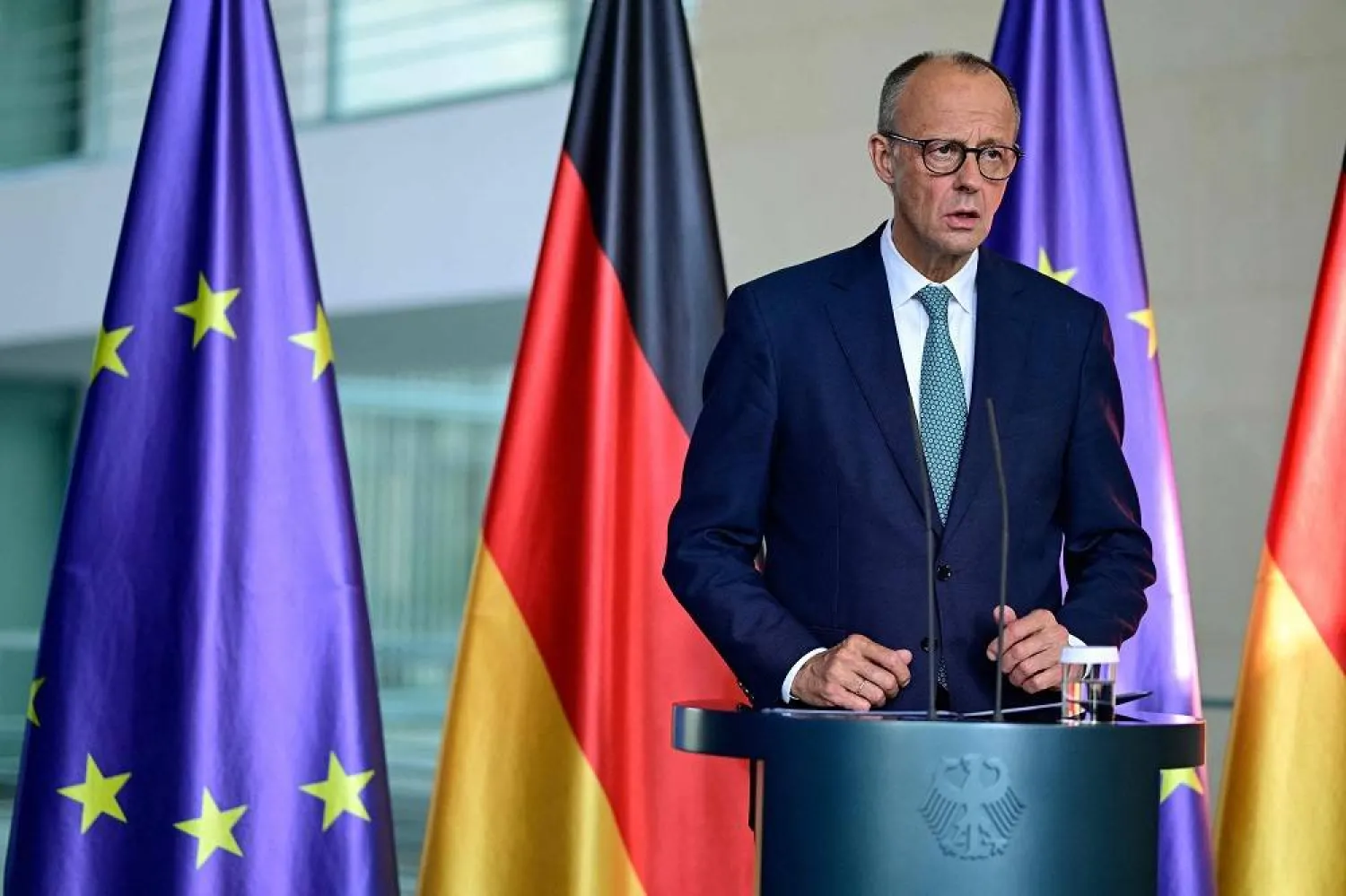
German Chancellor Friedrich Merz makes a statement to journalists following a meeting of the security Cabinet of the German government at the Chancellery in Berlin on July 28, 2025. (AFP)
TT

Germany Halts Arms Exports That Israel Can Use in Gaza

German Chancellor Friedrich Merz makes a statement to journalists following a meeting of the security Cabinet of the German government at the Chancellery in Berlin on July 28, 2025. (AFP)

Germany is to suspend exports of weaponry that could be used in the Gaza Strip because of Israel's plan to expand its operations there - the first time united Germany has acknowledged denying military support to its long-time ally. 

Chancellor Friedrich Merz's sudden about-turn on Friday followed mounting pressure from the public and his junior coalition partner over the manmade humanitarian crisis in Gaza, where Israel has severely restricted supplies of food and water. 

In a statement, Merz acknowledged Israel's right to disarm Hamas and seek the release of Israeli hostages, but said the Israeli decision "makes it increasingly difficult to see how these goals can be achieved". 

Germany is Israel's second biggest weapons supplier after the US, and has long been one of its staunchest supporters, principally because of historical guilt for the Nazi Holocaust - a policy known as the "Staatsraison". 

But an opinion poll in June indicated that 73% of Germans want tighter controls on arms exports, including 30% who favored a total ban. 

"This is the right decision. The humanitarian suffering in Gaza is unbearable," said vice chancellor and finance minister Lars Klingbeil of the Social Democrats, who govern alongside Merz's conservatives. 

Israel's Prime Minister Benjamin Netanyahu slammed the decision, saying the move would bolster Palestinian group Hamas.  

"Instead of supporting Israel's just war against Hamas, which carried out the most horrific attack against the Jewish people since the Holocaust, Germany is rewarding Hamas terrorism by embargoing arms to Israel," said a statement from Netanyahu's office, which added that the Israeli premier expressed his "disappointment" in a call with Merz. 

GERMANY'S REVERSAL A BLOW FOR ISRAEL 

"Politically and morally, this is certainly a hard blow for Netanyahu and his policies," said Meron Mendel, the director of the Anne Frank Education Center in Frankfurt. 

According to the Stockholm International Peace Research Institute, Germany provided 30% of Israel's major arms imports in 2019-2023, primarily naval equipment including Sa’ar 6-class frigates (MEKO A-100 Light Frigates), which have been used in the Gaza war. 

Merz said the release of hostages and ceasefire negotiations were Germany's top priorities, along with civilian suffering. He also urged the Israeli government not to take any further steps towards annexing parts of the West Bank. 

Far-right members of Netanyahu's coalition have been pushing for a total takeover of Gaza, though the military has warned this could jeopardize the lives of surviving hostages. 

Germany's parliament reported in June that export licenses for 485 million euros ($564 million) of military equipment for Israel had been granted between the day of the Hamas attack that triggered the Gaza war, October 7, 2023, and May 13, 2025. 

In the months after the Hamas attack, Germany increased its arms exports to Israel roughly tenfold. Human rights groups launched legal challenges, saying the weapons could be used in the Gaza war, but none has succeeded so far. 


Over 3,300 People Have Died in Iran During War

Commuters make their way past a giant billboard of slain Iranian supreme leader Ali Khamenei at the Valiasr Square in Tehran on April 19, 2026. (AFP)
TT

Over 3,300 People Have Died in Iran During War

Commuters make their way past a giant billboard of slain Iranian supreme leader Ali Khamenei at the Valiasr Square in Tehran on April 19, 2026. (AFP)

Iran on Monday offered a new death toll for its war with Israel and the United States, with its forensic chief saying at least 3,375 people had been killed in the conflict.

The figure came from Abbas Masjedi, the head of Iran’s Legal Medicine Organization.

Masjedi, quoted by the judiciary’s Mizan news agency and other outlets Monday, said only four of the dead remain unidentified.

His comments did not break down casualties among civilians and security forces, instead just saying that 2,875 were male and 496 were female.

Masjedi said 383 of the dead were children 18 years old and under.

Masjedi’s figures raised questions about whether or not they included security force members, particularly given the levels of intense bombings targeting military bases and arsenals in the country.


China Voices Concern Over US Seizure of Iranian Cargo Ship, Urges Further Talks

13 April 2026, China, Beijing: Guo Jiakun, spokesman for the Chinese Foreign Ministry, speaks to journalists. (dpa)
TT

China Voices Concern Over US Seizure of Iranian Cargo Ship, Urges Further Talks

13 April 2026, China, Beijing: Guo Jiakun, spokesman for the Chinese Foreign Ministry, speaks to journalists. (dpa)

China has expressed concern over the "forced interception" by the US of an Iranian-flagged cargo ship, a Chinese foreign ministry spokesperson said on Monday, urging relevant parties to abide by the ceasefire agreement in a responsible ‌manner.

"The situation ‌in the Strait of ‌Hormuz ⁠is sensitive and complicated," ⁠said spokesman Guo Jiakun during a regular press briefing. Parties involved should avoid further escalation and "create the necessary conditions for normal transit through the strait ⁠to resume," he added.

The ‌US said ‌earlier it fired on and seized ‌an Iranian cargo ship that tried ‌to run its blockade of Iranian ports.

Iran's military said the ship had been travelling from China ‌and vowed retaliation against what it called "armed piracy by the US ⁠military."

Beijing ⁠on Monday also urged relevant parties to "continue to maintain the momentum of the ceasefire and negotiations".

"Now that a window for peace has opened, favorable conditions should be created to bring the war to an end as soon as possible," Guo said.


Russia Arrests German Woman in Alleged Bomb Plot

People visit the observation deck at Vorobyovy gory (Sparrow Hills) with the main building of the Ministry of Foreign Affairs of Russia in the background during a spring day in Moscow, Russia, 17 April 2026. (EPA)
TT

Russia Arrests German Woman in Alleged Bomb Plot

People visit the observation deck at Vorobyovy gory (Sparrow Hills) with the main building of the Ministry of Foreign Affairs of Russia in the background during a spring day in Moscow, Russia, 17 April 2026. (EPA)

Russia said Monday it had arrested a German woman found with a homemade bomb in her backpack in what it alleged was a Ukrainian-hatched plot to blow up a security services facility in the south.

Russia has arrested dozens of people throughout the four-year war, mostly its own citizens, on allegations of working for Ukraine to carry out sabotage attacks.

There has been a string of high-profile arrests of Western citizens since Moscow ordered its troops into Ukraine -- typically on espionage charges that are widely seen as baseless, with those detained later swapped in exchange for Russians jailed abroad.

Detentions of Western citizens for carrying out or preparing actual attacks are much rarer.

The FSB security agency said the woman, born in 1969, had been dragged into the alleged plot by a citizen from a Central Asian country, who was working on orders from Ukraine.

She was detained and found with an improvised explosive device in her bag in the Caucasus city of Pyatigorsk, the FSB said.

The FSB said it had "prevented a terrorist attack planned by the Kyiv regime against a law enforcement facility in the Stavropol region, involving a German citizen born in 1969," the agency said in a statement.

The FSB said the device -- which contained an explosive charge equivalent to 1.5 kilograms (three pounds) of TNT -- was supposed to be detonated remotely, killing the German woman.

The blast was prevented by electronic jamming, the FSB added.

- 'Radical ideology' -

A man from an unidentified Central Asian state, born in 1997 and "a supporter of radical ideology", was found and arrested near the targeted site, it added.

The pair face life in prison on terrorist charges.

There was no immediate reaction to the allegations in Kyiv or Berlin.

Video footage of the purported arrest published on state media showed armed Russian security agents approach the woman, who was lying face down dressed in all black in a car park.

Another video showed masked plainclothes agents pulling a man into a station, followed by a controlled explosion of the backpack.

Russia has previously accused Ukraine of working with fundamentalists to carry out terror attacks inside Russia, without providing evidence.

Officials initially alleged that the perpetrators of a 2024 massacre at a concert hall on the outskirts of Moscow that killed 150 people were ISIS members in coordination with Ukraine.

ISIS claimed responsibility for that attack, making no reference of any Ukrainian involvement, for which no evidence was presented by Moscow and which Kyiv denies.
