
Germany Halts Arms Exports That Israel Can Use in Gaza

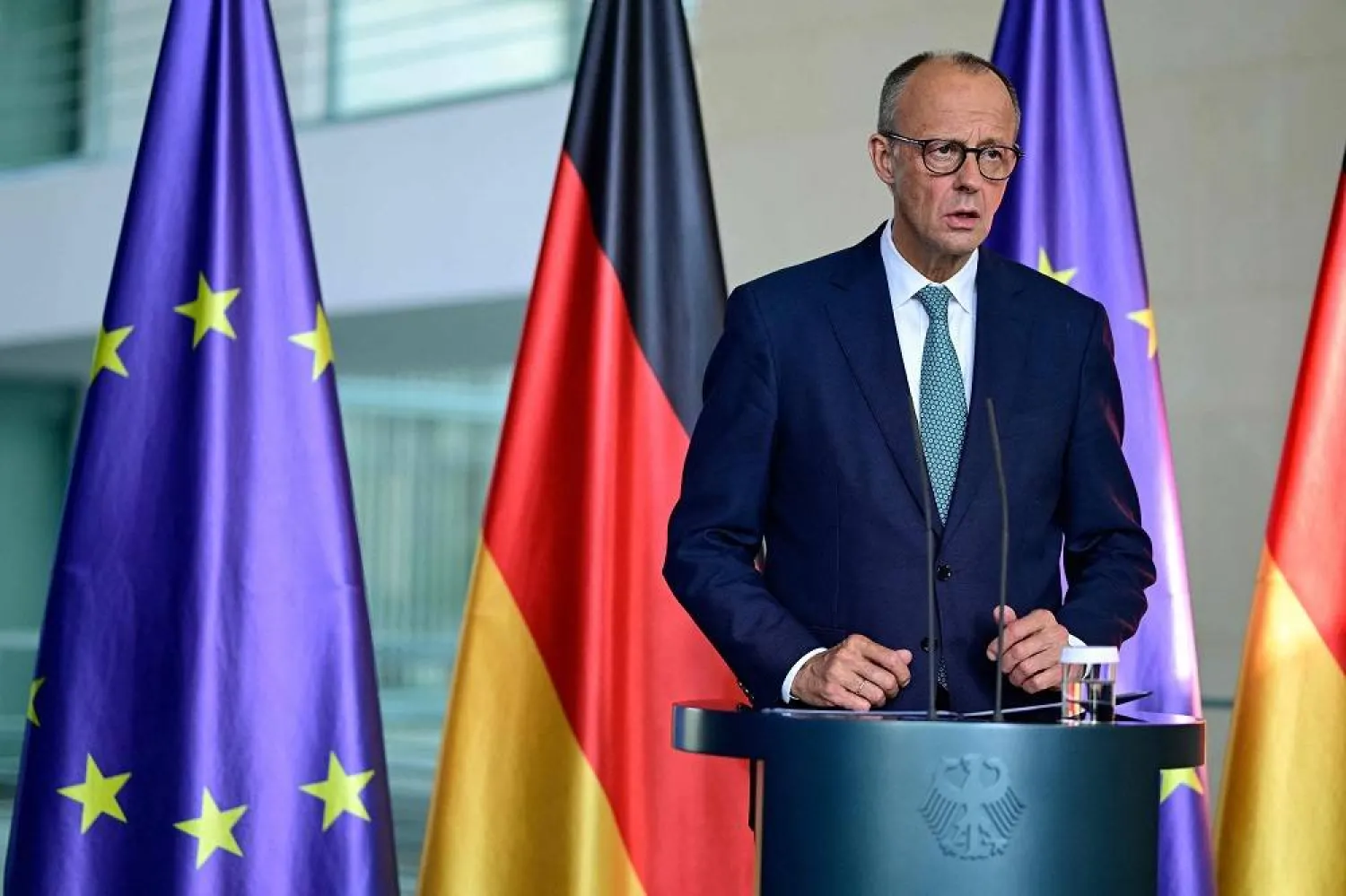
German Chancellor Friedrich Merz makes a statement to journalists following a meeting of the security Cabinet of the German government at the Chancellery in Berlin on July 28, 2025. (AFP)
TT

Germany Halts Arms Exports That Israel Can Use in Gaza

German Chancellor Friedrich Merz makes a statement to journalists following a meeting of the security Cabinet of the German government at the Chancellery in Berlin on July 28, 2025. (AFP)

Germany is to suspend exports of weaponry that could be used in the Gaza Strip because of Israel's plan to expand its operations there - the first time united Germany has acknowledged denying military support to its long-time ally. 

Chancellor Friedrich Merz's sudden about-turn on Friday followed mounting pressure from the public and his junior coalition partner over the manmade humanitarian crisis in Gaza, where Israel has severely restricted supplies of food and water. 

In a statement, Merz acknowledged Israel's right to disarm Hamas and seek the release of Israeli hostages, but said the Israeli decision "makes it increasingly difficult to see how these goals can be achieved". 

Germany is Israel's second biggest weapons supplier after the US, and has long been one of its staunchest supporters, principally because of historical guilt for the Nazi Holocaust - a policy known as the "Staatsraison". 

But an opinion poll in June indicated that 73% of Germans want tighter controls on arms exports, including 30% who favored a total ban. 

"This is the right decision. The humanitarian suffering in Gaza is unbearable," said vice chancellor and finance minister Lars Klingbeil of the Social Democrats, who govern alongside Merz's conservatives. 

Israel's Prime Minister Benjamin Netanyahu slammed the decision, saying the move would bolster Palestinian group Hamas.  

"Instead of supporting Israel's just war against Hamas, which carried out the most horrific attack against the Jewish people since the Holocaust, Germany is rewarding Hamas terrorism by embargoing arms to Israel," said a statement from Netanyahu's office, which added that the Israeli premier expressed his "disappointment" in a call with Merz. 

GERMANY'S REVERSAL A BLOW FOR ISRAEL 

"Politically and morally, this is certainly a hard blow for Netanyahu and his policies," said Meron Mendel, the director of the Anne Frank Education Center in Frankfurt. 

According to the Stockholm International Peace Research Institute, Germany provided 30% of Israel's major arms imports in 2019-2023, primarily naval equipment including Sa’ar 6-class frigates (MEKO A-100 Light Frigates), which have been used in the Gaza war. 

Merz said the release of hostages and ceasefire negotiations were Germany's top priorities, along with civilian suffering. He also urged the Israeli government not to take any further steps towards annexing parts of the West Bank. 

Far-right members of Netanyahu's coalition have been pushing for a total takeover of Gaza, though the military has warned this could jeopardize the lives of surviving hostages. 

Germany's parliament reported in June that export licenses for 485 million euros ($564 million) of military equipment for Israel had been granted between the day of the Hamas attack that triggered the Gaza war, October 7, 2023, and May 13, 2025. 

In the months after the Hamas attack, Germany increased its arms exports to Israel roughly tenfold. Human rights groups launched legal challenges, saying the weapons could be used in the Gaza war, but none has succeeded so far. 


US Military Strikes Another Alleged Drug Boat in Eastern Pacific, Killing 3

A shot of a boat targeted by a US raid in the Caribbean (archive - Reuters)
TT

US Military Strikes Another Alleged Drug Boat in Eastern Pacific, Killing 3

A shot of a boat targeted by a US raid in the Caribbean (archive - Reuters)

The US military said Friday that it has carried out another deadly strike on a vessel accused of trafficking drugs in the Eastern Pacific Ocean.

US Southern Command said on social media that the boat “was transiting along known narco-trafficking routes in the Eastern Pacific and was engaged in narco-trafficking operations.” It said the strike killed three people. A video linked to the post shows a boat floating in the water before bursting into flames.

Friday’s attack raises the death toll from the Trump administration’s strikes on alleged drug boats to at least 148 people in at least 43 attacks carried out since early September in the Caribbean Sea and eastern Pacific Ocean.

President Donald Trump has said the US is in “armed conflict” with cartels in Latin America and has justified the attacks as a necessary escalation to stem the flow of drugs. But his administration has offered little evidence to support its claims of killing “narcoterrorists.”

Critics have questioned the overall legality of the strikes as well as their effectiveness, in part because the fentanyl behind many fatal overdoses is typically trafficked to the US over land from Mexico.


Afghanistan Quake Causes No ‘Serious’ Damage, Injuries, Says Official

Afghan men prepare meals during the holy fasting month of Ramadan in Kabul, Afghanistan, 19 February 2026. (EPA)
TT

Afghanistan Quake Causes No ‘Serious’ Damage, Injuries, Says Official

Afghan men prepare meals during the holy fasting month of Ramadan in Kabul, Afghanistan, 19 February 2026. (EPA)

A 5.8-magnitude earthquake that rocked eastern Afghanistan including the capital Kabul has resulted in only minor damage and one reported injury, a disaster official told AFP on Saturday.

The quake hit on Friday just as people in the Muslim-majority country were sitting down to break their Ramadan fast.

The epicenter was near several remote villages around 130 kilometers (80 miles) northeast of Kabul, the United States Geological Survey said.

"There aren't any serious casualties or damages after yesterday's earthquake," said Mohammad Yousuf Hamad, spokesman for the National Disaster Management Authority.

He added that one person had sustained "a minor injury in Takhar", in Afghanistan's north, "and three houses had minor damage in Laghman" province.

Zilgay Talabi, a resident of Khenj district near the epicenter, said the tremor was "very strong, it went on for almost 30 seconds".

Earthquakes are common in Afghanistan, particularly along the Hindu Kush mountain range, near where the Eurasian and Indian tectonic plates meet.

In August last year, a shallow 6.0-magnitude quake in the country's east wiped out mountainside villages and killed more than 2,200 people.

Weeks later, a 6.3-magnitude quake in northern Afghanistan killed 27 people.

Large tremors in western Herat, near the Iranian border, in 2023, and in Nangarhar province in 2022, killed hundreds and destroyed thousands of homes.

Many homes in the predominantly rural country, which has been devastated by decades of war, are shoddily built.

Poor communication networks and infrastructure in mountainous Afghanistan have hampered disaster responses in the past, preventing authorities from reaching far-flung villages for hours or even days before they could assess the extent of the damage.


Serbia Urges Citizens to Quit Iran ‘As Soon as Possible’

People walk past an anti-US billboard in Tehran, Iran, January 26, 2026. Majid Asgaripour/WANA (West Asia News Agency) via Reuters
TT

Serbia Urges Citizens to Quit Iran ‘As Soon as Possible’

People walk past an anti-US billboard in Tehran, Iran, January 26, 2026. Majid Asgaripour/WANA (West Asia News Agency) via Reuters

Serbia has urged its citizens in Iran to leave the country "as soon as possible", after US President Donald Trump threatened military action over the country's nuclear program.

The Balkan nation had already invited Serbian nationals in mid-January to leave Iran and not to travel there, as the country's clerical authorities launched a bloody crackdown on a mass protest movement.

"Due to the deteriorating security situation, citizens of the Republic of Serbia are not recommended to travel to Iran in the coming period," the foreign ministry said in a statement on its website published overnight Friday to Saturday.

"All those who are in Iran are recommended to leave the country as soon as possible."

Iran said on Friday that it was hoping for a quick deal with the United States on Tehran's nuclear program, long a source of discord between the two foes.

But Trump, after ordering a major naval build-up in the Middle East aimed at heaping pressure on Tehran, said on Friday that he was "considering" a limited military strike if the negotiations proved unfruitful.