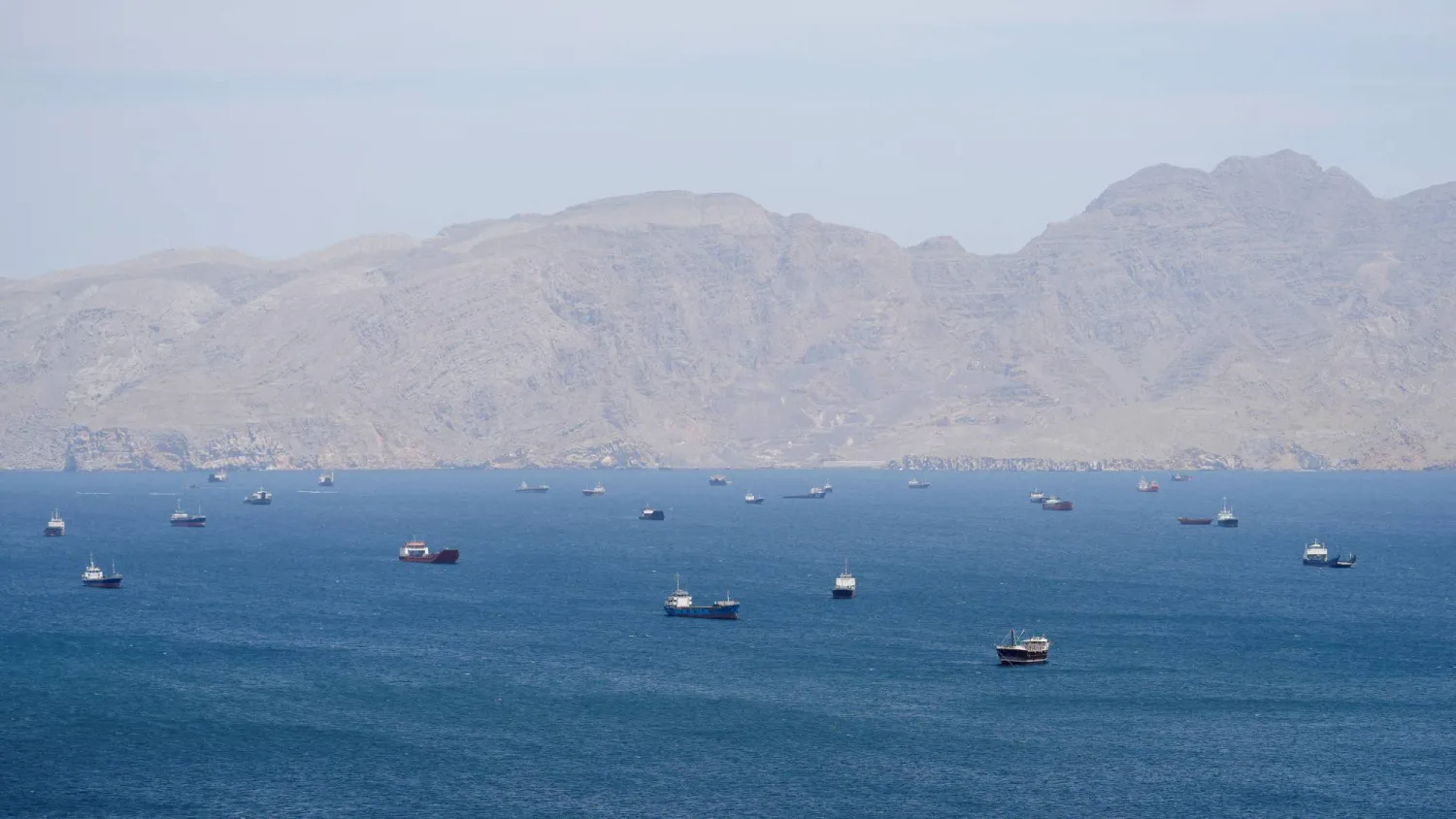
Dozens of countries gathered at the United Nations in New York on Monday to discuss “the safety and protection of waterways in the maritime domain,” demanding the reopening of the Strait of Hormuz, which has been closed by Iran since February.
During his speech at the Security Council open debate convened at the invitation of Bahrain, UN Secretary General Antonio Guterres said that ensuring the security of global waterways has become a fundamental test for the current international system, stressing that their stability is a cornerstone of global security and peace.
He said maritime routes have historically been vital arteries for global trade and energy flows among continents.
“Open the Strait. Let ships pass. No tolls. No discrimination. Let trade resume. Let the global economy breathe,” he noted.
Guterres warned that prolonged disruption risks triggering a global food emergency – pushing millions, especially in Africa and South Asia, into hunger and poverty.
Secretary-General of the International Maritime Organization (IOM) Arsenio Dominguez said straits used for international navigation cannot be closed by bordering States.
He said the geopolitical conflict around the Strait of Hormuz is having a very negative effect on seafarers and shipping, and on the global population and economy.
Coalition of like-minded partners
For his part, US Representative to the UN, Ambassador Mike Waltz said the Strait of Hormuz is not Iran’s to wield like its own moat and drawbridge.
“It is not Iran’s bargaining chip, it is not Iran’s toll road. And that’s what over 100 countries right outside these doors just testified in one of the most supported press conferences in recent years—100 countries just said what I said,” he told the open debate.
Waltz criticized both China and Russia for vetoing a resolution to protect the freedom of navigation and maritime security in the Straits of Hormuz. Instead, he said, they chose a radical religious regime for its partner, and ignored not only the plight of our Gulf countries, but the global economy.
He therefore called for a coalition of like-minded partners to step up and step in with real capabilities and help.
British Minister of State for Europe, North America, and the Overseas Territories Steven Doughty said shipping and seafarers must not be used as leverage, and there is no place for tolls or permissions in international straits.
“Throughout this crisis, the UK has been clear: Iran must not be able to hold the global economy hostage or indeed threaten regional and international security,” he said.
French Foreign Minister Jean-Noël Barrot emphasized that strategic straits are “arteries of the world" and "not the property of any individual.”
Barrot said Iran must make “major concessions” for a lasting solution to the Middle East crisis.
Speaking at the United Nations Security Council, he stressed that only a radical shift in Tehran’s stance can restore stability.
Russia and China
In return, Russia’s Permanent Representative at the Security Council open debate, Vassily Nebenzia said the situation in the Strait of Hormuz is the result of unprovoked US-Israeli aggression against Iran.
His Chinese counterpart, Fu Cong, said the root cause of the blockade of the Strait of Hormuz is the illegal military actions launched by the US and Israel against Iran.
He said China commends Pakistan and others for their role as mediators, and urges relevant parties to resolve disputes and conflicts by political and diplomatic means.
Saudi Arabia Rejects Threats
Saudi Arabia’s permanent representative to the UN, Abdulaziz Alwasil, said the Arab Gulf region is witnessing unprecedented tensions around the Strait of Hormuz.
“Any threat to freedom of navigation in this strategic waterway would directly impact global stability,” he noted.
The Saudi envoy condemned Iran for its actions and threats targeting international shipping and freedom of navigation, warning that such behavior constituted a serious threat to global peace and stability.
Alwasil said the waterway must remain open without restrictions, in accordance with international law.
Pakistan's ambassador to the UN Asim Iftikhar Ahmad emphasized that safeguarding sea lanes is essential not only for trade, but also for broader development and security goals.
The ambassador said Pakistan, alongside partners such as China, Saudi Arabia, Türkiye, and Egypt, is actively working toward de-escalation.
For his part, Iran’s envoy to the United Nations, Amir Saeid Iravani, said, “Lasting stability and security in the Arabian Gulf and the wider region can only be achieved through a durable and permanent cessation of aggression against Iran supplemented by credible guarantees of non-recurrence and full respect for the legitimate sovereign rights and interests of Iran.”
Joint Statement
Ahead of the open debate session, Bahrain's Foreign Minister Abdullatif bin Rashid Al Zayani, whose country holds the rotating presidency of the Council this month, read a joint statement on behalf of a broad coalition of countries, expressing strong opposition to actions affecting navigation in the Strait of Hormuz.
The statement reaffirmed support for Security Council Resolution 2817 and condemned what it described as Iranian actions, including the closure of the strait and attacks on regional neighbors.
It warned that such measures pose “a threat to international security and to navigational rights and freedoms,” emphasizing that free passage through the strait is essential to global stability and prosperity.
“We reiterate our call for the urgent and unimpeded opening of the strait,” Al Zayani said, reading from the statement.
Also on Monday, the US and Iran clashed at the United Nations over Tehran's nuclear program and its selection to be one of dozens of vice presidents at a month-long conference to review the nuclear Non-Proliferation Treaty.
The 11th conference to review implementation of the NPT, which came into force in 1970, began on Monday at the UN in New York.
Different groups nominated 34 conference vice presidents, and the conference chair, Vietnam's UN ambassador Do Hung Viet, said Iran was picked by “the group of non-aligned and other states.”
Christopher Yeaw, assistant secretary for the US Bureau of Arms Control and Nonproliferation, told the conference that Iran's selection was an “affront” to the NPT.
Reza Najafi, who serves as Tehran's ambassador to the International Atomic Energy Agency, rejected the US statement as “baseless and politically motivated.”