

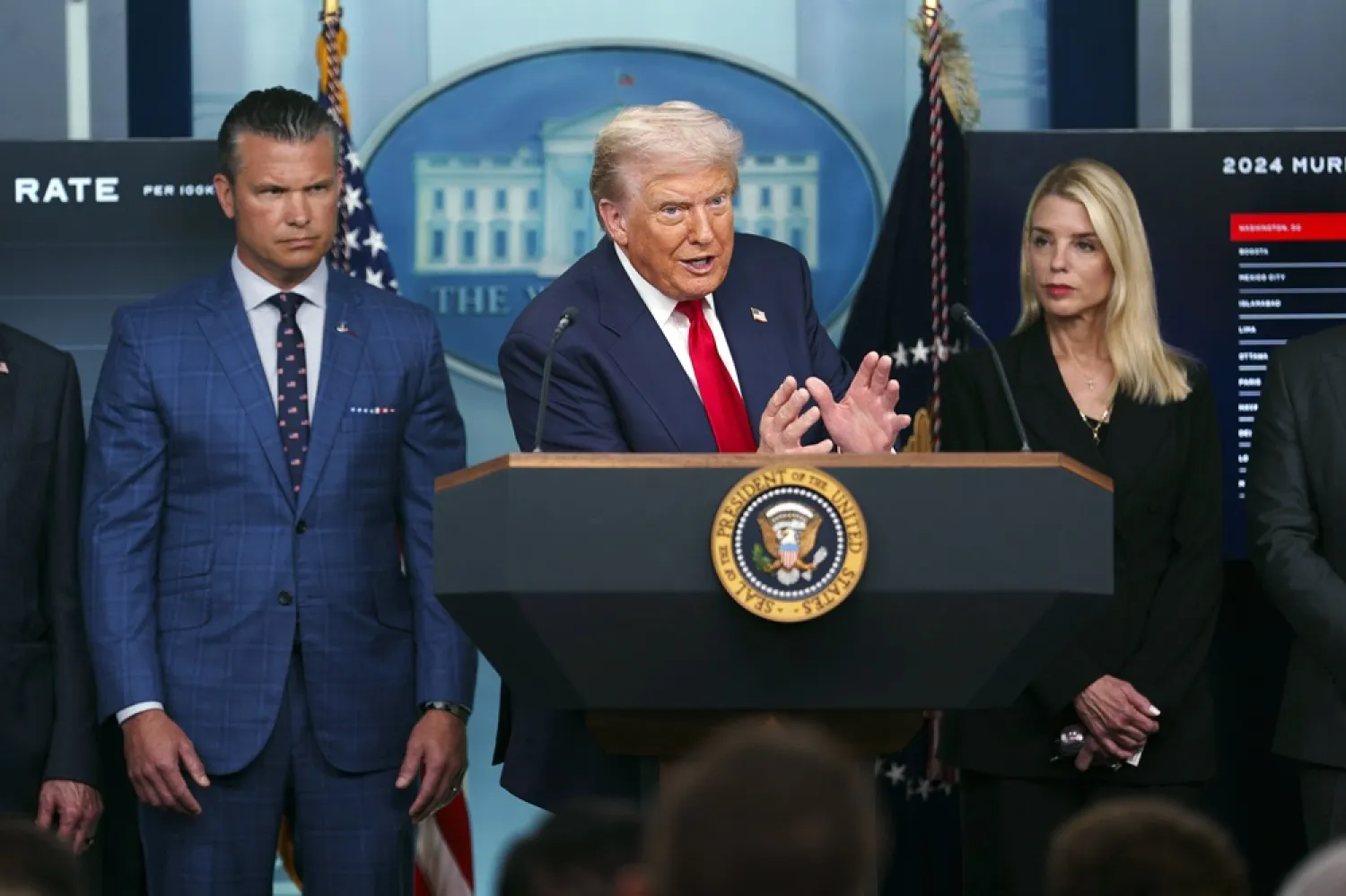

Trump Says He’s Placing Washington Police Under Federal Control and Deploying the National Guard

US President Donald Trump (C) with US Defense Secretary Pete Hegseth (L) and US Attorney General Pam Bondi (R) addresses the media in the James S. Brady Press Briefing Room of the White House, Washington, DC, USA, 11 August 2025. (EPA)
TT

Trump Says He’s Placing Washington Police Under Federal Control and Deploying the National Guard

US President Donald Trump (C) with US Defense Secretary Pete Hegseth (L) and US Attorney General Pam Bondi (R) addresses the media in the James S. Brady Press Briefing Room of the White House, Washington, DC, USA, 11 August 2025. (EPA)

President Donald Trump is promising new steps to tackle homelessness and crime in Washington including deployment of the National Guard, prompting the city's mayor to voice legal concerns about who would be patrolling the streets in the nation's capital. 

Trump said at a Monday news briefing that he was "deploying the National Guard to help reestablish law order and public safety in Washington, D.C., and they’re going to be allowed to do their job properly." 

The Republican president compared crime in the American capital with that in other major cities, saying Washington performs poorly on safety relative to the capitals of Iraq, Brazil and Colombia, among others. 

"We're getting rid of the slums, too," Trump said, adding that the US would not lose its cities and that Washington was just a start. 

For Trump, the effort to take over public safety in Washington reflects a next step in his law enforcement agenda after his aggressive push to stop illegal border crossings. But the move involves at least 500 federal law enforcement officials as well as the National Guard, raising fundamental questions about how an increasingly emboldened federal government will interact with its state and local counterparts. 

Combating crime  

The president has used his social media and White House megaphones to message that his administration is tough on crime, yet his ability to shape policy might be limited outside of Washington, which has a unique status as a congressionally established federal district. Nor is it clear how his push would address the root causes of homelessness and crime. 

Trump said he is invoking Section 740 of the District of Columbia Home Rule Act to deploy members of the National Guard. 

About 500 federal law enforcement officers are being tasked with deploying throughout the nation’s capital as part of the Trump administration’s effort to combat crime, a person familiar with the matter told The Associated Press on Monday. 

More than 100 FBI agents and about 40 agents with the Bureau of Alcohol, Tobacco, Firearms and Explosives are among federal law enforcement personnel being assigned to patrols in Washington, the person briefed on the plans said. The Drug Enforcement Administration, Immigration and Customs Enforcement and the Marshals Service are also contributing officers. 

The person was not authorized to publicly discuss personnel matters and spoke to the AP on the condition of anonymity. The Justice Department didn’t immediately have a comment Monday morning. 

Focusing on homelessness  

Trump in a Sunday social media post had emphasized the removal of Washington's homeless population, though it was unclear where the thousands of people would go. 

"The Homeless have to move out, IMMEDIATELY," Trump wrote Sunday. "We will give you places to stay, but FAR from the Capital. The Criminals, you don’t have to move out. We’re going to put you in jail where you belong." 

Last week, the Republican president directed federal law enforcement agencies to increase their presence in Washington for seven days, with the option "to extend as needed." 

On Friday night, federal agencies including the Secret Service, the FBI and the US Marshals Service assigned more than 120 officers and agents to assist in Washington. 

Trump said last week that he was considering ways for the federal government to seize control of Washington, asserting that crime was "ridiculous" and the city was "unsafe," after the recent assault of a high-profile member of the Department of Government Efficiency. 

The National Guard Mayor Muriel Bowser, a Democrat, questioned the effectiveness of using the Guard to enforce city laws and said the federal government could be far more helpful by funding more prosecutors or filling the 15 vacancies on the D.C. Superior Court, some of which have been open for years. 

Bowser cannot activate the National Guard herself, but she can submit a request to the Pentagon. 

"I just think that’s not the most efficient use of our Guard," she said Sunday on MSNBC's "The Weekend," acknowledging it is "the president’s call about how to deploy the Guard." 

Bowser was making her first public comments since Trump started posting about crime in Washington last week. She noted that violent crime in Washington has decreased since a rise in 2023. Trump's weekend posts depicted the district as "one of the most dangerous cities anywhere in the World." 

For Bowser, "Any comparison to a war-torn country is hyperbolic and false." 

Crime statistics  

Police statistics show homicides, robberies and burglaries are down this year when compared with this time in 2024. Overall, violent crime is down 26% compared with this time a year ago. 

Trump offered no details in Truth Social posts over the weekend about possible new actions to address crime levels he argues are dangerous for citizens, tourists and workers alike. The White House declined to offer additional details about Monday's announcement. 

The police department and the mayor’s office did not respond to questions about what Trump might do next. 

The president criticized the district as full of "tents, squalor, filth, and Crime," and he seems to have been set off by the attack on Edward Coristine, among the most visible figures of the bureaucracy-cutting effort known as DOGE. Police arrested two 15-year-olds in the attempted carjacking and said they were looking for others. 

"This has to be the best run place in the country, not the worst run place in the country," Trump said Wednesday. 

He called Bowser "a good person who has tried, but she has been given many chances." 

Trump has repeatedly suggested that the rule of Washington could be returned to federal authorities. Doing so would require a repeal of the Home Rule Act of 1973 in Congress, a step Trump said lawyers are examining. It could face steep pushback. 

Bowser acknowledged that the law allows the president to take more control over the city's police, but only if certain conditions are met. 

"None of those conditions exist in our city right now," she said. "We are not experiencing a spike in crime. In fact, we’re watching our crime numbers go down." 


Iran's Supreme Leader Warns any US Attack Would Spark 'Regional War'

People walk in front of a mural depicting the late Iranian revolutionary founder Khomeini, right, members of the Basij paramilitary force and Supreme Leader Ali Khamenei along Enqelab-e-Eslami Street in Tehran, Iran, Sunday, Jan. 25, 2026. (AP Photo/Vahid Salemi)
TT

Iran's Supreme Leader Warns any US Attack Would Spark 'Regional War'

People walk in front of a mural depicting the late Iranian revolutionary founder Khomeini, right, members of the Basij paramilitary force and Supreme Leader Ali Khamenei along Enqelab-e-Eslami Street in Tehran, Iran, Sunday, Jan. 25, 2026. (AP Photo/Vahid Salemi)

Iran's supreme leader warned Sunday that any attack by the United States would spark a “regional war” in the Mideast, further escalating tensions as President Donald Trump has threatened to militarily strike Iran. 

The comments from the 86-year-old Ali Khamenei are the most-direct threat he’s made so far as the aircraft carrier USS Abraham Lincoln and associated American warships are in the Arabian Sea, sent by Trump there after Tehran's bloody crackdown on nationwide protests. 

It remains unclear whether Trump will use force. He's repeatedly said Iran wants to negotiate and has brought up Tehran's nuclear program as another issue he wants to see resolved. 

But Khamenei also referred to the nationwide protests as “a coup,” hardening the government's position as tens of thousands of people reportedly have been detained since the start of the demonstrations. Seditious charges in Iran can carry the death penalty, which again renews concerns about Tehran carrying out mass executions for those arrested — a red line for Trump. 

Iran had also planned a live-fire military drill for Sunday and Monday in the strategic Strait of Hormuz, the narrow mouth of the Arabian Gulf through which a fifth of all oil traded passes. The US military's Central Command had warned against threatening American warships or aircraft during the drill or disrupting commercial traffic. 

Khamenei warns US Iranian state television reported Khamenei's comments online before airing any footage of his remarks. 

“The Americans should know that if they start a war, this time it will be a regional war," Khamenei was quoted as saying. 

It added that Khamenei said: “We are not the instigators and we do not seek to attack any country. But the Iranian nation will deliver a firm blow to anyone who attacks or harasses it.” 

Khamenei also hardened his position on the demonstrations after earlier acknowledging some people had legitimate economic grievances that sparked their protests. The demonstrations began Dec. 28, initially over the collapse of Iran's rial currency. It soon grew into a direct challenge to Khamenei's rule. 

“The recent sedition was similar to a coup. Of course, the coup was suppressed," he said. “Their goal was to destroy sensitive and effective centers involved in running the country, and for this reason they attacked the police, government centers, (Revolutionary Guard) facilities, banks and mosques — and burned copies of the Quran. They targeted centers that run the country.” 

Parliament speaker says EU militaries considered terrorist groups. The speaker of Iran's parliament, meanwhile, said that his country now considers all European Union militaries to be terrorist groups, lashing out after the bloc declared the country's paramilitary Revolutionary Guard a terror group over its bloody crackdown on nationwide protests. 

Mohammad Bagher Qalibaf, a former Guard commander, announced the terror designation, which will likely be mostly symbolic. Iran has used a 2019 law to reciprocally declare other nations' militaries terror groups following the United States declaration of the Guard a terror group that year. 

Qalibaf made the announcement as he and others in parliament wore Guard uniforms in support of the force. The Guard, which also controls Iran's ballistic missile arsenal and has vast economic interests in Iran, answers only to Iran's 86-year-old Khamenei. 

“By seeking to strike at the (Guard), which itself has been the greatest barrier to the spread of terrorism to Europe, Europeans have in fact shot themselves in the foot and, once again, through blind obedience to the Americans, decided against the interests of their own people," Qalibaf said. 

Lawmakers at the session later chanted: “Death to America!” and “Death to Israel!” at the session. 

Trump says Iran is ‘seriously talking' to US Trump has laid out two red lines for military action: the killing of peaceful protesters or the possible mass execution of those detained in a major crackdown over the demonstrations. He's increasingly begun discussing Iran's nuclear program as well, which the US negotiated over with Tehran in multiple sessions before Israel launched a 12-day war with Iran back in June. 

The US bombed three Iranian nuclear sites during the war. Activity at two of the sites suggests Iran may be trying to obscure the view of satellites as it tries to salvage what remains there. 

Trump on Saturday night declined to say whether he’d made a decision on what he wanted to do regarding Iran. 

Speaking to reporters as he flew to Florida, Trump sidestepped a question about whether Tehran would be emboldened if the US backed away from launching strikes on Iran, saying, “Some people think that. Some people don’t.” 

Trump said Iran should negotiate a “satisfactory” deal to prevent the Middle Eastern country from getting any nuclear weapons, but said, “I don’t know that they will. But they are talking to us. Seriously talking to us.” 

Ali Larijani, a top security official in Iran, wrote on X late Saturday that “structural arrangements for negotiations are progressing.” However, there is no public sign of any direct talks with the United States, something Khamenei has repeatedly ruled out. 


Musk Says Steps to Stop Russia from Using Starlink Have Worked

Starlink logo is seen on a smartphone in front of displayed Ukrainian flag in this illustration taken February 27, 2022. REUTERS/Dado Ruvic/Illustration
TT

Musk Says Steps to Stop Russia from Using Starlink Have Worked

Starlink logo is seen on a smartphone in front of displayed Ukrainian flag in this illustration taken February 27, 2022. REUTERS/Dado Ruvic/Illustration

Elon Musk said on Sunday that steps SpaceX had taken to stop the 'unauthorized' use of Starlink by Russia seemed to have worked.

"Looks like the steps we took ‌to stop ‌the unauthorized ‌use of ⁠Starlink by ‌Russia have worked. Let us know if more needs to be done," SpaceX CEO Musk said on ⁠X.

Ukrainian defense minister Mykhailo ‌Fedorov said on ‍Thursday that ‍Ukraine is working ‍with SpaceX to stop Russia from guiding drones using Starlink's internet system, after Kyiv said it had found it on ⁠long-range drones used in Russian attacks.

"Western technology must continue to help the democratic world and protect civilians, rather than being used for terrorism and destroying peaceful cities," ‌Fedorov said on X.


With Trump Mum, Last US-Russia Nuclear Pact Set to End

Russia's Yars intercontinental ballistic missile system unit drives in Red Square during a military parade on Victory Day, marking the 80th anniversary of the victory over Nazi Germany in World War Two, in central Moscow, Russia, May 9, 2025. (Maxim Bogodvid/Host agency RIA Novosti/Handout via Reuters)
TT

With Trump Mum, Last US-Russia Nuclear Pact Set to End

Russia's Yars intercontinental ballistic missile system unit drives in Red Square during a military parade on Victory Day, marking the 80th anniversary of the victory over Nazi Germany in World War Two, in central Moscow, Russia, May 9, 2025. (Maxim Bogodvid/Host agency RIA Novosti/Handout via Reuters)

Come Thursday, barring a last-minute change, the final treaty in the world that restricted nuclear weapon deployment will be over.

New START, the last nuclear treaty between Washington and Moscow after decades of agreements dating to the Cold War, is set to expire, and with it restrictions on the two top nuclear powers.

The expiration comes as President Donald Trump, vowing "America First," smashes through international agreements that limit the United States, although in the case of New START, the issue may more be inertia than ideology.

Russian President Vladimir Putin in September suggested a one-year extension of New START.

Trump, asked afterward by a reporter for a reaction while he was boarding his helicopter, said an extension "sounds like a good idea to me" -- but little has been heard since.

Putin ally Dmitry Medvedev, who as Russia's president signed New START with counterpart Barack Obama in 2010, said in a recent interview with the Kommersant newspaper that Russia has received no "substantive reaction" on New START but was still giving time to Trump.

A White House official said on condition of anonymity that Trump would like to see "limits on nuclear weapons and involve China in arms control talks."

The way to do that, the official said, Trump "will clarify on his own timeline."

Daryl Kimball, executive director of the Arms Control Association, which supports reducing nuclear risks, said Trump's second administration, which has sidelined career diplomats and entrusted decision-making only to a handful of people, is not functioning in a normal way that would allow complex negotiations.

Trump "seems to have the right instinct on this issue but has thus far failed to follow through with a coherent strategy," Kimball said.

Jon Wolfsthal, director of global risk at the Federation of American Scientists, said Trump and Putin could pick up the phone and agree immediately at a political level to extend New START.

"This is a piece of low-hanging fruit that the Trump administration should have seized months ago," he said.

Wolfsthal is among experts involved in the "Doomsday Clock" meant to symbolize how near humanity is to destruction. It was recently moved closer to midnight in part due to New START's demise.

- 'Empty formality'? -

Trump called in October for the United States to resume nuclear testing for the first time in more than 30 years, although it is not clear he will carry it out.

Russia in 2023 already suspended a key element of New START, allowing inspections, as relations deteriorated sharply with US President Joe Biden's administration over Russia's invasion of Ukraine.

Alexander Khramchikhin, a Russian military analyst, said the two powers already had indicated they will do as they like.

"It's clear that the treaty has reached its end," he said. "It's just an empty formality that will disappear."

Vassily Kashin, director of the Center for Comprehensive European and International Studies in Moscow, said Russia would watch if the United States ramps up its nuclear arsenal and, if so, would decide measures in response.

"But if the Americans don't take any drastic measures, such as installing warheads, Russia will most likely simply wait, observe and remain silent," he said.

- China factor -

New START restricted Russia and the United States to a maximum of 1,550 deployed strategic nuclear warheads each -- a reduction of nearly 30 percent from the previous limit set in 2002.

It also limits launchers and heavy bombers to 800 each, although the number is still easily enough to destroy Earth.

During his first term, also faced with New START's expiration, Trump insisted a new treaty bring in China -- whose arsenal is fast growing, although well below the other two powers. A US negotiator even provocatively put an empty chair with a Chinese flag.

Biden on taking office in 2021 quickly agreed to extend New START by five years to 2026.

Despite his stance on New START, Trump has enthusiastically restarted diplomacy with Russia that Biden cut off over the war, inviting Putin to an August summit in Alaska and unsuccessfully trying to broker a deal in Ukraine.

US allies France and Britain also have established nuclear arsenals on a smaller scale, while India, Pakistan, Israel and North Korea have known nuclear weapons but are not part of international agreements.
