

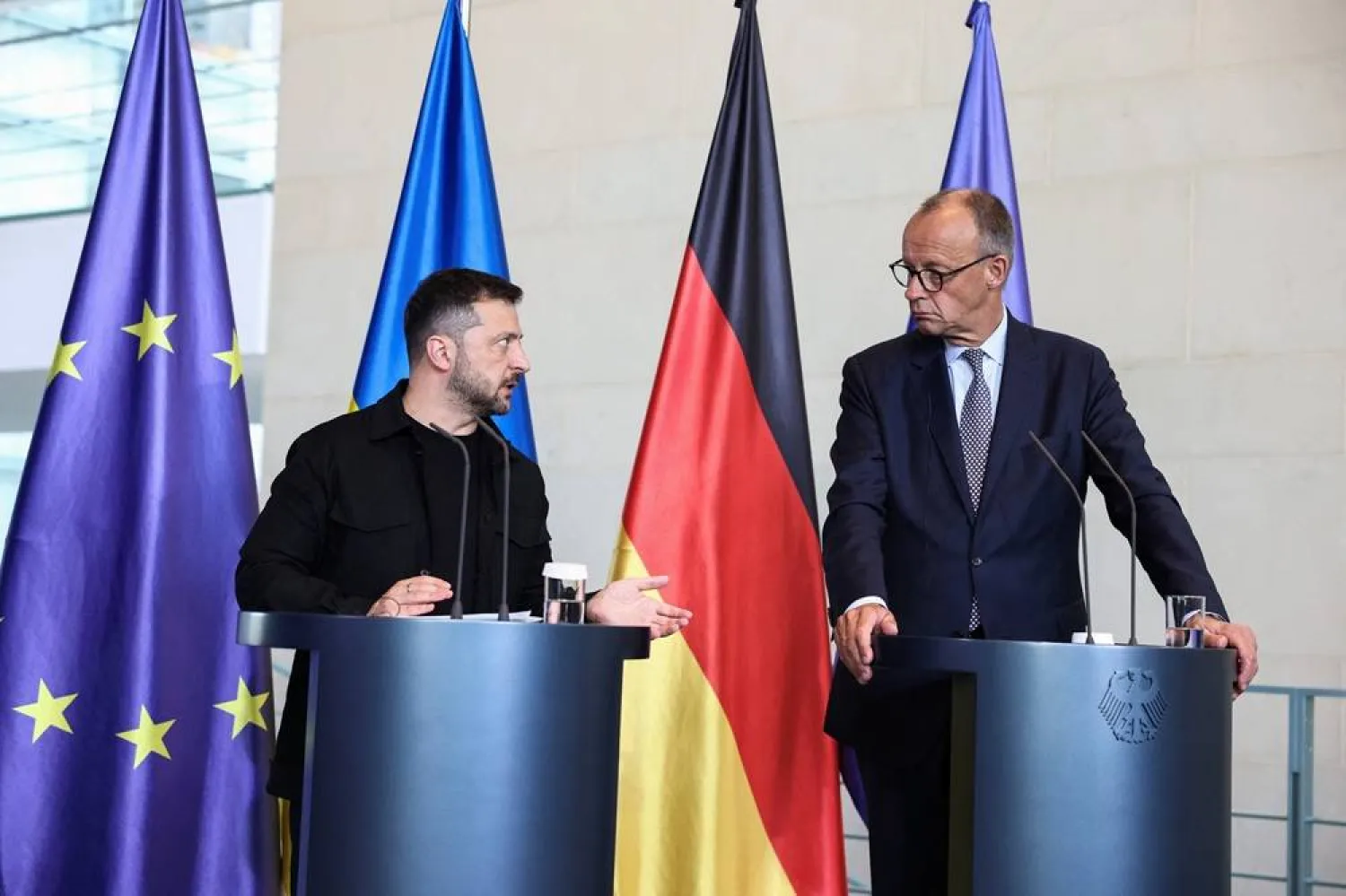

German Chancellor Says European Leaders and Zelenskyy Had ‘Constructive’ Meeting with Trump

German Chancellor Friedrich Merz and Ukrainian President Volodymyr Zelenskyy attend a press conference, on the day they attend a virtual meeting with US President Donald Trump and European leaders on the upcoming Trump-Putin summit on Ukraine, in Berlin, Germany, August 13, 2025. (Reuters)
TT

German Chancellor Says European Leaders and Zelenskyy Had ‘Constructive’ Meeting with Trump

German Chancellor Friedrich Merz and Ukrainian President Volodymyr Zelenskyy attend a press conference, on the day they attend a virtual meeting with US President Donald Trump and European leaders on the upcoming Trump-Putin summit on Ukraine, in Berlin, Germany, August 13, 2025. (Reuters)

European leaders and Ukrainian President Volodymyr Zelenskyy had a “constructive” discussion with US President Donald Trump on Wednesday, two days ahead of Trump’s planned meeting in Alaska with Russian President Vladimir Putin, German Chancellor Friedrich Merz said. 

Speaking alongside Zelenskyy, Merz said after the videoconference that “important decisions” could be made in Anchorage, but stressed that “fundamental European and Ukrainian security interests must be protected” at the meeting. 

Merz convened the virtual meetings in an attempt to make sure European and Ukraine’s leaders are heard ahead of the summit, where Trump and Putin are expected to discuss a path toward ending Moscow's war in Ukraine. 

Zelenskyy and the Europeans have been sidelined from that summit. German government spokesperson Steffen Meyer said the intention of Wednesday's meetings was to “make clear the position of the Europeans.” 

Zelenskyy is due to meet with European leaders first, in preparation for a virtual call with Trump and Vice President JD Vance about an hour later. A call among leaders of countries involved in the “coalition of the willing” — those who are prepared to help police any future peace agreement between Moscow and Kyiv — will take place last. 

The Ukrainian leader on Wednesday said his government has had over 30 conversations with partners ahead of the summit in Alaska, but reiterated his doubt that Putin would negotiate in good faith. 

Writing on his official Telegram channel, Zelenskyy said there was “currently no sign that the Russians are preparing to end the war,” and urged Ukraine's partners in the United States and Europe to coordinate efforts and "force Russia to peace.” 

"Pressure must be applied on Russia for an honest peace. We must take the experience of Ukraine and our partners to prevent deception by Russia,” Zelenskyy said. 

The stakes for Europe  

Trump has said he wants to see whether Putin is serious about ending the war, now in its fourth year, describing Friday's summit as "a feel-out meeting” where he can assess the Russian leader's intentions. 

Yet Trump has disappointed allies in Europe by saying Ukraine will have to give up some Russian-held territory. He has also said Russia must accept land swaps, although it was unclear what Putin might be expected to surrender. 

European allies have pushed for Ukraine’s involvement in any peace talks, fearful that discussions that exclude Kyiv could otherwise favor Moscow. 

Trump on Monday ducked repeated chances to say that he would push for Zelenskyy to take part in his discussions with Putin, and was dismissive of Zelenskyy and his need to be part of an effort to seek peace. Trump said that following Friday's summit, a meeting between the Russian and Ukrainian leaders could be arranged, or that it could also be a meeting with “Putin and Zelenskyy and me.” 

The Europeans and Ukraine are wary that Putin, who has waged the biggest land war in Europe since 1945 and used Russia’s energy might to try to intimidate the European Union, might secure favorable concessions and set the outlines of a peace deal without them. 

The overarching fear of many European countries is that Putin will set his sights on one of them next if he wins in Ukraine. 

Land concessions a non-starter for Kyiv  

Zelenskyy said Tuesday that Putin wants Ukraine to withdraw from the remaining 30% of the Donetsk region that it still controls as part of a ceasefire deal, a proposal the leader categorically rejected. 

Zelenskyy reiterated that Ukraine would not give up any territory it controls, saying that would be unconstitutional and would serve only as a springboard for a future Russian invasion. 

He said diplomatic discussions led by the US focusing on ending the war have not addressed key Ukrainian demands, including security guarantees to prevent future Russian aggression and including Europe in negotiations. 

Three weeks after Trump returned to office, his administration took the leverage of Ukraine’s NATO membership off the table — something that Putin has demanded — and signaled that the EU and Ukraine must handle security in Europe now while America focuses its attention elsewhere. 

Senior EU officials believe that Trump may be satisfied with simply securing a ceasefire in Ukraine, and is probably more interested in broader US geostrategic interests and great power politics, aiming to ramp up business with Russia and rehabilitate Putin. 

Russian advances in Donbas  

Russian forces on the ground in Ukraine have been closing in on a key territorial grab around the city of Pokrovsk, in the eastern Donbas region comprises Ukraine’s eastern industrial heartland that Putin has long coveted. 

Military analysts using open-source information to monitor the battles have said Ukraine's ability to fend off those advances could be critical: Losing Pokrovsk would hand Russia an important victory ahead of the summit and could complicate Ukrainian supply lines to the Donetsk region, where the Kremlin has focused the bulk of military efforts. 

Meanwhile, Ukrainian forces struck an oil pumping station in Russia’s Bryansk region overnight on Wednesday, according to a statement from Ukraine’s General Staff. 

Ukrainian drones struck the Unecha station which supplies the Russian army, the statement said, adding that damage and a large fire was reported in the area around the pumping station. 

Unecha transports oil to two pipelines with an annual capacity to pump 60 million tons. The operation was carried out by units of the Unmanned Systems Forces of Ukraine’s army and the Main Intelligence Directorate of the Defense Ministry, the statement said. 



Türkiye Prosecutors Order Nearly 1,000 Arrests ahead of Coup Anniversary

A Turkish flag with the Bosphorus Bridge in the background, flies on a passenger ferry in Istanbul, Türkiye, September 30, 2020. (Reuters)
TT

Türkiye Prosecutors Order Nearly 1,000 Arrests ahead of Coup Anniversary

A Turkish flag with the Bosphorus Bridge in the background, flies on a passenger ferry in Istanbul, Türkiye, September 30, 2020. (Reuters)

A decade after Türkiye ‘s failed 2016 coup, prosecutors ordered the arrest of nearly 1,000 suspects linked to an organization that Ankara holds responsible, the justice minister said Monday.

On July 15, 2016 a rogue military faction made a short-lived bid to overthrow the government of President Recep Tayyip Erdogan, sparking fighting that left some 250 people dead and another 2,000 wounded, AFP said.

Ankara blamed the US-based preacher Fethullah Gulen, a former Erdogan ally-turned-foe who has since died, vowing to eradicate his organization -- which it dubbed the Fetullah Terrorist Organization, or FETO -- from Turkish society.

Ankara imposed a two-year state of emergency during which it carried out a vast purge of the army, the police, the media, judiciary, the education system and the diplomatic sphere that saw hundreds of thousands detained and tens of thousands sacked, leaving a permanent mark on Turkish society.

Describing Monday's nationwide sweep as part of "the great purification campaign", Justice Minister Akin Gurlek and Interior Minister Mustafa Ciftci said police were seeking "968 suspects" in order to root out FETO-related elements.

"Our nation's will and the survival of our state are under threat from the treacherous FETO/PDY network, and our struggle against it continues with the same determination as on the first day," they wrote on X, using an acronym referring to the "parallel state structure" Ankara says Gulen's group set up.

Analysts say the coup became a turning point in modern Türkiye’s history, allowing Erdogan to cement his grip on power.

Last week, Ciftci sent a letter to the governors of Türkiye’s 81 provinces, describing the events of July 15, 2016 as "a foundational and indisputable turning point".


France Set to Summon Russian Ambassador to Paris over Alleged Cyberattack Campaign

French Foreign Minister Jean-Noel Barrot attends a joint press conference with the Polish foreign minister following their meeting at the Polish Foreign Ministry headquarters in Warsaw, Poland, 09 July 2026.  EPA/Radek Pietruszka POLAND OUT
French Foreign Minister Jean-Noel Barrot attends a joint press conference with the Polish foreign minister following their meeting at the Polish Foreign Ministry headquarters in Warsaw, Poland, 09 July 2026. EPA/Radek Pietruszka POLAND OUT
TT

France Set to Summon Russian Ambassador to Paris over Alleged Cyberattack Campaign

French Foreign Minister Jean-Noel Barrot attends a joint press conference with the Polish foreign minister following their meeting at the Polish Foreign Ministry headquarters in Warsaw, Poland, 09 July 2026.  EPA/Radek Pietruszka POLAND OUT
French Foreign Minister Jean-Noel Barrot attends a joint press conference with the Polish foreign minister following their meeting at the Polish Foreign Ministry headquarters in Warsaw, Poland, 09 July 2026. EPA/Radek Pietruszka POLAND OUT

France will summon the Russian ambassador to Paris in the coming days over an ‌alleged cyberhacking campaign ‌that Russia has carried ‌out ⁠against European countries including ⁠France, French Foreign Minister Jean-Noel Barrot said on Monday.

He added France would also place sanctions on some Russian individuals and entities, Reuters reported.

"Today, we will publicly condemn a widespread cyber campaign conducted ⁠by Russia that aimed to ‌carry out sabotage ‌and spying conducted against a dozen countries," ‌Barrot told BFM TV.

"We will summon ‌the Russian ambassador to France in the coming days," he said, adding that France would sanction nine Russian individuals and four ‌Russian entities regarding this campaign of cyberattacks that Barrot said Russia's ⁠Federal Security ⁠Service had orchestrated.

The European Union is trying to seal a 21st package of sanctions against Moscow in response to Russia's war with Ukraine and may on Monday decide to add further names to their sanctions list, the European Union's foreign policy chief said. The French government has previously accused Moscow of conducting cyberattacks against the country.


Trump Suggests a Standing Order to Attack Iran if it Assassinates Him. But Vance Would Make the Call

President Donald Trump listens to a translator at the beginning of a bilateral meeting with Turkish President Recep Tayyip Erdogan at the NATO summit in Ankara, Türkiye, Tuesday, July 7, 2026. (AP Photo/Alex Brandon)
TT

Trump Suggests a Standing Order to Attack Iran if it Assassinates Him. But Vance Would Make the Call

President Donald Trump listens to a translator at the beginning of a bilateral meeting with Turkish President Recep Tayyip Erdogan at the NATO summit in Ankara, Türkiye, Tuesday, July 7, 2026. (AP Photo/Alex Brandon)

President Donald Trump is suggesting he has left standing orders for the US military to destroy Iran “at levels they've never seen before” if Tehran follows through on its long-standing threats to kill him.

But the US government has no way to create an automatic, preauthorized “dead man’s switch” that would prompt immediate retaliation, The Associated Press said.

Instead, if Trump were killed, the transfer of power to his successor is governed by the 25th Amendment and the Presidential Succession Act of 1947. Vice President JD Vance instantaneously would become commander in chief and have authority for any retaliation.

Under such a scenario, Vance could do exactly what Trump called for, though there also is a chance he could decide not to follow his predecessor's orders — or offer a direct response in a different way.

“The US has, for a whole variety of reasons, never utilized a technical ‘dead man’s switch,'” said Garrett M. Graff, author of “Raven Rock: The Story of the US Government’s Secret Plan to Save Itself -- While the Rest of Us Die.”

The United States does have extensive contingency plans for continuity of government in the event of a nuclear attack or other major catastrophe that wipes out most or all of Washington. But those plans also do not allow for immediately launching retaliatory strikes upon the death of a president, even if that president had demanded that the military be ready to do so.

Trump nonetheless posted on his social media website Saturday that Iran had made threats “to assassinate, or attempt to assassinate” him and he said 1,000 “missiles are Locked and Loaded and aimed at the Islamic Republic of Iran, with thousands more to immediately follow, should the Iranian Government act on its threat.”

Iran's supreme leader, Mojtaba Khamenei, said hours later that Iranians would continue to avenge the killing of his father, Ali Khamenei. The elder Khamenei died in the initial US and Israeli strikes that started the war in late February, and he was mourned in funeral events throughout Iran this week. His son said retaliation “is the will of our nation and must certainly be carried out.”

“We pledge to take revenge for the pure blood of you and all the martyrs of these two wars from the criminal and disgraceful killers," he said in remarks aired on state television. "This revenge is the will of our nation and must certainly be carried out.”

The White House on Saturday did not immediately answer questions about what would become of Trump's military orders should he be killed.

During those recent funeral events, mourners repeatedly held posters or banners calling for Trump to be killed along with Israeli Prime Minister Benjamin Netanyahu.

The Wall Street Journal reported this week that Israel alerted US officials to fresh Iranian plots to kill Trump. The White House has refused to comment, but Trump appeared to reference such threats in comments during this week's NATO summit in Türkiye, saying, “They want to take out the US leader — me.”

Sabrina Singh, former Biden administration deputy Pentagon press secretary, said “Iran wanting to target senior American leaders is something that we know is happening."

“You have to take these as credible threats,” Singh said.

US retaliations would almost certainly come, just not automatically Trump was targeted in two domestic assassination attempts during the 2024 presidential campaign and saw a gunman storm the White House Correspondents' Association dinner he was attending in April.

The US and Iran once again began trading strikes, jeopardizing last month's initial deal to end the war. Asked about Iranian threats, Trump told reporters aboard Air Force One, “I’m No. 1 on their list."

Graff said the US prepared years of plans for how nuclear launch authority would devolve in the event of a surprise attack. That included, during 30 years of the Cold War, the country keeping fleets of airborne command posts flying 24 hours a day with a general aboard one of them who could take over nuclear launch orders in the event Washington was lost.

“What I believe Trump is saying is that he’s left standing orders to attack if he’s killed, e.g., that the Pentagon should proceed with standard launch protocols,” Graff said. “There’s a lot of reason to doubt the legality of such standing orders, since in the event of a president’s death, the nuclear launch authority would immediately pass to the vice president or designated successor — and ultimately it would be up to him or her to determine whether to proceed.”

Trump’s post only refers to firing missiles at Iran, which the US has done scores of times since its war with Iran began. He did not expressly threaten involving nuclear weapons.

Graff said that, in addition to leaving standing orders in case of his death, Trump also might say “something to Vance like, ‘If I’m killed, nuke Iran,'" and that would make” more sense and would be absolutely legal.”

Biden administration once warned Iran about Trump, too Washington receiving credible threats against the president and top US leaders from Iran and other foreign adversaries is not uncommon and is often disclosed via national security briefings or other classified means. But far less common is Trump declaring publicly that he personally has been targeted by Iran.

Still, this is not the first time Washington has threatened Iran over threats against Trump.

In 2022, the Biden administration warned Iran against attacking US citizens after the Justice Department's disclosure that a member of Iran’s Revolutionary Guard Corps had planned to assassinate John Bolton, Trump's first-term national security adviser. Now a Trump critic, Bolton last month pleaded guilty to illegally retaining classified documents in a case led by Trump’s Justice Department.

President Joe Biden’s national security adviser Jake Sullivan said in 2022 that “should Iran attack any of our citizens, to include those who continue to serve the United States or those who formerly served, Iran will face severe consequences.”

Two years later, in the heat of Trump’s campaign against Democrat Kamala Harris, Biden's vice president, the Biden administration again quietly warned Iran. This time, officials made clear that an attack on Trump would be considered an act of war.