WhatsApp Accuses Moscow of Trying to Block Secure Communication for Millions of Russians

FILE PHOTO: WhatsApp logo is seen in this illustration taken, August 22, 2022. REUTERS/Dado Ruvic/Illustration/File Photo
TT

WhatsApp Accuses Moscow of Trying to Block Secure Communication for Millions of Russians

FILE PHOTO: WhatsApp logo is seen in this illustration taken, August 22, 2022. REUTERS/Dado Ruvic/Illustration/File Photo

WhatsApp accused Moscow of trying to block millions of Russians from accessing secure communication after calls on the messaging app were restricted, as Russia promotes home-grown social media platforms and seeks greater control over the country's internet space.

Russia said on Wednesday that it had started restricting some WhatsApp, owned by Meta Platforms, and Telegram calls, accusing the foreign-owned platforms of failing to share information with law enforcement in fraud and terrorism cases.

Text messaging services and voice notes are currently unaffected, Reuters reported.

A simmering dispute with foreign tech providers intensified after Moscow's February 2022 invasion of Ukraine, with Russia blocking Meta's Facebook and Instagram, slowing the speed of Alphabet's YouTube and issuing hundreds of fines to platforms that failed to comply with Russian rules on online content and data storage.

"WhatsApp is private, end-to-end encrypted, and defies government attempts to violate people's right to secure communication, which is why Russia is trying to block it from over 100 million Russian people," WhatsApp said late on Wednesday.

"We will keep doing all we can to make end-to-end encrypted communication available to people everywhere, including in Russia."

Telegram said its moderators were using AI tools to monitor public parts of the platform to remove millions of malicious messages every day.

"Telegram actively combats harmful use of its platform including calls for sabotage or violence and fraud," Telegram said.

In July 2025, WhatsApp's monthly reach in Russia was 97.3 million people, compared to 90.8 million for Telegram, according to Mediascope data. Third-placed VK Messenger, an offering from state-controlled tech company VK, reached 17.9 million people.

Russia has a population of more than 140 million people.

STEADY DEGRADATION

Russia banning WhatsApp and Telegram users from making calls comes as the government is actively promoting a new state-controlled messaging app, MAX, that will be integrated with government services and which critics fear could track its users' activities.

Senior politicians are migrating to MAX, urging their followers to come with them. Anton Gorelkin, a leading regulator of Russia's IT sector in parliament, said he would post to his MAX followers first and said many other lawmakers would soon follow suit.

WhatsApp's other services remain available for now, but the steady degradation of a service is a tactic Russia has employed before, notably with YouTube, where slower download speeds have made it harder for people to access content.

Human Rights Watch said in a report last month that Russia has been "meticulously expanding legal and technological tools to carve out Russia's section of the internet into a tightly controlled and isolated forum".

Lawmakers have approved a new law that tightens censorship and could have sweeping ramifications for digital privacy, with Russians facing fines if they search online for content Moscow considers "extremist", including via virtual private networks that millions use to bypass internet blocks.


Zelenskyy Meets in London with European Allies on US Peace Plan and Security

 Ukrainian President Volodymyr Zelenskyy, left, with Britain's Prime Minister Keir Starmer, French President Emmanuel Macron, and German Chancellor Friedrich Merz pose on the doorstep of 10 Downing Street, London, Monday, Dec. 8, 2025, following a meeting of the leaders inside. (AP)
Ukrainian President Volodymyr Zelenskyy, left, with Britain's Prime Minister Keir Starmer, French President Emmanuel Macron, and German Chancellor Friedrich Merz pose on the doorstep of 10 Downing Street, London, Monday, Dec. 8, 2025, following a meeting of the leaders inside. (AP)
TT

Zelenskyy Meets in London with European Allies on US Peace Plan and Security

 Ukrainian President Volodymyr Zelenskyy, left, with Britain's Prime Minister Keir Starmer, French President Emmanuel Macron, and German Chancellor Friedrich Merz pose on the doorstep of 10 Downing Street, London, Monday, Dec. 8, 2025, following a meeting of the leaders inside. (AP)
Ukrainian President Volodymyr Zelenskyy, left, with Britain's Prime Minister Keir Starmer, French President Emmanuel Macron, and German Chancellor Friedrich Merz pose on the doorstep of 10 Downing Street, London, Monday, Dec. 8, 2025, following a meeting of the leaders inside. (AP)

President Volodymyr Zelenskyy met French, German and British leaders in London on Monday amid what Kyiv’s European allies described as a “decisive time” in the US-led effort to end Russia's war in Ukraine.

Prime Minister Keir Starmer held talks with Zelenskyy, French President Emmanuel Macron and German Chancellor Friedrich Merz at the British leader’s 10 Downing St. residence to try to strengthen Ukraine’s hand amid mounting impatience from US President Donald Trump.

“This is the furthest we’ve got in four years, and we welcome the fact that these talks are continuing at every level,” said Starmer's spokesman, Tom Wells, adding: “It isn't a straight line between conflict and peace.”

He said “intensive work” will continue in the coming days, although “there are still outstanding issues.”

Macron’s office said the session allowed the leaders “to continue joint work on the US plan in order to complement it with European contributions, in close coordination with Ukraine.”

In an exchange with reporters on Sunday night, Trump appeared frustrated with Zelenskyy, claiming the Ukrainian leader “hasn’t yet read the proposal.”

“Russia is, I believe, fine with it, but I’m not sure that Zelenskyy’s fine with it,” Trump said in Washington. “His people love it, but he hasn’t read it.”

It’s not clear why Trump thought Zelenskyy hadn’t read the plan or who he was saying loved it. Ukrainian officials have made sparing comments about it and few details of the negotiations have been made public.

Starmer, Macron and Merz took a more supportive stance toward Kyiv in comments before their Monday meeting, which lasted about two hours. The UK leader said the push for peace was at a “critical stage,” and stressed the need for "a just and lasting ceasefire.”

Merz, meanwhile, said he was “skeptical” about some details in documents released by the US. “We have to talk about it. That’s why we are here,” he said. “The coming days ... could be a decisive time for all of us."

European leaders are working to ensure that any ceasefire is backed by solid security guarantees both from Europe and the US to deter Russia from attacking again. Trump has not given explicit guarantees in public.

Zelenskyy said late Sunday that his talks with European leaders this week in London and Brussels will focus on security, air defense and long-term funding for Ukraine’s war effort. He said Monday that Ukraine needs support from both Europe and the US.

“There are some things we can’t manage without the Americans, things which we can’t manage without Europe, and that’s why we need to make some important decisions,” he said at Downing Street.

Macron's office said national security advisers are finalizing ways to provide Ukraine with robust security guarantees and to plan measures for Ukraine’s reconstruction.”

Obstacles in the peace plan

US and Ukrainian negotiators completed three days of talks on Saturday aimed at trying to narrow differences on the US administration’s peace proposal.

Zelenskyy said on Telegram that talks had been “substantive” and that National Security and Defense Council Secretary Rustem Umerov and Chief of the General Staff Andrii Hnatov were traveling back to Europe to brief him.

A major sticking point in the plan is the suggestion that Kyiv must cede control of the Donbas region of eastern Ukraine to Russia, which illegally occupies most but not all of the territory. Ukraine and its European allies have balked at the idea of handing over land.

Starmer said he “won’t be putting pressure” on Zelenskyy to accept a peace settlement.

Trump has had a hot-and-cold relationship with Zelenskyy since winning a second term, insisting the war was a waste of US taxpayers’ money. Trump has also repeatedly urged the Ukrainians to cede land to Russia to end the nearly four-year conflict.

US releases national security strategy

The European talks follow the publication of a new US national security strategy that alarmed European leaders and was welcomed by Russia.

Kremlin spokesman Dmitry Peskov said the document, which spells out the administration’s core foreign policy interests, was largely in line with Moscow’s vision.

“The nuances that we see in the new concept certainly look appealing to us,” he said Monday. “It mentions the need for dialogue and building constructive, friendly relations. This cannot but appeal to us, and it absolutely corresponds to our vision. We understand that by eliminating the irritants that currently exist in bilateral relations, a prospect may open for us to truly restore our relations and bring them out of the rather deep crisis.”

The document released Friday by the White House said the US wants to improve its relationship with Russia after years of Moscow being treated as a global pariah and that ending the war is a core US interest to “reestablish strategic stability with Russia.”

The document also says NATO must not be “a perpetually expanding alliance,” echoing another complaint by Russia. It was scathing about the migration and free speech policies of longstanding US allies in Europe, suggesting they face the “prospect of civilizational erasure” due to migration.

Starmer’s government has declined to comment on the document, saying it is a matter for the US. government.

Russia continued to attack Ukraine amid the diplomatic efforts. Its drones struck high-rise apartments in the northeastern Ukrainian city of Okhtyrka overnight, injuring seven people, according to the head of the regional administration, Oleh Hryhorov. He said the building was extensively damaged.

In the northern city of Chernihiv, a Russian drone exploded outside a residential building, injuring three people, regional head Viacheslav Chaus said. The attack also damaged a kindergarten, gas lines and cars.

Ukraine’s air force said Russia fired 149 drones overnight, with 131 neutralized and 16 others striking their targets.

Meanwhile, Russian air defenses destroyed 67 Ukrainian drones overnight, Russia’s Defense Ministry said. The drones were shot down over 11 Russian regions, it said.


Powerful 7.6-Magnitude Earthquake Strikes Japan’s Northeast

A tsunami warning flashes over live footage of a waterfront area, on a television screen in Sapporo, in Japan's northern Hokkaido prefecture on December 9, 2025. (AFP)
TT

Powerful 7.6-Magnitude Earthquake Strikes Japan’s Northeast

A tsunami warning flashes over live footage of a waterfront area, on a television screen in Sapporo, in Japan's northern Hokkaido prefecture on December 9, 2025. (AFP)

A powerful 7.6-magnitude earthquake shook northeastern Japan late on Monday, prompting tsunami warnings and orders for about 90,000 residents to evacuate. 

The Japan Meteorological Agency said a tsunami as high as 3 meters (10 feet) could hit Japan's northeastern coast after the earthquake struck off the coast at 11:15 p.m. (1415 GMT). 

Tsunami warnings were issued for the prefectures of Hokkaido, Aomori and Iwate, and tsunamis from 20 to 70 cm (7 to 27 inches) high were observed at several ports, JMA said. 

The epicenter of the quake was 80 km (50 miles) off the coast of Aomori prefecture, at a depth of 50 km, the agency added. 

On Japan's 1-7 scale of seismic intensity, the tremor registered as an "upper 6" in Aomori prefecture -- a quake strong enough to make it impossible to keep standing or move without crawling. In such tremors, most heavy furniture can collapse and wall tiles and windowpanes are damaged in many buildings. 

East Japan Railway suspended some services in the area, which was also hit by the massive 9.0-magnitude quake in March 2011. As of 1600 GMT, there was little information of major damage from public broadcaster NHK. 

"There is a possibility that further powerful and stronger earthquakes could occur over the next several days," a JMA official said at a briefing. 

No irregularities were reported at nuclear power plants in the region run by Tohoku Electric Power and Hokkaido Electric Power, the utilities said. Tohoku Electric initially said thousands of households had lost power but later lowered that number to the hundreds. 

The yen weakened against major currencies after news of the tremor, before regaining some ground. The dollar touched a session high and was trading at around 155.81 yen around 1533 GMT, while the euro also hit a session high. 

Japan is one of the world's most earthquake-prone countries, with a tremor occurring at least every five minutes. Located in the "Ring of Fire" of volcanoes and oceanic trenches partly encircling the Pacific Basin, Japan accounts for about 20% of the world's earthquakes of magnitude 6.0 or greater.  

The northeastern region suffered one of the country's deadliest earthquakes on March 11, 2011, when a 9.0-magnitude tremor struck under the ocean off the coast of the northern city of Sendai.  

It was the most powerful ever recorded in Japan and set off a series of massive tsunami that devastated a wide swathe of the Pacific coastline and killed nearly 20,000 people. 

The 2011 tsunami also damaged the Fukushima Daiichi nuclear plant, leading to a series of explosions and meltdowns in the world's worst nuclear disaster for 25 years. 


Iran Opens Trial of Dual National Accused of Spying for Israel 

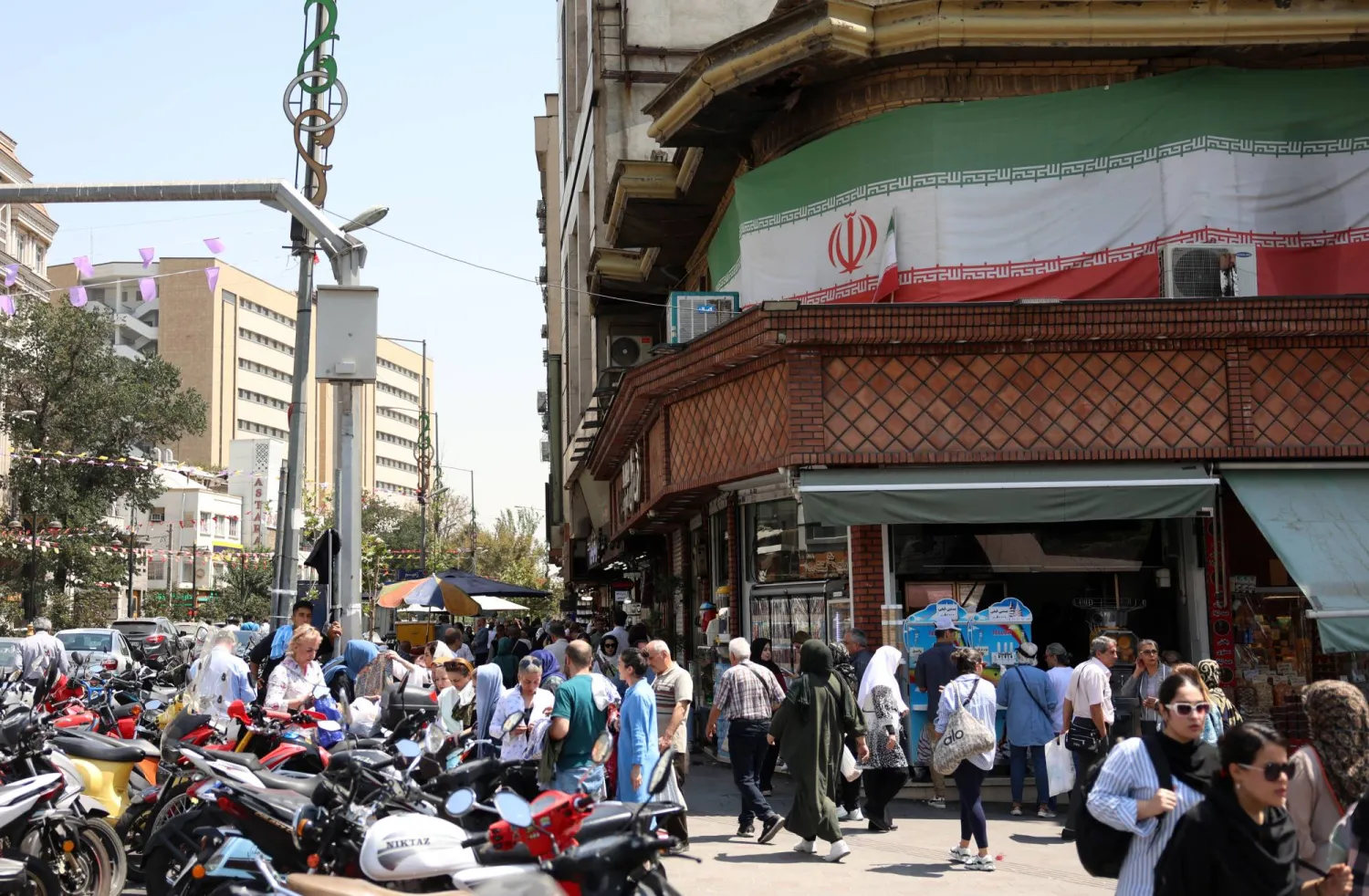
Iranians go shopping in Tajrish Bazaar in Tehran, Iran, 08 December 2025. (EPA)
TT

Iran Opens Trial of Dual National Accused of Spying for Israel 

Iranians go shopping in Tajrish Bazaar in Tehran, Iran, 08 December 2025. (EPA)

The trial of a dual national holding European citizenship has begun in Iran, the semi-official Tasnim news agency reported on Monday, saying they were indicted for "intelligence cooperation and espionage in favor of the Zionist regime (Israel)."

According to the Alborz provincial attorney general, the defendant - whose identity has not been disclosed - entered Iran about a month before the 12-day war in June, during which Israel and the US struck Iranian nuclear facilities.

They were arrested on the fourth day of the conflict by the elite Revolutionary Guards.

"Sophisticated spy and intelligence items and equipment were discovered in their villa in Karaj," the attorney general said, adding that the charges under investigation carry penalties for "waging war against God" and "corruption on earth" - offences often punishable by death.

In recent years, the Revolutionary Guards have detained dozens of dual nationals and foreigners, mostly on espionage and security-related charges.

Rights groups and some Western countries have accused Tehran of using such arrests to gain leverage in negotiations. Tehran denies arresting people for political reasons.