


European Leaders to Join Ukraine’s Zelenskyy for Meeting with Trump

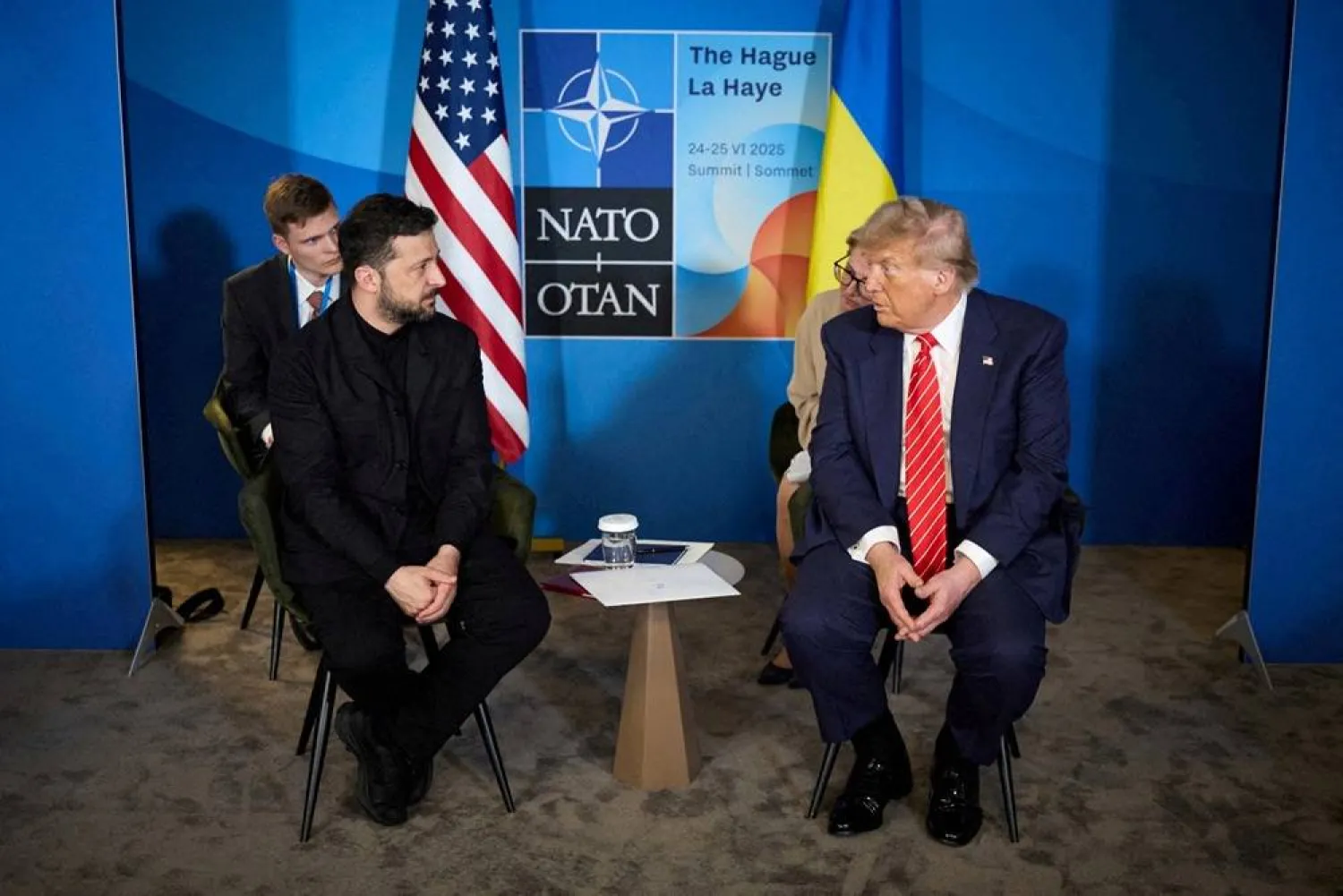
US President Donald Trump and Ukraine's President Volodymyr Zelenskyy attend a meeting on the sidelines of NATO summit in The Hague, Netherlands June 25, 2025. (Ukrainian Presidential Press Service/Handout via Reuters)
TT

European Leaders to Join Ukraine’s Zelenskyy for Meeting with Trump

US President Donald Trump and Ukraine's President Volodymyr Zelenskyy attend a meeting on the sidelines of NATO summit in The Hague, Netherlands June 25, 2025. (Ukrainian Presidential Press Service/Handout via Reuters)

European and NATO leaders announced Sunday they will join President Volodymyr Zelenskyy in Washington for talks with President Donald Trump on ending Russia’s war in Ukraine, with the possibility of US security guarantees now on the negotiating table. 

Leaders from France, Britain and Germany are rallying around the Ukrainian leader after his exclusion from Trump’s summit on Friday with Russian President Vladimir Putin. Their pledge to be at Zelenskyy’s side at the White House on Monday is an apparent effort to ensure the meeting goes better than the last one in February, when Trump berated Zelenskyy in a heated Oval Office encounter. 

“The Europeans are very afraid of the Oval Office scene being repeated and so they want to support Mr. Zelenskyy to the hilt,” said retired French Gen. Dominique Trinquand, a former head of France’s military mission at the United Nations. 

“It’s a power struggle and a position of strength that might work with Trump,” he said. 

Special US envoy Steve Witkoff said Sunday that Putin agreed at the meeting in Alaska with Trump to allow the US and European allies to offer Ukraine a security guarantee resembling NATO’s collective defense mandate as part of an eventual deal to end the 3 1/2-year war. 

European Commission President Ursula von der Leyen, speaking at a news conference in Brussels with Zelenskyy, said “we welcome President Trump’s willingness to contribute to Article 5-like security guarantees for Ukraine. And the ‘Coalition of the willing’ -- including the European Union -- is ready to do its share.” 

Von der Leyen was joined Sunday by French President Emmanuel Macron, British Prime Minister Keir Starmer and German Chancellor Friedrich Merz in saying they will take part in Monday's talks at the White House, as will secretary-general of the NATO military alliance, Mark Rutte. 

The European leaders’ demonstration of support could help ease concerns in Kyiv and in other European capitals that Ukraine risks being railroaded into a peace deal that Trump says he wants to broker with Russia. 

Neil Melvin, director of international security at the London-based Royal United Services Institute, said European leaders are trying to “shape this fast-evolving agenda.” After the Alaska summit, the idea of a ceasefire appears all-but-abandoned, with the narrative shifting toward Putin’s agenda of ensuring Ukraine does not join NATO or even the EU. 

US Secretary of State Marco Rubio said on NBC’s “Meet the Press” on Sunday that a possible ceasefire is “not off the table” but that the best way to end the war would be through a “full peace deal.” 

Putin has implied that he sees Europe as a hindrance to negotiations. He has also resisted meeting Zelenskyy in person, saying that such a meeting can only take place once the groundwork for a peace deal has been laid. 

Speaking to the press after his meeting with Trump, the Russian leader raised the idea that Kyiv and other European capitals could “create obstacles” to derail potential progress with “behind-the-scenes intrigue.” 

For now, Zelenskyy offers the Europeans the “only way” to get into the discussions about the future of Ukraine and European security, says RUSI's Melvin. 

However, the sheer number of European leaders potentially in attendance means the group will have to be “mindful” not to give “contradictory” messages, Melvin said. 

“The risk is they look heavy-handed and are ganging up on Trump,” he added. “Trump won’t want to be put in a corner.” 

Although details remain hazy on what Article 5-like security guarantees from the US and Europe would entail for Ukraine, it could mirror NATO membership terms, in which an attack on one member of the alliance is seen as an attack on all. 

In remarks made on CNN's “State of the Union,” Witkoff said Friday's meeting with Trump was the first time Putin has been had heard to agree to such an arrangement. 

Zelenskyy continues to stress the importance of both US and European involvement in any negotiations. 

“A security guarantee is a strong army. Only Ukraine can provide that. Only Europe can finance this army, and weapons for this army can be provided by our domestic production and European production. But there are certain things that are in short supply and are only available in the United States,” he said at the press conference Sunday alongside Von der Leyen. 


Iran President Calls on People to Save Energy

Iranians shop in the Tajrish bazaar in Tehran, Iran, 25 April 2026. (EPA)
TT

Iran President Calls on People to Save Energy

Iranians shop in the Tajrish bazaar in Tehran, Iran, 25 April 2026. (EPA)

Iranian President Masoud Pezeshkian called on his people Saturday to conserve electricity, warning that while there were no shortages at present, the US and Israel aimed to sow "dissatisfaction" among the Iranian people.

"We have asked our dear people, who are now ready and present on the ground, a simple request. And that is to reduce their own electricity and energy consumption," the president said on state TV.

"We do not need people to sacrifice for the time being, but we do need to control consumption. Instead of 10 lights, two lights should be turned on in the house -- what is wrong with that?" he added.

Despite the US-Israeli bombing campaign against Iran, there have been no reported power cuts in Tehran in recent days.

Pezeshkian accused Iran's enemies of hitting infrastructure and imposing a blockade "so that the current satisfaction turns into dissatisfaction".

US President Donald Trump has repeatedly threatened to wipe out Iran's power infrastructure, but has so far not followed through.

Even before the current war with the United States and Israel, however, Iran suffered frequent power outages during the winter and summer peaks in demand.

According to the International Energy Agency, Iran generates nearly four-fifths of its electricity from burning natural gas, a resource in which it is self-sufficient thanks to vast gas fields.

It supplements this with low-quality heavy fuel oil, known as mazout, used at older power stations.

Nevertheless, ageing infrastructure, a lack of investment and the impact of fierce international sanctions that cut off access to technology and investment have left the electricity grid unable to cope with demand.

Pezeshkian has previously launched several public awareness campaigns to reduce energy use.


Türkiye Dismisses Deputy Education Minister After School Shootings

Flowers are hung on the fence of a school where a shooting took place, in the southeastern province of Kahramanmaras, Türkiye, April 16, 2026. (Reuters)
TT

Türkiye Dismisses Deputy Education Minister After School Shootings

Flowers are hung on the fence of a school where a shooting took place, in the southeastern province of Kahramanmaras, Türkiye, April 16, 2026. (Reuters)

President Recep Tayyip Erdogan has dismissed Türkiye’s deputy education minister after two school shootings that left nine people dead, according to the official gazette published late Friday.

Eight students aged 10 and 11 and a teacher were killed this month when a 14-year-old opened fire at a school in the southern province of Kahramanmaras.

Authorities said the attacker, who died at the scene, brought five firearms and was the son of a former police inspector, who has since been arrested.

A separate attack in southeastern Sanliurfa province involved a former student who opened fire at his old high school before taking his own life when confronted by police.

Under a decree signed by Erdogan, deputy education minister Nazif Yilmaz was dismissed and replaced by Cihad Demirli.

The measures also targeted the leadership of state institutions responsible for education, according to the decree.

The incidents have sparked public outcry and Erdogan has said the government will introduce measures, including restrictions on gun ownership.


Macron Reaffirms Efforts to Reopen Strait of Hormuz, as TotalEnergies Warns of Energy Shortages

 French President Emmanuel Macron attends a Greece–France Economic Forum at the Stavros Niarchos Foundation Cultural Center in Athens, Greece, April 25, 2026. (Reuters)
French President Emmanuel Macron attends a Greece–France Economic Forum at the Stavros Niarchos Foundation Cultural Center in Athens, Greece, April 25, 2026. (Reuters)
TT

Macron Reaffirms Efforts to Reopen Strait of Hormuz, as TotalEnergies Warns of Energy Shortages

 French President Emmanuel Macron attends a Greece–France Economic Forum at the Stavros Niarchos Foundation Cultural Center in Athens, Greece, April 25, 2026. (Reuters)
French President Emmanuel Macron attends a Greece–France Economic Forum at the Stavros Niarchos Foundation Cultural Center in Athens, Greece, April 25, 2026. (Reuters)

French President Emmanuel Macron reiterated ‌on Saturday that he was focused on efforts to reopen the Strait of Hormuz, a day after the head of TotalEnergies warned of global energy shortages if the Iran war continues for months.

Macron, speaking at a news conference in Athens alongside Greek Prime Minister Kyriakos Mitsotakis, said panic caused by geopolitical uncertainty can in itself lead to shortages.

"Our goal is to achieve a full reopening in the coming days and weeks, in accordance with ‌international law, ‌guaranteeing freedom of navigation without tolls on ‌the ⁠Strait of Hormuz. Then ⁠things can gradually return to normal," Macron said.

TotalEnergies CEO Patrick Pouyanne pressed on Friday for the reopening of the strait, through which about a fifth of the globe's oil and gas supply normally flows.

Movement through the strait, which is also a key transport route for ⁠goods including fertilizers and pharmaceuticals, has been choked ‌due to the US-Israeli ‌war with Iran, as Iran has seized container ships and ‌the United States has mounted a blockade on Iranian ‌ports.

"If it lasts two, three months more, we are entering in a world of scarcity of energy, which Asian countries have already suffered," Pouyanne told the World Policy Conference in Chantilly, ‌outside Paris. "You cannot have 20% of the oil and gas of the planet being ⁠stranded and ⁠not accessible without major consequences."

More than a dozen countries have said they are willing to join an international mission led by France and Britain to protect shipping in the strait when conditions permit, even as US President Donald Trump has said he does not need allies' help.

"We're all in the same boat, and it's not a boat we chose, if I may say. We're victims of geopolitics and we're victims of this war that started several months ago," Macron said on Saturday.
