

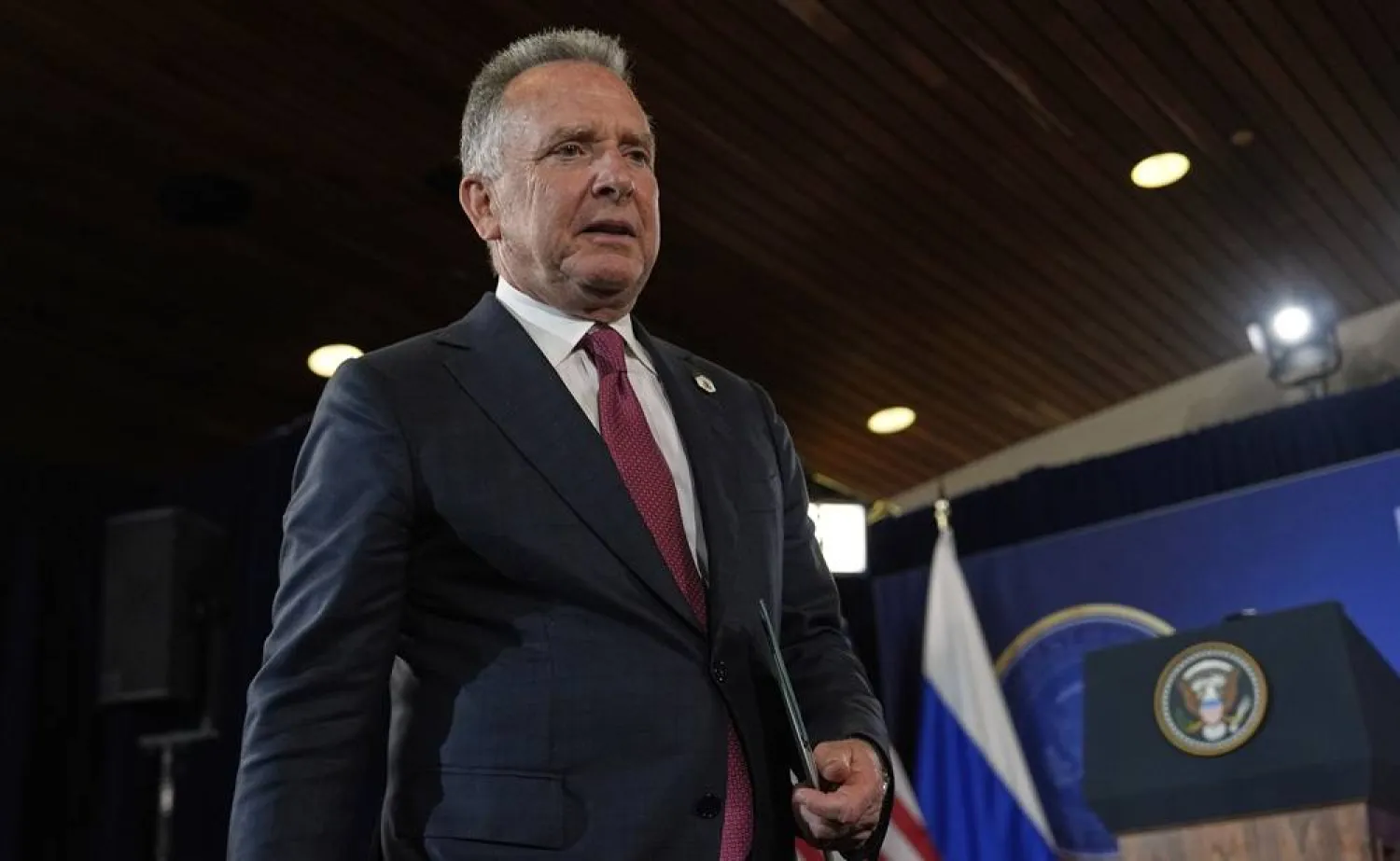

Putin Agreed to Let US, Europe Offer NATO-Style Security Protections for Ukraine, Trump Envoy Says

White House envoy Steve Witkoff arrives before a news conference with President Donald Trump and Russia's President Vladimir Putin at Joint Base Elmendorf-Richardson, Alaska, Friday, Aug. 15, 2025. (AP)
TT

Putin Agreed to Let US, Europe Offer NATO-Style Security Protections for Ukraine, Trump Envoy Says

White House envoy Steve Witkoff arrives before a news conference with President Donald Trump and Russia's President Vladimir Putin at Joint Base Elmendorf-Richardson, Alaska, Friday, Aug. 15, 2025. (AP)

Special US envoy Steve Witkoff said Sunday that Russian leader Vladimir Putin agreed at his summit with President Donald Trump to allow the US and European allies to offer Ukraine a security guarantee resembling NATO’s collective defense mandate as part of an eventual deal to end the 3 1/2-year war.

"We were able to win the following concession: That the United States could offer Article 5-like protection, which is one of the real reasons why Ukraine wants to be in NATO," he said on CNN's "State of the Union." He added that it "was the first time we had ever heard the Russians agree to that."

European Commission President Ursula von der Leyen, speaking at a news conference in Brussels with Ukrainian President Volodymyr Zelenskyy, said that "we welcome President Trump’s willingness to contribute to Article 5-like security guarantees for Ukraine. and the ‘Coalition of the willing’ -- including the European Union -- is ready to do its share."

Witkoff, offering some of the first details of what was discussed at Friday's summit in Alaska, said the two sides agreeing to "robust security guarantees that I would describe as game-changing." He added that Russia said that it would make a legislative commitment not to go after any additional territory in Ukraine.

Zelenskyy thanked the United States for recent signals that Washington is willing to support security guarantees for Ukraine, but said the details remained unclear.

"It is important that America agrees to work with Europe to provide security guarantees for Ukraine," he said, "But there are no details how it will work, and what America’s role will be, Europe’s role will be and what the EU can do, and this is our main task, we need security to work in practice like Article 5 of NATO, and we consider EU accession to be part of the security guarantees."

Witkoff defended Trump’s decision to abandon his push for Russian to agree to an immediate ceasefire, saying the president had pivoted toward a peace deal because so much progress was made.

"We covered almost all the other issues necessary for a peace deal," Witkoff said, without elaborating.

"We began to see some moderation in the way they’re thinking about getting to a final peace deal," he said.

Secretary of State Marco Rubio insisted there would be "additional consequences" as Trump warned before meeting with Putin, if they failed to reach a ceasefire. But Rubio noted that there wasn’t going to be any sort of deal on a truce reached when Ukraine wasn’t at the talks.

"Now, ultimately, if there isn’t a peace agreement, if there isn’t an end of this war, the president’s been clear, there are going to be consequences," Rubio said on ABC’s "This Week.But we’re trying to avoid that. And the way we’re trying to avoid those consequences is with an even better consequence, which is peace, the end of hostilities."

Rubio, who is also Trump's national security adviser, said he did not believe issuing new sanctions on Russia would force Putin to accept a ceasefire, noting that the latter isn’t off the table but that "the best way to end this conflict is through a full peace deal."

"The minute you issue new sanctions, your ability to get them to the table, our ability to get them to table will be severely diminished," Rubio said on NBC's "Meet the Press."

He also said "we’re not at the precipice of a peace agreement" and that getting there would not be easy and would take a lot of work.

"We made progress in the sense that we identified potential areas of agreement, but there remains some big areas of disagreement. So we’re still a long ways off," Rubio said.

Zelenskyy and Europeans leaders are scheduled to meet Monday with Trump at the White House. They heard from the president after his meeting with Putin.

"I think everybody agreed that we had made progress. Maybe not enough for a peace deal, but we are on the path for the first time," Witkoff said.

He added: "The fundamental issue, which is some sort of land swap, which is obviously ultimately in the control of the Ukrainians -- that could not have been discussed at this meeting" with Putin. "We intend to discuss it on Monday. Hopefully we have some clarity on it and hopefully that ends up in a peace deal very, very soon."



Turkish Police Detain Deutsche Welle Journalist over Social Media Posts

19 February 2026, Canada: Deutsche Welle (DW) logo is seen displayed on a smartphone screen. Photo: Thomas Fuller/SOPA Images via ZUMA Press Wire/dpa
TT

Turkish Police Detain Deutsche Welle Journalist over Social Media Posts

19 February 2026, Canada: Deutsche Welle (DW) logo is seen displayed on a smartphone screen. Photo: Thomas Fuller/SOPA Images via ZUMA Press Wire/dpa

Turkish police have detained investigative journalist Alican Uludag on suspicion of insulting President Recep Tayyip Erdogan and spreading misinformation, sparking outrage among journalism groups.
Uludag, who works for German broadcaster Deutsche Welle’s Turkish service, was taken from his home in Ankara late Thursday as part of an investigation into social media posts. The Istanbul Chief Prosecutor’s Office said he is suspected of “insulting the president” and “disseminating misleading information.”
The journalist, whose reporting focuses mainly on the judiciary and on corruption cases, was later transferred to Istanbul for questioning.
His detention drew sharp condemnation from press freedom advocates, who described it as an attack on media independence and democratic norms, The Associated Press said.
Deutsche Welle’s director‑general, Barbara Massing, demanded his release, calling the arrest “a deliberate act of intimidation.”
On Friday, journalists gathered outside Istanbul’s Çaglayan Courthouse to protest Uludag’s detention and to call for his immediate release.
The advocacy group, Reporters Without Borders considers Türkiye to be one of the most repressive countries for journalists, nothing that most media organizations are under government control and journalists face frequent legal pressure or intimidation.
At least 14 journalists or media sector workers are currently in prison, according to the Turkish Journalists Syndicate.


South Korea’s Ex-President Yoon Apologizes After Life Sentence Over Martial Law 

South Korean President Yoon Suk Yeol  delivers a speech to declare martial law in Seoul, South Korea, December 3, 2024. (The Presidential Office/Handout via Reuters/File Photo)
South Korean President Yoon Suk Yeol delivers a speech to declare martial law in Seoul, South Korea, December 3, 2024. (The Presidential Office/Handout via Reuters/File Photo)
TT

South Korea’s Ex-President Yoon Apologizes After Life Sentence Over Martial Law 

South Korean President Yoon Suk Yeol  delivers a speech to declare martial law in Seoul, South Korea, December 3, 2024. (The Presidential Office/Handout via Reuters/File Photo)
South Korean President Yoon Suk Yeol delivers a speech to declare martial law in Seoul, South Korea, December 3, 2024. (The Presidential Office/Handout via Reuters/File Photo)

Former ‌South Korean President Yoon Suk Yeol apologized on Friday for his short-lived declaration of martial law in December 2024, a day after a Seoul court sentenced him to life in prison for masterminding an insurrection.

In a statement released by his lawyers, Yoon said that while he was sorry for the "frustration and hardship" brought upon the people by his martial law decree, he stood behind the "sincerity and purpose" behind his actions.

The Seoul Central District Court's decision ‌to hand him ‌a life sentence on Thursday was "predetermined," he ‌said, ⁠adding that the verdict ⁠against him was political retaliation.

"Forces that seek to smear a decision made to save the nation as an 'insurrection' and to use it beyond political attacks as an opportunity to purge and eliminate their opponents will only grow more rampant going forward," he said.

Yoon also questioned ⁠whether an appeal would have meaning ‌in what he described as an ‌environment where judicial independence could not be guaranteed, while telling ‌supporters to "unite and rise."

His lawyers separately said the statement ‌did not amount to an intention to forgo an appeal.

Yoon's martial law declaration lasted around six hours before being voted down by parliament, but it sent shockwaves through the country and ‌sparked street protests.

The court found Yoon guilty of subverting constitutional order by deploying troops ⁠to storm ⁠parliament and move to detain opponents, capping a dramatic fall that saw him stripped of office and end up behind bars.

Yoon, a former career prosecutor, denied the charges, arguing he had presidential authority to declare martial law and his action was aimed at sounding the alarm over opposition parties' obstruction of government.

A special prosecutor had sought the death penalty for Yoon, though South Korea has not carried out an execution since 1997.

A prosecutor said on Thursday the team had some "regret" over the sentencing, but declined to say whether they planned to appeal.


Russia Hits Ukraine's Oil, Gas Infrastructure in Poltava Region, Naftogaz Says

FILE PHOTO: A Ukrainian service member of the 14th Unmanned Aerial Systems Regiment prepares a deep strike unmanned aerial vehicle before its launch toward Russian territory, amid Russia's attack on Ukraine, in an undisclosed location in Ukraine, undisclosed date, 2025. REUTERS/Valentyn Ogirenko/File Photo
TT

Russia Hits Ukraine's Oil, Gas Infrastructure in Poltava Region, Naftogaz Says

FILE PHOTO: A Ukrainian service member of the 14th Unmanned Aerial Systems Regiment prepares a deep strike unmanned aerial vehicle before its launch toward Russian territory, amid Russia's attack on Ukraine, in an undisclosed location in Ukraine, undisclosed date, 2025. REUTERS/Valentyn Ogirenko/File Photo

Russian drones hit Ukraine's oil and gas infrastructure in the central Poltava region, causing ‌damage ‌and a ‌fire, ⁠the state energy company ⁠Naftogaz said on Friday.

"This is yet another targeted ⁠attack on ‌our ‌oil and ‌gas infrastructure. ‌Since the beginning of the year, the ‌enemy has attacked Naftogaz Group facilities ⁠more ⁠than 20 times," Sergii Koretskyi, Naftogaz CEO said in a post on Facebook.