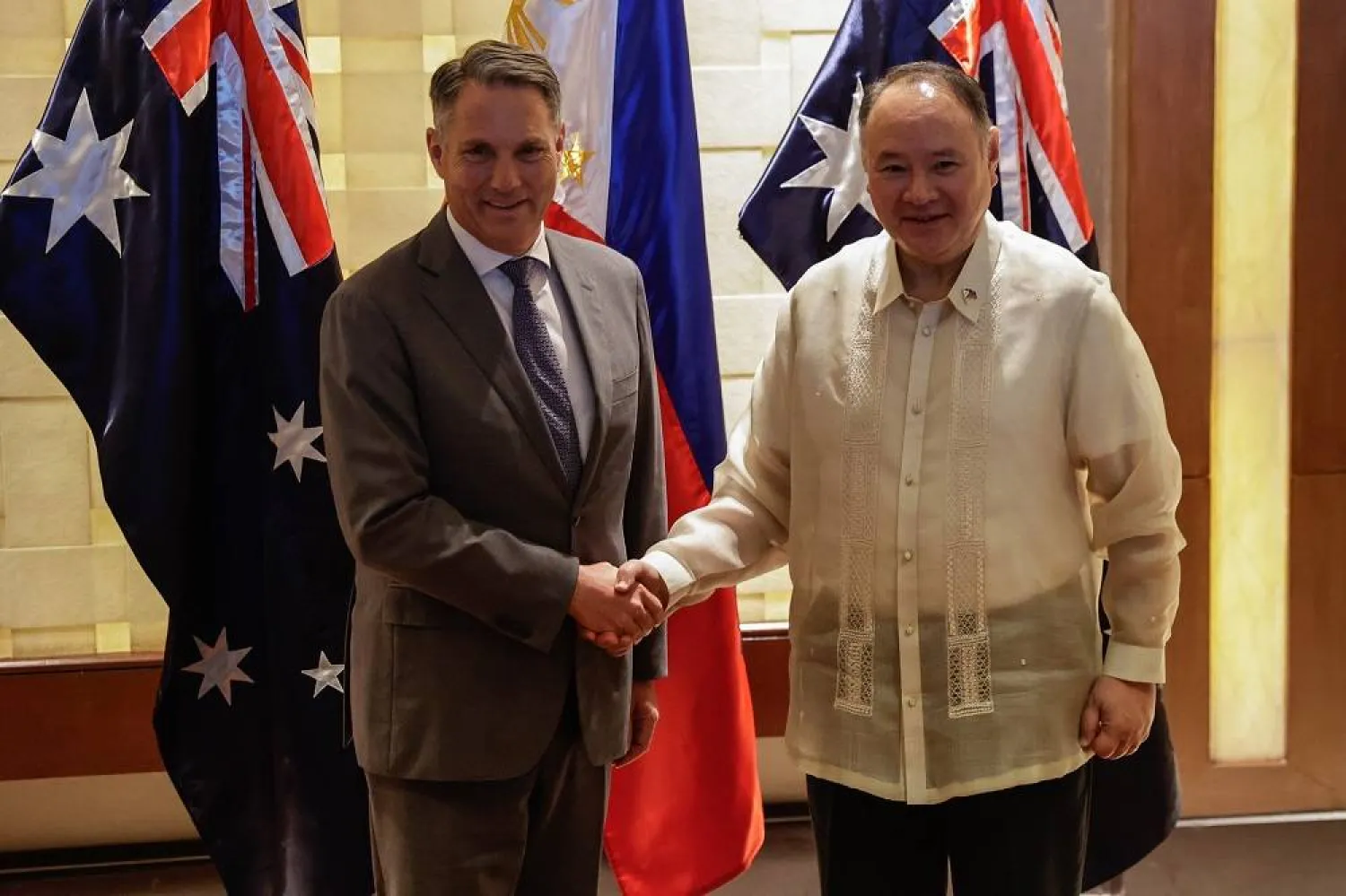
Philippines, Australia, Canada Hold Joint Sail in South China Sea 

Australian Deputy Prime Minister and Minister for Defense, Richard Marles (L), and Philippine Defense Secretary Gilberto Teodoro (R) shake hands before holding a meeting at a hotel in Makati City, Metro Manila, Philippines, 22 August 2025. (EPA)
TT

Philippines, Australia, Canada Hold Joint Sail in South China Sea 

Australian Deputy Prime Minister and Minister for Defense, Richard Marles (L), and Philippine Defense Secretary Gilberto Teodoro (R) shake hands before holding a meeting at a hotel in Makati City, Metro Manila, Philippines, 22 August 2025. (EPA)

The navies of the Philippines, Australia and Canada were conducting a joint sail in the South China Sea on Tuesday, an area of flaring tensions following a collision between two Chinese vessels last week.

The Philippine frigate BRP Jose Rizal, Australian destroyer HMAS Brisbane and Canadian frigate HMCS Ville de Quebec were participating in the operation, which a Philippine military official said was not directed at any country.

"Our activity is based on the premise that the exercise is anchored on the free and open Indo-Pacific with peace and prosperity in the region," colonel Dennis Hernandez told a media briefing, adding that the joint sail was taking place within the Philippines' exclusive economic zone.

The activity, which began on Sunday off the western province of Oriental Mindoro and will end in Palawan, is part of the ongoing military drills between the Philippines and Australia.

Called ALON, a Filipino word for "wave", the 15-day joint exercises, which began on August 15, include amphibious and land operations as well as live fire exercises designed to enhance the abilities of the two militaries to cooperate better.

This year's iteration is the largest joint activity to date, with 3,600 troops from both sides joined by a Canadian Navy contingent, as well as US Marines.

ALON started in 2023, the same year Australia and the Philippines elevated their ties to a strategic partnership in order to address the rising security challenges in the region, including in the South China Sea, where $3 trillion of annual shipborne commerce takes place.

Manila aims to increase the frequency of joint sails with foreign partners, Philippine navy spokesperson Rear Admiral Roy Vincent Trinidad told reporters, saying that such activities help deter China's aggression in the South China Sea.

Since late 2023, the Philippines has conducted "maritime cooperative activities" with allies, including joint passages with treaty ally the United States.

Early this month, the Philippines and India also sailed together for the first time in the South China Sea.


Spanish PM Under Fire as Ex-Top Aide Goes on Graft Trial

Former Spanish Minister of Transport Jose Luis Abalos leaves the Supreme Court following his appearance for alleged corruption in Madrid on October 15, 2025. (AFP)
TT

Spanish PM Under Fire as Ex-Top Aide Goes on Graft Trial

Former Spanish Minister of Transport Jose Luis Abalos leaves the Supreme Court following his appearance for alleged corruption in Madrid on October 15, 2025. (AFP)

A corruption trial of a former right-hand man to Spanish Prime Minister Pedro Sanchez begins on Tuesday, a politically explosive case that has threatened to topple the Socialist-led minority government.

Jose Luis Abalos is a disgraced ex-Socialist heavyweight, a former transport minister who helped propel Sanchez to power in 2018. The case is one of several corruption affairs rattling the fragile coalition.

Abalos and his former adviser Koldo Garcia are suspected of having pocketed kickbacks for handing out public contracts worth millions of euros for sanitary equipment during the Covid-19 pandemic.

The Supreme Court in Madrid will judge them for alleged bribery, embezzlement, influence peddling, membership of a criminal organization and misuse of confidential information. The men deny the charges.

Prosecutors want Abalos to serve 24 years in jail. They portray him as the mastermind of a scheme of illicit enrichment. They have called for a 19-year term for Garcia, who they say was a key intermediary.

They argued in court that both men had abused their government positions and contacts to favor the interests of businessman Victor de Aldama, who has already admitted his role in the vast and complex affair.

Abalos has consistently protested that the investigation has been unfair.

"I feel like I am living in a fiction," he told the conservative daily El Mundo in November, shortly before his arrest. "I cannot believe the prosecutor's office is asking for 24 years in jail for me."

Garcia also protested in comments to an investigatory committee of the Navarre regional parliament.

"I am in jail without proof that I've committed any crime," he said, speaking by video link from his place of pre-trial detention.

More than 75 witnesses and about 20 experts are to testify during the proceedings, which are due to run through April.

- Succession of scandals -

The investigation also appears to have ensnared Abalos's successor in the powerful post of Socialist organization secretary, Santos Cerdan.

Caught up in another case of suspected corruption for public works contracts, he has been forced to step down from what is a key position in the party.

The fall from grace of Abalos and Cerdan -- two of Sanchez's closest allies -- has embarrassed a leader who took power promising to clean up Spanish politics.

He took over from the main conservative Popular Party (PP) after it had been engulfed in its own graft scandal.

Separate corruption investigations into Sanchez's wife Begona Gomez and his brother David, who faces trial later this year, have piled further pressure on the government, one of few leftist administrations in Europe.

Both the PP and far-right opposition party Vox have called for Sanchez's resignation and early elections. They argue that the scandals expose systemic Socialist corruption that reaches the premier himself.

Sanchez has always denied any illegal funding of the Socialists and rebuffed calls for polls before the next scheduled general election, due in 2027.


In High-Stakes Mission, US Special Forces Rescue Airman from Iran After F-15 Crash

 A US Air Force Airman taxis an F-22 Raptor during Operation Epic Fury in the US Central Command area of responsibility, March 15, 2026. (US Air Force/Handout via Reuters)
A US Air Force Airman taxis an F-22 Raptor during Operation Epic Fury in the US Central Command area of responsibility, March 15, 2026. (US Air Force/Handout via Reuters)
TT

In High-Stakes Mission, US Special Forces Rescue Airman from Iran After F-15 Crash

 A US Air Force Airman taxis an F-22 Raptor during Operation Epic Fury in the US Central Command area of responsibility, March 15, 2026. (US Air Force/Handout via Reuters)
A US Air Force Airman taxis an F-22 Raptor during Operation Epic Fury in the US Central Command area of responsibility, March 15, 2026. (US Air Force/Handout via Reuters)

US special operations forces have staged a daring rescue of an airman caught behind enemy lines after Iran shot down his F-15 fighter jet, officials said on Sunday, resolving a major crisis for President Donald Trump as he weighs whether to escalate the five-week-old war on Iran.

"Over the past several hours, the United States Military pulled off one of the most daring Search and Rescue Operations in US History," Trump said in a statement, adding that the airman was injured, but "he will be just fine."

The airman, who Trump said held the rank of colonel, was the second of the two crew of an F-15 that Iran said on Friday had been ‌brought down by ‌its air defenses.

Reuters reported on Friday that the first crew member ‌had ⁠been retrieved, triggering a ⁠high-profile search by both Iran and the United States for the remaining airman.

Iranian officials had urged citizens to help find him, hoping to gain leverage against Washington in the war Trump and Israel launched on February 28.

Trump has threatened to escalate the conflict in the coming days with attacks on Iran's energy infrastructure.

Had Iran captured the airman, the ensuing hostage crisis could have shifted American public perception of a conflict that opinion polls show has already struggled to win popular support.

Trump gave no details of the rescue but said it ⁠was the first time in military memory that two US pilots had been ‌rescued, separately, deep in enemy territory.

US AIRCRAFT HIT

The rescue effort, ‌involving dozens of military aircraft, encountered fierce resistance from Iran.

Reuters reported on Friday that two Black Hawk helicopters involved in ‌the search were hit by Iranian fire but escaped from Iranian airspace.

In a separate incident, a ‌pilot ejected from an A-10 Warthog fighter aircraft after it was hit over Kuwait and crashed, the officials said, though the extent of crew injuries was unclear.

Still, Trump was triumphant.

"The fact that we were able to pull off both of these operations, without a SINGLE American killed, or even wounded, just proves once again, that we have ‌achieved overwhelming Air Dominance and Superiority over the Iranian skies," he said in his statement.

US air crews are trained in what to do if ⁠they go down behind enemy ⁠lines, measures known as Survival, Evasion, Resistance and Escape (SERE), but few are fluent in Persian and face a challenge in staying undetected while seeking rescue.

The conflict has killed 13 US military service members, with more than 300 wounded, the US Central Command says.

No US troops have been taken prisoner by Iran.

While Trump has repeatedly sought to portray the Iranian military as being in tatters, it is noteworthy that they have repeatedly been able to hit US aircraft, military experts say.

Reuters first reported on US intelligence showing that Iran retains large amounts of missile and drone capability. Until just over a week ago, the US could only determine with certainty that it had destroyed about one-third of Iran's missile arsenal.

The status of about another third was less clear, but bombings probably damaged, destroyed or buried those missiles in underground tunnels and bunkers, Reuters sources said.

The US and Israeli war on Iran has spread across the Middle East, killing thousands and hitting the global economy with soaring energy prices that are fueling fears of inflation.


Aid Groups Warn Iran War Is Hindering Food and Medicine from Reaching Millions

 Aid distributed by the World Food Program, the UNHCR, UNICEF and UNFPA arrives in Qlayaa, amid escalating hostilities between Israel and Hezbollah, as the US-Israel conflict with Iran continues, in southern Lebanon, March 27, 2026. (Reuters)
Aid distributed by the World Food Program, the UNHCR, UNICEF and UNFPA arrives in Qlayaa, amid escalating hostilities between Israel and Hezbollah, as the US-Israel conflict with Iran continues, in southern Lebanon, March 27, 2026. (Reuters)
TT

Aid Groups Warn Iran War Is Hindering Food and Medicine from Reaching Millions

 Aid distributed by the World Food Program, the UNHCR, UNICEF and UNFPA arrives in Qlayaa, amid escalating hostilities between Israel and Hezbollah, as the US-Israel conflict with Iran continues, in southern Lebanon, March 27, 2026. (Reuters)
Aid distributed by the World Food Program, the UNHCR, UNICEF and UNFPA arrives in Qlayaa, amid escalating hostilities between Israel and Hezbollah, as the US-Israel conflict with Iran continues, in southern Lebanon, March 27, 2026. (Reuters)

Aid groups are warning that the war in the Middle East has upended their ability to get food and medicine to millions of people around the world in need, and that the suffering will deepen if the violence continues.

Not only has the conflict cut off vital shipping routes, creating a global energy crisis, it’s also disrupting supply chains for aid groups, forcing them to use costlier, more time-consuming routes.

Key pathways such as the Strait of Hormuz have been effectively shuttered and routes from strategic hubs such as Dubai, Doha and Abu Dhabi have also been impacted. Transport costs have spiked with higher fuel and insurance rates, meaning less supplies can be delivered with the same amount of money.

The World Food Program says it has tens of thousands of metric tons of food heavily delayed in transit. The International Rescue Committee has $130,000 worth of pharmaceuticals intended for war-torn Sudan stranded in Dubai and nearly 670 boxes of therapeutic food meant for severely malnourished children in Somalia stuck in India. The UN Population Fund says it's delayed sending equipment to 16 countries.

Steep US cuts to foreign aid already had hobbled many aid groups, who say the war is exacerbating the problem.

The United Nations says this is the most significant supply chain disruption since COVID, with up to a 20% cost increase on shipments and delays as goods are rerouted. And the war is creating new emergencies, such as in Iran, and also in Lebanon where at least one million people have been displaced.

“The war on Iran and disruption to the Strait of Hormuz risk pushing humanitarian operations beyond their limits," said Madiha Raza, associate director for public affairs and communications for Africa for the International Rescue Committee.

Even when the fighting stops, the shock to global supply chains could continue to delay lifesaving aid for months, she said.

Longer and more costly routes

The war has forced organizations to find new ways to transport goods, with some bypassing the Strait of Hormuz and the Suez Canal and rerouting vessels around Africa, adding weeks to the delivery.

Others are using a hybrid of methods, including land, sea and air, increasing costs.

Jean-Cedric Meeus, chief of global transport and logistics for UNICEF, said his agency is using a mix of land and air routes to send vaccines to Nigeria and Iran in order to get them there in time for the vaccination campaigns, but the costs have soared.

Before the war, UNICEF sent vaccines to Iran by plane directly from vendors around the world. Now it’s flying the vaccines to Türkiye and driving them into Iran, which has increased costs by 20% and has added 10 days to the delivery time, he said.

Save the Children International, which would normally send supplies by ocean freight from Dubai to Port Sudan, will now have to truck the goods from Dubai through Saudi Arabia and then by barge across the Red Sea, it said. The route adds 10 days and increases costs by about 25%, at a time when over 19 million Sudanese face acute food insecurity. The delay puts more than 90 primary health care facilities across Sudan at risk of running out of essential medicines, it said.

The spike in prices also means organizations have to choose what to prioritize.

“In the end, you sacrifice either the number of children that you serve ... or you sacrifice the number of items that you can afford to buy,” said Janti Soeripto, president of Save the Children for the United States. The group said it has stockpiles in countries where it works but some of those could run out within weeks.

Rising costs are also impacting people's ability to seek help within their countries.

Doctors Without Borders said rising fuel prices across Somalia — where some 6.5 million people are experiencing acute food insecurity — have driven up transport and food costs, making it harder for people to get care. In Nigeria, the IRC says fuel prices have surged by 50% and clinics are struggling to power equipment, such as generators and mobile health teams have scaled back operations.

Hunger crisis could deepen

One of the biggest concerns is the impact the war will have on global hunger.

WFP warns that if the conflict continues through June, 45 million more people will be acutely hungry, adding to nearly 320 million people facing hunger around the world.

Some 30% of the world's fertilizer comes through the Strait of Hormuz and with planting season ahead in areas like East Africa and South Asia, small farmers in poor countries will be hard hit. Sudan imports more than half its fertilizer from the Gulf and Kenya approximately 40% from there, aid groups say.

The UN secretary-general has established a task force to facilitate fertilizer trade — modeled on the Black Sea Grain Initiative. But aid groups say that won't be enough. If there's no ceasefire, governments need to provide more funding for organizations to respond to the rising costs, they say.

Humanitarian experts say there's been a slower international response to fund aid during this war compared to previous conflicts like Ukraine, which could reflect growing pressure to invest in security over aid at a time when the world is in turmoil.

“They’re making hard choices between defense security and humanitarian aid,” said Sam Vigersky, an international affairs fellow at the Council on Foreign Relations who has written about the war’s impact on aid.

He said when the US goes to war, it normally has provisions for aid, but hasn't been “activating” those provisions. “It’s not a capacity issue, it’s a policy decision,” he said.

Tommy Pigott, principal deputy spokesperson for the US State Department, said that the US has been the “most generous country in the world" when it comes to humanitarian aid.

The department said it's releasing an additional $50 million in emergency assistance to Lebanon, including to the World Food Program and working closely with the United Nations and others to address the humanitarian needs.