

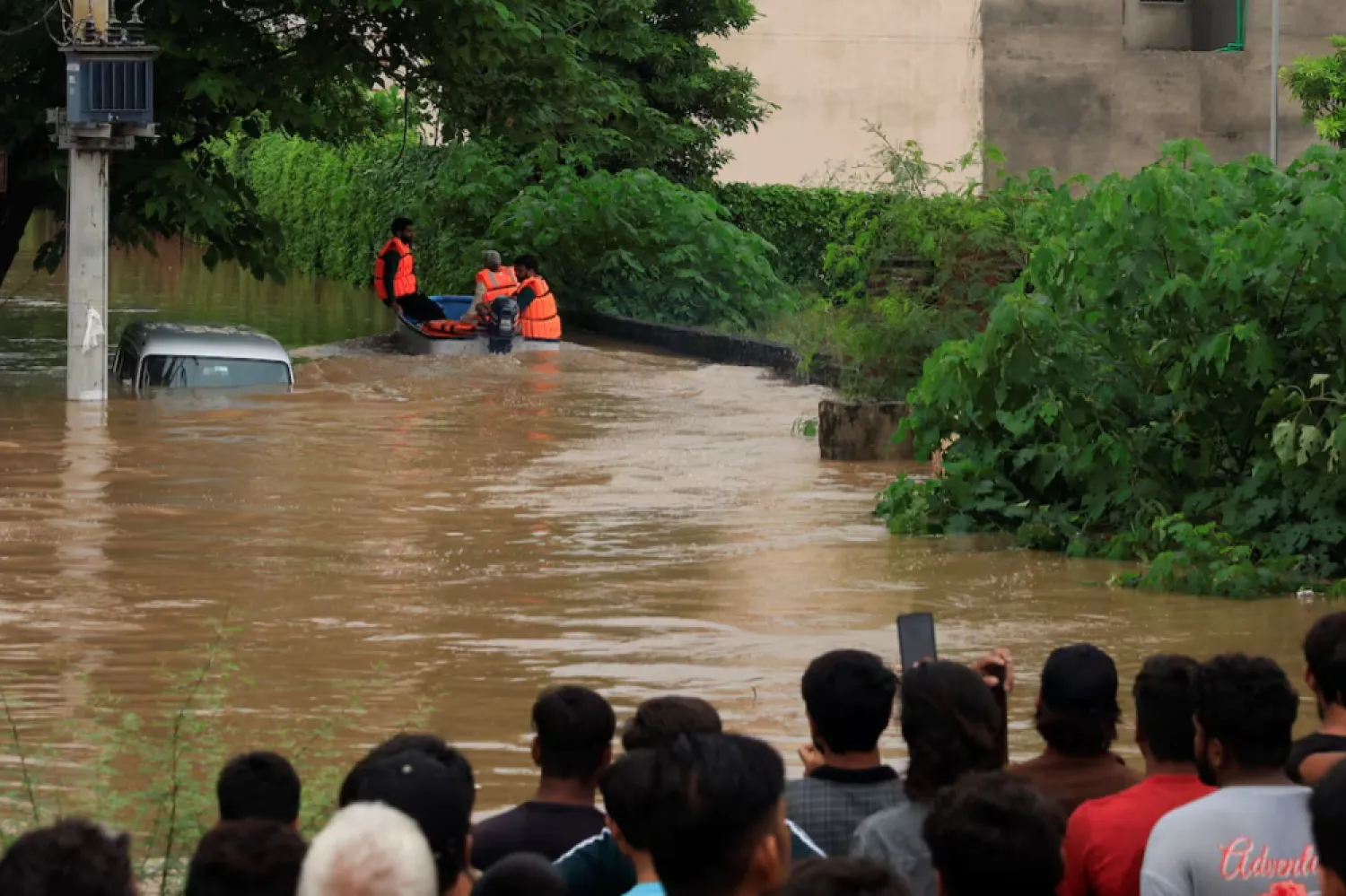

Pakistan Races to Evacuate Tens of Thousands Stranded by Floods in Punjab

Volunteers from Rescue 1122 search for residents in a flooded area, following monsoon rains and rising water levels in Sialkot, Punjab province, Pakistan, August 27, 2025. REUTERS/Akhtar Soomro/File Photo
TT

Pakistan Races to Evacuate Tens of Thousands Stranded by Floods in Punjab

Volunteers from Rescue 1122 search for residents in a flooded area, following monsoon rains and rising water levels in Sialkot, Punjab province, Pakistan, August 27, 2025. REUTERS/Akhtar Soomro/File Photo

Rescuers in Pakistan raced to evacuate tens of thousands of people stranded by floods, with many left without food or medical supplies Friday as the government struggled to provide aid and prevent Lahore and other cities from deluges. 

The floods in the eastern Punjab province began Monday when an abnormal amount of rain triggered sudden water releases from Indian dams on the Sutlej, Chenab and Ravi rivers. The rising floodwaters were the first to hit the region in four decades. 

New Delhi last week alerted Islamabad about potential cross-border flooding. Since then, nearly 300,000 people have been evacuated from flood-hit areas, said Irfan Ali Kathia, director general of the Punjab Disaster Management Authority. More than 1 million have been affected. 

Around 20 people have died in this week’s floods in Punjab, raising the nationwide death toll to 820 since flash floods in late June, Kathia said. 

Pakistan’s army chief, Field Marshal Asim Munir, visited flood-hit areas of Narowal district on Friday to review rescue and relief operations. 

Nearly 1,100 relief and medical camps are operating in the province to provide temporary shelter and treatment, with more medical camps being set up in flood-hit areas, he added. 

Floodwater inundated some villages near Lahore, raising fears in the city. 

On Friday, authorities and the military made controlled breaches in protective embankments at several points along the overflowing Chenab River to reduce pressure and protect major cities, according to the National Disaster Management Authority. It said water levels in rivers remain dangerously high and warned that further rainfall could worsen flooding. 

Authorities have struggled to respond to the floods. Many people said Friday they were still without any government help and urgently needed food and medical supplies. 

An Associated Press reporter on Thursday saw village after village underwater. Floodwaters covered fields and streets and thousands of people sat along the roadsides. Many had fled their homes in haste, carrying little or no food. 

“We are in great misery. Neither the government nor anyone else has come to inquire about us,” said Mohammad Saleem, a farmer in Narowal, sitting on a road surrounded by water with hundreds of other people. 

Rana Hanan, a lecturer at Narowal University, said more than 100 houses in his community were destroyed. “When the water came, people saved themselves on their own,” he said. 

In some areas, residents clung to rooftops awaiting rescue, while those who reached higher ground reported hunger, skin infections, and diarrhea. 

Private charity Sahara Foundation has set up a medical camp in Kartarpur village to treat those suffering from illnesses caused by a lack of clean water and food. 

Dr. Bilal Siddiq, a senior physician with Sahara Foundation, said 50 nearby villages remain submerged. “Fungal and skin infections are everywhere,” he said. “We’re also seeing rising cases of diarrhea, gastric pain, and malaria.” 

Haji Amjad, 45, showed his infected feet as he sat outside his flooded home for a fourth day. “My whole-body itches, my stomach hurts, and there’s no medicine,” he said. 

But even as water levels begin to recede in some areas, some residents say their problems are mounting. With fodder destroyed, livestock are falling sick without veterinary care. 

Nargis Bibi, 45, broke down as she described how floods had ruined her grain stores. “The floods have destroyed everything. Only our lives remain,” she said. 

Punjab Chief Minister Maryam Nawaz Sharif said in a statement Friday that damage to homes, crops, and livestock is being assessed and promised that all losses would be compensated. 

She added that her priority is saving lives and delivering aid to displaced people, and urged residents in flood-hit areas to move to safer locations. 

Reports of new possible flooding have sparked panic in Sindh where 2022 flooding killed hundreds of people, claiming a total of 1,739 lives across the country. 

In Indian-controlled Kashmir, the floods have killed nearly 100 people, according to Indian officials. 

The crisis in Pakistan’s Punjab province underscores the growing challenges of climate change, with the country ranked among the 10 most vulnerable. 


Israel Army Confirms Struck Two Nuclear Sites in Iran

Emergency responders inspect the site of a residential building damaged by a strike, amid the US-Israeli conflict with Iran, in Tehran, Iran, March 27, 2026. Majid Asgaripour/WANA (West Asia News Agency) via Reuters
TT

Israel Army Confirms Struck Two Nuclear Sites in Iran

Emergency responders inspect the site of a residential building damaged by a strike, amid the US-Israeli conflict with Iran, in Tehran, Iran, March 27, 2026. Majid Asgaripour/WANA (West Asia News Agency) via Reuters

The Israeli military confirmed it struck a heavy water reactor and a uranium processing plant in central Iran on Friday, as it targeted nuclear sites in the country.

"A short while ago, the Israeli Air Force... struck the heavy water plant in Arak, central Iran," the military said in a statement, describing the site as a "key plutonium production site for nuclear weapons".

Iranian media had earlier reported that US-Israeli strikes hit the Khondab heavy water complex, saying they caused no casualties or radiation leak from the site.

Work on the reactor on the outskirts of the village of Khondab began in the 2000s, but was halted under the terms of a now-abandoned 2015 nuclear deal struck between Iran and world powers.

The core of the reactor was removed and concrete was poured into it, rendering it inoperative.

The research reactor was officially intended to produce plutonium for medical research and the site includes a production plant for heavy water.

The Israeli military also confirmed it struck a uranium processing site in central Iran's Yazd on Friday, after the country’s atomic energy organization said US-Israeli strikes hit the facility.

"A short while ago, the Israeli Air Force... struck a uranium extraction plant located in Yazd, central Iran," the military said in a statement, describing the site as a "unique facility in Iran used for the production of raw materials required for the uranium enrichment process".

Iran's atomic energy organization said the strike on the plant "did not result in the release of any radioactive material."

Israel and the US accuse Iran of seeking to acquire nuclear weapons, while Tehran maintains that its program is for civilian purposes.

The heavy water plant in Arak was targeted by Israeli strikes during the 12-day war between Iran and Israel last June, during which the US also carried out bombings.

The International Atomic Energy Agency (IAEA) says the site was "damaged" during the attacks and "is assessed not to have been fully operational since that time."

But the agency said it has not had access to the site since May 2025.

The Middle East was plunged into war on February 28 when the US and Israel launched joint strikes on Iran, triggering retaliatory missile and drone attacks targeting Israel and several countries in the region.


US, Israel Unlikely to Achieve ‘Regime Change’ in Iran, Says Merz

 27 March 2026, Hesse, Frankfurt/Main: Germany's Chancellor Friedrich Merz speaks at the "FAZ" Congress. (dpa)
27 March 2026, Hesse, Frankfurt/Main: Germany's Chancellor Friedrich Merz speaks at the "FAZ" Congress. (dpa)
TT

US, Israel Unlikely to Achieve ‘Regime Change’ in Iran, Says Merz

 27 March 2026, Hesse, Frankfurt/Main: Germany's Chancellor Friedrich Merz speaks at the "FAZ" Congress. (dpa)
27 March 2026, Hesse, Frankfurt/Main: Germany's Chancellor Friedrich Merz speaks at the "FAZ" Congress. (dpa)

The US-Israeli war against Iran is unlikely to lead to "regime change", German Chancellor Friedrich Merz said Friday, as the month-long conflict showed no signs of abating.

"Is regime change really the goal?" he said at a forum in Frankfurt organized by the FAZ newspaper.

"If that's the goal, I don't think you'll achieve it. It's mostly gone wrong" in past conflicts, he said, pointing to the Afghanistan war.

"I have serious doubts as to whether there is a strategy and whether that strategy is being successfully implemented," he added. "In that respect, it could take even longer."

Germany has pushed back at US President Donald Trump's criticisms of NATO members for failing to join the attacks on Iran, insisting that it is not their war.

Merz however said Friday he believed that Trump had accepted this stance.

He also said Germany would be open to helping provide military protection in the Strait of Hormuz, a key route for oil and gas, which has been nearly totally blocked, in the event of a ceasefire.

"This requires an international mandate, it requires approval from the German parliament and, prior to that, a cabinet decision. And we are far from that."


More Than 300 US Troops Injured Since Start of Iran War

US Navy sailors taxi an F/A-18F Super Hornet on the flight deck aboard Nimitz-class aircraft carrier USS Abraham Lincoln in support of the Operation Epic Fury attack on Iran from an undisclosed location March 17, 2026. (US Navy/Handout via Reuters)
TT

More Than 300 US Troops Injured Since Start of Iran War

US Navy sailors taxi an F/A-18F Super Hornet on the flight deck aboard Nimitz-class aircraft carrier USS Abraham Lincoln in support of the Operation Epic Fury attack on Iran from an undisclosed location March 17, 2026. (US Navy/Handout via Reuters)

More than 300 US troops have been wounded since the start of the Iran war on February 28, US Central Command said on Friday.

"Since the start of Operation Epic Fury, approximately 303 US service members have been wounded. The vast majority of these injuries have been minor, and 273 troops have returned to duty," US Navy Captain Tim Hawkins said.

A US official who asked not to be identified told AFP that 10 troops remain seriously wounded.

A further 13 troops have been killed in the war, according to the latest figures, with seven killed in the Gulf and six in Iraq.

In a separate development Friday, Iran's military said that hotels housing US soldiers in the region would be considered targets.

"When all the Americans (forces) go into a hotel, then from our perspective that hotel becomes American," armed forces spokesman Abolfazl Shekarchi told state television on Thursday.

Iran's government has not released an updated casualty toll, but a US-based activist group said on March 23 that some 1,167 Iranian troops had been killed and 658 troops' status is unknown. AFP is not able to independently verify tolls in Iran due to reporting restrictions.

The war began on February 28 when the United States and Israel launched strikes on Iran, killing its supreme leader Ali Khamenei.

Since then, the conflict has spread across the Middle East. Iran has fired drone and missiles at Gulf states home to American military bases and other interests.

US President Donald Trump insisted on Thursday that talks to end the conflict were "ongoing" and "going very well".
