Israel is Undermining the Two-state Solution, Denmark's Foreign Minister Says

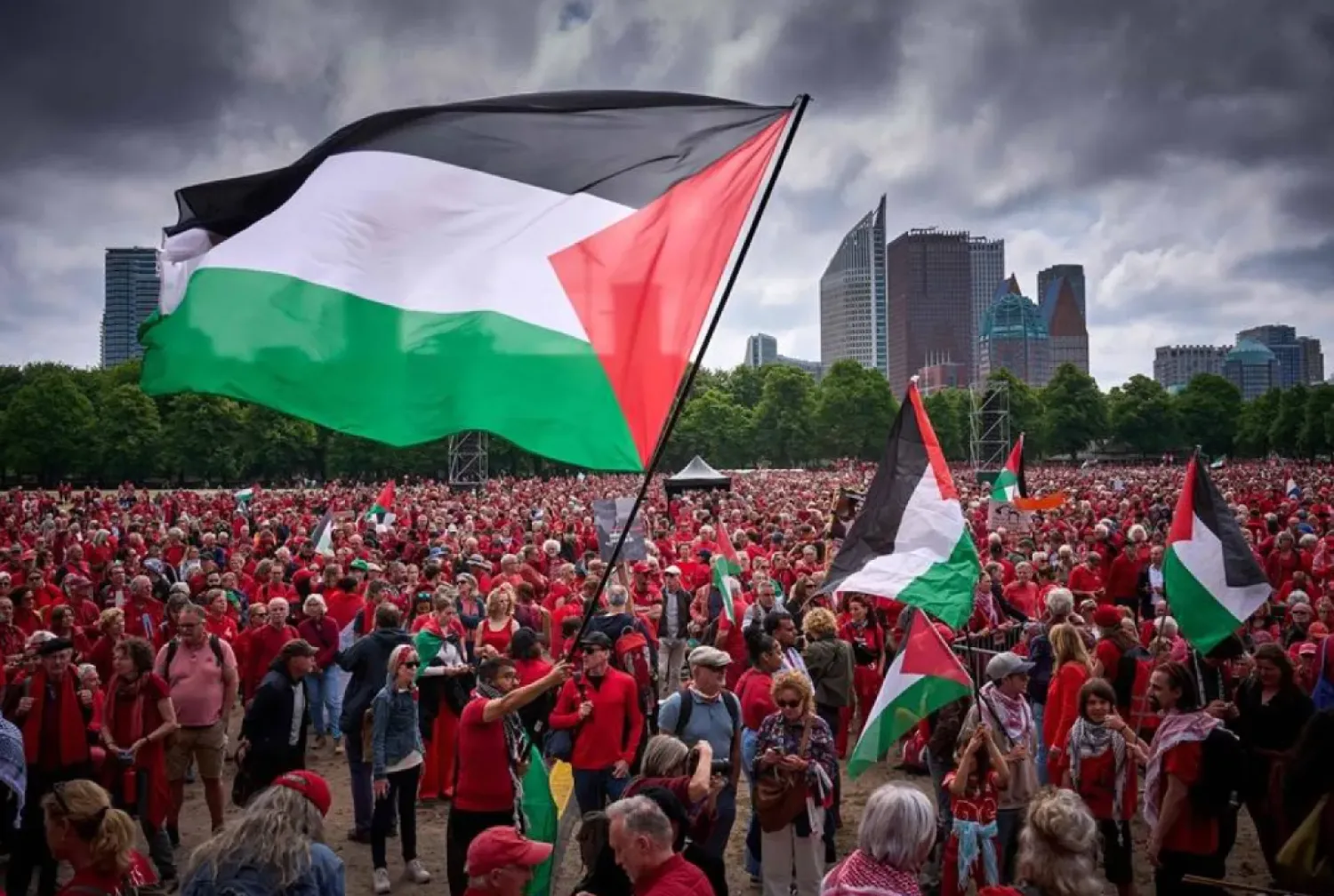
Thousands of people, some waving the Palestinian flag, gather against the Dutch government's Israel policy, as they protest on Malieveld, in The Hague on May 18, 2025. (AFP)
TT

Israel is Undermining the Two-state Solution, Denmark's Foreign Minister Says

Thousands of people, some waving the Palestinian flag, gather against the Dutch government's Israel policy, as they protest on Malieveld, in The Hague on May 18, 2025. (AFP)

Israel is undermining a two-state solution to the Middle East crisis through its actions in Gaza, Denmark's foreign minister said on Saturday, Reuters reported.

"Israel is right now undermining the two-state solution," Lars Lokke Rasmussen told reporters after a meeting of EU foreign ministers in Copenhagen.

A two-state solution would see the creation of an independent Palestinian state in the West Bank and Gaza that would co-exist alongside Israel.

Such an outcome has become increasingly unlikely amid the devastation in Gaza caused by Israel's war against the Islamist group Hamas as well as the encroachment of Israeli settlers in the West Bank.


Ukraine’s Zelenskiy Sees Window for US Mediation Until Summer 2027

 Ukraine's President Volodymyr Zelenskiy attends a press conference following a meeting of the so-called Coalition of the Willing group, amid Russia's attack on Ukraine, in Kyiv, Ukraine August 24, 2026. (Reuters)
Ukraine's President Volodymyr Zelenskiy attends a press conference following a meeting of the so-called Coalition of the Willing group, amid Russia's attack on Ukraine, in Kyiv, Ukraine August 24, 2026. (Reuters)
TT

Ukraine’s Zelenskiy Sees Window for US Mediation Until Summer 2027

 Ukraine's President Volodymyr Zelenskiy attends a press conference following a meeting of the so-called Coalition of the Willing group, amid Russia's attack on Ukraine, in Kyiv, Ukraine August 24, 2026. (Reuters)
Ukraine's President Volodymyr Zelenskiy attends a press conference following a meeting of the so-called Coalition of the Willing group, amid Russia's attack on Ukraine, in Kyiv, Ukraine August 24, 2026. (Reuters)

Ukraine sees a window of opportunity for US mediation to end Russia's war in Ukraine until the end of next summer and has drafted one page of ideas with US and European officials to be presented to Moscow, President Volodymyr Zelenskiy said.

Zelenskiy said that a ceasefire and a previously discussed US proposal for a free economic zone in Ukraine's eastern Donbas area — to be administered by a third party — were among the ideas in the ‌document.

"It contains ‌one of the ideas for a ceasefire — that ‌is ⁠the main point. The ⁠second part concerns what the Americans proposed regarding a free economic zone," Zelenskiy told reporters in a weekend briefing.

Zelenskiy said that he saw a window to end the nearly four-and-a-half years of fighting that stretched from the G20 summit in the US in December this year until the end of summer 2027, given the looming campaign for the ⁠2028 presidential election in the US.

Zelenskiy said earlier this ‌month that Ukraine had handed proposals to ‌US negotiators for a plan to end the war, without providing more detail.

US-led ‌peace talks fell apart earlier this year as Ukraine refused Russian ‌demands to cede more territory and as Washington became increasingly preoccupied with the conflict with Iran.

US negotiators Steve Witkoff and Jared Kushner were last in Moscow in January and have not yet visited Kyiv.

Zelenskiy said the third ‌element in the draft proposal was the role that the European Union and NATO would play and ⁠what "Ukraine is ⁠prepared to do to achieve this". He did not elaborate further.

"These three ideas I've mentioned are not exclusively Ukrainian ideas," Zelenskiy said, adding they were developed jointly with the Americans and the Europeans, with some stemming from previous talks US negotiators had with Ukraine and Russia.

Russia was open to listening to new proposals on how to reach a settlement on the Ukraine conflict, but they should reflect the "realities on the ground", a senior Russian diplomat said in an interview published last week.

Moscow's key objective is capturing the remainder of Donbas, where it has been making a push to advance into Ukraine's so-called fortress belt of eastern cities.


UN, Red Cross Chiefs: World Must Rein in Autonomous Weapons

FILE PHOTO: United Nations Secretary-General Antonio Guterres leaves after a press conference at a UN compound in the Nicosia airport area, Cyprus, July 29, 2026. REUTERS/Yiannis Kourtoglou/File Photo
TT

UN, Red Cross Chiefs: World Must Rein in Autonomous Weapons

FILE PHOTO: United Nations Secretary-General Antonio Guterres leaves after a press conference at a UN compound in the Nicosia airport area, Cyprus, July 29, 2026. REUTERS/Yiannis Kourtoglou/File Photo

The United Nations and Red Cross warned Tuesday the world is "dangerously close" to a future where autonomous weapons -- so-called "killer robots" -- could target humans, and issued an urgent appeal for international regulations.

The warning follows a call in 2023 from UN Secretary General Antonio Guterres and Mirjana Spoljaric, president of the International Committee of the Red Cross, for countries to establish specific bans and restrictions on the rapidly developing technology by this year.

"Today, we renew this call with even greater urgency," they said in a joint statement, adding that while their "fundamental concerns remain unchanged... the risks have intensified.”

"We are now dangerously close to crossing a moral red line: the autonomous targeting of humans by machines," they warned.

Lethal autonomous weapon systems are generally understood as weapon systems that select targets and apply force without human intervention.

There has to date been no confirmed use of fully autonomous weapons.

But with global tensions soaring and conflicts raging in the Middle East and Ukraine, where drone warfare has become a major feature of the battlefield, fears abound that it could soon happen.

There is currently no specific treaty on autonomous and artificial intelligence-enabled weapons.

"Autonomous weapon systems are not part of a distant future: a race towards greater autonomy in weapons systems is already well under way," AFP quoted Guterres and Spoljaric as saying.

"Future generations will ask whether leaders acted when there was still a chance to set limits before these weapons proliferated beyond control."

They highlighted that scientists and engineers involved in developing such systems had, in many cases, raised the alarm themselves.

"When the architects of this technology are calling for limits, states cannot afford to remain passive," they said.

Discussions have been running for a decade around a possible future treaty regulating the use of autonomous weapons.

After three years of discussions, countries are due to decide in November whether to launch full-on treaty negotiations.

The UN and Red Cross chiefs called for "political courage,” saying: "A failure to act quickly and decisively will cost lives."

The need for clearly defined rules was "urgent,” they said, insisting that "innovation must serve humanity -- not endanger it.”


Iran Vows to Retaliate After US Widens Sanctions

Drivers queue at a petrol station to refuel in Tehran, on August 25, 2026. (AFP)
TT

Iran Vows to Retaliate After US Widens Sanctions

Drivers queue at a petrol station to refuel in Tehran, on August 25, 2026. (AFP)

Iran promised to retaliate against expanded US sanctions that the Americans said would cut Iran's economic lifeline, with Tehran expressing confidence that major trading partners would resist Washington's pressure campaign.

US Treasury Secretary Scott Bessent unveiled the measures on Monday but stopped short of the most punishing sanctions, saying countries that continued trading with Iran risked being forced out of the dollar-based financial system.

Bessent declined to identify the countries that would be targeted or reveal when the penalties would take effect, saying he would instead give them time to comply with the new directive.

The Treasury Department did announce new sanctions on 60 individuals, entities and vessels, but the list did not feature any of the Chinese financial institutions suspected of facilitating Iran's oil trade.

Iran and the United States signed an interim deal in June aimed at ending the war that began with US and Israeli attacks on Iran, but the Islamabad memorandum, as it is known, quickly faltered.

Mediator Pakistan made "significant progress" in the latest talks with Tehran that focused on measures such ‌as prevention of further escalation ‌of the conflict and the reopening of the Strait of Hormuz, the Pakistani military said in ‌a statement ⁠on Tuesday.

"The Iranian president ⁠candidly shared his government's perspective and we had a very constructive exchange on the issues involved," Interior Minister Mohsin Naqvi, who accompanied army chief Asim Munir to Tehran, said on X.

The White House and the State Department did not immediately respond to requests for comment made outside business hours.

Iran has not yet commented on the latest talks with Pakistan.

Before news of the latest sanctions, Iran threatened both a possible military response and further reduction in oil exports from the Gulf in retaliation for any US economic measures.

After they were unveiled, Iranian Economy Minister Ali Madanizadeh said: "We are fully prepared for the US sanctions."

He told state television: "Naturally, the enemies intend to launch an economic terrorist attack on us, but we also have our own tools and know how to play the game. ⁠Our defense is no longer so defensive; the enemies should wait for an attack."

Neither China nor Russia ‌had "accepted" the US measures, he added, predicting that other countries would resist them.

Brigadier General Hossein Mohebbi, ‌a spokesperson for Iran's Revolutionary Guard Corps, vowed heavy blows to US vital interests and energy chokepoints if Iran's infrastructure is threatened, Press TV reported.

LITTLE SIGN ‌OF DIPLOMATIC SOLUTION

Struggling to resolve an unpopular war that has pushed up energy prices, the administration of President Donald Trump appears to be counting ‌on further economic pressure, even though Iran has spent decades under layers of US and international sanctions that have battered its economy but have not deterred its leadership.

Despite no major strikes by either side in weeks, the war shows little sign of reaching a diplomatic solution.

The United States is seeking new ways to end Iranian attacks on ships in the Gulf.

Just two commodity vessels transited the key energy chokepoint of the Strait ‌of Hormuz on Monday, for the lowest daily tally since early May, shipping data showed.

Before the conflict, the strait carried about a fifth of global flows of crude oil and liquefied natural gas.

Almost six ⁠months have passed since the US ⁠and Israel launched strikes on Iran. Thousands of people have died, most of them in Iran and Lebanon.

While the war has degraded much of Iran's conventional military capacity, inflicted economic pain and killed then-Supreme Leader Ali Khamenei, Iran has preserved enough missile and drone capability to attack Gulf neighbors and threaten oil tankers in the Strait of Hormuz.

The exact state of Iran's nuclear program, which the Americans and Israelis aim to wipe out, remains unknown.

Oil prices steadied on Tuesday, having fallen more than $2 a barrel a day earlier.

CHINESE OIL TRADE

Asked why he stopped short of imposing penalties on Iran and declined to identify targeted countries, Bessent responded: "Why would I want to blow up the global financial system?"

He said he wanted to give countries and companies time to sever ties. Bessent previously urged cooperation from China, the biggest buyer of Iranian oil for several years, although the US blockade of Iran's ports, renewed in mid-July, has already cut Iranian oil flows to China.

Experts say Washington is wary of Chinese retaliation for any sanctions on its banks ahead of expected talks next month between Trump and Chinese President Xi Jinping, with any curbs on China's exports of critical minerals especially sensitive.

Asked about Chinese banks on Monday, Bessent said: "We want to make clear here today that no one is above the reach of US sanctions."

The Chinese Foreign Ministry said sanctions and pressure tactics do not help and Beijing would do what was necessary to protect China's interests.