Pakistan’s Punjab Faces the Biggest Floods in Its History, Affecting 2 Million People

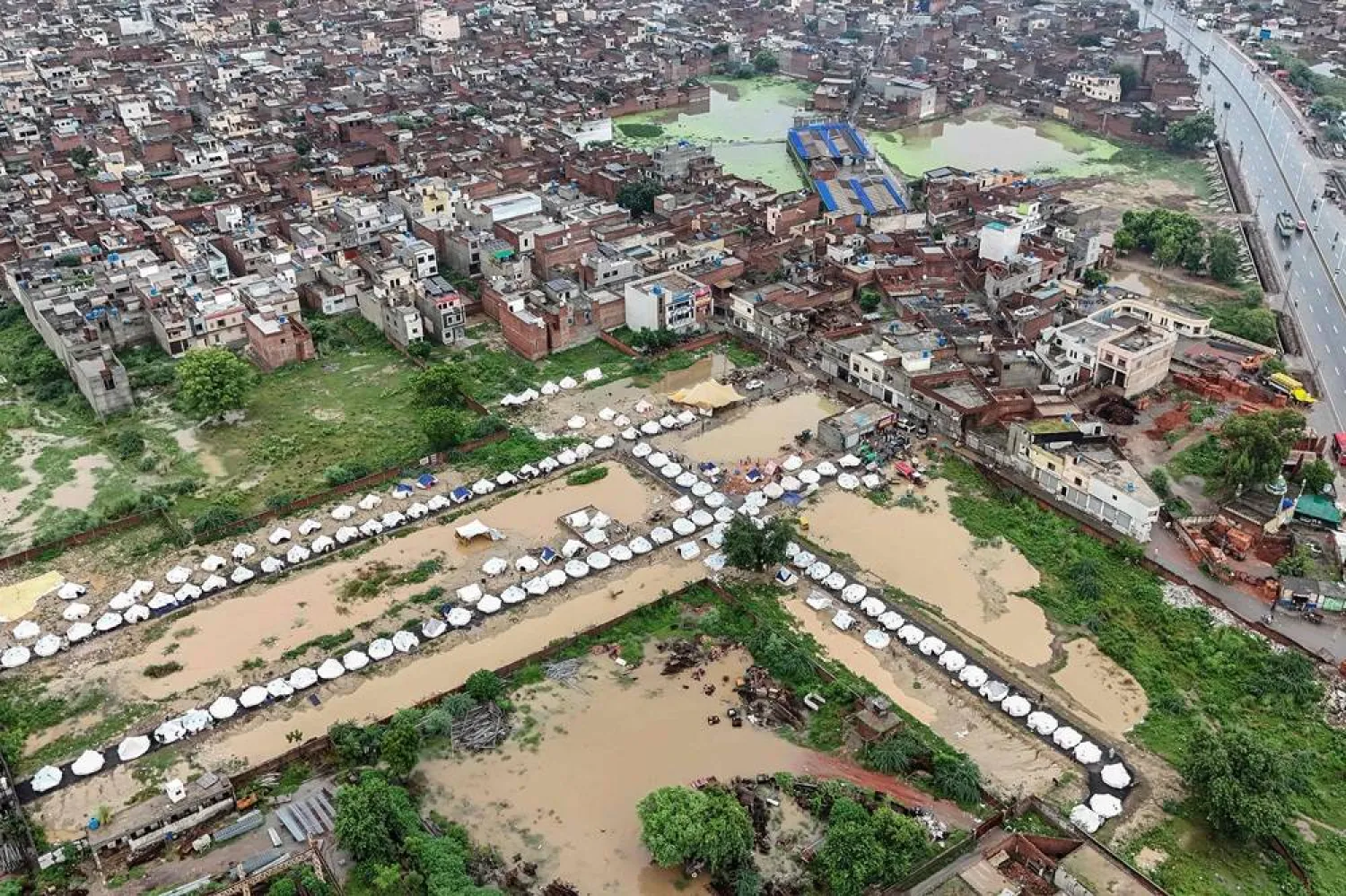
This aerial view shows makeshift shelters built for flood-affected people in Chung, in Pakistan's Punjab province, on August 31, 2025. (AFP)
TT

Pakistan’s Punjab Faces the Biggest Floods in Its History, Affecting 2 Million People

This aerial view shows makeshift shelters built for flood-affected people in Chung, in Pakistan's Punjab province, on August 31, 2025. (AFP)

Pakistan’s eastern Punjab province is dealing with the biggest flood in its history, a senior official said Sunday, as water levels of rivers rise to all-time highs.

Global warming has worsened monsoon rains this year in Pakistan, one of the countries most vulnerable to climate change. Downpours and cloudbursts have triggered flash floods and landslides across the mountainous north and northwest in recent months.

Residents in eastern Punjab have also experienced abnormal amounts of rain, as well as cross-border flooding after India released water from swollen rivers and overflowing dams into Pakistan’s low-lying regions.

The senior minister for the province, Maryam Aurangzeb, told a press conference on Sunday: “This is the biggest flood in the history of the Punjab. The flood has affected two million people. It’s the first time that the three rivers — Sutlet, Chenab, and Ravi — have carried such high levels of water.”

Local authorities are using educational institutions, police, and security facilities as rescue camps, and evacuating people, including by boat, she said.

“The Foreign Ministry is collecting data regarding India’s deliberate release of water into Pakistan,” added Aurangzeb. There was no immediate comment from India.

India alerted its neighbor to the possibility of cross-border flooding last week, the first public diplomatic contact between the two countries since a crisis brought them close to war in May.

Punjab, home to some 150 million people, is a vital part of the country’s agricultural sector and is Pakistan’s main wheat producer. Ferocious flooding in 2022 wiped out huge swaths of crops in the east and south of the country, leading Prime Minister Shehbaz Sharif to warn that his country faced food shortages.

Figures from Pakistan’s national weather center show that Punjab received 26.5% more monsoon rain between July 1 and August 27 compared to the same period last year.

The country's disaster management authority said 849 people have been killed and 1,130 injured nationwide in rain-related incidents since June 26.

Pakistan's monsoon season usually runs to the end of September.


US Attempt to Open Strait of Hormuz Tests Fragile Iran War Ceasefire

In this picture obtained from Iran's ISNA news agency and taken on May 2, 2026, the Iran-flagged container vessel Hamouna is pictured while anchored as a small motorboat passes by, in the Strait of Hormuz off Bandar Abbas in southern Iran. (ISNA/AFP)
TT

US Attempt to Open Strait of Hormuz Tests Fragile Iran War Ceasefire

In this picture obtained from Iran's ISNA news agency and taken on May 2, 2026, the Iran-flagged container vessel Hamouna is pictured while anchored as a small motorboat passes by, in the Strait of Hormuz off Bandar Abbas in southern Iran. (ISNA/AFP)

The Iran war risked reigniting after the US tried to force open the Strait of Hormuz for commercial shipping, though a ceasefire seemed to be holding Tuesday even after the United Arab Emirates said Iran fired missiles and drones at it.

It is unclear what will follow after an American attempt to end Iran’s stranglehold on the strait by creating an “enhanced security area." A prominent Iranian official accused the US of undermining regional security with the effort and warned that Iran will respond.

The US military said two American-flagged merchant ships successfully transited the strait on Monday, and that it fired on Iranian forces, sinking six small boats that were targeting vessels. It remained to be seen if any more ships would cross on Tuesday.

Ship tracking data showed a Panamanian-flagged crude oil tanker heading toward the center of the strait Tuesday morning after leaving an anchorage in the Gulf, though it was unclear if it would try to pass through. The tanker had a stated destination of Singapore, according to the MarineTraffic ship tracking site.

Iran’s effective closure of the strait, through which about a fifth of the world’s trade in oil and natural gas typically passes, along with fertilizer and other petroleum-derived products, has sent fuel prices skyrocketing, rattled the global economy, and proved a major strategic advantage in negotiations to end the war. Breaking that chokehold would ease global economic concerns and deny Tehran a major source of leverage.

But such efforts also risk reigniting the full-scale fighting that erupted when the US and Israel first attacked Iran on Feb. 28, prompting it to close the strait.

Iran accuses US of ceasefire violation

Iran has said the new US effort is a violation of the fragile ceasefire that has held for more than three weeks.

In a post on X Tuesday, Iran’s powerful parliamentary speaker and chief negotiator, Mohammad Bagher Qalibaf, accused Washington of undermining shipping security in the Strait of Hormuz.

Qalibaf warned that a “new equation” in the strait is taking shape. He signaled that Tehran has yet to fully respond to the US attempt to reopen the waterway, saying: “We know full well that the continuation of the status quo is intolerable for America; while we have not even begun yet.”

Trump vows to reopen the strait

US President Donald Trump on Sunday warned that Iranian efforts to halt passage through the strait “will, unfortunately, have to be dealt with forcefully.” He said the US effort to reopen the strait, dubbed “Project Freedom,” was intended to aid stranded seafarers on hundreds of ships stuck in the Gulf since the war began.

The US-led Joint Maritime Information Center advised ships on Monday to cross the strait in Oman’s waters, saying it had set up an “enhanced security area.”

The UAE bore the brunt of Iran’s retaliation

The United Arab Emirates' Defense Ministry said its air defenses had engaged 15 missiles and four drones fired by Iran. Authorities in the eastern emirate of Fujairah said one drone sparked a fire at a key oil facility, wounding three Indian nationals.

Indian Prime Minister Narendra Modi on Tuesday condemned the attacks, saying the targeting of civilians and infrastructure was “unacceptable.”

In a statement on X, Modi said India stands in “firm solidarity” with the UAE and stressed the need for safe and uninterrupted shipping through the Strait of Hormuz, saying it “is vital for enduring regional peace, stability and global energy security.”

Tehran did not confirm or deny the attacks but early on Tuesday, Iran’s Foreign Minister Abbas Araghchi said on X that both the US and the UAE “should be wary of being dragged back into quagmire.”

Pakistan, which has been mediating between the US and Iran, and Saudi Arabia both condemned the strikes against the UAE.

Strait of Hormuz closure has far-reaching consequences

The disruption of the waterway has squeezed countries in Europe and Asia that depend on Gulf oil and gas, raising prices far beyond the region.

The US has meanwhile enforced a naval blockade on Iranian ports since April 13, telling at least 49 commercial ships to turn back, according to Central Command. It's also warned shipping companies they could face sanctions if they pay Iran for transit of the strait.

The blockade has deprived Tehran of oil revenue it needs to shore up its ailing economy. US officials have expressed hope the blockade will force Iran to make concessions in talks on its disputed nuclear program and other longstanding issues.

Negotiations make little progress

Iran’s latest proposal for ending the war calls for the US to lift sanctions, end the blockade, withdraw forces from the region, and cease all hostilities including Israel’s operations in Lebanon, according to the semiofficial Nour News and Tasnim agencies, which have close ties to Iran’s security apparatus.

Iranian officials said they were reviewing the US response. Tehran has claimed its proposal does not include its nuclear program and enriched uranium, long a driving force in tensions with the US and Israel.

Iran wants other issues resolved within 30 days and aims to end the war rather than extend the ceasefire. Trump expressed doubt over the weekend that the proposal would lead to a deal.



IAEA Says Drone Damaged Equipment at Zaporizhzhia Nuclear Plant in Ukraine

The interior of the damaged flat in an apartment building hit by a Russian drone strike, amid Russia's attack on Ukraine, in Zaporizhzhia, Ukraine February 26, 2026. (Reuters)
TT

IAEA Says Drone Damaged Equipment at Zaporizhzhia Nuclear Plant in Ukraine

The interior of the damaged flat in an apartment building hit by a Russian drone strike, amid Russia's attack on Ukraine, in Zaporizhzhia, Ukraine February 26, 2026. (Reuters)

The International Atomic Energy Agency said on Monday meteorological monitoring equipment at the Russian-held Zaporizhzhia nuclear power plant in southeastern Ukraine had been damaged by a drone.

The Zaporizhzhia plant, Europe's largest with six reactors, was seized by Russian forces in the early weeks of Moscow's February 2022 invasion of Ukraine. Each side has since regularly accused the other of military action which could compromise safety at ‌the plant, ‌located near the war's front ‌line.

Posting ⁠on X, the ⁠IAEA said a team of its experts had visited the station's External Radiation Control Laboratory (ERCL), a day after the plant's Russian management said it had been hit by a drone.

"Team observed damage to some of the lab's meteorological monitoring equipment ⁠which is no longer operational," the ‌IAEA, the UN's nuclear ‌watchdog, said in its statement.

The statement said IAEA Director ‌General Rafael Grossi had issued a fresh appeal "for ‌maximum military restraint near all nuclear facilities to avoid safety risks".

The plant, which now produces no electricity, has been struck several times by drones since the ‌beginning of the conflict. The plant's management on Sunday said damage has been minor ⁠and that ⁠operations were otherwise unaffected.

One of the station's external power lines - required to keep nuclear fuel cool - has been down since late March and the IAEA said last week it was trying to arrange a local ceasefire to carry out repair work.

Grossi has paid several visits to the Zaporizhzhia plant since it came under Russian control and the IAEA has placed observers permanently at Zaporizhzhia and Ukraine's three other functioning nuclear stations.


China Fireworks Factory Explosion Kills Tens, Injures 61

Image from the explosion site (Chinese media)
TT

China Fireworks Factory Explosion Kills Tens, Injures 61

Image from the explosion site (Chinese media)

The death toll from a giant explosion at a fireworks factory in central China rose to 26, with 61 more injured, officials said Tuesday.

The explosion occurred at around 4:43 pm on Monday at the Liuyang Huasheng Fireworks Manufacturing and Display Company in Liuyang, Hunan province, state broadcaster CCTV reported.

Following the blast, all fireworks makers in Hunan's provincial capital Changsha, which administers Liuyang, had been ordered to stop production ahead of safety inspections, CCTV said.

Videos on social media from Monday showed continuous explosions accompanied by a vast cloud of smoke rising high into the air in a rural area surrounded by mountains, said AFP.

Drone footage from CCTV taken a day later showed a swathe of smoldering debris where buildings had stood, with rescue workers and excavators scouring the rubble.

Smoke continued to rise from some buildings left standing, many of them with their roofs blown off.

Changsha mayor Chen Bozhang told a news conference on Tuesday afternoon that another five people had died since earlier reports that 21 were killed.

"We feel deeply grieved and filled with remorse," Chen said, adding that search and rescue work was "basically complete".

The central government had sent experts to guide rescue efforts, while more than 480 rescuers had been urgently dispatched to the site, according to CCTV.

They had established a 3-kilometer (1.9-mile) control zone around the site and evacuated people nearby.

Police had apprehended the company's management while investigations into the cause of the accident continue, CCTV said.

President Xi Jinping had called for "all-out efforts" to treat the injured, search for missing persons, and for those responsible to be held accountable, state news agency Xinhua reported.

Liuyang is a major fireworks hub, producing around 60 percent of the fireworks sold in China and 70 percent of those exported.

Industrial accidents, including in the fireworks industry, are common in China due to lax safety standards.

Last year, an explosion at another fireworks factory in Hunan killed nine people, and in 2023, three people were killed after blasts struck residential buildings in the northern city of Tianjin.

In February, separate explosions at fireworks shops in Hubei and Jiangsu provinces killed 12 and eight people.