


Aid Agencies Tell Countries to Send Funds to Help Afghanistan After Earthquake

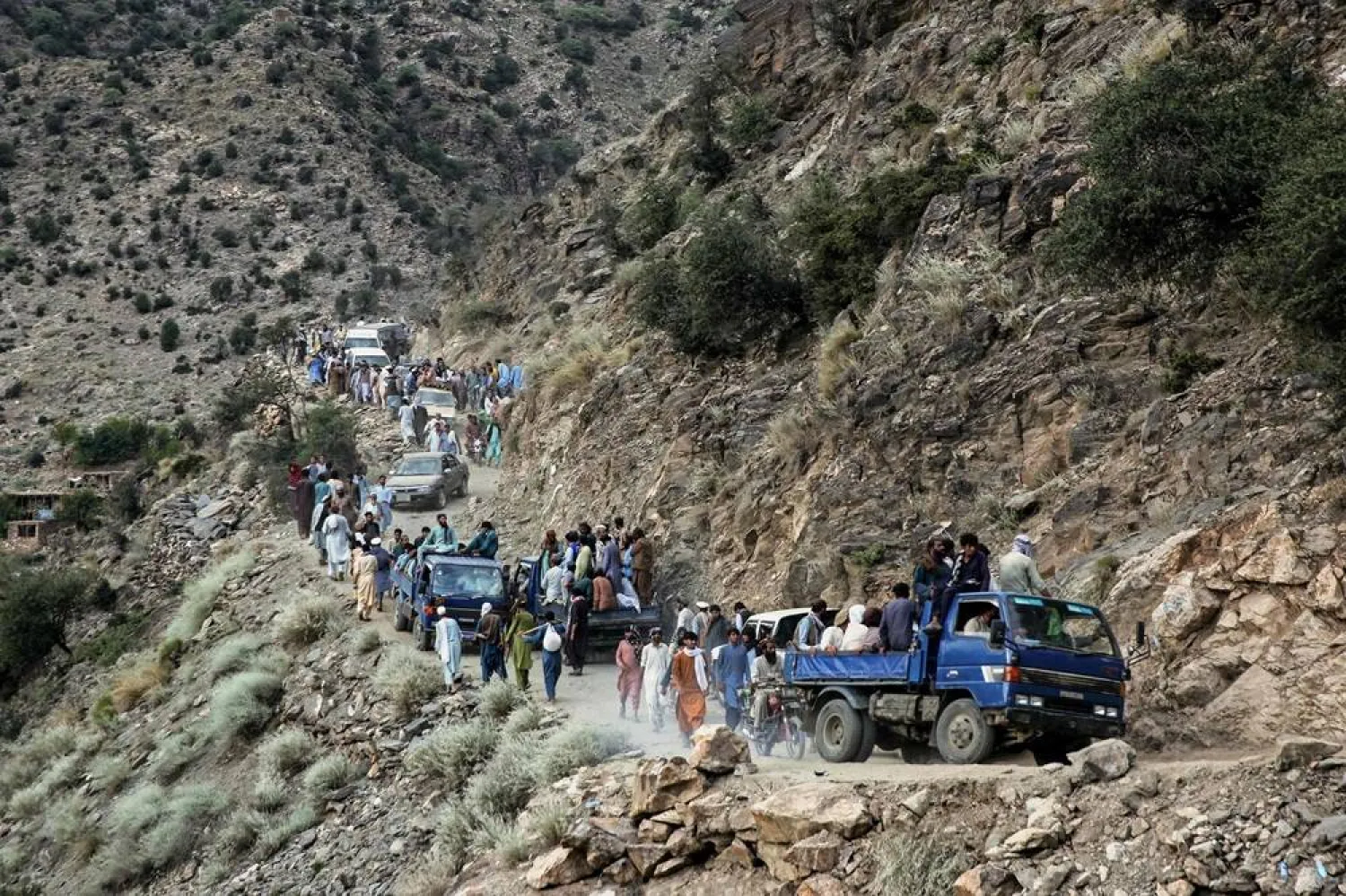
Afghans commute along a hillside, in the aftermath of an earthquake at the Nurgal district of Kunar province on September 3, 2025. (AFP)
TT

Aid Agencies Tell Countries to Send Funds to Help Afghanistan After Earthquake

Afghans commute along a hillside, in the aftermath of an earthquake at the Nurgal district of Kunar province on September 3, 2025. (AFP)

Aid agencies on Wednesday urged the international community to increase funding to Afghanistan after a major earthquake killed at least 1,400 people and injured thousands more.

Just a few countries have publicly committed money since Sunday night’s 6.0-magnitude quake struck several provinces in the mountainous and remote east, leveling villages and trapping people under rubble.

It’s the latest crisis to beset the country, and the third strong quake since the Taliban seized power in 2021.

The United Kingdom is giving 1 million pounds ($1.3 million) to help. This money will go to aid organizations and not the Taliban government, which the UK doesn't recognize. South Korea on Wednesday said that it would provide $1 million through the United Nations.

Australia on Thursday pledged $1 million and said it worked with established partners to ensure its support helped those in need and not the Taliban government.

A further $11 million is being released through funds overseen by the UN and the European Union, while development agencies are channeling money through nongovernmental organizations or charities.

But many traditional donor countries have yet to come forward with financial assistance. The US was once the largest humanitarian funder to Afghanistan until it gutted this support earlier this year.

“Afghans are weary of this never-ending crisis upon crisis, which they have to meet with dwindling external help and their own often desperate efforts,” said Thamindri De Silva, national director of World Vision Afghanistan.

“International governments are queasy about investing in the longer-term solutions that can address the drivers of crises, such as the lack of preparedness, rural health care, and fragile infrastructure that made the impacts of these earthquakes so devastating.”

World Vision has launched a private fundraising campaign, De Silva added.

Some governments and ambassadors have pledged assistance in kind to Afghanistan. India is sending tents and food. The United Arab Emirates dispatched a rescue team and essential relief supplies.

Taliban authorities have appealed for international help despite restricting and, in some cases, interfering with the work of NGOs.

International funding to Afghanistan has fallen dramatically since the Taliban takeover, and just 28% of the humanitarian funding target has been met this year.

Local resources were stretched to breaking point, and the lack of money was limiting the scale and speed of the response to the quake, said Jacopo Caridi, the country director for the Norwegian Refugee Council.

Rescue teams have struggled to reach affected communities in Kunar, the worst-affected province, hampered by rockfalls and landslides. Some are walking for hours to deliver aid and medicine, often up steep hills. People from surrounding areas have rushed in to help.

“The earthquake is not a stand-alone disaster,” Caridi said. “It hit communities that were already struggling with displacement, food insecurity, drought, and the return of hundreds of thousands of Afghan refugees from neighboring countries. Our teams in Kunar report that families are sleeping in the open, enduring repeated aftershocks.”

On Wednesday, UN spokesperson Stéphane Dujarric told reporters that more than 25 square kilometers (around 10 square miles) of land was contaminated by mines and explosive ordnance in earthquake-affected areas because of years of conflict.

He said that assessments of the quake’s impact and response efforts have been “very challenging” because of blocked roads, but the distribution of food and shelter materials and health assistance has started. The priorities are shelter, medical supplies, drinking water, food and sanitation.

“The needs remain immense, and we call on all those who are able to provide support for the earthquake response to do so,” he added.



UN Rights Council to Hold Emergency Session on Iran, Document Shows

FILE - This frame grab from footage circulating on social media shows protesters dancing and cheering around a bonfire as they take to the streets despite an intensifying crackdown as the Iranian Republic remains cut off from the rest of the world, in Tehran, Iran, Jan. 9, 2026. (UGC via AP, File)
TT

UN Rights Council to Hold Emergency Session on Iran, Document Shows

FILE - This frame grab from footage circulating on social media shows protesters dancing and cheering around a bonfire as they take to the streets despite an intensifying crackdown as the Iranian Republic remains cut off from the rest of the world, in Tehran, Iran, Jan. 9, 2026. (UGC via AP, File)

The UN Human Rights Council will hold an emergency session on Iran on Friday, with proponents aiming to discuss "alarming violence" used against protesters, a document showed on Tuesday.

An Iranian official said authorities have verified at least 5,000 deaths in the protests ‌which are ‌the biggest demonstrations since 2022, ‌prompting ⁠UN rights ‌chief Volker Turk to condemn the violence.

"A special session is needed because of the importance and urgency of the situation, in particular due to credible reports of alarming violence, crackdowns on protesters and violations of international human ⁠rights law across the country," according to a letter written ‌by Iceland's ambassador Einar ‍Gunnarsson on behalf of ‍a group of countries including Germany and ‍Britain, and seen by Reuters.

The special session will happen on Friday, the UN confirmed, adding that 21 countries so far have supported the proposal.

Human Rights Watch has denounced mass unlawful killings and is asking for an existing ⁠UN probe, set up by the council in 2022 after the last wave of protests, to investigate the deaths and be given extra financing to do so.

Iran's diplomatic mission did not immediately respond to a request for comment. Diplomats said Iran had sent to missions pages of rebuttal against allegations of a crackdown, saying the clashes followed armed ‌attacks on security forces.


Iran FM Says Davos Appearance Cancellation Based on ‘Lies’

Iranian Foreign Minister Abbas Araqchi adjusts glasses during a press conference following talks with Russian Foreign Minister Sergei Lavrov in Moscow, Russia, December 17, 2025. (Reuters)
TT

Iran FM Says Davos Appearance Cancellation Based on ‘Lies’

Iranian Foreign Minister Abbas Araqchi adjusts glasses during a press conference following talks with Russian Foreign Minister Sergei Lavrov in Moscow, Russia, December 17, 2025. (Reuters)

Iran's foreign minister hit out at the World Economic Forum in Davos for cancelling his appearance over a crackdown on recent protests, saying the decision was based on "lies and political pressure".

Protests in Iran sparked by economic strain in late December exploded into the biggest challenge to the Iranian leadership in years, with the full scale of the violent crackdown yet to emerge due to an internet blackout.

Iranian Foreign Minister Abbas Araghchi was slated to speak on Tuesday at the annual gathering of global elites in Switzerland, but was disinvited after the WEF said it would not be "right" due to the "loss of lives of civilians in Iran over the past few weeks".

Araghchi said his appearance was cancelled "on the basis of lies and political pressure from Israel and its US-based proxies and apologists", in an X post late Monday.

He called it a "blatant double standard" to disinvite him while inviting Israel after its war in Gaza, saying it "conveys moral depravity and intellectual bankruptcy".

Iranian officials have said the recent demonstrations were peaceful before descending into "riots" fueled by Iran's arch-foes the United States and Israel in an effort to destabilize the nation.

Araghchi's post on X was accompanied by a video saying the demonstrations were a "terror operation" spurred by Israel's Mossad spy agency.

Rights groups say they have verified at least several thousand protesters killed by Iranian security forces, with some estimates putting the true figure as high as 20,000 dead.

The Norway-based NGO Iran Human Rights, which has verified the deaths of at least 3,428 protesters, said on Monday that "all indications are that this massacre was planned and carried out with full coordination" by the country.


Bessent Says US-Europe Relations Have ‘Never Been Closer’ Despite Greenland Crisis

Scott Bessent, US Secretary of the Treasury, holds a speech at the USA House during the Annual Meeting of the World Economic Forum in Davos, Switzerland, Tuesday, Jan. 20, 2026. (AP)
TT

Bessent Says US-Europe Relations Have ‘Never Been Closer’ Despite Greenland Crisis

Scott Bessent, US Secretary of the Treasury, holds a speech at the USA House during the Annual Meeting of the World Economic Forum in Davos, Switzerland, Tuesday, Jan. 20, 2026. (AP)

US Treasury Secretary Scott Bessent on Tuesday said America’s relations with Europe remain strong and urged trading partners to “take a deep breath” and let tensions driven by the Trump administration's new tariff threats over Greenland “play out.”

“I think our relations have never been closer,” he said, speaking on the sidelines of the World Economic Forum annual meeting in Davos, Switzerland.

On Saturday, US President Donald Trump announced a 10% import tax starting in February on goods from eight European nations that have rallied around Denmark in the wake of his stepped up calls for the United States to take over the semi-autonomous Danish territory of Greenland.

Trump has insisted the US needs the territory for security reasons against possible threats from China and Russia.

The American leader’s threats have sparked outrage and a flurry of diplomatic activity across Europe, as leaders consider possible countermeasures, including retaliatory tariffs and the first-ever use of the European Union’s anti-coercion instrument.

The EU has three major economic tools it could use to pressure Washington: new tariffs, suspension of the US-EU trade deal, and the “trade bazooka” — the unofficial term for the bloc’s Anti-Coercion Instrument, which could sanction individuals or institutions found to be putting undue pressure on the EU.

Earlier Tuesday, Trump posted on social media that he had spoken with NATO Secretary General Mark Rutte. He said "I agreed to a meeting of the various parties in Davos, Switzerland,” which is hosting the World Economic Forum’s annual meeting this week.

France's Macron suggests G7 meeting

Trump also posted a text message from Emmanuel Macron in which the French president suggested a meeting of members of the Group of Seven industrialized democracies in Paris after the Davos gathering.

Later, however, Trump posted some provocatively doctored images. One showed him planting the US flag next to a sign reading “Greenland, US Territory, Est. 2026.” The other showed Trump in the Oval Office next to a map that showed Greenland and Canada covered with the US Stars and Stripes.

In a sign of how tensions have increased in recent days, thousands of Greenlanders marched over the weekend in protest of any effort to take over their island. Greenland Prime Minister Jens-Frederik Nielsen said in a Facebook post Monday that the tariff threats would not change their stance.

“We will not be pressured,” he wrote.

In his latest threat of tariffs, Trump indicated that the import taxes would be retaliation for last week’s deployment of symbolic numbers of troops from the European countries to Greenland — though he also suggested that he was using the tariffs as leverage to negotiate with Denmark.

Danish minister called for a stronger Europe

Denmark's minister for European affairs called Trump's tariff threats “deeply unfair." He said that Europe needs to become even stronger and more independent, while stressing there is "no interest in escalating a trade war."

"You just have to note that we are on the edge of a new world order, where having power has unfortunately become crucial, and we see a United States with an enormous condescending rhetoric towards Europe,” Marie Bjerre told Danish public broadcaster DK on Tuesday.

European markets opened sharply lower on Tuesday and US futures fell further as tensions rose over Greenland. Benchmarks in Germany, France and Britain fell about 1%. The future for the S&P 500 lost 1.5% and the Dow future was down 1.4%.

With US trading closed Monday for a holiday, financial markets had a relatively muted response to Trump’s threat to put a 10% extra tariff on exports from eight European countries that have opposed his push to exert control over Greenland. Jonas Golterman of Capital Economics described the situation as a lose-lose one for both the US and the targets of Trump’s anger. He said, “It certainly fells like the kind of situation that could get worse before it gets better.”

In another sign of tension between allies, the British government on Tuesday defended its decision to hand sovereignty of the Chagos Islands to Mauritius after Trump attacked the plan, which his administration previously supported.

Trump said that relinquishing the remote Indian Ocean archipelago, home to a strategically important American naval and bomber base, was an act of stupidity that shows why he needs to take over Greenland.

The United Kingdom signed a deal in May to give Mauritius sovereignty over the islands, though the UK will lease back the island of Diego Garcia, where the US base is located, for at least 99 years.