


Putin Urges Russia’s Aerospace Industry to Develop Rocket Engines

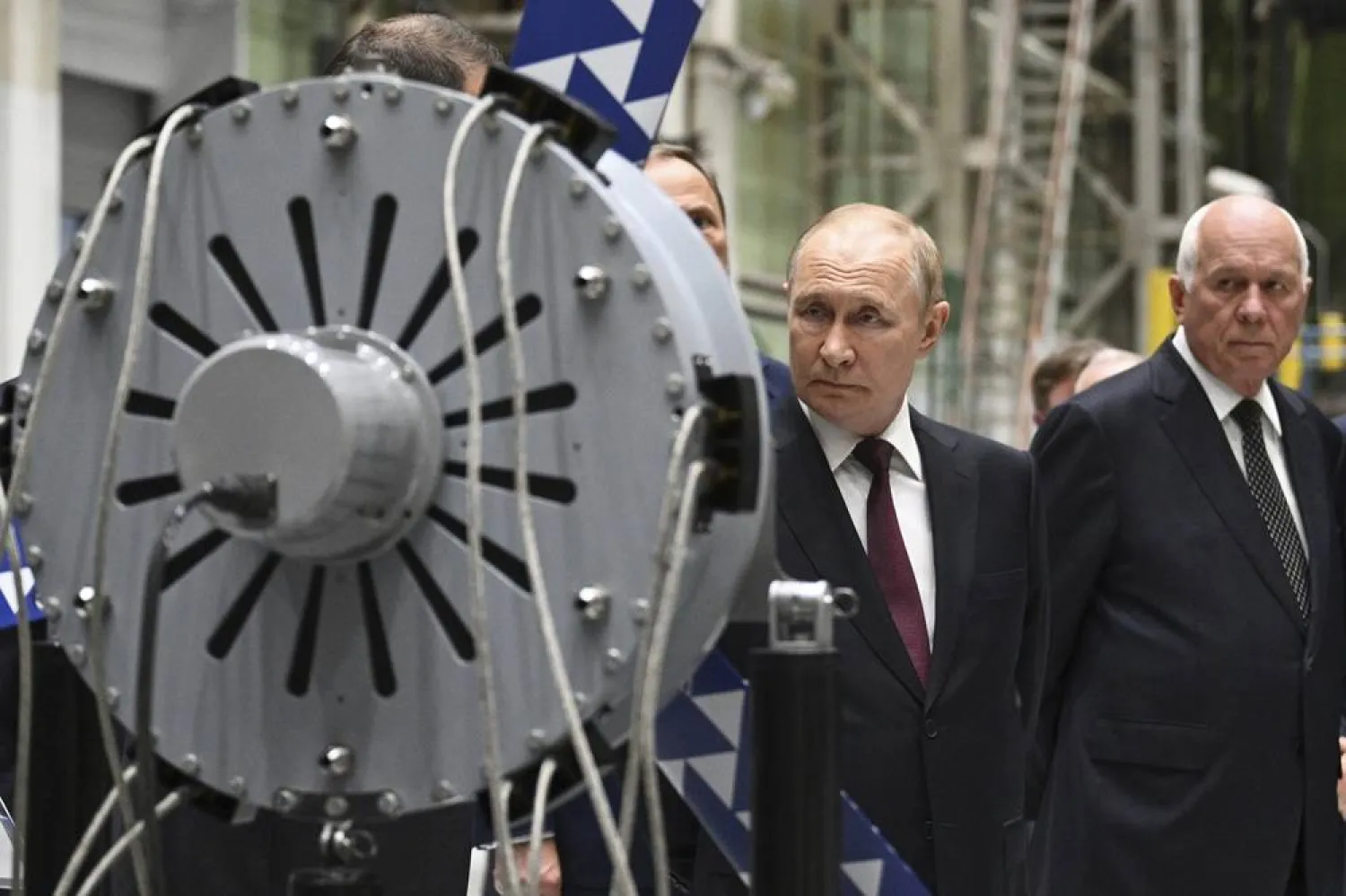
 Russian President Vladimir Putin, left, accompanied by Rostec Corporation CEO Sergei Chemezov, right, visits the Kuznetsov Design Bureau, an aircraft engines facility in Samara, Russia, Friday, Sept. 5, 2025. (Kristina Kormilitsyna, Sputnik, Kremlin Pool Photo via AP)
Russian President Vladimir Putin, left, accompanied by Rostec Corporation CEO Sergei Chemezov, right, visits the Kuznetsov Design Bureau, an aircraft engines facility in Samara, Russia, Friday, Sept. 5, 2025. (Kristina Kormilitsyna, Sputnik, Kremlin Pool Photo via AP)
TT

Putin Urges Russia’s Aerospace Industry to Develop Rocket Engines

 Russian President Vladimir Putin, left, accompanied by Rostec Corporation CEO Sergei Chemezov, right, visits the Kuznetsov Design Bureau, an aircraft engines facility in Samara, Russia, Friday, Sept. 5, 2025. (Kristina Kormilitsyna, Sputnik, Kremlin Pool Photo via AP)
Russian President Vladimir Putin, left, accompanied by Rostec Corporation CEO Sergei Chemezov, right, visits the Kuznetsov Design Bureau, an aircraft engines facility in Samara, Russia, Friday, Sept. 5, 2025. (Kristina Kormilitsyna, Sputnik, Kremlin Pool Photo via AP)

President Vladimir Putin urged aerospace industry leaders on Friday to press on with efforts to develop booster rocket engines for space launch vehicles and build on Russia's longstanding reputation as a leader in space technology.

Putin, who has spent the past week in China and the Russian far eastern port of Vladivostok, flew to the southern Russian city of Samara, where he met industry specialists and toured the Kuznetsov design bureau aircraft engine manufacturing plant.

Quoted by Russian news agencies, Putin said Russia remained a leading force in the development of the aerospace industry.

"It is important to consistently renew production capacity in terms of engines for booster rockets," the agencies quoted Putin as saying late on Friday.

"And in doing so, we must not only meet our own current and future needs but also move actively on world markets and be successful competitors."

Putin noted Russian success in developing innovations in terms of producing engines, particularly in the energy sector, despite the imposition of sanctions by Western countries linked to Moscow's 2022 invasion of Ukraine.

"In conditions of restrictions from sanctions, we succeeded in a short period of time in developing a series of innovative engines for energy," Putin was quoted as saying. "These are being actively used, including in terms of gas transport infrastructure."

Putin called it "an extremely important theme", particularly for the development of Russian gas exports, including the planned Power of Siberia 2 pipeline under discussion in China this week to bring Russian gas to China.

Putin praised the Power of Siberia 2 pipeline as beneficial to both sides. Russia proposed the route years ago, but the plan has gained urgency as it looks to Beijing as a customer to replace Europe, which is trying to reduce Russian energy supplies since the Russian invasion of its smaller neighbor.

Putin also pointed to the development of the PD-26 aircraft engine, saying it would allow for the development of military transports and wide-bodied passenger planes.

"The development of this project will allow for the modernization not only of military transport aircraft, but also opens up prospects for construction of a new generation of wide-bodied civil planes," he was quoted as saying.



Trump Says Iran’s Leaked Deal Terms Are Untrue

US President Donald Trump. (AFP file)
TT

Trump Says Iran’s Leaked Deal Terms Are Untrue

US President Donald Trump. (AFP file)

US President Donald Trump denied on Friday that the United States has made major concessions to Iran and a senior US official called an emerging pact "performance-based" with Tehran getting no frozen assets until its part of the agreement is fulfilled.

In a post on his Truth Social platform, Trump said Iran's leaked comments on a deal with the United States do not represent what has been agreed to in writing.

"What they said, including their weak and pathetic statement on having a deal, bears no relation to the truth. Very dishonorable people to deal with. ‌With them, there ‌is no such thing as dealing in good faith. ‌AMAZING!," ⁠he wrote on ⁠Truth Social.

Iran's version of the deal as outlined by the IRNA news agency said the United States will release part of Iran's frozen assets immediately after the deal is signed with the remainder freed gradually during further negotiations.

It says Iran's nuclear program remains untouched.

The senior US official, speaking on condition of anonymity, said that under the agreement Iran's nuclear material "will ⁠be destroyed and removed" and its nuclear program will ‌be dismantled.

Iran is believed to possess 900 ‌pounds (408 kg) of highly enriched uranium.

"None of their money released until they perform. Strait ‌of Hormuz will be open. No Iran funding of terrorist groups," ‌the official said.

"This is what they have agreed to. This is a performance-based deal," the official said.

Trump said on Thursday he was calling off new strikes on Iran because a deal had been reached.

Terms of the deal as described on ‌Friday by Iranian officials appear to offer Tehran much of what it has demanded so far, with Trump ⁠appearing to win ⁠little of what he has sought, beyond the reopening of the Strait of Hormuz, which Iran shut after he ordered attacks in February.

A senior Iranian source told Reuters on Friday that the draft would waive sanctions on Iran's oil, unfreeze billions of dollars of its funds, and require a cessation of hostilities on all fronts, including in Lebanon.

Nuclear issues would be set aside for later talks. Washington wants a deal to ensure that Iran never develops a nuclear weapon. Iran says it is not seeking one.

The waiving of sanctions, unfreezing of Iranian assets and halt to Israeli attacks on Lebanon are essential Iranian demands. The source made no mention of what Iran might offer in return.


UN Official to Asharq Al-Awsat: Hunger Threatening 300 Million People Around the World

Acting Executive Director of the UN World Food Program (WFP) Carl Skau. (Turky Al-Agili)
TT

UN Official to Asharq Al-Awsat: Hunger Threatening 300 Million People Around the World

Acting Executive Director of the UN World Food Program (WFP) Carl Skau. (Turky Al-Agili)

Acting Executive Director of the UN World Food Program (WFP) Carl Skau warned that severe hunger was threatening 300 million people around the world, with the figure continuing to rise.

In an interview with Asharq Al-Awsat, Skau, who is visiting Saudi Arabia, said: “The escalations and disruptions in the region have pushed up fuel costs significantly, making both our operations and the price of food globally more expensive.”

“These rising fuel costs are then reflected directly in higher food prices around the world. When the price of food goes up by 20 percent, people often eat 20 percent less. Where we work, many people are already surviving on just one meal a day to begin with, so this has an immediate and serious impact,” he explained.

“It is also becoming more expensive for us to buy and deliver food. Shipping costs have increased by around 25 percent, as we are having to use longer and more expensive routes,” he went on to say.

“These global shocks are felt the most by people already going through crises. Like Yemen, which relies heavily on imports, or Gaza, where access was already limited, infrastructure destroyed, and people are relying on what comes through the borders,” he said.

“In Sudan, this will have longer term impacts because the fertilizers they received to plant during harvest season is stuck. They will not be able to grow their own food, while we struggle to deliver aid,” he added.

“All of this is happening while we are facing a historic funding gap, which is further constraining our ability to respond. We are making impossible decisions on who to reach. We are prioritizing emergency assistance to people, but that means taking away food from the hungry to go to the starving,” Skau said.

“WFP is operating at scale across all these crises, delivering food, cash, and nutrition support to millions every month. We are keeping essential supply chains moving, supporting local food systems, and prioritizing those most at risk,” he told Asharq Al-Awsat.

“However, the reality is that without urgent funding and sustained humanitarian access, we face the very real prospect of scaling back assistance at a time when needs are at their peak.”

“That is why partnerships - particularly with countries like Saudi Arabia - are absolutely critical to ensuring we can continue to deliver and prevent a further deterioration of the situation,” he stressed.

“We are very keen on strengthening this partnership. Saudi Arabia plays a critical leadership role - not only as a major donor, but as a key partner in supporting regional stability and enabling humanitarian action where it is needed most,” he said.

Sudan, Yemen, Syria, and Palestine

Asked about the food situation in Sudan, Yemen, Syria, and Palestine, he told Asharq Al-Awsat: “These are among the most severe hunger crises in the world today.”

“Having visited Gaza, Sudan, and Lebanon this year, I have seen firsthand the rapidly deteriorating situation on the ground. This level of conflict and crisis did not exist five years ago in any of these countries,” Skau noted.

“Sudan is now the largest humanitarian emergency in the world, more than 19 million people in Sudan face acute hunger, and famine has been confirmed in parts of the country, and others at risk,” he warned.

“In both Yemen and Syria, more than half the population are unable to meet their basic food needs due to conflict, economic decline, and high prices,” he revealed.

“In Gaza, it has been seven months into the ceasefire, but families remain highly vulnerable, struggling to rebuild after two years of war. Many families are only eating once a day. Food items are not affordable. It’s a very fragile situation.”


Two Ebola-related Deaths Confirmed in Eastern Congo Displacement Camp

TOPSHOT - Volunteers of the Democratic Republic of Congo Red Cross wearing personal protective equipment carry the body of an Ebola virus disease victim from the morgue of the Rwampara health center, Ituri Province, Democratic Republic of Congo, on June 8, 2026 before loading it into a vehicle for transfer to a cemetery as part of safe and dignified burial operations aimed at preventing the spread of the virus. (Photo by Jospin Mwisha / AFP)
TT

Two Ebola-related Deaths Confirmed in Eastern Congo Displacement Camp

TOPSHOT - Volunteers of the Democratic Republic of Congo Red Cross wearing personal protective equipment carry the body of an Ebola virus disease victim from the morgue of the Rwampara health center, Ituri Province, Democratic Republic of Congo, on June 8, 2026 before loading it into a vehicle for transfer to a cemetery as part of safe and dignified burial operations aimed at preventing the spread of the virus. (Photo by Jospin Mwisha / AFP)

Two Ebola-related deaths have been confirmed in a displacement camp in eastern ‌Congo, ‌the United Nations ‌refugee ⁠agency (UNHCR) said in ⁠a report.

The two victims were internally ⁠displaced people ‌living in the ‌Kpangba camp, ‌which ‌hosts 30,000 refugees, UNHCR said in ‌the report published on Thursday, ⁠adding that ⁠the high risks of transmission required strengthened prevention and response measures, said Reuters.