


Iran’s Revolutionary Guard Recruiting Sleeper Cells in Britain

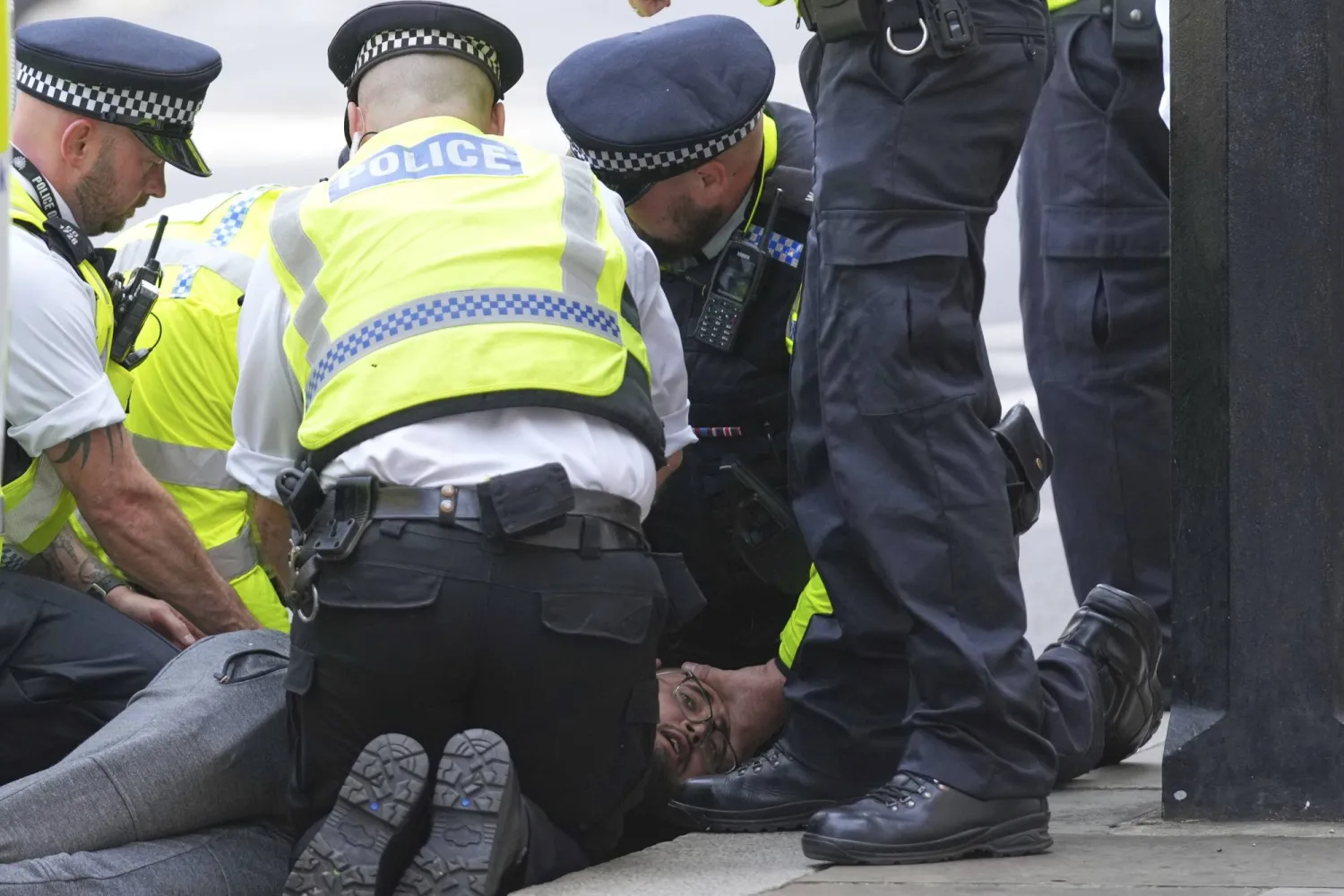
Police officers arrest a protester during a protest to support Palestine Action in London, Saturday, Sept. 6, 2025.(AP Photo/Joanna Chan)
TT

Iran’s Revolutionary Guard Recruiting Sleeper Cells in Britain

Police officers arrest a protester during a protest to support Palestine Action in London, Saturday, Sept. 6, 2025.(AP Photo/Joanna Chan)

Operatives within Iran's Revolutionary Guard (IRGC) are recruiting sleeper cells in Britain by using online grooming techniques, a report by the Daily Express said on Saturday.

“An arm of IRGC has used the internet and social media to put in place an informal but complex mosaic of sleeper cells and lone-wolf operatives across the country, ready to act at the behest of the regime,” the newspaper said.

It said men of Middle Eastern and Eastern European origin living in Britain are being recruited as would-be terrorists by the Iranian military operatives who groom them online.

Their role is chiefly to spy, intimidate and harass, but MI5 agents have uncovered at least one major bomb plot which could have been as devastating as the 7/7 London bombings.

The newspaper wrote that Britain’s security services keep a watching brief on the movements of these Iranian “sleeper cells” but they are deliberately designed to provide plausible deniability for the regime in Tehran and be near impossible to fully counter.

But in recent years the security services have foiled multiple plots to commit murder or atrocities on British soil.

Andreas Krieg, Associate Professor of Security Studies at Kings College, in London, told the newspaper that “in Britain it’s not quite sleeper cells, it’s more the co-ordination of useful idiots... a lot of people who like the regime in Iran and want to do their dirty work for them.”

“Iran’s strategy generally is a network strategy, a mosaic. The most powerful weapon Iran has is not ballistic missiles but this network, not just in Britain but across the world. The biggest threat from Iran is not a nuclear missile, it is on Britain’s streets,” he added.

Krieg said: “IRGC is heavily invested in this, it’s part of Iran’s irregular warfare. This way they might not be able to win the war but they will never lose it either.”

He noted that “these people are directly or indirectly connected to the IRGC or the Ministry of Intelligence. There is no direct link to the regime of course, they are not usually sent as agents, they could be Romanian nationals or Afghans... but they are all likely to be with a grudge against the West, America and Israel.”

Director General of MI5 Ken McCallum confirmed that since 2022, MI5 along with police, had responded to 20 Iran-backed plots presenting potentially lethal threats to British citizens and UK residents.

A spokesman for Britain’s Counter Terrorism Police said: “At a time when we are witnessing sabotage attacks directed by Russia and espionage operations by China, Iran continues to source violence in the UK and Europe.

“We are alive to the persistent and enduring threat posed to the UK by the state of Iran,” he added.




Nepal Flood Reconstruction Bill to be $4.78 Bn

A man carrying his belongings walks past a damaged house in the aftermath of flash floods at Trishuli in Nepal's Nuwakot district on September 11, 2026. (Photo by Prakash MATHEMA / AFP)
TT

Nepal Flood Reconstruction Bill to be $4.78 Bn

A man carrying his belongings walks past a damaged house in the aftermath of flash floods at Trishuli in Nepal's Nuwakot district on September 11, 2026. (Photo by Prakash MATHEMA / AFP)

The reconstruction bill after deadly floods sparked by a glacial mountain collapse that hit Nepal last month would amount to $4.78 billion, the foreign ministry said on Friday.

"The total estimated requirement for reconstruction is approximately $4.78 billion," foreign ministry spokesman Lok Bahadur Chhetri told reporters.

Nepali rescuers clung to hopes of finding survivors trapped in hydropower tunnels on Wednesday.

The August 26 tsunami-like surge of water, mud and debris, which began on the China-Nepal border, has killed more than 1,410 people and left 5,651 missing.

"The rescue and search work in the tunnels at Trishuli 3A, 3B and Chilime hydropower projects is ongoing," Nepal Army spokesman Raja Ram Basnet told AFP.

In Nepal, 1,367 bodies have been recovered and 5,132 people are missing, its disaster authority said on Wednesday.

In China, 43 people are dead and 519 are missing, according to state media.

Hundreds of foreigners are among the missing, as well as hundreds of hydropower workers.


China, Iran Among Countries That Have Used AI to Aid Spying, Anthropic Says

The Anthropic logo in this illustration taken June 5, 2026. (Reuters)
TT

China, Iran Among Countries That Have Used AI to Aid Spying, Anthropic Says

The Anthropic logo in this illustration taken June 5, 2026. (Reuters)

Anthropic said Thursday it shut down multiple cases of state-sponsored surveillance operations that used its artificial intelligence (AI) models, and warned that governments and state-aligned actors are increasingly using AI to spy on ethnic minorities and dissidents.

The incidents were found and disrupted between January and July, and they originated in China, Iran and west Africa, Anthropic said in a report about misuse of its models.

These surveillance campaigns "targeted the same diaspora and dissident communities these regimes have historically targeted. These include pro-democracy figures in Hong Kong, Tibetan and Falun Gong communities across Asia, and Iranian minority communities and opponents of the Iranian regime abroad," the report said.

In one case, Iranian actors developed a way to identify people through their social media accounts; in another, a contractor working for Malian national security authorities used Claude "to design the underlying software that enabled the intelligence gathering."

"AI is now being used in place of an engineering workforce," the report said.

Anthropic also disrupted efforts by users to design weapons, conduct questionable biological research, and create dating scams.

The San Francisco-based AI lab also accused Chinese developers of deceptively using Claude to produce responses to user queries while simultaneously "distilling" that data to improve their own models.

Distilling is an industry term that refers to a process where one AI model is used to train another one.

Chinese developers have previously been accused of using that technique without permission, essentially stealing resources from American labs such as Anthropic and OpenAI.

Now Anthropic alleges that China's Moonshot and DeepSeek have also secretly used Claude to generate answers given to its users.

"In one instance, over a ten-day period, Moonshot relayed almost 300,000 customer requests to Anthropic" through a "network of 5,380 fraudulent accounts, most of which appeared to be located in Singapore and Japan," the report said.

Some of that data contained sensitive user information, potentially in violation of privacy agreements.

"We do not know if Moonshot notified their customers that their requests were being rerouted to Anthropic and exposed to a third party," the report said.

DeepSeek used similar techniques.

When it comes to the research Anthropic detected and blocked that was related to biological weapons, the intent of the actors was less clear-cut and the AI lab did not identify them.

"The individuals implicated in these case studies are working scientists. We do not assert that they intended harm, and identifying them or their labs could expose them to harm," the report said.

The scientific research in those cases involved work around the mosquito-born chikungunya virus, a "highly-pathogenic" strain of the bird flu, a family of viruses that include smallpox and mpox, venoms and other toxins.


Iran is Reportedly Producing Ballistic Missiles Again in Underground Facilities

FILE PHOTO: A man walks next to a symbolic mockup of an Iranian missile and an Iranian flag at Imam Hussein Square in Tehran, Iran, July 12, 2026. Majid Asgaripour/WANA (West Asia News Agency) via REUTERS
TT

Iran is Reportedly Producing Ballistic Missiles Again in Underground Facilities

FILE PHOTO: A man walks next to a symbolic mockup of an Iranian missile and an Iranian flag at Imam Hussein Square in Tehran, Iran, July 12, 2026. Majid Asgaripour/WANA (West Asia News Agency) via REUTERS

Iran has resumed its production of ballistic missiles using stockpiled components and working in underground facilities, officials from the US and Middle East familiar with the matter said.

Despite heavy attacks on its missile sites and industrial facilities during the initial phase of the war, Iran has been busy assembling liquid-propellant missiles, which have to be fueled just before launch, as well as solid-propellant missiles, which can be stored ready to fire, some of the officials told The Wall Street Journal.

Intelligence points to activity at several underground sites, including the Khojir missile facility in southeastern Iran, those officials said. Iran is also attempting to build new underground assembly points to avoid getting struck again, the daily quoted them as saying.


A banner with a picture of US President Donald Trump next to an Iranian missile system at Azadi Square in Tehran, Iran, July 30, 2026. Majid Asgaripour/WANA (West Asia News Agency) via REUTERS

So far, Iran is mainly assembling the new missiles from existing components in more limited quantities than before the war, the US and regional officials said. The US and Israel damaged a number of industrial facilities needed to produce missile components and missiles themselves, and the naval blockade has complicated imports of parts and ingredients for solid fuel.

The renewed production underscores the difficulty of fully dismantling Tehran’s missile program, a goal of the war the US and Israel launched on Feb. 28.

“When there are no bombings of the facilities, you can replace damaged infrastructure, and you can buy new components from other countries and store them in the facilities,” said Tal Inbar, a senior analyst at the US-based Missile Defense Advocacy Alliance. “You have to be extremely naive to think that Iran is not rebuilding its missile-production capabilities.”

A White House official didn’t directly address the question of whether Tehran had resumed production of ballistic missiles but said that Iran’s nuclear facilities had been obliterated and its military forces severely degraded. “Iran is weaker now than ever before, and President Trump will never allow Iran to have a nuclear weapon,” the official said.

Sean Parnell, the Pentagon’s chief spokesman, said the US had “destroyed up to 90% of Iran’s drone, ballistic missile, and naval industrial base” and “significantly degraded” Iran’s ability to launch missiles and drones.