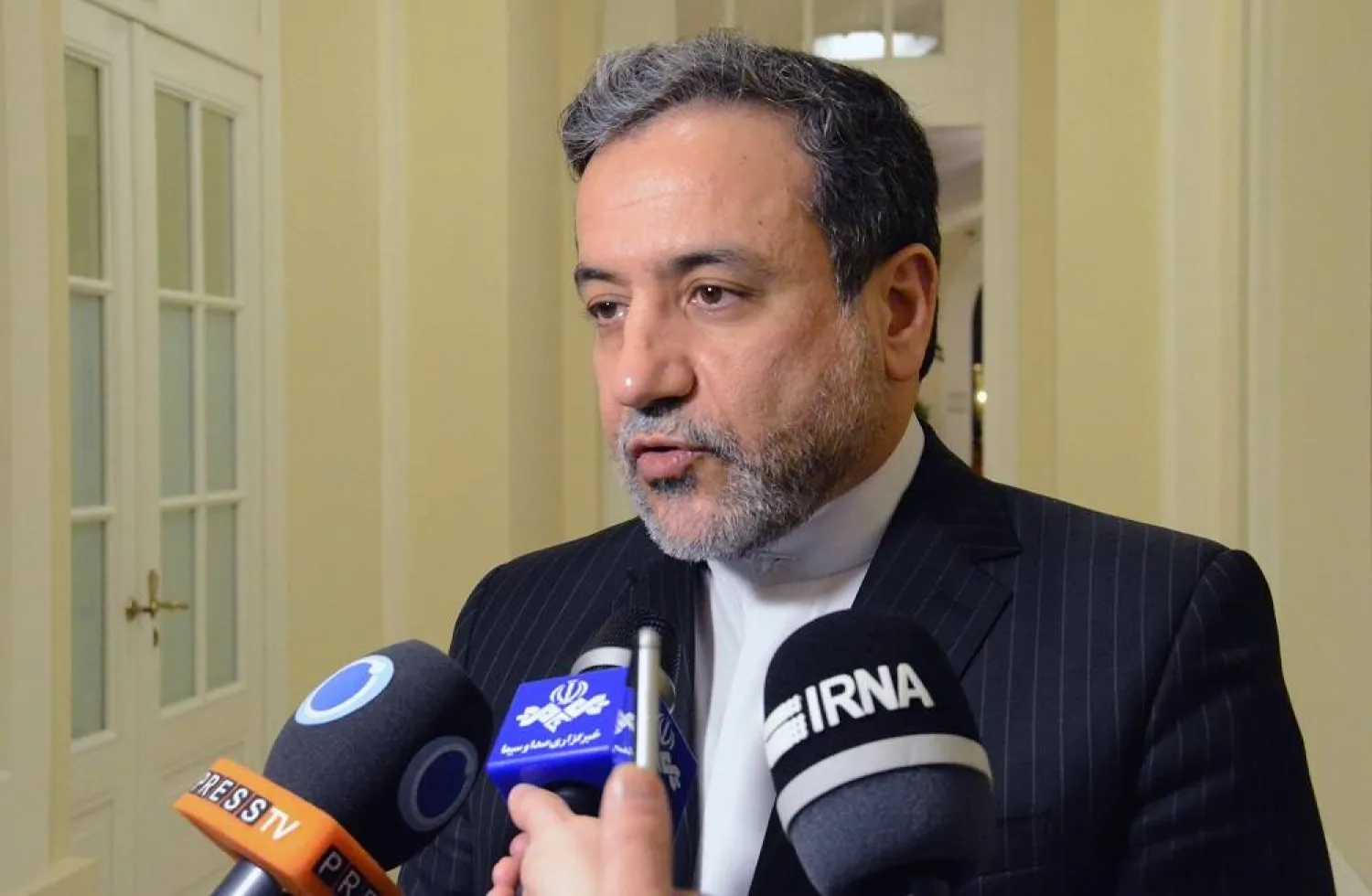
Iran's Foreign Minister to Meet IAEA Chief in Egypt 

16 March 2018, Austria, Vienna: Abbas Araghchi, then Deputy Foreign Minister of Iran, gives an interview in Vienna. (dpa)
TT

Iran's Foreign Minister to Meet IAEA Chief in Egypt 

16 March 2018, Austria, Vienna: Abbas Araghchi, then Deputy Foreign Minister of Iran, gives an interview in Vienna. (dpa)

Iranian Foreign Minister Abbas Araghchi will meet with UN nuclear watchdog chief Rafael Grossi in Egypt, Tehran's state media reported late Monday.

"During a trip to Cairo, a meeting will be held with the director general of the International Atomic Energy Agency to conclude negotiations on a new protocol for interaction between Iran and the Agency," the official IRNA news agency said, quoting the foreign ministry spokesman without specifying the date of the meeting.

Egyptian Foreign Minister Badr Abdelatty held telephone talks on Monday with each of Araghchi and Grossi at the directives of President Abdel Fattah al-Sisi with the aim to back de-escalation efforts in the region, said a foreign ministry statement.

They also aim to pave the way for the resumption of negotiations between the IAEA and Iran over the latter’s nuclear program.

Egypt is keen on achieving rapprochement between Iran and the United States, Britain, France and Germany over the nuclear program to avert escalation and support regional security and stability.

On August 28 Britain, France and Germany launched a 30-day process to reimpose UN sanctions, accusing Tehran of failing to abide by a 2015 deal with world powers that aimed to prevent it from developing a nuclear weapon.

Time is running out in talks between the IAEA and Iran on how to fully resume inspections in the country, Grossi said on Monday, adding that he hoped the discussions would conclude within days.

The IAEA has not had access to Iran's key nuclear facilities since the United States and Israel bombed them in June.


US and Iran End 21-hour Ceasefire Talks Without Agreement

Vice President JD Vance (R) speaks during a news conference after meeting with representatives from Pakistan and Iran, as US President Donald Trump's son-in-law Jared Kushner (L) and US Special Envoy to the Middle East Steve Witkoff (C) watch, in Islamabad on April 12, 2026. (Photo by Jacquelyn MARTIN / POOL / AFP)
TT

US and Iran End 21-hour Ceasefire Talks Without Agreement

Vice President JD Vance (R) speaks during a news conference after meeting with representatives from Pakistan and Iran, as US President Donald Trump's son-in-law Jared Kushner (L) and US Special Envoy to the Middle East Steve Witkoff (C) watch, in Islamabad on April 12, 2026. (Photo by Jacquelyn MARTIN / POOL / AFP)

The United States and Iran ended a historic round of face-to-face talks early Sunday without reaching an agreement and the fate of the fragile, two-week ceasefire still unclear.

Vice President JD Vance, who led the US delegation during the 21 hours of talks in Pakistan's capital Islamabad, said negotiations finished without a deal after the Iranians refused to accept American terms to refrain from developing a nuclear weapon.

Pakistani Foreign Minister Ishaq Dar called on Iran and the US to keep their commitment to maintain the ceasefire.

“It is imperative that the parties continue to uphold their commitment to ceasefire,” Dar said.

Pakistan will continue to play a mediating role and try to facilitate dialogue between Iran and the US in coming days, Dar said.

The discussions began Saturday, a few days after a fragile ceasefire was announced as the war that has killed thousands of people and shaken global markets entered its seventh week.

Vance said he remained in constant communication with US President Donald Trump and others in the administration during the negotiations.

“But the simple fact is that we need to see an affirmative commitment that they will not seek a nuclear weapon, and they will not seek the tools that would enable them to quickly achieve a nuclear weapon,” Vance told reporters. “That is the core goal of the president of the United States. And that’s what we’ve tried to achieve through these negotiations.”

The vice president said he spoke with Trump “a half dozen times, a dozen times, over the past 21 hours” and also spoke with Secretary of State Marco Rubio, Treasury Secretary Scott Bessent and Adm. Brad Cooper, head of the United States Central Command.

“We were constantly in communication with the team because we were negotiating in good faith,” Vance said, speaking at a podium in front of a pair of American flags with special envoys Steve Witkoff and Jared Kushner to his side. “And we leave here, and we leave here with a very simple proposal, a method of understanding that is our final and best offer. We’ll see if the Iranians accept it.”


US Warships Transit Strait of Hormuz in Mine Clearance Op

A boat is off the coast of Musandam governorate, overlooking the strait of Hormuz, in Musandam governance, in Oman, April 8, 2026. (Reuters)
TT

US Warships Transit Strait of Hormuz in Mine Clearance Op

A boat is off the coast of Musandam governorate, overlooking the strait of Hormuz, in Musandam governance, in Oman, April 8, 2026. (Reuters)

Two US Navy warships have transited the Strait of Hormuz at the start of an operation to clear the strategic waterway of mines laid by Iran, US Central Command said Saturday.

The announcement -- which marks the first such transit since the US-Israeli war with Iran began -- came shortly after President Donald Trump said Washington had started "clearing out" the strait, through which a fifth of the world's crude oil passes.

"Today, we began the process of establishing a new passage and we will share this safe pathway with the maritime industry soon to encourage the free flow of commerce," said CENTCOM commander Admiral Brad Cooper.

The USS Frank E. Peterson and the USS Michael Murphy are the guided-missile destroyers involved in the operation, but CENTCOM said that "additional US forces including underwater drones" could join the effort in coming days.

Earlier, US media outlet Axios reported that the operation was not coordinated with authorities in Tehran.

"We're now starting the process of clearing out the Strait of Hormuz," Trump said on his Truth Social platform, calling it "a favor" to countries such as China, Japan and France that "don't have the Courage or Will to do this work themselves."

He insisted that Iran is "LOSING BIG!" in the conflict, while acknowledging that Iranian mines in the strategic strait still pose a threat.

"The only thing they have going is the threat that a ship may 'bunk' into one of their sea mines," Trump wrote.

The key shipping lane off the coast of Iran has been virtually blocked by Tehran since the United States and Israel started bombing Iran on February 28, though reopening the strait was ostensibly a condition of the shaky ceasefire put in place earlier this week.

Senior Iranian and American officials held face-to-face negotiations in Pakistan on Saturday in a bid to bring an end to a conflict that has plunged the Middle East into violence and sent shockwaves through the world economy.

In an earlier post, Trump said that empty tankers were headed to the United States from around the world to purchase oil, without providing details.


In Fiery Speech, Pope Leo Says ‘Enough to War!’

 Pope Leo XIV presides over a Prayer Vigil and Rosary for Peace, in Saint Peter's Basilica at the Vatican, April 11, 2026. (Reuters)
Pope Leo XIV presides over a Prayer Vigil and Rosary for Peace, in Saint Peter's Basilica at the Vatican, April 11, 2026. (Reuters)
TT

In Fiery Speech, Pope Leo Says ‘Enough to War!’

 Pope Leo XIV presides over a Prayer Vigil and Rosary for Peace, in Saint Peter's Basilica at the Vatican, April 11, 2026. (Reuters)
Pope Leo XIV presides over a Prayer Vigil and Rosary for Peace, in Saint Peter's Basilica at the Vatican, April 11, 2026. (Reuters)

Pope Leo lashed out against warmongers on Saturday while calling on billions of people around the globe to embrace peace and "believe once again in love, moderation and good politics".

In one of his most passionate entreaties yet to end the raging conflict in the Middle East, the American pope said faith was needed "in order to face this dramatic hour in history together".

"Enough of the idolatry of self and money! Enough of the display of power! Enough of war! True strength is shown in serving life," Pope Leo implored in an address during a prayer vigil for peace at St Peter's Basilica.

Uttered in measured tones, as is customary for the soft-spoken head of the world's 1.4 billion Catholics, the comments by the 70-year-old Leo nevertheless marked some of the most pointed criticism yet of the wave of conflicts inflaming the globe.

"Dear brothers and sisters, there are certainly binding responsibilities that fall to the leaders of nations. To them we cry out: Stop! It is time for peace! Sit at the table of dialogue and mediation, not at the table where rearmament is planned and deadly actions are decided!"

As he has done in the past, the Chicago native did not cite politicians by name, and did not call out specific countries.