

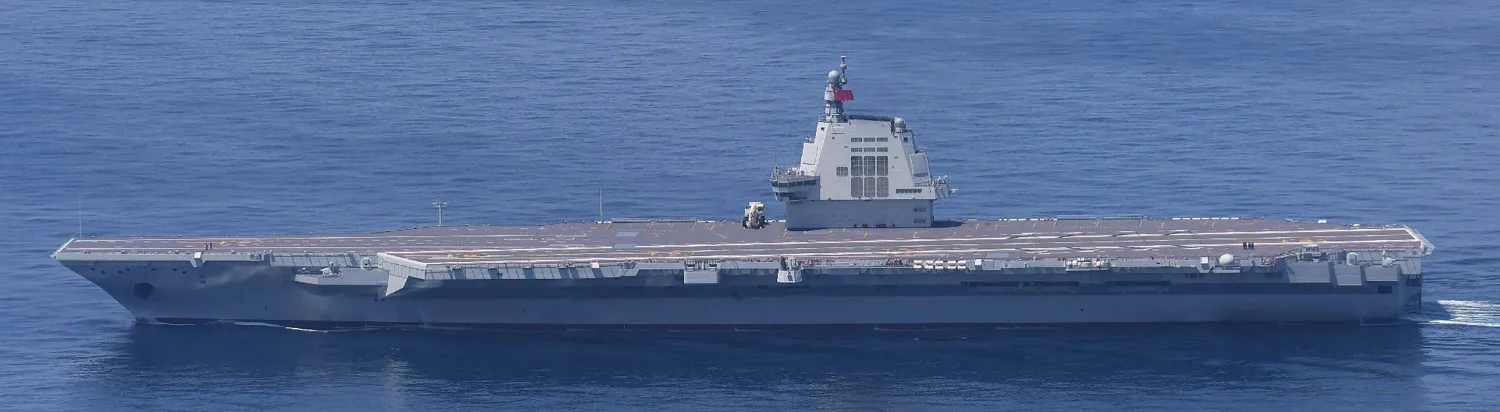

China’s Newest Aircraft Carrier Sails Through Taiwan Strait into South China Sea 

This handout photo taken by Japan's Ministry of Defense on September 11, 2025 and received via Jiji Press on September 12, 2025 shows China's third and newest aircraft carrier, the Fujian, sailing in the East China Sea. (AFP / Japan's Ministry of Defense via Jiji Press) 
TT

China’s Newest Aircraft Carrier Sails Through Taiwan Strait into South China Sea 

This handout photo taken by Japan's Ministry of Defense on September 11, 2025 and received via Jiji Press on September 12, 2025 shows China's third and newest aircraft carrier, the Fujian, sailing in the East China Sea. (AFP / Japan's Ministry of Defense via Jiji Press) 

China's most advanced aircraft carrier, the Fujian, recently sailed through the Taiwan Strait and into the South China Sea - both very sensitive waterways - as part of its sea trials.

The Chinese navy said in a statement on Friday that the journey was made to conduct scientific research trials and training missions. First unveiled in 2022, the country's third aircraft carrier began sea trials last year and has yet to formally enter service.

"This cross-regional trial and training exercise for the Fujian is a routine arrangement in the carrier's construction process and is not directed at any specific target," it added.

The sailing comes as US Marines and Japanese counterparts stage a fortnight of exercises on the nearby island of Okinawa with the Typhon missile system and other advanced anti-ship weapons. The exercises are due to run until September 25.

Japan's defense ministry said late on Thursday that the Fujian had entered the East China Sea, sailing southwest toward Taiwan, accompanied by two Chinese missile destroyers.

Taiwan's defense ministry said it has been monitoring the situation with joint intelligence surveillance and has taken appropriate measures.

China has, over the past five years or so, stepped up its military presence around Taiwan, including staging war games, to assert its sovereignty claims.

Taiwan's government rejects Beijing's sovereignty, saying only the island's people can decide their future.

China considers the Taiwan Strait to be its territorial waters. Taiwan, the United States and many of its allies say it is an international waterway.

The South China Sea has been another site of increased Chinese military activity. China claims most of the sea - claims that are contested by many countries including the Philippines and Vietnam.

The Fujian, designed and built domestically, is larger and more advanced than the Shandong, commissioned in late 2019, and the Liaoning, which China bought second-hand from Ukraine in 1998.

With a flat deck and electro-magnetic catapults to launch aircraft, the Fujian is expected to host a larger and wider range of planes than the other two carriers - including early-warning aircraft and, eventually, China's first carrier-capable stealth jet fighters.

Regional security analysts and military attaches are watching the Fujian's trials closely, in part to see how effectively China's navy can coordinate full-blown carrier operations with escort ships and submarines.



Strikes Near Iran, Israel Nuclear Sites Risk ‘Unmitigated Catastrophe’, Says UN

 A drone view shows a damage in a residential neighborhood, following a night of Iranian missile strikes which injured dozens of Israelis, amid the US-Israel conflict with Iran, in Dimona, southern Israel March 22, 2026. (Reuters)
A drone view shows a damage in a residential neighborhood, following a night of Iranian missile strikes which injured dozens of Israelis, amid the US-Israel conflict with Iran, in Dimona, southern Israel March 22, 2026. (Reuters)
TT

Strikes Near Iran, Israel Nuclear Sites Risk ‘Unmitigated Catastrophe’, Says UN

 A drone view shows a damage in a residential neighborhood, following a night of Iranian missile strikes which injured dozens of Israelis, amid the US-Israel conflict with Iran, in Dimona, southern Israel March 22, 2026. (Reuters)
A drone view shows a damage in a residential neighborhood, following a night of Iranian missile strikes which injured dozens of Israelis, amid the US-Israel conflict with Iran, in Dimona, southern Israel March 22, 2026. (Reuters)

Strikes around Iran and Israel's nuclear sites risk unleashing an "unmitigated catastrophe", the United Nations rights chief said Wednesday, warning that the Middle East war had created an "extremely dangerous" situation.

Speaking before the UN Human Rights Council, where countries were holding an urgent debate on Tehran's attacks across the Gulf, Volker Turk warned that many of the strikes in the weeks-long war "raise serious concerns under international law".

In particular, Turk cautioned that "recent missile strikes near nuclear sites in both Israel and Iran underscore the immense danger of further escalation".

"States are flirting with unmitigated catastrophe."

His comments came after the UN nuclear watchdog said Iran had informed it that "another projectile hit the premises" of the Bushehr nuclear power plant on Tuesday, without damaging it.

Over the weekend, an Iranian strike hit the southern Israeli town of Dimona, home to a nuclear facility, in what Tehran said was in response to an earlier attack on its nuclear site at Natanz.

"The situation is extremely dangerous and unpredictable, and has created chaos across the region," Turk said, insisting that "we cannot go back to war as a tool of international relations".

The UN rights chief also warned that "this conflict has an unprecedented power to ensnare countries across borders and around the world".

"The complex dynamics could ignite further national, regional or global crises at any moment, with an appalling impact on civilians and people everywhere."


Hungary Says Will Phase Out Gas Deliveries to Ukraine

Hungarian Prime Minister Viktor Orban speaks during an assembly of European far-right parties with Orban’s Patriots for Europe group, in Budapest, Hungary, Monday, March 23, 2026. (AP)
TT

Hungary Says Will Phase Out Gas Deliveries to Ukraine

Hungarian Prime Minister Viktor Orban speaks during an assembly of European far-right parties with Orban’s Patriots for Europe group, in Budapest, Hungary, Monday, March 23, 2026. (AP)

Hungary's prime minister said on Wednesday that Budapest would phase out gas deliveries to Ukraine, the latest salvo in a bitter feud between the two countries over a damaged pipeline transporting Russian oil. 

Hungarian Prime Minister Viktor Orban, whose country is a major gas supplier to Ukraine, has accused Kyiv of delaying repairs on the pipeline, effectively stopping the flow of Russian oil to Hungary and its neighbor Slovakia. 

"To break the oil blockade and guarantee the security of Hungary's energy supply, new measures are now necessary," Orban said in a video posted on Facebook. 

"We are gradually halting gas shipments from Hungary to Ukraine and storing the gas that remains here domestically. Until Ukraine supplies oil, it will receive no gas from Hungary," he added. 

Ukrainian authorities have said that the Druzhba (Friendship) pipeline, which crosses its territory, was damaged by Russian airstrikes on January 27. 

Hungary and Slovakia, which have obtained exemptions from the European Union to continue purchasing Russian oil, accuse Kyiv of dragging their feet to repair it. 

In retaliation, Orban -- who is facing crucial parliamentary elections next month -- is blocking a European loan of 90 billion euros ($104 billion) to Ukraine. 

Last week, European Commission President Ursula von der Leyen announced that the EU would help reopen the Druzhba pipeline. 

Budapest and Bratislava are also blocking the official adoption of new economic sanctions against Russia, endorsed by other EU countries. 

According to analysts at the pro-government Hungarian Economic Research Foundation (Oeconomus), Hungary has become one of Ukraine's main gas suppliers. 

Ukraine imported 2.94 billion cubic meters of gas from Hungary in 2025, the top source for Ukrainian imports, accounting for 45.5 percent of all Ukrainian imports, Ukrainian consultancy ExPro said in a report. 

ExPro said separately that Ukraine's imports from Hungary were already slightly dropping as a share in 2026, down to 34 percent of Ukraine's import mix in March 2026. 

Ukraine's total gas consumption in 2025 was 21 billion cubic meters, the Dixi group consultancy said in a report in March, meaning Hungary accounted for 14 percent of Ukraine's total gas use in 2025. 


Iran Speaker Warns US Not to Test 'Resolve to Defend Our Land'

FILED - 12 October 2024, Lebanon, Beirut: Iranian Parliament speaker Mohammad Bagher Ghalibaf speaks during a press conference in Beirut. Photo: Hassan Ibrahim/Lebanese Parliament/dpa
TT

Iran Speaker Warns US Not to Test 'Resolve to Defend Our Land'

FILED - 12 October 2024, Lebanon, Beirut: Iranian Parliament speaker Mohammad Bagher Ghalibaf speaks during a press conference in Beirut. Photo: Hassan Ibrahim/Lebanese Parliament/dpa

Iran's parliament speaker on Wednesday warned Washington not to test Tehran’s determination to defend its territory after the United States was reported to be sending more troops to the Middle East.

"We are closely monitoring all US movements in the region, especially troop deployments.

What the generals have broke, the soldiers can't fix; instead, they will fall victim to (Israeli Prime Minister Benjamin) Netanyahu's delusions," said Mohammad Bagher Ghalibaf in an X post in English.

"Do not test our resolve to defend our land."

At least 1,000 troops from the 82nd Airborne Division will be sent to the Mideast in the coming days, three people with knowledge of the plans told The Associated Press. They spoke on condition of anonymity to discuss sensitive military plans.

The Pentagon is also in the process of deploying two Marine units that will add about 5,000 Marines and thousands of sailors to the region.