


Iran’s President Blasts US, Israeli Attacks for Dealing ‘Grievous Blow’ to Peace as Sanctions Loom

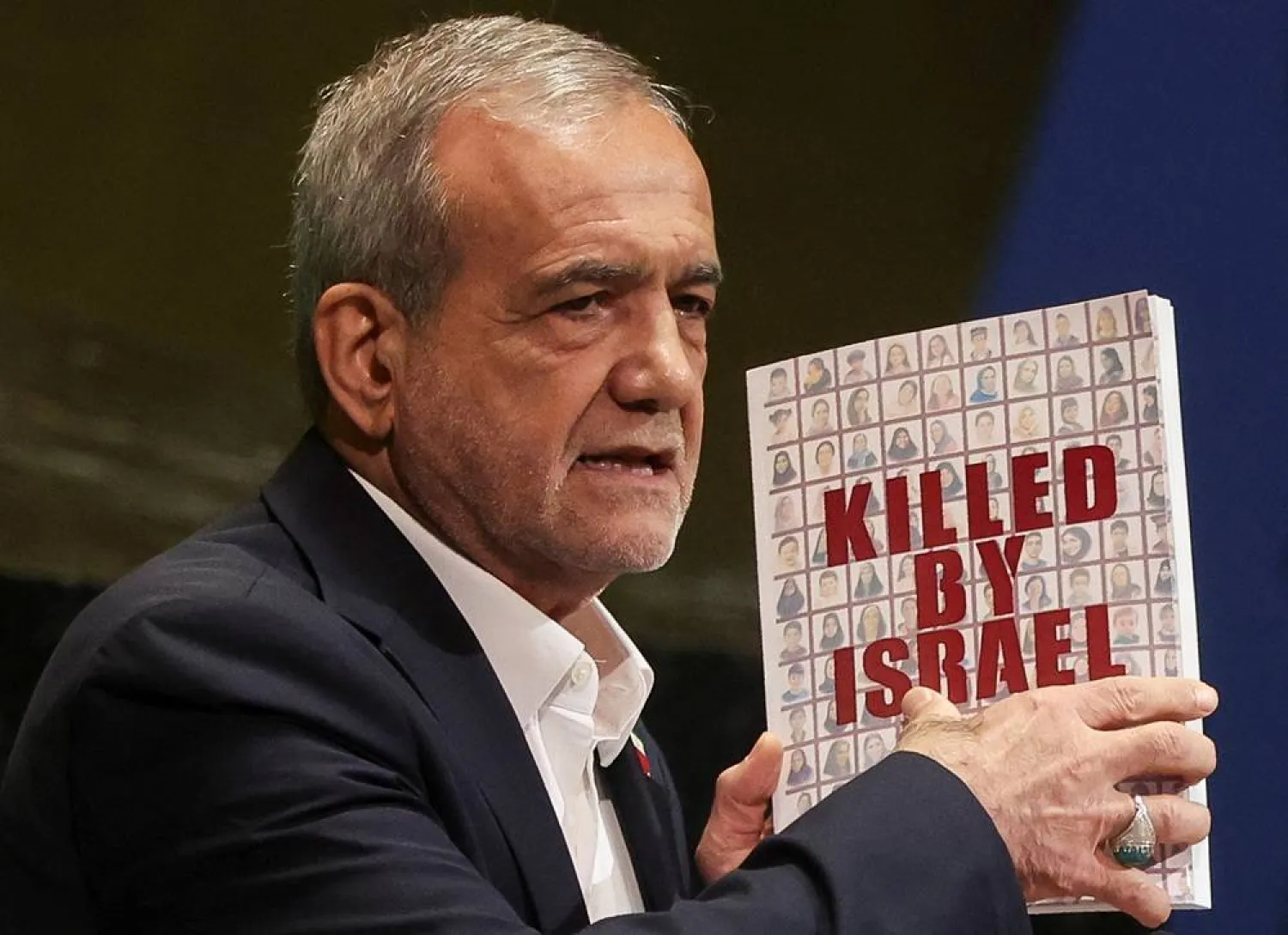
 Iran's President Masoud Pezeshkian holds a book as he addresses the 80th United Nations General Assembly (UNGA) at the UN headquarters in New York, US, September 24, 2025. (Reuters)
Iran's President Masoud Pezeshkian holds a book as he addresses the 80th United Nations General Assembly (UNGA) at the UN headquarters in New York, US, September 24, 2025. (Reuters)
TT

Iran’s President Blasts US, Israeli Attacks for Dealing ‘Grievous Blow’ to Peace as Sanctions Loom

 Iran's President Masoud Pezeshkian holds a book as he addresses the 80th United Nations General Assembly (UNGA) at the UN headquarters in New York, US, September 24, 2025. (Reuters)
Iran's President Masoud Pezeshkian holds a book as he addresses the 80th United Nations General Assembly (UNGA) at the UN headquarters in New York, US, September 24, 2025. (Reuters)

Addressing the world's leaders, Iranian President Masoud Pezeshkian on Wednesday blamed the United States and Israeli attacks for “dealing a grievous blow” to peace negotiations as Tehran braces for the reinstatement of sanctions in the next week, barring a last-minute diplomatic breakthrough. Hours before his speech, Iran's rial currency fell to a new all-time low. 

Pezeshkian's remarks before the UN General Assembly are the first in a global forum since the 12-day Israel-Iran war over the summer that saw the assassination of many of the country’s highest military and political leaders and broke down weeks of negotiations with the United States. 

“Ladies and gentlemen, you all bore witness that this past June, my country was subjected to a savage aggression and flagrant contravention of the most elementary principles of international law,” said the president, who within Iran’s political landscape is considered a moderate politician. 

Pezeshkian is in New York as Tehran seeks to engage in last-minute talks with European nations to stop the coming reimposition of UN sanctions on Iran over its nuclear program. But before even landing in the US, any diplomatic efforts planned by Pezeshkian and Iran's foreign minister, Abbas Araghchi, were overshadowed when Supreme Leader Ali Khamenei rejected any direct nuclear talks with America in a speech on Tuesday. 

“The US has announced the results of the talks in advance,” he said. “The result is the closure of nuclear activities and enrichment. This is not a negotiation. It is a diktat, an imposition.” 

A deadline is coming for sanctions to resume  

France, Germany and the United Kingdom triggered the so-called “snapback mechanism” to reinstate sanctions — barring a last-minute accord — over Iran’s failure to comply with conditions of a 2015 nuclear deal aimed at preventing Tehran from developing nuclear weapons. 

“Snapback” was designed to be veto-proof at the UN It started a 30-day window for the resumption of sanctions, which ends Sunday, unless the West and Iran reach a diplomatic agreement. 

European nations have said that they would be willing to extend the deadline if Iran resumes direct negotiations with the US over its nuclear program, allows UN nuclear inspectors access to its nuclear sites, and accounts for the more than 400 kilograms (880 pounds) of highly enriched uranium that the UN watchdog says it has. Iran is the only nation in the world that enriches uranium up to 60% — a short, technical step away from weapons-grade levels — that doesn’t have a weapons program. 

But Pezeshkian used his UN speech to criticize the E3 for having operated in “bad faith” for years to dictate Iranian compliance with a deal that the US abandoned in 2018. “They falsely presented themselves as parties of good standing to the agreement, and they disparaged Iran’s sincere efforts as insufficient," he said. 

If no diplomatic deal is found this week, the sanctions will automatically “snapback” on Sunday. That would again freeze Iranian assets abroad, halt arms deals with Tehran and penalize any development of Iran’s ballistic missile program, among other measures, further squeezing the country’s reeling economy. 

Nuclear maneuvering continues  

Earlier this month, the UN nuclear watchdog and Iran signed an agreement mediated by Egypt to pave the way for resuming cooperation, including on ways of relaunching inspections of Iran’s nuclear facilities. However, that agreement has yet to fully take hold. 

In July, Pezeshkian had signed a law adopted by his country’s parliament suspending all cooperation with the International Atomic Energy Agency. That followed Israel’s 12-day war with Iran in June, during which Israel and the US bombed Iranian nuclear sites. 

Iran has long insisted its program is peaceful, though Western nations and the Vienna-based IAEA assess that Tehran had an active nuclear weapons program until 2003. Khamenei again said Tuesday that Iran doesn’t seek atomic bombs. 

However, he added, “Science will not be demolished by threats and bombing.” 

At the General Assembly, Pezeshkian said: “I hereby declare once more before this assembly that Iran has never sought and will never seek to build a nuclear bomb. We do not seek nuclear weapons.” 


Turkish FM to Attend Trump’s Board of Peace Meeting in Washington, Italy as ‘Observer’ 

28 November 2025, Berlin: Turkish Foreign Minister Hakan Fidan during a joint press conference with German Foreign Minister Wadephul. (dpa)
TT

Turkish FM to Attend Trump’s Board of Peace Meeting in Washington, Italy as ‘Observer’ 

28 November 2025, Berlin: Turkish Foreign Minister Hakan Fidan during a joint press conference with German Foreign Minister Wadephul. (dpa)

‌Turkish Foreign Minister Hakan Fidan will travel to Washington in lieu of President Recep Tayyip Erdogan for the inaugural meeting of US President Donald Trump's "Board of Peace" on Thursday, the foreign ministry said on Wednesday.

A Turkish diplomatic source told Reuters ‌that Fidan, during the ‌talks, would call ‌for ⁠determined steps to ⁠resolve the Palestinian issue and emphasize that Israel must end actions to hinder the flow of aid into Gaza and stop its ceasefire violations.

Fidan ⁠will also reiterate Türkiye's ‌readiness ‌to contribute to Gaza's reconstruction and its ‌desire to help protect Palestinians ‌and ensure their security, the source said.

He will also call for urgent action against Israel's "illegal ‌settlement activities and settler violence in the West Bank", ⁠the ⁠source added.

According to a readout from Erdogan's office, the president separately told reporters on Wednesday that he hoped the Board of Peace would help achieve "the lasting stability, ceasefire, and eventually peace that Gaza has longed for", and would focus on bringing about a two-state solution.

The board, of which Trump is the chairman, was initially designed to oversee the Gaza truce and the territory's reconstruction after the war between Hamas and Israel.

Meanwhile, Italy will be present at the meeting as an "observer", Italian Foreign Minister Antonio Tajani said Wednesday.

"I will go to Washington to represent Italy as an observer to this first meeting of the Board of Peace, to be present when talks occur and decisions are made for the reconstruction of Gaza and the future of Palestine," Tajani said according to ANSA news agency.

Italy cannot be present as anything more than an observer as the country's constitutional rules do not allow it to join an organization led by a single foreign leader.

But Tajani said it was key for Rome to be "at the forefront, listening to what is being done".

Since Trump launched the Board of Peace at the World Economic Forum in Davos in January, at least 19 countries have signed its founding charter.


Energy Secretary: US to Stop Iran's Nuclear Ambitions 'One Way or the Other'

US Secretary of Energy Chris Wright speaks during a press conference after a meeting with Venezuela's acting president Delcy Rodriguez at the Miraflores Presidential Palace in Caracas on February 11, 2026. (Photo by Juan BARRETO / AFP)
TT

Energy Secretary: US to Stop Iran's Nuclear Ambitions 'One Way or the Other'

US Secretary of Energy Chris Wright speaks during a press conference after a meeting with Venezuela's acting president Delcy Rodriguez at the Miraflores Presidential Palace in Caracas on February 11, 2026. (Photo by Juan BARRETO / AFP)

The United States will deter Iran from acquiring nuclear weapons "one way or the other", US Energy Secretary Chris Wright warned on Wednesday.

"They've been very clear about what they would do with nuclear weapons. It's entirely unacceptable," Wright told reporters in Paris on the sidelines of meetings of the International Energy Agency.

"So one way or the other, we are going to end, deter Iran's march towards a nuclear weapon," Wright said.

US and Iranian officials held talks in Geneva on Tuesday aimed at averting the possibility of US military intervention to curb Tehran's nuclear program.

Iran said following the talks that they had agreed on "guiding principles" for a deal to avoid conflict.

US Vice President JD Vance, however, said Tehran had not yet acknowledged all of Washington's red lines.


Iran, Russia to Conduct Joint Drills in the Sea of Oman 

This handout photo released by Iran's Revolutionary Guards Corps (IRGC)'s official website Sepanews on February 17, 2026, shows boats maneuvering around a tanker vessel during a military exercise by members of the IRGC and navy in the Strait of Hormuz. (Sepahnews / AFP)
TT

Iran, Russia to Conduct Joint Drills in the Sea of Oman 

This handout photo released by Iran's Revolutionary Guards Corps (IRGC)'s official website Sepanews on February 17, 2026, shows boats maneuvering around a tanker vessel during a military exercise by members of the IRGC and navy in the Strait of Hormuz. (Sepahnews / AFP)

Iran and Russia will conduct naval maneuvers in the Sea of Oman on Thursday, following the latest round of talks between Tehran and Washington in Geneva, Iranian media reported.

On Monday, the Revolutionary Guards, the ideological arm of Iran's military, also launched exercises in the strategic Strait of Hormuz, a challenge to US naval forces deployed in the region.

"The joint naval exercise of Iran and Russia will take place tomorrow (Thursday) in the Sea of Oman and in the northern Indian Ocean," the ISNA agency reported, citing drill spokesman, Rear Admiral Hassan Maghsoudloo.

"The aim is to strengthen maritime security and to deepen relations between the navies of the two countries," he said, without specifying the duration of the drill.

The war games come as Iran struck an upbeat tone following the second round of Oman-mediated negotiations in Geneva on Tuesday.

Previous talks between the two foes collapsed following the unprecedented Israeli strike on Iran in June 2025, which sparked a 12-day war that the United States briefly joined.

US President Donald Trump has deployed a significant naval force in the region, which he has described as an "armada."

Iranian officials have repeatedly threatened to block the Strait of Hormuz, particularly during periods of tension with the United States, but it has never been closed.

A key passageway for global shipments of oil and liquefied natural gas, the Strait of Hormuz has been the scene of several incidents in the past and has returned to the spotlight as pressure has ratcheted amid the US-Iran talks.

Iran announced on Tuesday that it would partially close it for a few hours for "security" reasons during its own drills in the strait.
