


Iran Recalls Envoys from UK, France, Germany for Consultations

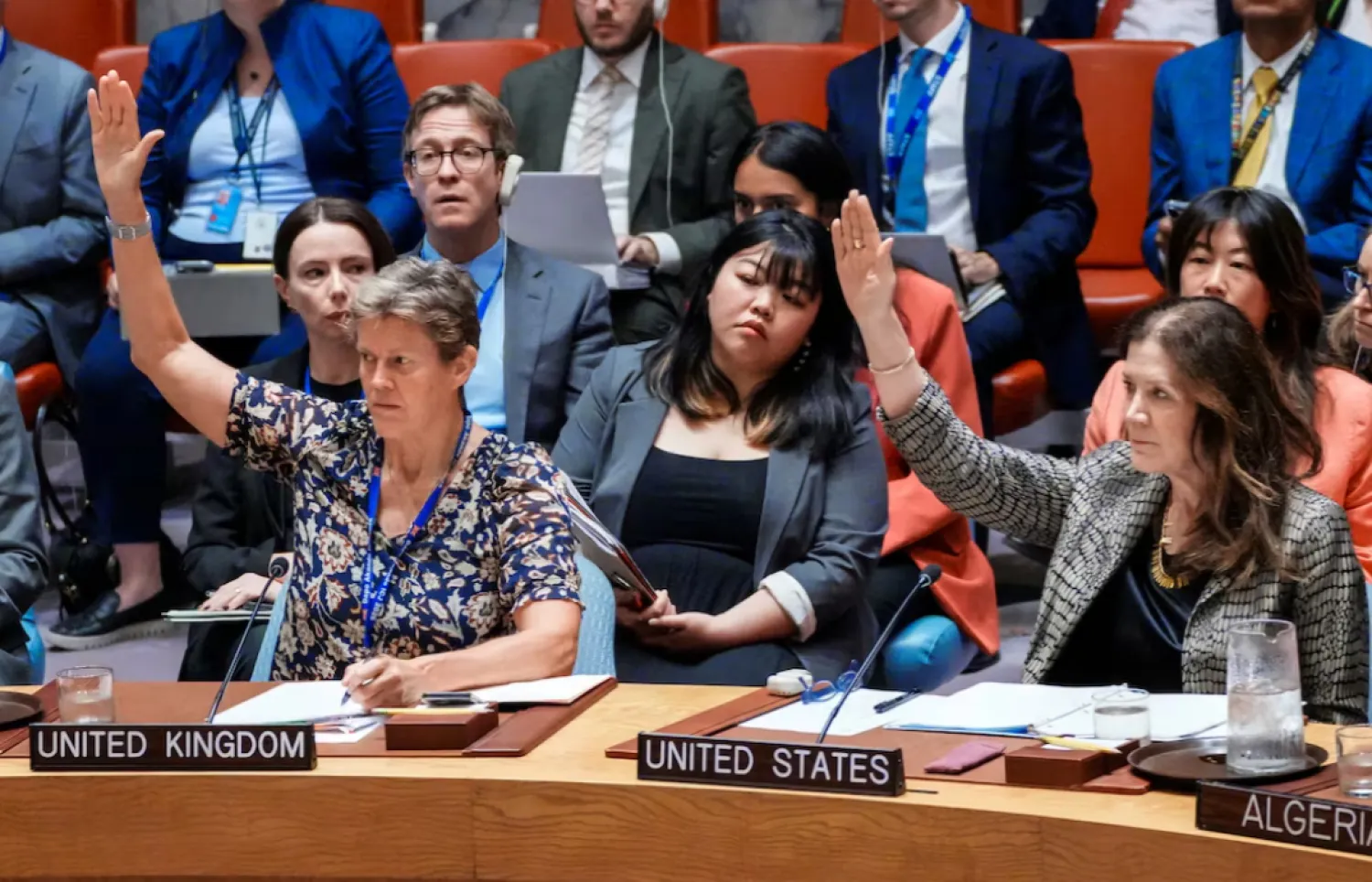
Members of the UN Security Council vote against a resolution that would permanently lift UN sanctions on Iran at the UN headquarters in New York City, US, September 19, 2025. REUTERS/Eduardo Munoz/File photo
TT

Iran Recalls Envoys from UK, France, Germany for Consultations

Members of the UN Security Council vote against a resolution that would permanently lift UN sanctions on Iran at the UN headquarters in New York City, US, September 19, 2025. REUTERS/Eduardo Munoz/File photo

Iranian President Masoud Pezeshkian said the reimposition of global sanctions over Iran's nuclear program is "not like the sky is falling" as he headed home on Saturday from New York where he failed to convince Western powers to delay the move.

Iran's immediate reaction to the resumption of United Nations sanctions came with the announcement earlier on Saturday it was recalling its ambassadors to Britain, France and Germany for consultations, but it has warned a harsher response awaits, Reuters reported.

"It is not like the sky is falling. If we are weak they will crush us. But if we are united, there is no fear from this crisis," Pezeshkian told Iranian state television before leaving New York, where he was attending the United Nations General Assembly.

All UN sanctions on Iran are due to be restored overnight, after the three European powers, known as the E3, triggered a 30-day process accusing Tehran of violating a 2015 deal meant to prevent it from building a nuclear bomb.

Iran denies seeking nuclear weapons.

It has warned Western countries they will face "serious consequences" for restoring the sanctions, but Pezeshkian has also said Iran has no intention of quitting the nuclear Non-Proliferation Treaty.

Russia and China mounted a last-ditch effort at the UN Security Council on Friday to delay the sanctions snap back, warning it could prompt escalation in the Middle East, but only four of the 15 council members supported their draft resolution.

Meanwhile, Iran's rial currency continued to decline over fears of new sanctions. The rial fell to 1,123,000 per US dollar, a new record low, on Saturday, from about 1,085,000 on Friday, according to foreign exchange websites, including Bon-bast.com.

The return of the UN sanctions including asset freezes and travel bans will mean further trouble for the Islamic Republic's ailing economy, which is already laboring under a separate list of US sanctions. European sanctions will resume next week.

The returning UN sanctions will also include an arms embargo, a ban on uranium enrichment and reprocessing and a ban on activities with ballistic missiles capable of delivering nuclear weapons.

Iran's nuclear program has already been set back by Israeli airstrikes in June that pounded major atomic facilities as well as targeting military bases and individuals involved in the nuclear program.

It remains unclear how far the strikes succeeded in derailing Iran's nuclear work, which Tehran says is purely for peaceful purposes such as generating electricity, but which Western countries believe is aimed at building a bomb.



Pentagon Reportedly Weighs Diverting Ukraine Military Aid to the Middle East

FILE - The Pentagon and the surrounding area is seen in this aerial view in Washington, Jan. 26, 2020. (AP Photo/Pablo Martinez Monsivais, File)
TT

Pentagon Reportedly Weighs Diverting Ukraine Military Aid to the Middle East

FILE - The Pentagon and the surrounding area is seen in this aerial view in Washington, Jan. 26, 2020. (AP Photo/Pablo Martinez Monsivais, File)

The Pentagon is weighing whether to redirect weapons originally meant for Ukraine to the Middle East, as the war in Iran strains supplies of some of the US military's most critical munitions, the Washington Post reported Thursday, citing three people familiar with the matter.

The weapons that could be redirected include air defense interceptor missiles purchased through a NATO initiative launched last year, under which ⁠partner countries buy ⁠US arms for Kyiv, the report said.

The consideration comes as US operations in the region intensify. Admiral Brad Cooper, the Central Command chief leading US forces in the Middle East, on Wednesday said the US had hit ⁠over 10,000 targets inside Iran and was on track to limit Iran's ability to project power outside its borders.

A Pentagon spokesperson told the newspaper that the Defense Department would "ensure that US forces and those of our allies and partners have what they need to fight and win."

In response to a query about the report, a NATO official said members of ⁠the ⁠alliance and its partners continue to contribute to its Prioritized Ukraine Requirements List (PURL) program that funds the supply of US arms for Kyiv.

"Equipment is continuously flowing into Ukraine," the official added. "The amount pledged to PURL so far is of several billion US dollars and we expect more contributions to follow."

The Pentagon and the US State Department did not immediately respond to Reuters' requests for comment.


Israel Defense Minister Says Iran Guards Navy Commander Killed in Strike

(FILES) This handout photo provided by Iran's Revolutionary Guard Corps (IRGC) official website Sepah News on February 1, 2025, shows navy commander Admiral Alireza Tangsiri. (Photo by SEPAH NEWS / AFP)
TT

Israel Defense Minister Says Iran Guards Navy Commander Killed in Strike

(FILES) This handout photo provided by Iran's Revolutionary Guard Corps (IRGC) official website Sepah News on February 1, 2025, shows navy commander Admiral Alireza Tangsiri. (Photo by SEPAH NEWS / AFP)

Defense Minister Israel Katz announced on Thursday that an Israeli airstrike had killed Alireza Tangsiri, commander of the Iranian Revolutionary Guards' navy.

"Last night, in a precise and lethal operation, the IDF eliminated the commander of the Revolutionary Guards' navy, Tangsiri, along with senior officers of the naval command," Katz said in a video statement.

"The man who was directly responsible for the terrorist operation of mining and blocking the Strait of Hormuz to shipping was blown up and eliminated."

Since the start of the joint US-Israeli attacks on Iran on February 28, Israel has announced the killing of several top Iranian officials, including supreme leader Ali Khamenei and the security chief, Ali Larijani.

In recent days, Israeli forces have carried out several strikes targeting the naval assets of Iran.

Last week, Israeli airstrikes hit several Iranian naval ships in the Caspian Sea, including ones equipped with missile systems, support vessels and patrol craft.


Israel Reportedly Took Iran's Araghchi, Qalibaf Off Hit List after Pakistan Request to US

FILED - 09 September 2025, Egypt, Cairo: Iranian Foreign Minister Abbas Araghchi attends a joint press conference in Cairo. Photo: Stringer/dpa
TT

Israel Reportedly Took Iran's Araghchi, Qalibaf Off Hit List after Pakistan Request to US

FILED - 09 September 2025, Egypt, Cairo: Iranian Foreign Minister Abbas Araghchi attends a joint press conference in Cairo. Photo: Stringer/dpa

Israel took Iranian Foreign Minister Abbas Araghchi and Parliamentary Speaker Mohammad Baqer Qalibaf off its hit list after Pakistan requested that Washington not target them, a Pakistani source with knowledge of the discussions told Reuters on Thursday.

"The Israelis had their coordinates and wanted to take them out, we told the US if they are also eliminated then there is no one else to talk to, hence the US asked the Israelis to back off," the source said.

Pakistan's ⁠military and foreign ⁠office did not immediately respond to requests for comment.
The Wall Street Journal first reported that the two top Iranian officials had been temporarily removed from Israel's list of officials to eliminate as they explore possible peace talks.

The two officials have been removed from the list ⁠for up to four or five days, the Journal said, citing US officials, but did not mention any Pakistani role in it. Pakistan, Egypt and Türkiye are playing the role of mediator between Tehran and Washington to end the Iran war.

Islamabad has maintained direct contact with both Washington and Tehran at a time when such channels are frozen for most other countries. Islamabad has also been seen as a likely venue if peace talks are ⁠held.

Iran is ⁠reviewing a 15-point proposal from US President Donald Trump, sent through Pakistan, to end the war. The proposal calls for removing Iran's stocks of highly enriched uranium, halting enrichment, curbing its ballistic missile program and cutting off funding for regional allies, according to Israeli cabinet sources familiar with the plan.

Trump has said Iran is desperate to make a deal, while Araghchi said Tehran was reviewing the US proposal but had no intention of holding talks to wind down the conflict.