Russia Says it Does Not Believe US Has Taken Decision on Supplying Ukraine with Tomahawk Missiles

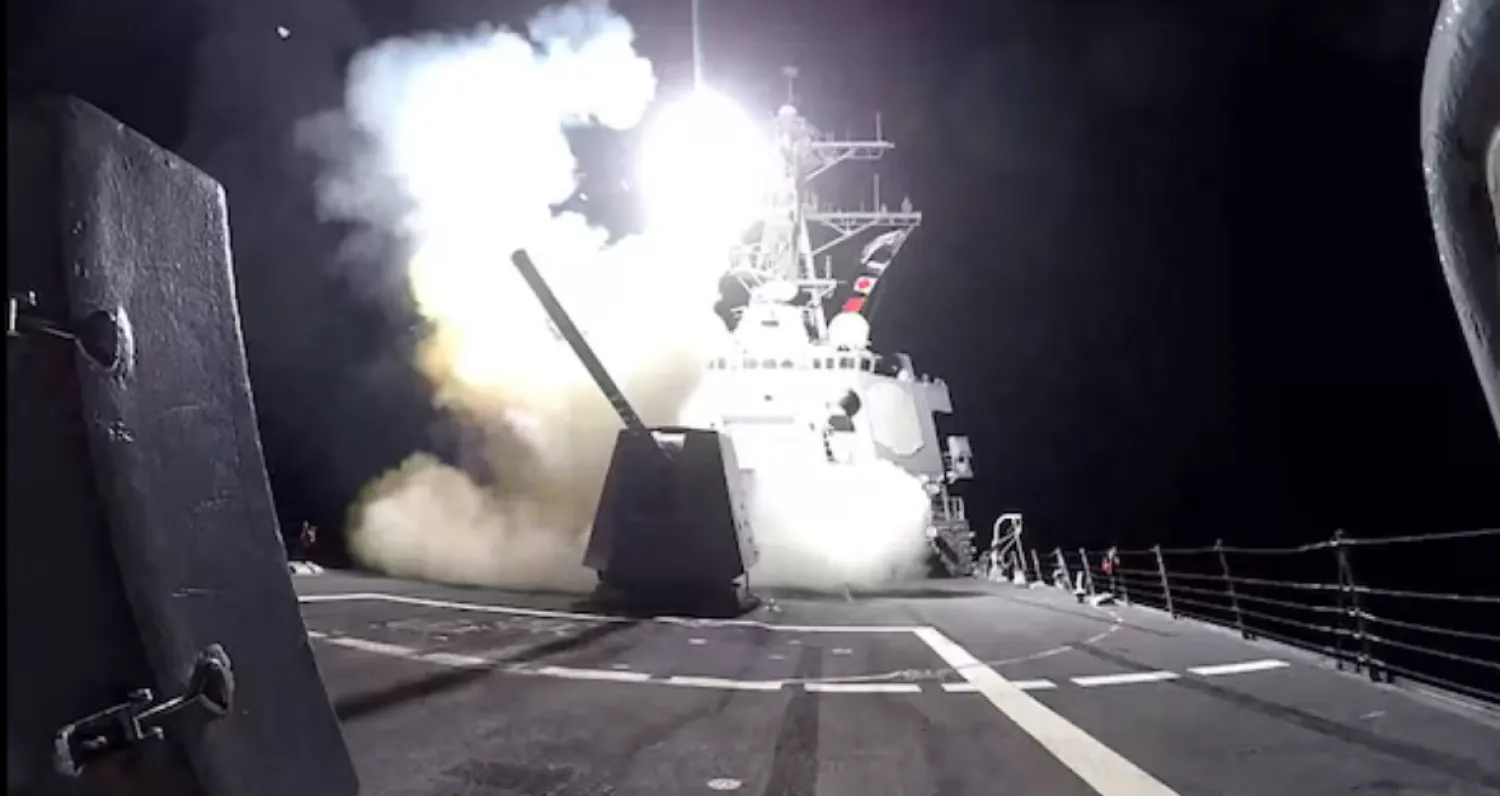
A Tomahawk land attack missile (TLAM) is launched from the US Navy Arleigh Burke-class guided missile destroyer USS Gravely against what the US military describe as Houthi military targets in Yemen, February 3, 2024. US Central Command/Handout via REUTERS
TT

Russia Says it Does Not Believe US Has Taken Decision on Supplying Ukraine with Tomahawk Missiles

A Tomahawk land attack missile (TLAM) is launched from the US Navy Arleigh Burke-class guided missile destroyer USS Gravely against what the US military describe as Houthi military targets in Yemen, February 3, 2024. US Central Command/Handout via REUTERS

Russian Foreign Minister Sergei Lavrov said on Tuesday that Moscow did not believe that Washington had taken a final decision on supplying Tomahawk cruise missiles to Ukraine.

US Vice President JD Vance said on Sunday that Washington was considering a Ukrainian request for Tomahawks, Reuters reported.

Lavrov said that US talk about the matter looked like it was the result of pressure from Europe and that Washington wanted to show it was taking its allies' opinions into account.

Russia said on Monday that its military was analysing whether the United States would supply Tomahawks to Ukraine for strikes deep into Russia, a step that Russian officials say could trigger a steep escalation.


Iran’s Armed Forces: We Are Ready for Any Hostile Scenario

A poster shows slain members of the Iranian Revolutionary Guards Corps, who were killed in the June war, over a highway in Tehran on June 14.
TT

Iran’s Armed Forces: We Are Ready for Any Hostile Scenario

A poster shows slain members of the Iranian Revolutionary Guards Corps, who were killed in the June war, over a highway in Tehran on June 14.

Spokesperson of the Iranian Armed Forces Brigadier General Abolfazl Shekarchi said on Tuesday that his country’s naval, ground, and missile forces are ready to confront any threat or hostile scenario.

Speaking at a meeting at Sharif University, Shekarchi said much of Iran’s military capabilities have not yet been utilized, in a direct threat to Israel amid escalating regional tension that followed the June war.

“Iran’s defense doctrine is based on deterrence,” he said, emphasizing that his country does not initiate wars, but responds decisively to aggression.

“Any offensive action would be intended to punish an aggressor rather than to start a conflict,” Shekarchi said, according to the Daneshjoo News Agency, a semi-official Iranian news outlet primarily managed by the University Students' Basij Organization.

Referring to the June war with Israel, Shekarchi said Iran’s adversaries employed a comprehensive hybrid strategy combining military and non‑military tools but failed to achieve their objectives.

But he added that the Basij forces, as well as the naval and ground forces, remains “fully prepared and unused.”

In an indirect reference to Western reports saying Iran is restoring damaged ballistic missile production capabilities, Shekarchi said Iran has continued to strengthen its power and has never suspended its military activities, even at the height of tensions.

He said Iran’s Fattah missiles were able to penetrate advanced air defense systems and struck targets in Israel with high precision.

“These missiles did not strike blindly or wander off course,” Shekarchi said. “They hit exactly the predetermined targets,” he added, noting that the missile strikes demonstrated accuracy and operational effectiveness.

In his speech, the spokesperson also spoke about the nature of hostility against Iran, which has increasingly shifted toward “soft warfare”, including media campaigns, propaganda and psychological operations aimed at undermining public morale and hope rather than direct military confrontation.

At the local security level, Shekarchi revealed that Iranian authorities dismantled a large espionage network. He said around 2,000 people linked to hostile intelligence services were arrested several months before the start of the war and until its end.

He said the network took years of planning, training and financial investment, with large sums spent on organizing and supporting its members.

“It will take years and lots of money to rebuild such a network,” he said.

His comments come as US and Israeli officials warn that Tehran is ramping up its missile and nuclear production efforts.

On Monday, Israeli Prime Minister Benjamin Netanyahu indicated that Israel is watching Iran and warned of a tough response to any aggression.

“We know that Iran has been doing exercises lately. We are following this, and we are making the necessary preparations. I want to make it clear to Iran here, any action against Israel will be met with a very harsh response,” he warned.


Two Police Officers Killed by Bomb in Moscow Near Site of Russian General’s Killing

The damaged Kia Sorento lies at the scene where Lieutenant General Fanil Sarvarov, head of the Russian General Staff's army operational training directorate, was killed in a car bomb in Moscow, Russia, December 22, 2025. (Reuters)
TT

Two Police Officers Killed by Bomb in Moscow Near Site of Russian General’s Killing

The damaged Kia Sorento lies at the scene where Lieutenant General Fanil Sarvarov, head of the Russian General Staff's army operational training directorate, was killed in a car bomb in Moscow, Russia, December 22, 2025. (Reuters)

Three people were killed by a bomb on Wednesday in Moscow after two police officers approached a man acting suspiciously near the site where a senior general was killed two days ago ‌by a car ‌bomb that Russia said ‌was planted ⁠by ​Ukrainian ‌intelligence.

A string of Russian military figures and high-profile supporters of the war in Ukraine have been assassinated during the nearly four-year-old conflict; Ukrainian military intelligence has said it was responsible for a number of the attacks.

Russia's State Investigative Committee said that when two police officers ⁠approached a man who was acting strangely, they were killed by ‌an explosive device, adding that ‍a third person was also ‍killed. It did not specify who the ‍third person was.

It said it opened criminal cases under clauses dealing with the murder of law enforcement officers and the illegal trafficking of bombs.

Unofficial Russian Telegram news channels ​said the bomber was one of those killed and he detonated the bomb when approached ⁠by the officers. Reuters could not independently confirm those details.

The blast took place very close to where Lieutenant General Fanil Sarvarov, head of the Russian General Staff's army operational training directorate, was killed on Monday.

Russia said it suspected Ukraine was behind the killing. There was no official comment from Ukraine.

Myrotvorets, an unofficial Ukrainian website that provides a database of people described as war criminals or traitors, updated its entry ‌on Sarvarov to say the 56-year-old general had been "liquidated."


Iran and US Reaffirm Commitment to Diplomacy at UN, but Gap on a Nuclear Deal Remains Wide

An Iranian man feeds birds in a street in Tehran, Iran, December 20, 2025. Majid Asgaripour/WANA (West Asia News Agency) via Reuters
TT

Iran and US Reaffirm Commitment to Diplomacy at UN, but Gap on a Nuclear Deal Remains Wide

An Iranian man feeds birds in a street in Tehran, Iran, December 20, 2025. Majid Asgaripour/WANA (West Asia News Agency) via Reuters

Iran and the United States reaffirmed their commitments to diplomacy at a contentious meeting of the UN Security Council on Tuesday, but the gap between the Trump administration and Tehran on a nuclear deal remains wide and deep.

The sixth round of negotiations between Washington and Tehran had been scheduled for soon after Israel’s 12-day war with Iran in June, during which the US joined Israel in bombing Iranian nuclear sites. The talks were canceled, and in September Iran’s supreme leader, Ali Khamenei, rejected any direct nuclear negotiations with the United States.

But Iran’s UN Ambassador Amir Saeid Iravani told the Security Council that “Iran remains fully committed to principled diplomacy and genuine negotiations.” And said it's now up to France, Britain and the US “to reverse course and take concrete, credible steps to restore trust and confidence.”

He said Iran remains committed to the core principles of the 2015 nuclear deal aimed at preventing Tehran from developing nuclear weapons, in which Iran had agreed to limit its nuclear program in exchange for the lifting of sanctions.

President Donald Trump in 2018 pulled the US out of the agreement between Iran and the five permanent members of the Security Council, plus Germany.

In a rare public exchange between diplomats from the two countries, US Mission counselor Morgan Ortagus, a Trump ally and former State Department spokesperson, said, “The United States remains available for formal talks with Iran but only if Tehran is prepared for direct and meaningful dialogue.”

Ortagus said Trump extended “the hand of diplomacy” to Iran during both of his administrations.

“But instead of taking that hand of diplomacy, you continue to put your hand in the fire,” she said, looking directly at Iravani. “Step away from the fire, sir, and take President Trump’s hand of diplomacy. It’s extended to you.”

She stressed, however, that the Trump administration has been clear that there can be no enrichment of nuclear material inside Iran, a major point of contention.

Irvani said the US insistence on zero enrichment was contrary to Iran's rights under the 2015 deal and showed the US was not pursuing fair negotiations. He said if France and Britain continued to side with the US, “diplomacy will be effectively destroyed.”

“Iran will not bow down to any pressure and intimidation,” Irvani said.

In September, the agreement's three Western members — Britain, France and Germany — triggered a “snapback” mechanism to reinstate the sanctions that had been lifted, citing Iran’s failure to comply with the deal’s conditions.

As tensions between Tehran and Washington have increased, Iran has accelerated its production of uranium to near weapons-grade. The UN nuclear watchdog, the Vienna-based International Atomic Energy Agency, has reported that Iran has over 440 kilograms of uranium enriched up to 60% — a short, technical step away from weapons-grade levels of 90%.

France’s deputy UN ambassador Jay Dharmadhikari defended the “snapback” of UN sanctions, saying that since 2019 Iran has been in “increasingly flagrant violation” of all limitations designed to guarantee that its nuclear program remains peaceful. But he said the reimposition of sanctions does not mean the end of efforts to find a diplomatic solution.

Russia’s UN Ambassador Vassily Nebenzia shot back, telling the French envoy: “You failed miserably in your so-called diplomatic efforts to strike a deal on the nuclear issue with Iran, and you know it.”