


Zelenskyy and UN Atomic Agency Head Warn of Heightened Risk at Huge Ukrainian Nuclear Plant 

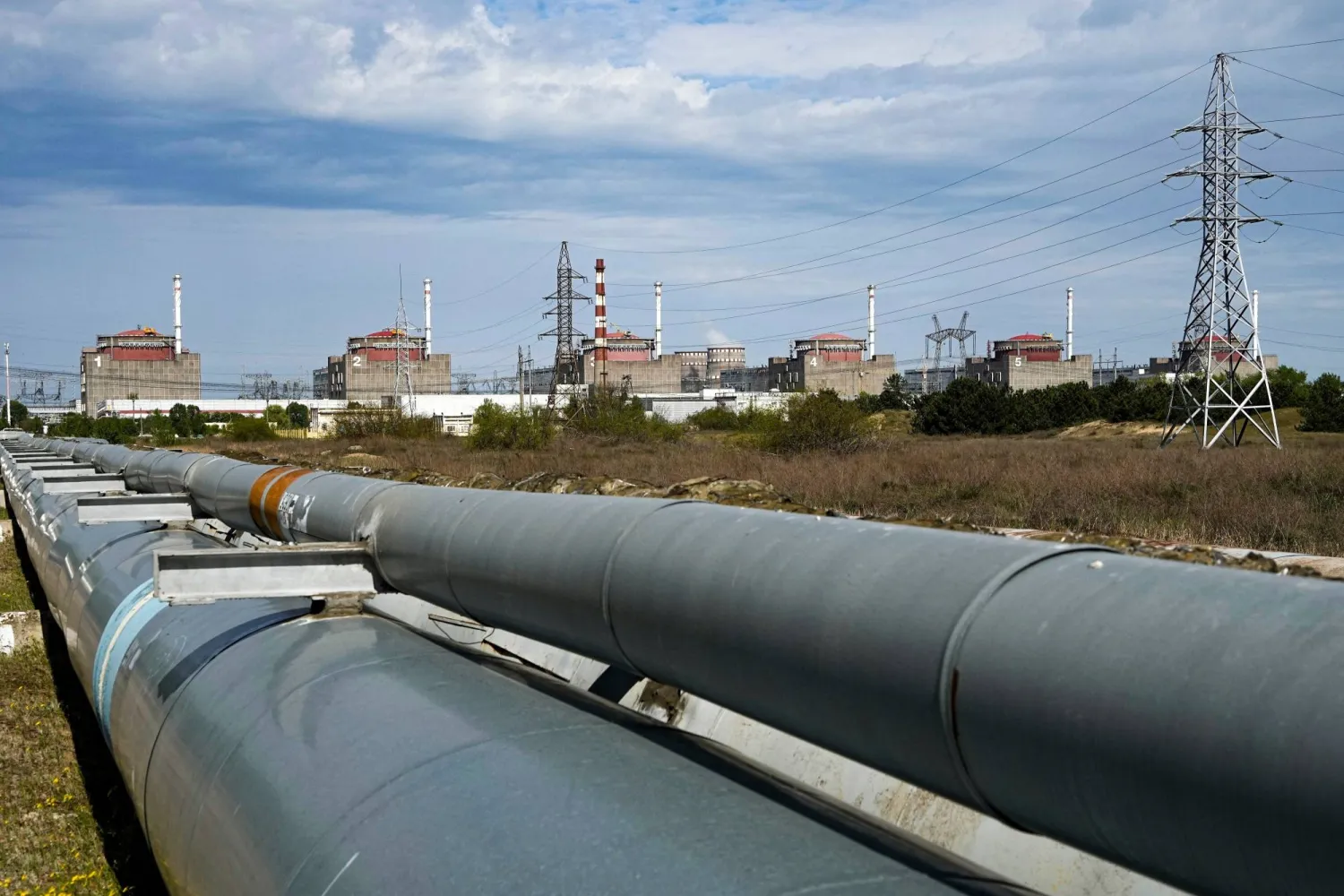
A view of the Zaporizhzhia Nuclear Power Station, in Enerhodar, Zaporizhzhia region, in territory under Russian military control, southeastern Ukraine, on May 1, 2022. (AP)
TT

Zelenskyy and UN Atomic Agency Head Warn of Heightened Risk at Huge Ukrainian Nuclear Plant 

A view of the Zaporizhzhia Nuclear Power Station, in Enerhodar, Zaporizhzhia region, in territory under Russian military control, southeastern Ukraine, on May 1, 2022. (AP)

Ukraine’s president and the UN nuclear agency head are sounding the alarm about increased safety risks at the Russia-occupied Zaporizhzhia Nuclear Power Plant in southern Ukraine, which lost its external power supply more than a week ago as the war raged around it.

Emergency diesel generators are providing power for crucial cooling systems for the facility’s six shutdown reactors and spent fuel, and there is no immediate danger to Europe’s biggest nuclear plant, according to International Atomic Energy Agency Director-General Rafael Mariano Grossi.

But “it is clearly not a sustainable situation in terms of nuclear safety,” he said.

The backup generators have never needed to run for so long, according to Ukrainian President Volodymyr Zelenskyy.

“The generators and the plant were not designed for this,” Zelenskyy said late Tuesday, describing the situation as “critical.”

Zaporizhzhia is one of the 10 biggest nuclear plants in the world, and its fate amid the fighting has caused fears of a potential nuclear catastrophe. Russian forces seized it days after the full-scale invasion of neighboring Ukraine began on Feb. 24, 2022.

The Vienna-based IAEA has been walking a tightrope in the war, eager to maintain access to nuclear facilities and issuing warnings about the dangers without angering either side. Ukraine has four nuclear plants, though Zaporizhzhia is the only one in Russian hands.

Grossi said that Zaporizhzhia's emergency generators were coping with the extra strain so far.

“The current status of the reactor units and spent fuel is stable as long as the emergency diesel generators are able to provide sufficient power to maintain essential safety-related functions and cooling,” he said in a statement late Tuesday.

An IAEA team at the plant reported that it has fuel reserves ensuring the generators can operate for more than 10 days, with regular off-site supplies maintaining this level.

“Nevertheless, it is extremely important that off-site power is restored,” Grossi said, adding that he was in touch with Russian and Ukrainian officials about how to swiftly reconnect the plant to the grid.

As Russia’s invasion churns across the Ukrainian countryside, the Zaporizhzhia facility has repeatedly been caught in the crossfire.

It lost its off-site power for the 10th time during the war on Sept. 23, when its only remaining power line was damaged by military activity about 1½ kilometers (a mile) from the plant, the IAEA statement said.

Eight emergency diesel generators are operating, with nine additional units in standby mode and three in maintenance, according to the IAEA.

It said that over the past week, the plant has been alternating those in use and servicing idle generators in an effort to ensure continuous availability.



Back From Iran, Pakistani Students Say They Heard Gunshots While Confined to Campus

 A Pakistani medical student Arslan Haider waits at the airport after arriving from Tehran on a commercial flight amid the ongoing nationwide protests in Iran, in Islamabad, Pakistan, January 15, 2026. (Reuters)
A Pakistani medical student Arslan Haider waits at the airport after arriving from Tehran on a commercial flight amid the ongoing nationwide protests in Iran, in Islamabad, Pakistan, January 15, 2026. (Reuters)
TT

Back From Iran, Pakistani Students Say They Heard Gunshots While Confined to Campus

 A Pakistani medical student Arslan Haider waits at the airport after arriving from Tehran on a commercial flight amid the ongoing nationwide protests in Iran, in Islamabad, Pakistan, January 15, 2026. (Reuters)
A Pakistani medical student Arslan Haider waits at the airport after arriving from Tehran on a commercial flight amid the ongoing nationwide protests in Iran, in Islamabad, Pakistan, January 15, 2026. (Reuters)

Pakistani students returning from Iran on Thursday said they heard gunshots and stories of rioting and violence while being confined to campus and not allowed out of their dormitories in the evening.

Iran's leadership is trying to quell the worst domestic unrest since its 1979 revolution, with a rights group putting the death toll over 2,600.

As the protests swell, Tehran is seeking to deter US President Donald Trump's repeated threats to intervene on behalf of anti-government protesters.

"During ‌nighttime, we would ‌sit inside and we would hear gunshots," Shahanshah ‌Abbas, ⁠a fourth-year ‌student at Isfahan University of Medical Sciences, said at the Islamabad airport.

"The situation down there is that riots have been happening everywhere. People are dying. Force is being used."

Abbas said students at the university were not allowed to leave campus and told to stay in their dormitories after 4 p.m.

"There was nothing happening on campus," Abbas said, but in his interactions with Iranians, he ⁠heard stories of violence and chaos.

"The surrounding areas, like banks, mosques, they were damaged, set on fire ... ‌so things were really bad."

Trump has repeatedly ‍threatened to intervene in support of protesters ‍in Iran but adopted a wait-and-see posture on Thursday after protests appeared ‍to have abated. Information flows have been hampered by an internet blackout for a week.

"We were not allowed to go out of the university," said Arslan Haider, a student in his final year. "The riots would mostly start later in the day."

Haider said he was unable to contact his family due to the blackout but "now that they opened international calls, the students are ⁠getting back because their parents were concerned".

A Pakistani diplomat in Tehran said the embassy was getting calls from many of the 3,500 students in Iran to send messages to their families back home.

"Since they don't have internet connections to make WhatsApp and other social network calls, what they do is they contact the embassy from local phone numbers and tell us to inform their families."

Rimsha Akbar, who was in the middle of her final year exams at Isfahan, said international students were kept safe.

"Iranians would tell us if we are talking on Snapchat or if we were riding in a cab ... ‌that shelling had happened, tear gas had happened, and that a lot of people were killed."


Bomb Hoax Forces Turkish Airlines to Make Emergency Landing in Barcelona

A Turkish Airlines aircraft after landing at El Prat airport, in Barcelona, northeastern Spain, 15 January 2026, after Spanish security forces where alerted due to a bomb threat on board the aircraft. (EPA)
TT

Bomb Hoax Forces Turkish Airlines to Make Emergency Landing in Barcelona

A Turkish Airlines aircraft after landing at El Prat airport, in Barcelona, northeastern Spain, 15 January 2026, after Spanish security forces where alerted due to a bomb threat on board the aircraft. (EPA)

A false bomb threat delivered via an onboard mobile connection caused a Turkish Airlines flight from Istanbul to make an emergency landing at Barcelona's El Prat Airport on Thursday, Spanish police and the airline ‌said.

A Turkish ‌Airlines spokesperson ‌said ⁠earlier that ‌the plane had landed after crew detected that a passenger had created an in-flight internet hotspot which was named to include a bomb threat as the aircraft approached ⁠Barcelona.

Spain's Guardia Civil police force said ‌in a statement ‍that following a ‍thorough inspection of the aircraft ‍after its passengers had disembarked, the alert had been deactivated and no explosives had been found. Spanish airport operator AENA said El Prat was operating normally.

Police have launched ⁠an investigation to determine who was behind the hoax, the statement added.

Türkiye's flag carrier has faced previous incidents of hoax threats, usually made via written messages, that led to emergency landings over the years.


US Sanctions Iranian Officials Over Protest Crackdown

 Treasury Secretary Scott Bessent watches as President Donald Trump speaks to reporters on the South Lawn at the White House, Tuesday, Jan. 13, 2026, in Washington. (AP)
Treasury Secretary Scott Bessent watches as President Donald Trump speaks to reporters on the South Lawn at the White House, Tuesday, Jan. 13, 2026, in Washington. (AP)
TT

US Sanctions Iranian Officials Over Protest Crackdown

 Treasury Secretary Scott Bessent watches as President Donald Trump speaks to reporters on the South Lawn at the White House, Tuesday, Jan. 13, 2026, in Washington. (AP)
Treasury Secretary Scott Bessent watches as President Donald Trump speaks to reporters on the South Lawn at the White House, Tuesday, Jan. 13, 2026, in Washington. (AP)

The United States imposed sanctions Thursday on Iranian security officials and financial networks, accusing them of orchestrating a violent crackdown on peaceful protests and laundering billions in oil revenues.

Treasury Secretary Scott Bessent announced the measures in the wake of the biggest anti-government protests in the history of the republic, although the demonstrations appear to have diminished over the last few days in the face of repression and an almost week-long internet blackout.

"The United States stands firmly behind the Iranian people in their call for freedom and justice," Bessent said in a statement, adding that the action was taken at President Donald Trump's direction.

Among those sanctioned is Ali Larijani, secretary of Iran's Supreme Council for National Security, whom Washington accused of coordinating the crackdown and calling for force against protesters.

Four regional commanders of Iran's Law Enforcement Forces and Revolutionary Guard were also sanctioned for their roles in the crackdown in Lorestan and Fars provinces.

Security forces in Fars "have killed countless peaceful demonstrators" with hospitals "so inundated with gunshot wound patients that no other types of patients can be admitted," the Treasury said.

The Treasury additionally designated 18 individuals and entities accused of operating "shadow banking" networks that launder proceeds from Iranian oil sales through front companies in the UAE, Singapore and Britain.

These networks funnel billions of dollars annually using cover companies and exchange houses, as Iranian citizens face economic hardship, according to the Treasury.

The sanctions freeze any US assets of those designated and prohibit Americans from doing business with them. Foreign financial institutions risk secondary sanctions for transactions with the designated entities.

The action builds on the Trump administration's "maximum pressure" campaign against Iran. In 2025, the Treasury sanctioned more than 875 persons, vessels and aircraft as part of this effort, it said.