


One of Two Victims in Manchester Synagogue Attack May Have Been Killed by a Bullet Fired by Police

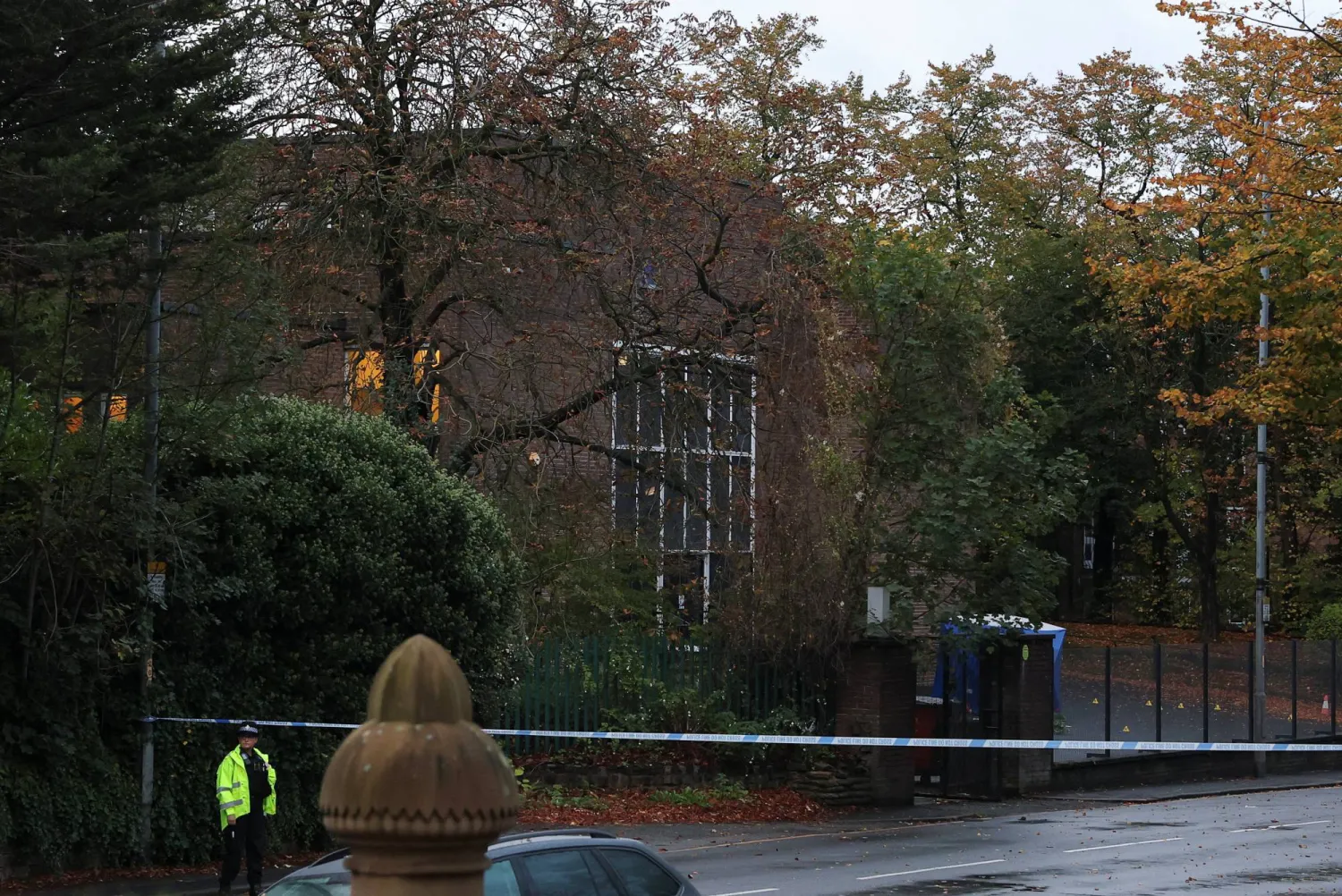
A police officer stands guard near the Manchester synagogue in north Manchester, Britain, October 3, 2025. (Reuters)
TT

One of Two Victims in Manchester Synagogue Attack May Have Been Killed by a Bullet Fired by Police

A police officer stands guard near the Manchester synagogue in north Manchester, Britain, October 3, 2025. (Reuters)

One of the two men killed in a car and knife attack on a synagogue in the city of Manchester may have been tragically killed by a bullet fired by a police officer, the force said on Friday. 

Greater Manchester Police chief Stephen Watson said a forensic examination has provisionally determined that the victim had "a wound consistent with a gunshot injury." He said the attacker did not have a gun and that the only shots fired were by police. 

"This injury may sadly have been sustained as a tragic and unforeseen consequence of the urgently required action taken by my officers to bring this vicious attack to an end," Watson said. 

Police said local residents Adrian Daulby, 53, and Melvin Cravitz, 66, died in the attack Thursday on the Heaton Park Congregation Synagogue in the Manchester suburb of Crumpsall. Three other people are hospitalized in serious condition. 

Police shot and killed a suspect seven minutes after he rammed a car into pedestrians outside the synagogue on Thursday morning and then attacked them with a knife. He wore what appeared to be an explosives belt, which was found to be fake. 

The assault took place as people gathered at the Orthodox synagogue on Yom Kippur, the day of atonement and the most solemn day in the Jewish calendar. 

Chief Rabbi Ephraim Mirvis, the head of Orthodox Judaism in Britain, said the attack was the result of "an unrelenting wave of Jew hatred" on the streets and online. 

"This is the day we hoped we would never see, but which deep down, we knew would come," he wrote on social media. 

Police identified the attacker as Jihad Al-Shamie, a 35-year-old British citizen of Syrian descent who entered the United Kingdom as a young child and became a citizen in 2006. Al-Shamie translates into English as "the Syrian," and authorities are unsure whether that is his birth name. 

Police said the crime is being investigated as a terrorist attack. Home Secretary Shabana Mahmood said the attacker was not previously known to police or to Prevent, a national counterterror program that tries to identify people at risk of radicalization. 

Mahmood said "it’s too early to say" whether the attacker acted alone or was part of a cell. 

Police said they are still probing the attacker’s motive. Officers arrested three people Thursday on suspicion of the preparation or commission of acts of terrorism. They are two men in their 30s and a woman in her 60s. 

Religious and political leaders condemned the attack and pledged to reassure Britain’s Jewish community, which numbers about 300,000. 

Police said extra officers would be on the streets of Manchester on Friday and through the weekend to reassure the community. 

Recorded antisemitic incidents in the UK have risen sharply since Hamas’ Oct. 7, 2023, attack on Israel and Israel’s ensuing war against Hamas in Gaza, according to Community Security Trust, an advocacy group for British Jews. More than 1,500 incidents were reported in the first half of the year, the second-highest six-month total reported since the record set over the same period a year earlier. 

Calls for pro-Palestinian protests to be canceled  

Prime Minister Keir Starmer denounced the "vile" assailant who "attacked Jews because they are Jews." He promised British Jews that he would do "everything in my power to guarantee you the security that you deserve." 

He said the country would come together "to wrap our arms around your community and show you that Britain is a place where you and your family are safe, secure and belong." 

Some politicians and religious leaders claimed pro-Palestinian demonstrations, which have been held regularly since the war in Gaza began, had played a role in spreading hatred of Jews. Some say chants such as "From the river to the sea, Palestine will be free" incite violence. Others, including Jews who support the protests, say they want a ceasefire, an end to the suffering of Palestinians in Gaza and the release of Israeli hostages held by Hamas. 

Mirvis, the chief rabbi, urged authorities to "get a grip on these demonstrations. They are dangerous." 

"You cannot separate the words on our streets, the actions of people in this way, and what inevitably results, which was yesterday’s terrorist attack," he told the BBC. 

Mahmood, the home secretary, said 40 people were arrested on Thursday evening at protests that were unrelated to the synagogue attack and were organized in response to the Israeli navy's interception of a flotilla attempting to break Israel's blockade of Gaza. 

She said it was "dishonorable" that the protests had not been canceled after the Manchester attack. 

Police in London urged organizers to call off a protest planned for Saturday to oppose the banning of the group Palestine Action. Organizers said they would not cancel the demonstration. 


Russian Strikes kill 11, Including 3 Children

Local residents stand amid the rubble of a five-story residential building following a Russian attack that killed seven people, including three children, in Zaporizhzhia on October 10, 2026. (Photo by Daria Nazarova / AFP)
TT

Russian Strikes kill 11, Including 3 Children

Local residents stand amid the rubble of a five-story residential building following a Russian attack that killed seven people, including three children, in Zaporizhzhia on October 10, 2026. (Photo by Daria Nazarova / AFP)

Russian strikes on Ukraine's southeastern city of Zaporizhzhia on Saturday killed at least 11 people, including three children, according to regional authorities.

Ukrainian national police said Russia had targeted residential neighborhoods in the city with "five guided aerial bombs" early Saturday morning, hitting two residential buildings.

The strikes came a day after Ukrainian and European officials met in Miami in a renewed diplomatic push to end Russia's war in Ukraine.

"The toll from the air strikes on Zaporizhzhia continues to rise. At present, 11 civilians have been killed. Among them are three children," said Mykhailo Semikin, head of Zaporizhzhia Regional Military Administration.

He said rescuers were continuing their search for people under the rubble.

An AFP correspondent at the scene saw people being pulled from the rubble by Ukrainian emergency services.

"We saw people under the rubble -- a woman, her husband and a child," one volunteer rescuer, Daniil Pishkin, told AFP.

He added that he saw two people rescued from the wreckage but "unfortunately there was a little girl who died.”

A resident of one of the buildings that was hit, who identified herself as Iryna, 69, said she just had time to seek refuge in the toilets after receiving an air raid warning.

She said her two neighbors were killed.

"They were 75 years old. They were simply thrown out there, onto the street. They didn't make it to the hospital," she told AFP.

The Zaporizhzhia region, located just a few dozen kilometers from the front line, and its capital by the same name have been the target of frequent strikes.

Russia has intensified its strikes on Ukrainian territory in recent months, causing a growing number of civilian casualties.

Diplomatic efforts mediated by the United States to end the war more than four years since Russia's invasion of Ukraine have so far yielded no results.


OpenAI Disrupts 2 Influence Operations Linked to Russia and Iran

A keyboard is placed in front of a displayed OpenAI logo in this illustration taken February 21, 2023. REUTERS/Dado Ruvic/Illustration//File Photo
TT

OpenAI Disrupts 2 Influence Operations Linked to Russia and Iran

A keyboard is placed in front of a displayed OpenAI logo in this illustration taken February 21, 2023. REUTERS/Dado Ruvic/Illustration//File Photo

OpenAI on Thursday said it shut down two influence operations -- from Russia and Iran -- that used ChatGPT to push fake journalist personas and run a “think-tank” to covertly peddle anti-Ukraine propaganda.

The American AI giant said it banned a cluster of ChatGPT accounts that originated in Russia and Iran and were used to support “false front” entities for geopolitical and conflict-related messaging, according to AFP.

The Iranian operation involved seven “journalist” profiles, each purporting to be from Western countries including the United States, that were used to plant long-form articles in media outlets around the world.

“We identified almost 100 articles published or syndicated under the operation's bylines across roughly a dozen online outlets around the world,” OpenAI said.

“These were small to medium outlets, generally focused on international affairs, geopolitics, and events in the Middle East.”

The earliest article identified by OpenAI was published in July 2025, and the latest in October 2026, with the frequency of reports increasing after the US-Iran war broke out earlier this year.
The operation also generated social media comments on topics related to the US-Iran war, it added.

One of the personas named Ervin B Hoskins, whose bio claimed to be “an American freelance writer,” had social media accounts across tech platforms including Elon Musk's X and Meta-owned Instagram.

X's transparency information showed the account was connected via a “West Asia android app” and Instagram's transparency information showed the account was based in Iran, according to screenshots provided by OpenAI.

Both accounts appeared to be suspended.

The Russian operation co-opted “unwitting people” in Latin America to run a “think-tank” -- called the Social Research Center (SRC) -- used for covert activities aimed at undermining Ukraine's reputation in the region and to influence local politics, the company said.

“The available evidence indicates that the SRC's employees in Latin America were not aware that they were working for a Russian group,” OpenAI said.

The SRC appears to have produced a majority of original content via its co-opted staff. “This stands out as the most complex attempt to run a front identity that we've disrupted over the past two and a half years,” it added.


Iran Guards Say Struck Tanker Transiting Strait of Hormuz

An aerial view shows ships anchored off the coast of Khasab in Oman's Musandam Governorate, near the Strait of Hormuz, on October 2, 2026. (Photo by AFP)
TT

Iran Guards Say Struck Tanker Transiting Strait of Hormuz

An aerial view shows ships anchored off the coast of Khasab in Oman's Musandam Governorate, near the Strait of Hormuz, on October 2, 2026. (Photo by AFP)

Iran's Revolutionary Guards said that they had struck a tanker attempting to take an “illegal route” through the Strait of Hormuz, which Tehran has sought to blockade since the outset of the Middle East war.

Maritime trackers also reported on Friday that an unknown projectile sparked a fire aboard a ship off the UAE coast, but named a different vessel.

In a statement carried by official media, the Guards said its naval forces were acting in accordance with “the orders of the commander-in-chief of the armed forces and the Iranian people’s desire to exercise sovereignty over the Strait of Hormuz.”

“In carrying out this mission, a few hours ago, a giant LPG carrier named NV Sunshine, owned by NatWit, which was attempting to transit via the illegal route south of the Strait of Hormuz, was struck,” they added, according to AFP.

Iran has attempted to impose its control over the Hormuz over the course of the war, insisting that vessels seek its permission to cross via its preferred routes.

However, ships have increasingly been willing to risk transiting via an alternative route hugging the strait's southern coast.

Britain's UKMTO maritime agency said on Friday that a ship 13 nautical miles (24 kilometers) off the UAE's Al Jazeera Al Hamra, southwest of the strait, was struck by a projectile, which caused a fire on board.

“Status of the crew, damage assessment and environmental impact are unknown at present. Authorities are investigating,” UKMTO said in a statement.

British security firm Vanguard also reported the incident, and identified the vessel as the Panama-flagged crude tanker GEM NO2.

The incident comes days after a tanker was hit off Qatar, around 500 kilometers west of the vital strait.

Ships in the Gulf and those attempting to transit the strait -- the only maritime route in or out of the oil-rich region -- have come under repeated attack since the US and Israel sparked the Middle East war on February 28.

Iran has blockaded the strait ever since, though some vessels do manage to cross, and US media has reported on American military efforts to protect ships on the southern route.

The United States has set up its own counter-blockade of Iranian ports and occasionally fires on vessels linked to Tehran.

Hormuz is vital to the world economy, with around a fifth of the planet's oil and liquefied natural gas passing through the strait before the war began.
