


Rescuers in India Search for Missing After Landslides Kill 24 in Darjeeling Region 

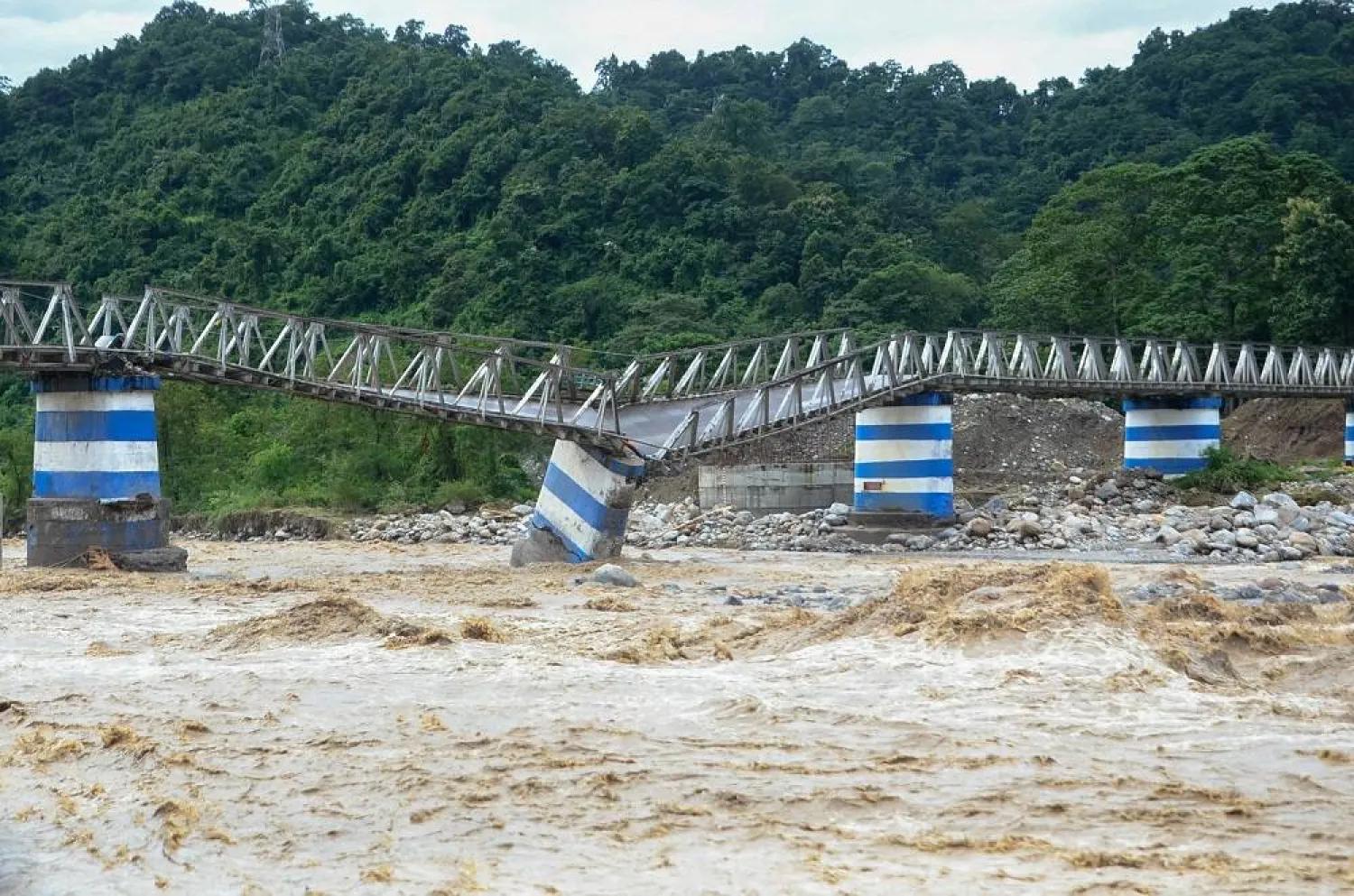
The collapsed Dudhia Iron Bridge over the Balason River after torrential rains in Darjeeling, India, October 5, 2025. (Reuters) 
TT

Rescuers in India Search for Missing After Landslides Kill 24 in Darjeeling Region 

The collapsed Dudhia Iron Bridge over the Balason River after torrential rains in Darjeeling, India, October 5, 2025. (Reuters) 

Rescuers were scouring India's northeastern tea-growing hill district of Darjeeling on Monday for those reported missing a day after landslides triggered by heavy downpours killed at least 24 people, officials said. 

Teams of Indian army personnel and members of the disaster response force were searching for people who are feared trapped under debris, said Udayan Guha, West Bengal state development minister. 

Downpours and road damage hampered efforts to reach several affected villages, officials said. Television news showed rescue workers using earth movers to clear the debris. 

Landslides triggered by intense rains destroyed homes and infrastructure and left hundreds of tourists stranded in Darjeeling over the weekend. Rainfall also caused two iron bridges to collapse, West Bengal Chief Minister Mamata Banerjee said in a post on X. 

India’s weather department has forecast heavy rainfall in the region to last until Tuesday. 

On Sunday, at least 44 people were killed in Nepal due to mudslides and flooding triggered by severe rainfall. The victims included at least 37 people in the eastern mountain district of Illam, where whole villages were swept away by landslides. 

The weekend’s heavy rainfall arrived at the end of Nepal’s monsoon season, which usually begins in June and ends by mid-September. It also left parts of the capital, Kathmandu, flooded and caused the cancellation of all domestic flights on Saturday. 

In a separate incident, rescuers were helping hundreds of hikers trapped by heavy snow at tourist campsites on a slope of Mount Everest in Tibet, Chinese state media said. 

About 350 hikers had reached a meeting point in Tingri country and rescuers were in contact with another 200, state broadcaster CCTV said late Sunday. There was no immediate update on rescue efforts on Monday. 

Cloudbursts, floods and landslides have caused significant loss of life and property in recent months across India. Flash floods swept away an entire village in the northern state of Uttarakhand in August. 

Extreme rains this year have caused flooding and landslides across the South Asian region, which includes India, Pakistan, Bangladesh, Bhutan, Sri Lanka, Afghanistan, Maldives and Nepal. 

Experts say human-caused climate change is intensifying South Asia’s monsoons, which traditionally run from June to September and again from October to December. The rains, once predictable, now arrive in erratic bursts that dump extreme amounts of water in short periods, followed by dry spells.  


Iran's Pezeshkian Says Tehran Seeks Peace, But Will Not Bow to Coercion

Iranian President Masoud Pezeshkian visits the Iranian Atomic Energy Organisation in Tehran, Iran, November 2, 2025. Iranian Atomic Organisation/WANA (West Asia News Agency)/Handout via REUTERS
TT

Iran's Pezeshkian Says Tehran Seeks Peace, But Will Not Bow to Coercion

Iranian President Masoud Pezeshkian visits the Iranian Atomic Energy Organisation in Tehran, Iran, November 2, 2025. Iranian Atomic Organisation/WANA (West Asia News Agency)/Handout via REUTERS

Iranian President Masoud Pezeshkian said on Friday that Iran seeks peace, but will not be coerced into abandoning its nuclear and missile programs, state media reported. US President Donald Trump said on Thursday that Iran had been asking if US sanctions against the country could be lifted.

"We are willing to hold talks under international frameworks, but not if they say you can't have a (nuclear) science, or the right to defend yourself (with missiles) or else we will bomb you," Pezeshkian said, Reuters reported.

Iran has repeatedly dismissed the possibility of negotiations over its defensive capabilities, including its missile program, and the idea of abandoning all enrichment of uranium on its soil.

"We want to live in this world in peace and security, but not be humiliated, and it is not acceptable that they impose upon us whatever they want and we just serve them," Pezeshkian said.

Israel sees Iran as an existential threat. But Iran says its ballistic missiles, with a range of up to 2,000 km (1,200 miles), are an important deterrent and retaliatory force against the United States, Israel and other potential regional targets. It denies seeking nuclear weapons.


Four Arrested after Protesters Disrupt Israeli Concert in Paris

A view shows streets Rue Ferdinand Flocon, one of the pedestrianized streets, ahead of the March 23 citywide vote on a proposition from city hall to pedestrianize 500 streets, in Paris, France, March 21, 2025. (Reuters)
TT

Four Arrested after Protesters Disrupt Israeli Concert in Paris

A view shows streets Rue Ferdinand Flocon, one of the pedestrianized streets, ahead of the March 23 citywide vote on a proposition from city hall to pedestrianize 500 streets, in Paris, France, March 21, 2025. (Reuters)

Four people were arrested after protesters used flares to disrupt a concert by the Israeli Philharmonic Orchestra in Paris on Thursday night, the latest in a wave of anti-Israel incidents linked to the Gaza conflict, French officials said on Friday.

In footage posted on social media, protesters were seen lighting flares and chanting pro-Palestinian slogans in La Philharmonie concert hall in northern Paris as some audience members and security personnel tried to remove them.

Despite the chaos and several interruptions, the concert went ahead after the protesters were evacuated, Reuters reported.

"I strongly condemn the actions committed last night during a concert at the Philharmonie de Paris. Nothing can justify them," Interior Minister Laurent Nunez said on X.

"I thank the personnel from the Paris police who enabled the rapid arrest of several perpetrators of serious disturbances inside the venue and contained the demonstrators outside. Four people have been placed in custody," he added.

The Paris prosecutor's office said three women and a man were in custody, on charges ranging from violence, destruction and organising an unauthorised protest.

Culture Minister Rachida Dati on X condemned the disruptions as going against the "fundamental rights of our Republic."

The Philharmonie said it had filed a criminal complaint.


Türkiye Preparing Law to Let PKK Fighters Return under Peace Plan

(FILES) Supporters display a poster depicting jailed leader of the Kurdistan Workers' Party (PKK) Abdullah Ocalan, after he called on the Kurdistan Workers' Party (PKK) to disarm and dissolve itself in Diyarbakir, southeastern Türkiye, on February 27, 2025.(Photo by Yasin AKGUL / AFP)
TT

Türkiye Preparing Law to Let PKK Fighters Return under Peace Plan

(FILES) Supporters display a poster depicting jailed leader of the Kurdistan Workers' Party (PKK) Abdullah Ocalan, after he called on the Kurdistan Workers' Party (PKK) to disarm and dissolve itself in Diyarbakir, southeastern Türkiye, on February 27, 2025.(Photo by Yasin AKGUL / AFP)

Türkiye is preparing a law to let thousands of Kurdistan Workers Party (PKK) fighters and civilians return home from hideouts in northern Iraq under negotiations to end generations of war.

A senior Middle East official and a Kurdish political party source in Türkiye said the proposed law would protect those returning home but stop short of offering a general amnesty for crimes committed by former militants. Some militant leaders could be sent to third countries under the plans.

Bringing PKK guerrillas and their families home from their bases in mountainous northern Iraq is seen as one of the final hurdles in a peace process launched a year ago to end a war that has killed 40,000 people.

While officials have spoken publicly about reconciliation efforts in general terms, the sources disclosed details that have not previously been reported, including proposals for returns to take place in separate waves of civilians and fighters, and for commanders to be sent to third countries.

The Middle East official, describing the sensitive negotiations on condition of anonymity, said legislation to allow the returns could come before the Turkish parliament as soon as this month.

PLAN COULD INCLUDE SEPARATE WAVES OF RETURNS

Türkiye‘s intelligence agency MIT, which has led talks with the PKK, did not immediately comment on the proposal. The PKK did not immediately comment.

Since Kurdish militants launched their insurgency in 1984 - originally with the aim of creating an independent Kurdish state - the conflict has exerted a huge economic and social burden on Türkiye and neighboring countries.

Ending it would boost NATO member Türkiye’s political and economic stability, and ease tensions in Iraq where the PKK is based, and Syria where Kurdish fighters have been allied with US forces.

In a major breakthrough, the PKK announced a decision in May to disarm and disband after a call to end its armed struggle from its jailed leader Abdullah Ocalan.

In July the group symbolically burned weapons, and last month it announced it was withdrawing fighters from Türkiye as part of the disarmament process. It called on Ankara to take steps to let its members participate in "democratic politics".

But the terms of reconciliation have been sensitive, with Türkiye wary of offering a wide amnesty for what it considers past crimes of a terrorist organization.

Numan Kurtulmus, who heads a reconciliation commission set up by Türkiye in August, said last week that any legal steps would come only after Türkiye verifies that the PKK has completed its dissolution process.

"Once Türkiye’s security and intelligence units have verified and confirmed that the organiئation has truly laid down its arms and completed its dissolution process, the country will enter a new phase of legal regulations aimed at building a terror-free Türkiye," he said.

According to the senior Middle East official, the proposal now being discussed would see roughly 1,000 civilians and non-combatants return first, followed by about 8,000 fighters after individual screening.

Beyond that, the official said Türkiye had so far rejected taking back around 1,000 senior and mid-level PKK figures, and wants them relocated to a third country, possibly in Europe.

Talks were ongoing on that issue, with some parties involved in the negotiations concerned that excluding PKK top brass from repatriation could eventually fuel a renewed insurgency, the official said.

Legislation to enable returns could come before the Turkish parliament as early as the end of November, the official added.

Tayip Temel, deputy co-chair of the pro-Kurdish DEM Party - which though an opposition party has worked closely with the government on the peace process - said the ongoing negotiations focused on a formula personally emphasiئed by Ocalan.

"Work is underway on a special law for the PKK to enable the democratic and social reintegration of its members," Temel told Reuters.

"The law will cover everyone returning from the PKK, whether civilian or militant. There is no plan for a phased return. The formula being worked on is comprehensive and applies to all."

He confirmed that Türkiye had raised the idea of some PKK figures being sent to third countries, but said this would have to be discussed with the potential hosts.

DIFFERENT PROCEDURES FOR DIFFERENT GROUPS

Another source at DEM, parliament's third-biggest party, said the commission drafting the proposal was working on a single, PKK-specific law that would avoid the language of a general amnesty.

"Different procedures will apply to different groups of returnees," the source said, adding that some returning PKK members will likely face investigations and trials. "Otherwise it will be hard to reach common ground among parties in the commission."

Once the parliamentary commission completes its work, it is expected to recommend the special PKK law to parliament, paving the way for potential legislation.

Human Rights Watch urged lawmakers to use the peace process to reform laws that have long been used to charge and incarcerate non-violent Kurdish activists.

The commission "has a unique opportunity to help shape a post-conflict society and should make bold recommendations to repeal abusive laws used to silence and marginalize people," said Hugh Williamson, Europe and Central Asia director at HRW.
