


China Takeover of Taiwan Would Threaten US Too, Taiwan President Says 

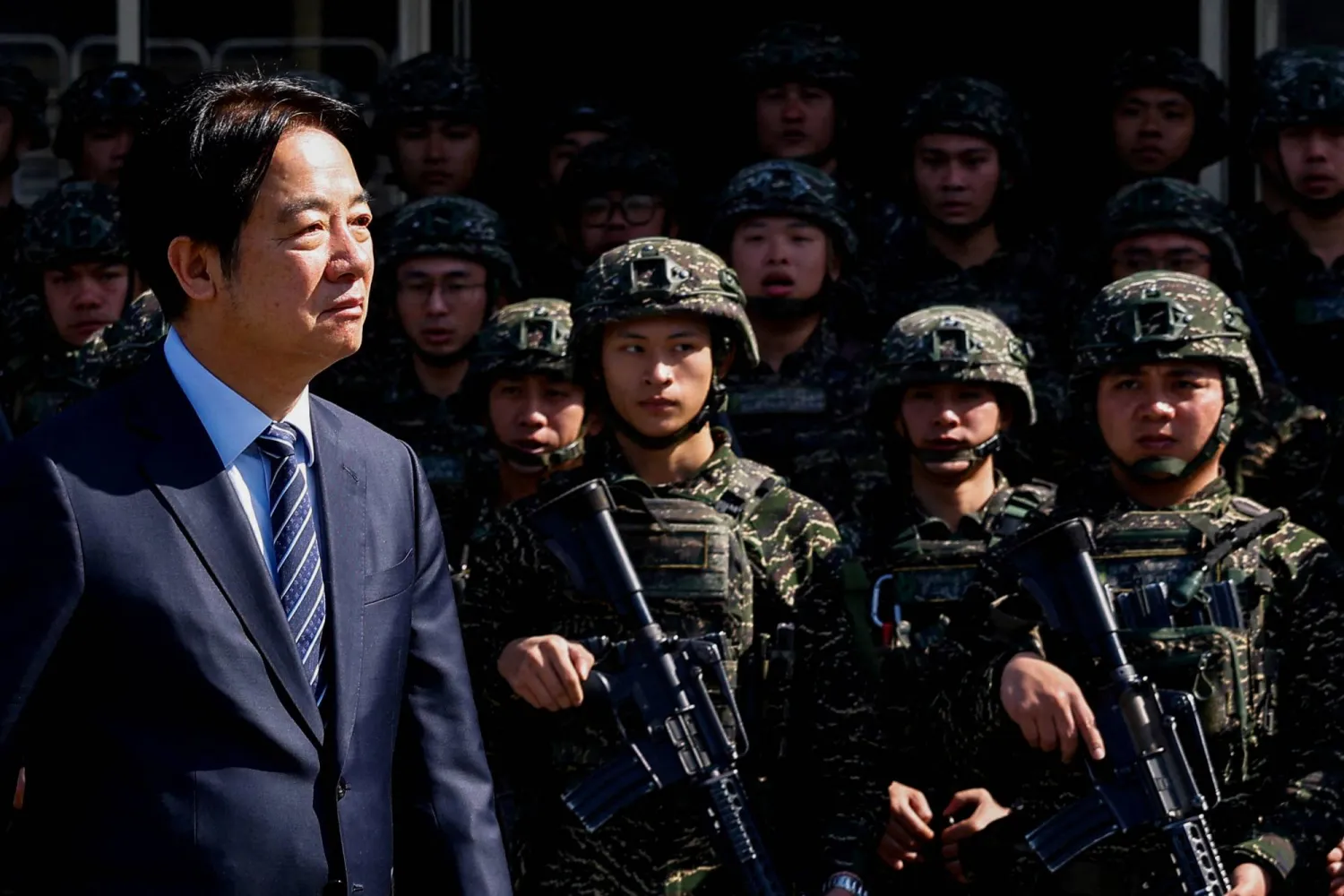
Taiwan's President Lai Ching-te pays a visit to Songshan airbase in Taipei, Taiwan March 21, 2025. (Reuters)
TT

China Takeover of Taiwan Would Threaten US Too, Taiwan President Says 

Taiwan's President Lai Ching-te pays a visit to Songshan airbase in Taipei, Taiwan March 21, 2025. (Reuters)

A Chinese takeover of Taiwan would threaten US homeland interests and further embolden Beijing to compete with Washington on the international stage, President Lai Ching-te told a conservative US radio show and podcast in an interview.

The United States is Chinese-claimed Taiwan's most important international backer, despite the absence of formal ties, but since President Donald Trump took office earlier this year he has not announced any new arms sales to the island.

Trump could meet Chinese President Xi Jinping at a meeting of Asia-Pacific leaders in South Korea later this month.

Lai was asked this week on The Clay Travis and Buck Sexton Show, which is carried on more than 400 talk radio stations, what he would tell the US president if he were to meet him, and he said he would advise Trump to pay attention to Xi's actions.

"I would advise him to pay particular attention to the fact that Xi Jinping is not only conducting increasingly large-scale military exercises in the Taiwan Strait, but is also expanding military forces in the East China Sea and South China Sea," Lai said, according to a transcript of his remarks released by the presidential office on Tuesday.

China's increasing military activities further and further from its own shores are not only a challenge for Taiwan, Lai said.

"The challenge extends beyond merely annexing Taiwan. Once Taiwan is annexed, China will gain greater strength to compete with the United States on the international stage, undermining the rules-based international order," he said.

"Ultimately, this will also impact US homeland interests. Therefore, I hope President Trump will continue to uphold peace and stability in the Indo-Pacific."

China's foreign ministry did not immediately respond to a request for comment about Lai's remarks.

Given the lack of formal ties, Taiwanese presidents do not speak directly to or meet US presidents.

Taiwan, along with major Western allies, has worked to address Washington's concerns that it is not spending enough on its own defense - Lai has set a target of defense spending to reach 5% of gross domestic product by 2030.

"I will tell them that Taiwan is absolutely determined to safeguard its national security," Lai told the show, when asked about how he would show the United States the island's resolve to defend itself.

"When Taiwan protects itself, it is also committing to maintaining regional peace and stability," he added.

The United States, which is bound by law to provide Taiwan with the means to defend itself, has long stuck to a policy of "strategic ambiguity," not making clear whether it would respond militarily to a Chinese attack on Taiwan.

Lai rejects Beijing's sovereignty claims, saying only the island's people can decide their future. China calls Lai a "separatist" and has repeatedly rebuffed his offers of talks.


Trump Hints at Land Strike as Venezuela Pressure Mounts

A US Air Force C-130J Super Hercules aircraft approaches for landing at Rafael Hernandez Airport, amid tensions between US President Donald Trump's administration and the government of Venezuelan President Nicolas Maduro, in Aguadilla, Puerto Rico, December 28, 2025. (Reuters)
TT

Trump Hints at Land Strike as Venezuela Pressure Mounts

A US Air Force C-130J Super Hercules aircraft approaches for landing at Rafael Hernandez Airport, amid tensions between US President Donald Trump's administration and the government of Venezuelan President Nicolas Maduro, in Aguadilla, Puerto Rico, December 28, 2025. (Reuters)

A throwaway remark last week by President Donald Trump has raised questions about whether US forces may have carried their first land strike against drug cartels in Venezuela.

Trump said the US knocked out a "big facility" for producing trafficking boats, as he was discussing his pressure campaign against Venezuelan President Nicolas Maduro in an interview broadcast Friday.

"They have a big plant or a big facility where they send, you know, where the ships come from," Trump said in an interview with billionaire supporter John Catsimatidis on the WABC radio station in New York.

"Two nights ago we knocked that out. So we hit them very hard."

Trump did not say where the facility was located or give any other details. US forces have carried out numerous strikes in both the Caribbean Sea and eastern Pacific Ocean since September, killing more than 100 people.

The Pentagon referred questions about Trump's remarks to the White House. The White House did not respond to requests for comment from AFP.

There has been no official comment from the Venezuelan government.

Trump has been saying for weeks that the United States will "soon" start carrying out land strikes targeting drug cartels in Latin America, but there have been no confirmed attacks to date.

The Trump administration has been ramping up pressure on Maduro, accusing the Venezuelan leader of running a drug cartel himself and imposing an oil tanker blockade.

Maduro has accused Washington of attempting regime change.


UN Chief Says ‘Get Serious’ in Grim New Year Message

 UN Secretary-General Antonio Guterres. (AFP)
UN Secretary-General Antonio Guterres. (AFP)
TT

UN Chief Says ‘Get Serious’ in Grim New Year Message

 UN Secretary-General Antonio Guterres. (AFP)
UN Secretary-General Antonio Guterres. (AFP)

The United Nations urged global leaders Monday to focus on people and the planet in a New Year's message depicting the world in chaos.

"As we enter the new year, the world stands at a crossroads. Chaos and uncertainty surround us. Division. Violence. Climate breakdown. And systemic violations of international law," UN Secretary-General Antonio Guterres said in a video message.

In 2026, as war rages in Ukraine and elsewhere, world leaders must work to ease human suffering and fight climate change, he added.

"I call on leaders everywhere: Get serious. Choose people and planet over pain," said Guterres, criticizing the global imbalance between military spending and financing for the poorest countries.

Military spending is up nearly 10 percent this year to $2.7 trillion, which is 13 times total world spending on development aid and equivalent to the entire gross domestic product of Africa, he said.

Wars are raging at levels unseen since World War II, he added.

"In this New Year, let's resolve to get our priorities straight. A safer world begins by investing more in fighting poverty and less in fighting wars. Peace must prevail," said Guterres, who will be serving his last year as secretary general.


Türkiye and Armenia Agree to Simplify Visa Procedures to Normalize Ties

Türkiye’s President Recep Tayyip Erdogan, right, and Armenia's Prime Minister Nikol Pashinyan shake hands before a meeting at Prague Castle in Prague, Czech Republic, Thursday, Oct. 6, 2022. (Turkish Presidency via AP, File)
TT

Türkiye and Armenia Agree to Simplify Visa Procedures to Normalize Ties

Türkiye’s President Recep Tayyip Erdogan, right, and Armenia's Prime Minister Nikol Pashinyan shake hands before a meeting at Prague Castle in Prague, Czech Republic, Thursday, Oct. 6, 2022. (Turkish Presidency via AP, File)

Türkiye and Armenia have agreed to simplify visa procedures as part of efforts to normalize ties, Türkiye’s Foreign Ministry announced Monday, making it easier for their citizens to travel between the two countries.

Relations between Türkiye and Armenia have long been strained by historic grievances and Türkiye’s alliance with Azerbaijan. The two neighboring countries have no formal diplomatic ties and their joint border has remained closed since the 1990s.

The two countries, however, agreed to work toward normalization in 2021, appointing special envoys to explore steps toward reconciliation and reopening the frontier. Those talks have progressed in parallel with efforts to ease tensions between Armenia and Azerbaijan.

Türkiye supported Azerbaijan during its 2020 conflict with Armenia for control of the Karabakh region, known internationally as Nagorno-Karabakh, a territorial dispute that had lasted nearly four decades.

The Turkish Foreign Ministry said in a statement posted on social platform X that Ankara and Yerevan agreed that holders of diplomatic, special and service passports from both countries would be able to obtain electronic visas free of charge as of Jan. 1.

“On this occasion, Türkiye and Armenia reaffirm once again their commitment to continue the normalization process between the two countries with the goal of achieving full normalization without any preconditions,” the ministry said.

Türkiye and Armenia also have a more than century-old dispute over the deaths of an estimated 1.5 million Armenians in massacres, deportations and forced marches that began in 1915 in Ottoman Türkiye. Historians widely view the event as genocide.

Türkiye denies the deaths constituted genocide, saying the toll has been inflated and those killed were victims of civil war and unrest. It has lobbied to prevent countries from officially recognizing the massacres as genocide.
