

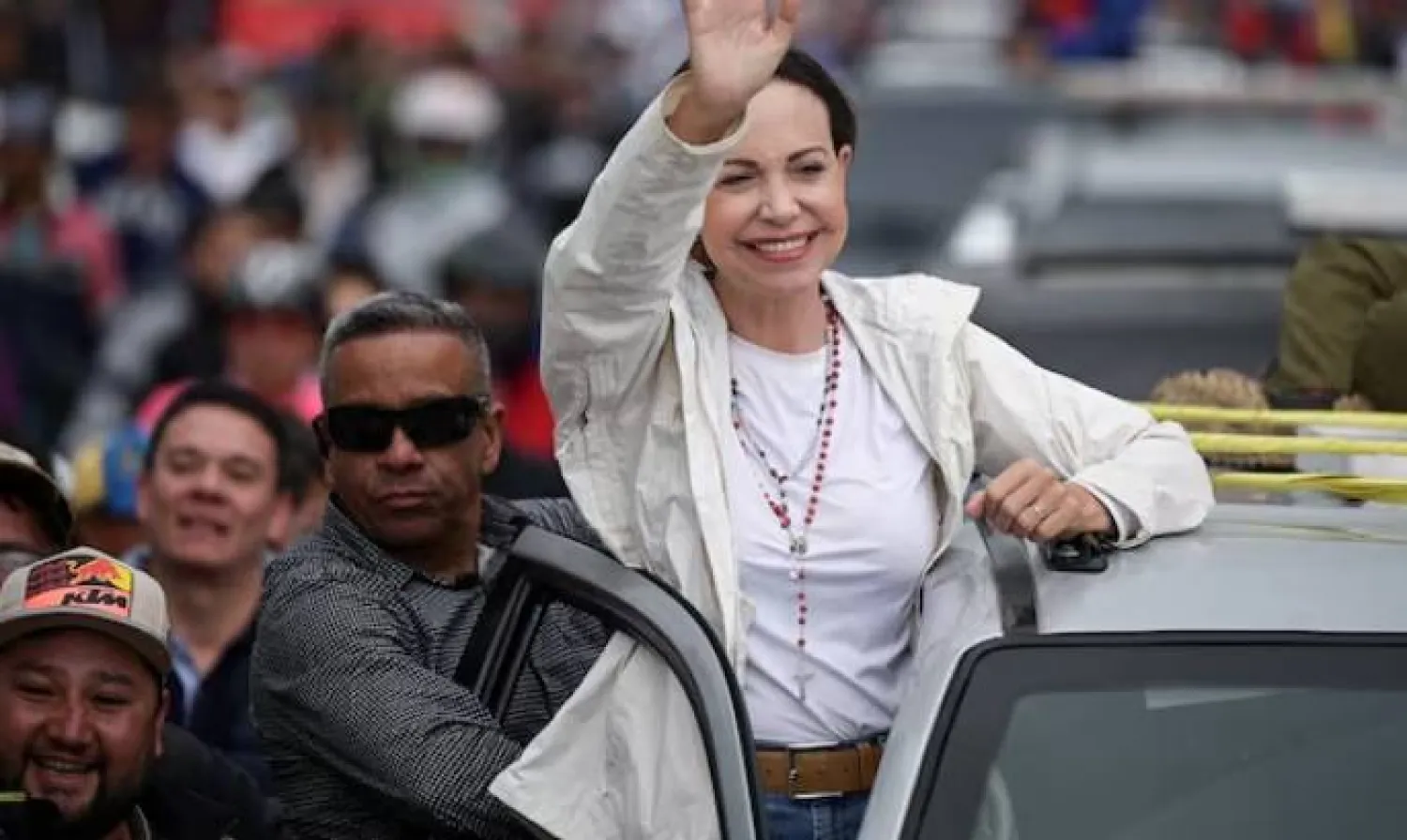

Opposition Activist María Corina Machado of Venezuela Wins the Nobel Peace Prize

Venezuelan opposition leader Maria Corina Machado greets supporters during a campaign rally for the presidential election, in Merida state, Venezuela June 25, 2024. REUTERS/Gaby Oraa
TT

Opposition Activist María Corina Machado of Venezuela Wins the Nobel Peace Prize

Venezuelan opposition leader Maria Corina Machado greets supporters during a campaign rally for the presidential election, in Merida state, Venezuela June 25, 2024. REUTERS/Gaby Oraa

Opposition activist María Corina Machado of Venezuela won the Nobel Peace Prize on Friday. 

The former opposition presidential candidate in Venezuela was lauded for being a “key, unifying figure in a political opposition that was once deeply divided — an opposition that found common ground in the demand for free elections and representative government,” said Jørgen Watne Frydnes, chair of the Norwegian Nobel committee. 

“In the past year, Miss Machado has been forced to live in hiding. Despite serious threats against her life, she has remained in the country, a choice that has inspired millions. When authoritarians seize power, it is crucial to recognize courageous defenders of freedom who rise and resist.” 

President Nicolás Maduro's government routinely targeted its real or perceived opponents ahead of last year’s presidential election, The Associated Press said. 

Machado was set to run against Maduro, but the government disqualified her. Edmundo González took her place. He had never run for office before. The lead-up to the election saw widespread repression including disqualifications, arrests and human rights violations. 

The crackdown on dissent only increased after the country’s National Electoral Council, which is stacked with Maduro loyalists, declared him the winner despite credible evidence to the contrary. 

The election results announced by the Electoral Council sparked protests across the country to which the government responded with force and ended with more than 20 people dead. They also prompted an end to diplomatic relations between Venezuela and various foreign countries, including Argentina. 

Machado went into hiding and has not been seen in public since January. A Venezuelan court issued an arrest warrant for González, who moved to Spain and was granted asylum. 

Last year, Machado and González were awarded the European Union’s top human rights honor, The Sakharov Prize. 

There had been persistent speculation ahead of the announcement about the possibility of the prize going to US President Donald Trump, fueled in part by the president himself, amplified by this week’s approval of his plan for a ceasefire in the Gaza Strip. 

Asked about lobbying for and by Trump, Frydnes said: “I think this committee has seen any type of campaign, media attention. We receive thousands and thousands of letters every year of people wanting to say what for them leads to peace. 

"This committee sits in a room filled with the portraits of all laureates, and that room is filled with both courage and integrity. So we base only our decision on the work and the will of Alfred Nobel.” 

Last year's award went to Nihon Hidankyo, a grassroots movement of Japanese atomic bombing survivors who have worked for decades to maintain a taboo around the use of nuclear weapons. 

The peace prize is the only one of the annual Nobel prizes to be awarded in Oslo, Norway. 

Four of the other prizes have already been awarded in the Swedish capital, Stockholm this week — in medicine on Monday, physics on Tuesday, chemistry on Wednesday and literature on Thursday. The winner of the prize in economics will be announced on Monday. 


Venezuela's Maduro Back in US Court after Stunning Capture

(FILES) Venezuela's President Nicolas Maduro looks on during a meeting at the National Assembly in Caracas on August 22, 2025. (Photo by Juan BARRETO / AFP)
TT

Venezuela's Maduro Back in US Court after Stunning Capture

(FILES) Venezuela's President Nicolas Maduro looks on during a meeting at the National Assembly in Caracas on August 22, 2025. (Photo by Juan BARRETO / AFP)

Ousted Venezuelan president Nicolas Maduro will appear Thursday in a New York court for the second time since his capture by US forces in an extraordinary nighttime raid.

Maduro, 63, and wife Cilia Flores have been held in a Brooklyn jail for almost three months after American commandos snatched the pair from their compound in Caracas in early January, said AFP.

The stunning operation deposed the strongman who had led Venezuela since 2013 and has since forced the oil-rich country to largely bend to the will of US President Donald Trump.

Maduro has declared himself a "prisoner of war" and pleaded not guilty to the four counts of "narco-terrorism" conspiracy, cocaine importation conspiracy, possession of machine guns and destructive devices, and conspiracy to possess machine guns and destructive devices.

Thursday's hearing at 11:00 am (1500 GMT) will likely see Maduro push for the dismissal of his case as lawyers tussle over who will pay the former leader's legal fees.

Venezuela's government is seeking to cover the costs, but because of Washington's sanctions, his lawyer Barry Pollack must obtain a US license that has not been issued.

Pollack argued in a court submission that the license requirement violated Maduro's constitutional right to legal representation and demanded the case be thrown out on procedural grounds.

- Deadly raid -

Detained in Brooklyn's Metropolitan Detention Center, a federal prison known for unsanitary conditions, Maduro is reportedly alone in a cell with no access to the internet or newspapers.

A source close to the Venezuelan government said the incarcerated Maduro reads the Bible and is referred to as "president" by some of his fellow detainees.

He is only allowed to communicate by phone with his family and lawyers for a maximum of 15 minutes per call, the source added.

"The lawyers told us he is strong. He said we must not be sad," said his son, Nicolas Maduro Guerra, adding his father told him: "We are fine, we are fighters."

Maduro and his wife were forcibly taken by US commandos in the early hours of January 3 in airstrikes on the Venezuelan capital backed by warplanes and a heavy naval deployment.

At least 83 people died and more than 112 people were injured in the assault, according to Venezuelan officials. No US service members were killed.

- US pressure -

At his first US court appearance in January, Maduro struck a defiant tone as he identified himself the president of Venezuela despite being captured.

The South American country is now led by Delcy Rodriguez, who had been Maduro's vice president since 2018.

Under US pressure, she is grappling with leading a country saddled with the world's largest proven oil reserves but an economy in shambles.

Rodriguez has since enacted a historic amnesty law to free political prisoners jailed under Maduro and reformed oil and mining regulations in line with US demands for access to her country's vast natural wealth.

This month, the State Department said it was restoring diplomatic ties with Venezuela in a sign of thawing relations.

Security is expected to be heightened around the New York courthouse for Thursday's hearing.

Presiding over the case is Alvin Hellerstein, a 92-year-old judge credited with overseeing several high-profile trials during his decades on the bench.


Bus Sinks in Bangladesh River, Many Killed

Rescue teams conduct search operations and look for victims, a day after a bus plunged into the Padma River while boarding a ferry in Rajbari district, 84 km from Dhaka, Bangladesh, 26 March 2026. EPA/STR
TT

Bus Sinks in Bangladesh River, Many Killed

Rescue teams conduct search operations and look for victims, a day after a bus plunged into the Padma River while boarding a ferry in Rajbari district, 84 km from Dhaka, Bangladesh, 26 March 2026. EPA/STR

A bus carrying about 50 people plunged into a major river in central Bangladesh as it was driving onto a ferry, leaving at least 18 people dead, authorities said Thursday.

The bus plunged into the Padma River on Wednesday afternoon in Rajbari district, about 84 kilometers (52 miles) from the capital, Dhaka, said fire official Dewan Sohel Rana.

The bus was traveling to the capital from the southwestern district of Kushtia as people return to work after the Islamic festival of Eid al-Fitr, The Associated Press said.

Rana said many of the passengers swam to safety after the accident but others got trapped.

A rescue vessel joined the operation late Wednesday and lifted the bus, he said, and rescuers worked overnight to recover bodies, finding 18 by Thursday morning.

Strong currents and rains disrupted the rescue operations overnight, he said.

It was not clear if there was still anyone missing.

Ten women and two children were among the dead, according to the Fire Service and Civil Defense Department.


US Activists Work to Connect Iranians Via Starlink

Iranian women walk at Pardisan Park, amid the US-Israeli conflict with Iran, in Tehran, Iran, March 25, 2026. Majid Asgaripour/WANA (West Asia News Agency) via REUTERS
TT

US Activists Work to Connect Iranians Via Starlink

Iranian women walk at Pardisan Park, amid the US-Israeli conflict with Iran, in Tehran, Iran, March 25, 2026. Majid Asgaripour/WANA (West Asia News Agency) via REUTERS

With the war in Iran leading to a near-total internet blackout in the country, activists around the world -- especially in the United States -- are mobilizing to help Iranians stay connected via Starlink.

Despite being banned, billionaire Elon Musk's satellite internet system has gained ground in Iran thanks to a network of international activists, multiple people involved in these efforts told AFP.

The digital activists' efforts began in 2022, when mass protests broke out following the death of Mahsa Amini, who was being held by Iran's police for violating the country's strict dress code for women.

- Smuggling networks -

"As of this year, we have more than 300 devices that we have delivered to the country," said Emilia James of the US-based organization NetFreedom Pioneers. She declined to go into further detail to protect the operation and the users, said AFP.

Ahmad Ahmadian, executive director of Holistic Resilience, explained that his organization purchased Starlink devices in European countries or elsewhere, before moving them into Iran via "neighboring countries."

The government cracked down hard on the Starlink terminals in 2025, and those caught using them face imprisonment.

Charges may be enhanced if the device is found to have been sent by a US organization, Ahmadian pointed out.

His group has supplied "up to 200" antennas to individuals in Iran, and has facilitated the sale of "more than 5,000 Starlink devices" by connecting ordinary citizens with underground resellers, he said.

This approach is less risky for both the activists and for the users.

For these reasons, Holistic Resilience taps smuggling networks and provides security tips and usage instructions remotely.

- Astronomical costs -

To get a Starlink antenna on the black market, Iranians previously had to shell out around "$800 or $1,000" at the end of 2025, Ahmadian recalled, a prohibitive amount for many.

Then there's the issue of paying for usage.

The devices can -- theoretically, at least -- provide internet to an entire family or apartment building.

But in practice, usage remains "limited" because "the costs are still prohibitive for most users," according to NetFreedom Pioneers' Emilia James.

For those that can afford the fees, Visa and Mastercard payments do not work in Iran, forcing users to find workarounds.

Since the bloody crackdown on protesters in January, free usage has been granted for new subscribers. However, the cost of terminals has skyrocketed to some $4,000, according to Ahmadian.

Demand is not the only factor driving up costs.

Many of the terminals were brought into Iran through the "southern borders and through the waterways," Ahmadian said.

The closure of the Straight of Hormuz due to the war "suppresses the supply" of the devices.

- 'More than 50,000' -

While the number of terminals within Iran is not publicly known, Ahmadian estimates that "there are more than 50,000 Starlink terminals in Iran, for sure."

For her part, James estimates that there are "tens of thousands" of Starlink devices in the country of 92 million.

Starlink did not respond to AFP requests for details.

James said that she has heard reports of Iranian authorities searching rooftops and balconies for the antennas since the start of the war.

And earlier this month, a man described as the head of a network that sold internet access via Starlink was arrested by Iranian authorities.
