

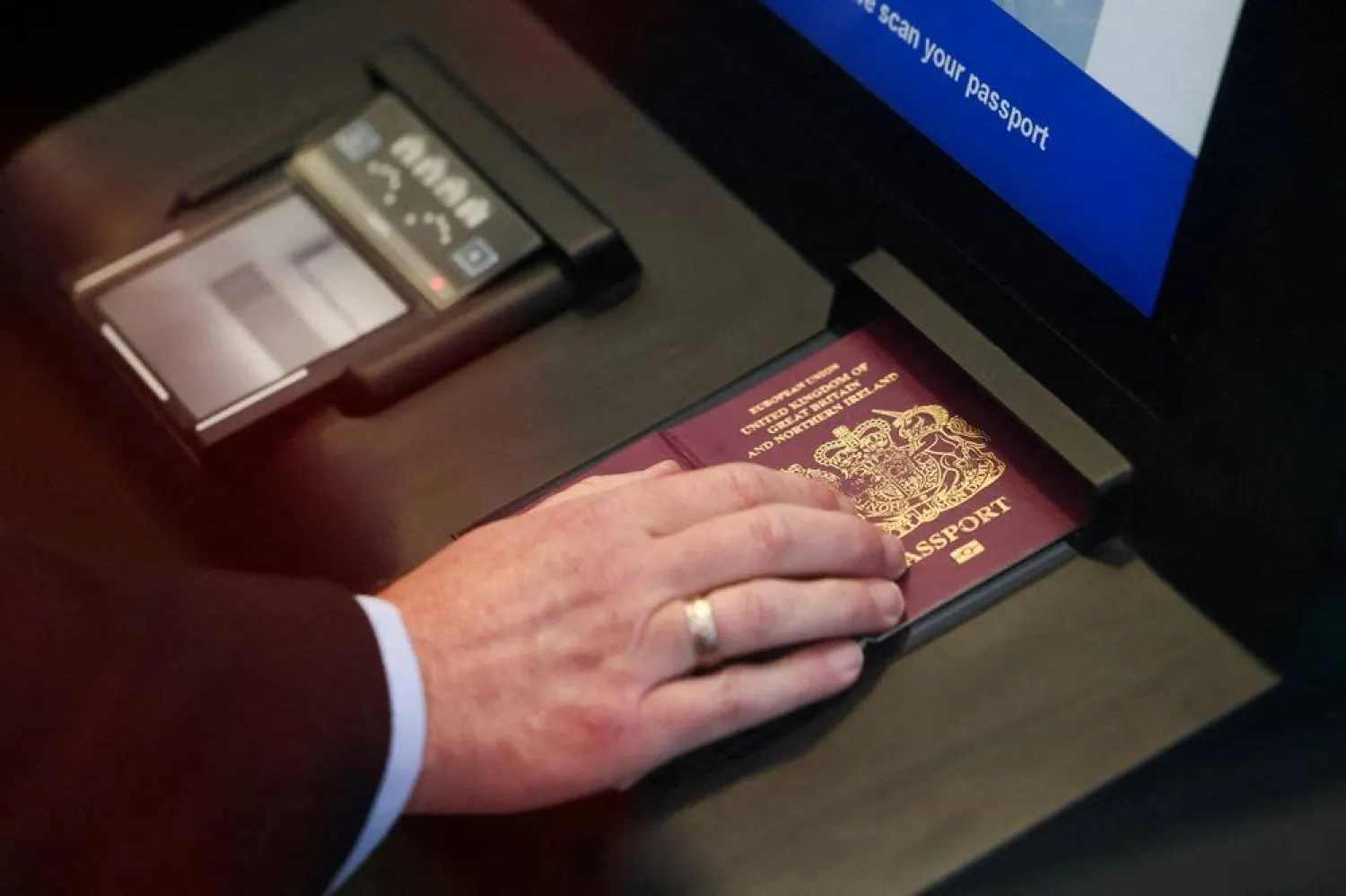

EU Begins Gradual Rollout of Digital Border System

A man scans his passport during a demonstration of the European Union's Entry/Exit System (EES) at the Eurotunnel terminal in Folkestone, Britain, September 23, 2025. (Reuters)
TT

EU Begins Gradual Rollout of Digital Border System

A man scans his passport during a demonstration of the European Union's Entry/Exit System (EES) at the Eurotunnel terminal in Folkestone, Britain, September 23, 2025. (Reuters)

European Union member countries began rolling out a new entry and exit system on Sunday at the bloc’s external borders, electronically registering non-EU nationals' data.

The Entry/Exit System (EES), an automated system that requires travelers to register at the border by scanning their passport and having their fingerprints and photograph taken, will be introduced over six months.

The move is aimed at detecting overstayers, tackling identity fraud and preventing illegal migration amid political pressure in some EU countries to take a tougher stance.

"The Entry/Exit System is the digital backbone of our new common European migration and asylum framework,” European Internal Affairs and Migration Commissioner Magnus Brunner said in a statement.

SIX MONTHS TO ADJUST

Non-EU citizens will have to register their personal details when they first enter the Schengen area - all EU member countries apart from Ireland and Cyprus, but including Iceland, Norway, Switzerland and Liechtenstein. Subsequent journeys will only require facial biometric verification.

The system should be fully operational, with passport stamping replaced with electronic records, on April 10, 2026.

"Every third country national who arrives at an external border will undergo identity verification, security screening, and registration in the EU databases," Brunner said, adding that "the six-month rollout gives member states, travelers, and businesses time to transition smoothly to the new procedures".

For British travelers using the Port of Dover, the Eurotunnel terminal at Folkestone or Eurostar terminal at London's St Pancras International, the process will take place at the border before they leave the UK.

At Dover and the Eurotunnel terminal, only freight and coach traffic will be subject to EES checks from Sunday.

Passenger vehicle checks will follow in November at Dover and by the end of the year at Eurotunnel, while the Eurostar at St Pancras will gradually introduce the new process starting with some business travelers from Sunday.

"We recognize that EES checks will be a significant change for British travelers, which is why we have worked closely with our European partners to ensure the rollout goes as smoothly as possible," British Minister for Border Security and Asylum Alex Norris said.

"The UK and EU have a shared objective of securing our borders and these modernization measures will help us protect our citizens and prevent illegal migration," Norris said.



Russia Says It Hopes for New Round of Ukraine Talks with US as Soon as Conditions Allow

FILE PHOTO: Kremlin spokesman Dmitry Peskov looks on as Russia's President Vladimir Putin (not pictured) and Togo's President of the Council of Ministers Faure Gnassingbe (not pictured) meet at the Kremlin in Moscow, Russia November 19, 2025. REUTERS/Ramil Sitdikov/Pool/File Photo
TT

Russia Says It Hopes for New Round of Ukraine Talks with US as Soon as Conditions Allow

FILE PHOTO: Kremlin spokesman Dmitry Peskov looks on as Russia's President Vladimir Putin (not pictured) and Togo's President of the Council of Ministers Faure Gnassingbe (not pictured) meet at the Kremlin in Moscow, Russia November 19, 2025. REUTERS/Ramil Sitdikov/Pool/File Photo

Russia is in contact with the United States about a new round of talks on a Ukraine peace settlement as soon as conditions allow, the Kremlin said on Thursday.

"We remain open, we are in contact with the Americans, and we are counting on holding the next round of talks as soon ‌as circumstances permit," ‌Kremlin spokesman Dmitry Peskov said.

Peskov rejected ‌the ⁠thesis of a ⁠New York Times opinion piece that said the Iran war had caused President Vladimir Putin to lose interest in negotiating an end to the Ukraine conflict, Reuters reported.

"This is an absolutely false invention that does not correspond to reality. During the rounds of trilateral talks that ⁠have taken place, some progress was made ‌toward a settlement," Peskov told ‌reporters.

Peskov said Russia had not lost interest in peace ‌talks but added that key issues - including territory - had ‌yet to be settled.

The NYT opinion piece, by Russian journalist Mikhail Zygar, said Russia's economy had been faltering earlier this year, prompting Putin at that point to take negotiations on ‌a Ukraine settlement more seriously.

However, Zygar said the Iran war had reversed those dynamics by ⁠boosting ⁠oil prices, easing the economic pressure on Moscow and reducing the US focus on Ukraine, weakening any incentive for the Kremlin to seek a settlement.

Earlier this week, Kremlin aide Yuri Ushakov said the US had briefed Russia about Washington's latest round of talks with a Ukrainian delegation in Florida, which took place last Saturday.

The last three-way peace talks between Russia, Ukraine and the US took place last month, before the Trump administration and Israel began airstrikes against Iran on February 28.


Pentagon Reportedly Weighs Diverting Ukraine Military Aid to the Middle East

FILE - The Pentagon and the surrounding area is seen in this aerial view in Washington, Jan. 26, 2020. (AP Photo/Pablo Martinez Monsivais, File)
TT

Pentagon Reportedly Weighs Diverting Ukraine Military Aid to the Middle East

FILE - The Pentagon and the surrounding area is seen in this aerial view in Washington, Jan. 26, 2020. (AP Photo/Pablo Martinez Monsivais, File)

The Pentagon is weighing whether to redirect weapons originally meant for Ukraine to the Middle East, as the war in Iran strains supplies of some of the US military's most critical munitions, the Washington Post reported Thursday, citing three people familiar with the matter.

The weapons that could be redirected include air defense interceptor missiles purchased through a NATO initiative launched last year, under which ⁠partner countries buy ⁠US arms for Kyiv, the report said.

The consideration comes as US operations in the region intensify. Admiral Brad Cooper, the Central Command chief leading US forces in the Middle East, on Wednesday said the US had hit ⁠over 10,000 targets inside Iran and was on track to limit Iran's ability to project power outside its borders.

A Pentagon spokesperson told the newspaper that the Defense Department would "ensure that US forces and those of our allies and partners have what they need to fight and win."

In response to a query about the report, a NATO official said members of ⁠the ⁠alliance and its partners continue to contribute to its Prioritized Ukraine Requirements List (PURL) program that funds the supply of US arms for Kyiv.

"Equipment is continuously flowing into Ukraine," the official added. "The amount pledged to PURL so far is of several billion US dollars and we expect more contributions to follow."

The Pentagon and the US State Department did not immediately respond to Reuters' requests for comment.


Israel Defense Minister Says Iran Guards Navy Commander Killed in Strike

(FILES) This handout photo provided by Iran's Revolutionary Guard Corps (IRGC) official website Sepah News on February 1, 2025, shows navy commander Admiral Alireza Tangsiri. (Photo by SEPAH NEWS / AFP)
TT

Israel Defense Minister Says Iran Guards Navy Commander Killed in Strike

(FILES) This handout photo provided by Iran's Revolutionary Guard Corps (IRGC) official website Sepah News on February 1, 2025, shows navy commander Admiral Alireza Tangsiri. (Photo by SEPAH NEWS / AFP)

Defense Minister Israel Katz announced on Thursday that an Israeli airstrike had killed Alireza Tangsiri, commander of the Iranian Revolutionary Guards' navy.

"Last night, in a precise and lethal operation, the IDF eliminated the commander of the Revolutionary Guards' navy, Tangsiri, along with senior officers of the naval command," Katz said in a video statement.

"The man who was directly responsible for the terrorist operation of mining and blocking the Strait of Hormuz to shipping was blown up and eliminated."

Since the start of the joint US-Israeli attacks on Iran on February 28, Israel has announced the killing of several top Iranian officials, including supreme leader Ali Khamenei and the security chief, Ali Larijani.

In recent days, Israeli forces have carried out several strikes targeting the naval assets of Iran.

Last week, Israeli airstrikes hit several Iranian naval ships in the Caspian Sea, including ones equipped with missile systems, support vessels and patrol craft.
