


Russia’s Lavrov Says Trump’s Plan Is ‘Too Vague’ on Palestinian Statehood 

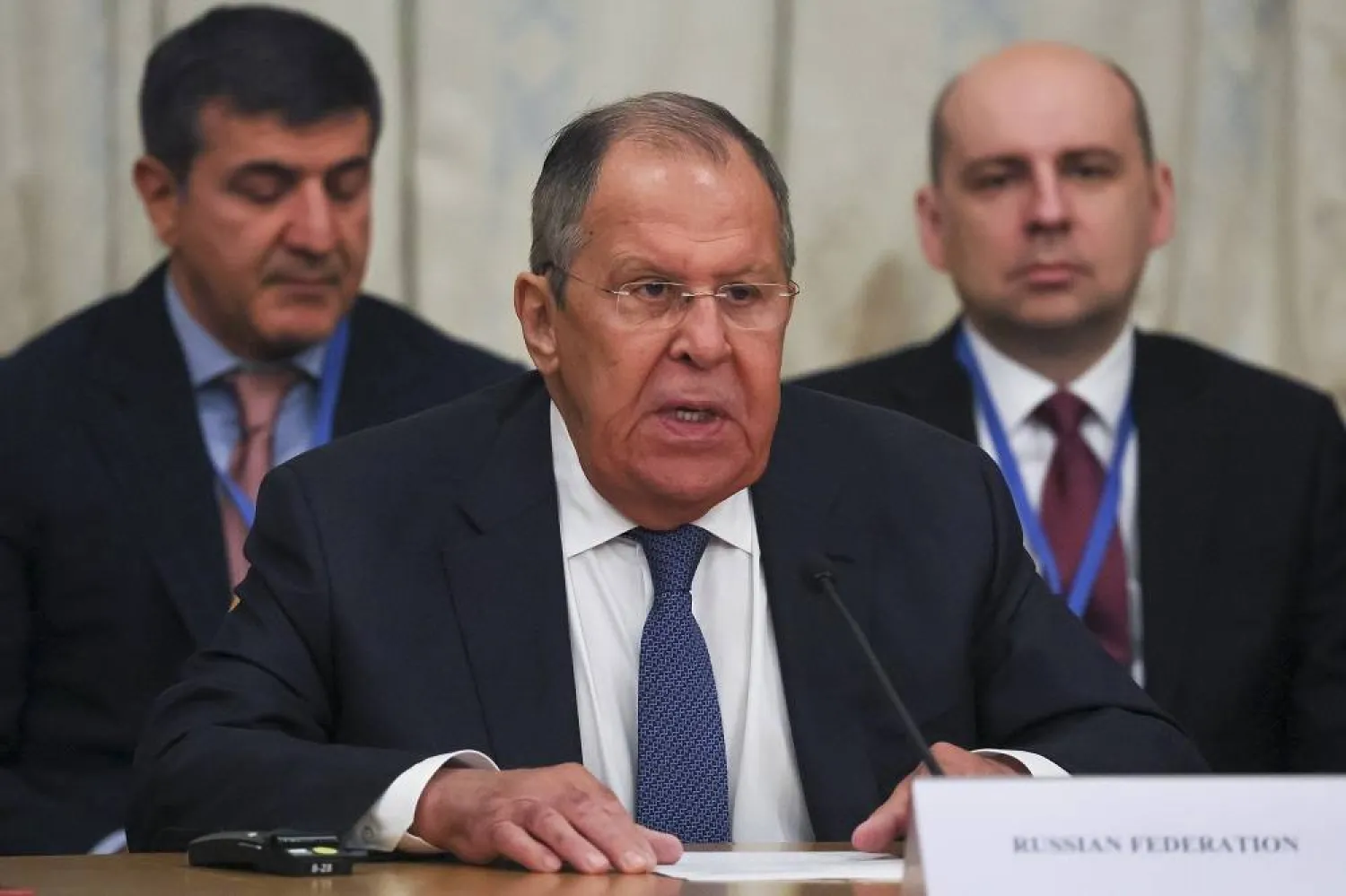
Russian Foreign Minister Sergei Lavrov delivers his speech at the 7th meeting of the Moscow Format of Consultations on Afghanistan in Moscow, Russia, 07 October 2025. (EPA)
TT

Russia’s Lavrov Says Trump’s Plan Is ‘Too Vague’ on Palestinian Statehood 

Russian Foreign Minister Sergei Lavrov delivers his speech at the 7th meeting of the Moscow Format of Consultations on Afghanistan in Moscow, Russia, 07 October 2025. (EPA)

Russian Foreign Minister Sergei Lavrov said on Monday that US President Donald Trump's plan to settle the Palestinian-Israeli conflict only dealt with Gaza and was not specific enough on Palestinian statehood. 

"We have noted that Donald Trump's peace plan only addresses the Gaza Strip. It mentions statehood, but in rather general terms," Lavrov told reporters from Arab countries. 

"It's imperative to flesh out these approaches, including defining what will happen in the West Bank." 

It was Moscow's clearest statement so far that it does not see the Trump plan as sufficiently detailed and far-reaching - although Lavrov also said Russia hoped all the agreements reached between Israel and Hamas under the plan would be implemented. 

President Vladimir Putin said last week that Russia was ready to help peace efforts, using its contacts with all parties in the region. 


Trump Expected to Tell Türkiye He is Ready to Restore Access to F-35 jets, NYT Reports

US President Donald Trump and Turkish President Recep Tayyip Erdoğan during the NATO summit in The Hague in 2025 (Turkish Presidency)
TT

Trump Expected to Tell Türkiye He is Ready to Restore Access to F-35 jets, NYT Reports

US President Donald Trump and Turkish President Recep Tayyip Erdoğan during the NATO summit in The Hague in 2025 (Turkish Presidency)

US President Donald ‌Trump is expected to tell Turkish President Recep Tayyip Erdogan that he is prepared to allow the country to rejoin the F-35 stealth fighter program, the New York Times reported on Monday, citing four senior administration officials.

The report comes as Trump heads to Ankara for a NATO summit, where he is expected to meet Erdogan. The summit is set to begin on Tuesday ‌evening, said Reuters.

According to ‌the New York Times report, ‌the ⁠officials differed on the ⁠details of how Trump would seek to work around congressional and legal restrictions, but suggested there could be an exchange of letters on the subject between the two leaders.

The White House did not immediately respond to Reuters' request for ⁠comment on the report.

Türkiye’s 2019 acquisition ‌of the Russian ‌S-400 air defense system has soured ties with the United ‌States and hampered congressional support for Ankara. ‌In response, Washington imposed sanctions and removed Türkiye from the F-35 fighter jet program.

Congress also passed a law prohibiting any sales of F-35s to Türkiye as long ‌as Ankara remained in possession of the S-400s, saying the Russian system poses ⁠a security ⁠risk to US-made combat aircraft.

The issue has remained a major point of contention between the two countries even though Türkiye enjoys warmer ties with Washington under Trump.

The reported development is a sign of improving ties between the two countries, especially after Trump’s administration formally notified Congress of its intention to sell dozens of jet engines worth more than $700 million to Türkiye last month, according to a copy of the formal notification seen by Reuters.


Iran Issues Security Directives to Control Narrative Around Khamenei Funeral

Satellite image of Tehran’s Grand Mosalla during the funeral ceremony for former Iranian Supreme Leader Ali Khamenei in Tehran, July 5, 2026. (Planet Labs/Reuters) 
TT

Iran Issues Security Directives to Control Narrative Around Khamenei Funeral

Satellite image of Tehran’s Grand Mosalla during the funeral ceremony for former Iranian Supreme Leader Ali Khamenei in Tehran, July 5, 2026. (Planet Labs/Reuters) 

Iran’s security agencies have ordered media outlets and public relations departments at state institutions to adhere to a unified framework when covering news and analysis related to the funeral of former Supreme Leader Ali Khamenei, in an effort to tightly manage the public narrative during one of the country’s most sensitive political moments since the leadership transition.

The directives, obtained by Asharq Al-Awsat, instruct media organizations to reinforce specific messaging, remove accounts that deviate from the official narrative, and portray the funeral as proof of the continuity of the leadership and the resilience of the political system in the face of what the document describes as the enemy’s “cognitive warfare.”

The document treats the funeral as a political, security, and media event simultaneously. It instructs outlets to depict public attendance as a unique “human shield” and as a “strategic declaration of loyalty” to Khamenei’s legacy and the Iranian Revolution’s “strategic depth.”

Media observers in Tehran said the directives reflect an effort to shape public opinion and curb media pluralism during a delicate transitional period.

The guidance requires coverage to revolve around three themes: “continuity of leadership,” “continuity of resistance,” and “a bright future.” It warns that inconsistent messaging would create space for competing narratives and urges all media to adopt a unified account on behalf of what it calls the “Front of the Revolution.”

The document also calls for highlighting the attendance of foreign delegations and republishing favorable analyses from Western media in domestic outlets as evidence of the success of Iran’s public diplomacy and the failure of efforts to isolate the country despite sanctions.

It instructs media to counter arguments by supporters of the former Pahlavi monarchy while avoiding defensive responses, instead emphasizing what it describes as the regime’s achievements in the nuclear, missile, and regional arenas.

Emphasis is placed on rebutting narratives of a “succession vacuum” and an “uncertain future.” The directives call for calm, well-documented explanations of Iran’s constitutional succession process to prevent what they describe as a cascading collapse in public confidence.

The guidance also bans coverage that could inflame political or sectarian divisions, urging media to stress national unity and consensus.

Media are further instructed to portray the funeral crowds as a historic display comparable to the 1979 Iranian Revolution and a decisive rebuttal to predictions of state collapse. They are encouraged to use statistics, photographs, and field reports to project national strength and cohesion, while incorporating deterrent messages emphasizing Iran’s military readiness and continued commitment to the “path of resistance.”

Finally, the directives warn against what they describe as pessimistic analyses or forecasts rooted in fear and uncertainty, urging media instead to promote an image of “a proud and advancing Iran” through what the document calls the “engineering of hope,” while affirming that “Iran’s future is bright and remains connected to the path of the Imam and the leadership.”


Iran Fires Two Missiles at Commercial Ships in Strait of Hormuz, Axios Report

Vessels in the Strait of Hormuz (Reuters) 
TT

Iran Fires Two Missiles at Commercial Ships in Strait of Hormuz, Axios Report

Vessels in the Strait of Hormuz (Reuters) 

Iran's Revolutionary Guards fired at least two missiles at commercial ships transiting through the Strait of Hormuz on Monday night, Axios reported, citing two US officials.

Two commercial ships suffered significant damage but had no casualties, the report said, citing a US official.

Separately, Britain's maritime security agency said a tanker caught fire after being hit by an unknown projectile early on Tuesday.

The United Kingdom Maritime Trade Operations (UKMTO) said the incident took place eight nautical miles east of Limah, Oman, according to AFP.

“A tanker has reported being hit by an unknown projectile on the port side causing a fire, whilst travelling southbound,” UKMTO said in a post on X.

The agency said there were no reports of casualties or environmental damage.

“Vessels are advised to transit with caution and report any suspicious activity to UKMTO,” the agency added, saying authorities were investigating.

Since March, a number of commercial vessels came under attack in the Strait of Hormuz when Iran blockaded the waterway in response to US-Israeli attacks.

In return, the United States imposed its own naval blockade and later launched retaliatory strikes against Iran after accusing Tehran of targeting commercial shipping.

Maritime traffic resumed after Washington and Tehran signed a memorandum of understanding on June 17 aimed at ending the conflict and reopening the strategic route.

However, Iran has insisted there will be no return to pre-war arrangements, under which vessels could pass freely through the strait.

Tehran has warned ships against using routes outside a corridor it has authorized along its coastline.
