
Iranian President: We Will Never Concede to Pressure, Bow to Aggressors

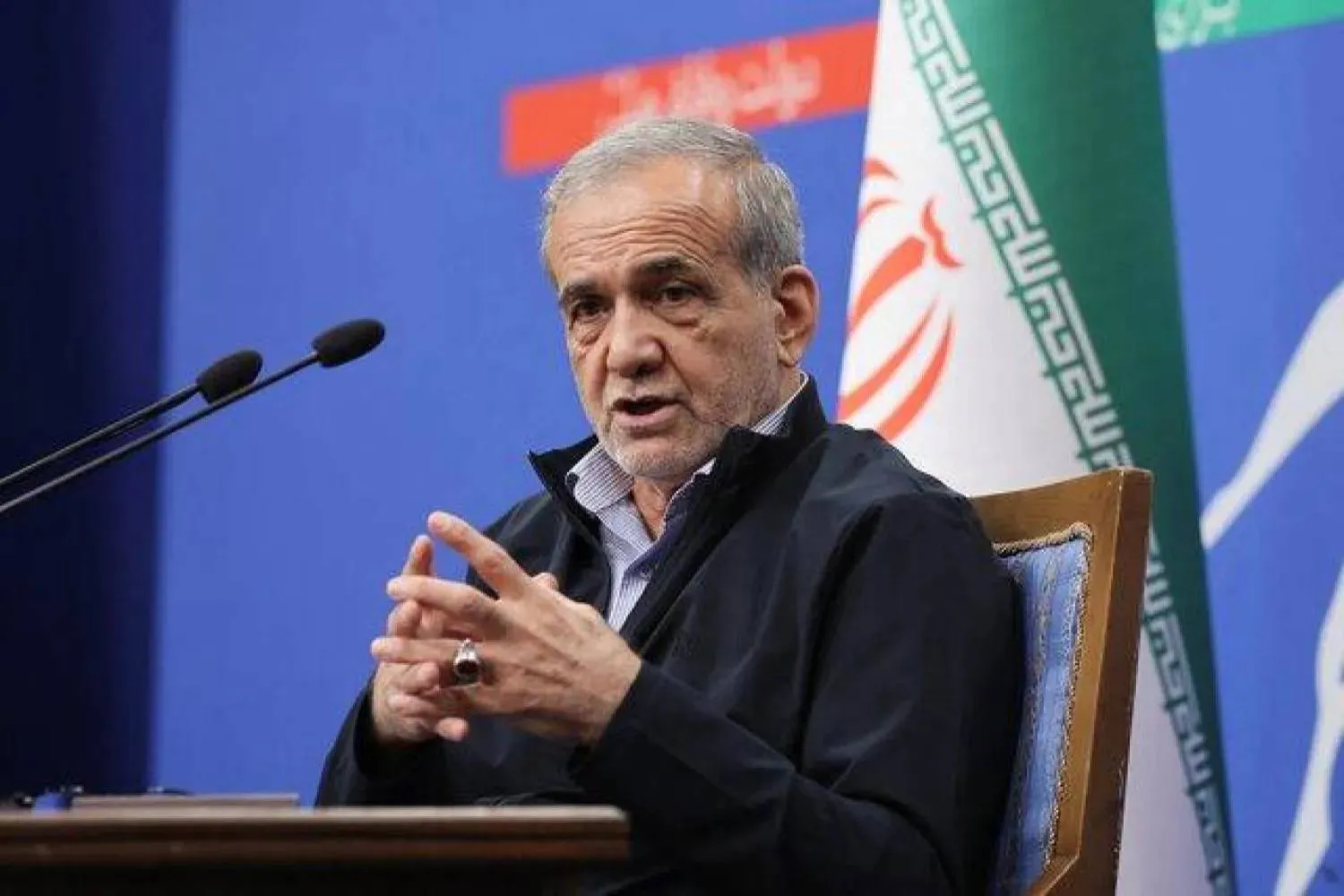
Iranian President Masoud Pezeshkian (Reuters)
TT

Iranian President: We Will Never Concede to Pressure, Bow to Aggressors

Iranian President Masoud Pezeshkian (Reuters)

Iranian President Masoud Pezeshkian said on Monday that a country like Iran, with 16 neighbors, cannot be easily sanctioned.

“If we effectively manage our relationships with our neighbors, we can successfully overcome external pressures,” Pezeshkian said in a meeting with governors from across Iran on Monday.

He then urged the Interior Minister to consult with heads of border provinces and organize a plan on interaction and cooperation with their counterparts in neighboring countries.

The President emphasized that Iran has no intention to oppress anyone. “But we will never yield to force and bow down in the face of aggressors,” he noted.

Last month, three European powers, the UK, France and Germany, triggered the reimposition of international sanctions on Iran, accusing Tehran of spurning diplomacy and nuclear inspections.

Also, since he resumed office in January, US President Donald Trump reinstated the “maximum pressure” campaign of US sanctions on Tehran.

On Sunday, the US state department told Iran International that Washington remains ready for “serious and direct dialogue” with Tehran, hours after Iranian leaders declined invitations to attend a Gaza peace summit in Egypt chaired by Trump.

“We are ready to talk directly,” a state department spokesperson said. “The United States has kept the door open for serious and direct dialogue, even as Iran has consistently rejected negotiations.”

“Should the Iranians want to negotiate, the ball is in their court,” the spokesperson added, quoting Trump. “They are the ones that stand to benefit from the negotiation.”

Last week at a cabinet meeting in the White House, Trump said Iran told the administration it was in favor of the Israel-Hamas ceasefire and hostage deal and that the US would work with Tehran.

“We'd like to see them be able to rebuild their country too, but they can't have a nuclear weapon,” said Trump.

His comments came while the US Treasury Department imposed sanctions on about 100 individuals, entities and vessels, including a Chinese independent refinery and terminal, that helped Iran's oil and petrochemicals trade.

Meanwhile, Ali Shamkhani, an adviser to Iran’s Supreme Leader Khamenei, said “sanctions prevent any country in the world from cooperating with us seriously on armaments.”

The adviser said he wishes he had pursued a nuclear weapon in the late 1990s and, asked if he would do so were he back in that role, he answered: “Yes, I certainly would.”

On the downing of Ukraine International Airlines on January 8, 2020 by Iranian Revolutionary Guards surface-to-air missiles, Shamkhani said: “I knew, and the president knew.”

Shamkhani also discussed the killing of former President Ebrahim Raisi in an Iranian Air Force helicopter crash near the village of Uzi, East Azerbaijan.

When asked whether Raisi’s death was connected to Israel, he said, “In the investigators’ inquiry, no signs of foreign interference were found in the president’s death. However, it cannot be ruled out that something beyond the technical capabilities of the investigation has occurred.”


Dam Reservoir Levels Drop Below 3% in Iran's Second City

A general view shows part of the Iranian capital Tehran on June 13, 2025. (AFP)
TT

Dam Reservoir Levels Drop Below 3% in Iran's Second City

A general view shows part of the Iranian capital Tehran on June 13, 2025. (AFP)

Water levels at the dam reservoirs supplying Iran's northeastern city of Mashhad plunged below three percent, media reported Sunday, as the country suffers from severe water shortages.

"The water storage in Mashhad's dams has now fallen to less than three percent," Hossein Esmaeilian, the chief executive of the water company in Iran's second largest city by population, told ISNA news agency.

He added that "the current situation shows that managing water use is no longer merely a recommendation -- it has become a necessity".

Mashhad, home to around four million people, relies on four dams for its water supply.

Esmaeilian said consumption in the city had reached around "8,000 liters per second, of which about 1,000 to 1,500 liters per second is supplied from the dams".

It comes as authorities in Tehran warned over the weekend of possible rolling cuts to water supplies in the capital amid what officials call the worst drought in decades.

In the capital, five major dams supplying drinking water are at "critical" levels, with one empty and another at less than eight percent of capacity, officials say.

"If people can reduce consumption by 20 percent, it seems possible to manage the situation without rationing or cutting off water," Esmaeilian said, warning that those with the highest consumption could face supply cuts first.

Nationwide, 19 major dams -- about 10 percent of the country's reservoirs -- have effectively run dry, Abbasali Keykhaei of the Iranian Water Resources Management Company said in late October, according to Mehr news agency.

President Masoud Pezeshkian has cautioned that without rainfall before winter, even Tehran could face evacuation, though he did not elaborate.

The water crisis in Iran follows month of drought across the country.

Authorities over the summer announced public holidays in Tehran to cut back on water and energy consumption as the capital faced almost daily power outages during a heatwave.

Local papers on Sunday slammed what they described as the politicization of environmental decision-making for the water crisis.

The reformist Etemad newspaper cited the appointment of "unqualified managers... in key institutions" as being the main cause of the crisis.

Shargh, another reformist daily, said that "climate is sacrificed for the sake of politics".


Spanish PM Calls for Stronger Ties with Mexico After Colonialism Row

Spain's Prime Minister Pedro Sanchez speaks during the COP30 leaders' summit in Belem, Brazil, 07 November 2025. (EPA)
TT

Spanish PM Calls for Stronger Ties with Mexico After Colonialism Row

Spain's Prime Minister Pedro Sanchez speaks during the COP30 leaders' summit in Belem, Brazil, 07 November 2025. (EPA)

Spanish Prime Minister Pedro Sanchez on Sunday said improving ties with Mexico is a priority for his government after years of diplomatic tensions over Spain's colonial past.

Sanchez acknowledged the "light and shadow" in their shared history during an interview with El Pais daily, stressing that recognizing both is key to building stronger relations.

"I can guarantee that for Spain, normalizing our relations with a country we consider very close is a priority," he said.

The prime minister highlighted Mexico's support for Spanish exiles after the 1936–39 civil war, noting the historic and cultural bonds between the two nations.

Relations have been strained in recent years due to calls by Mexican leaders for an official apology from Spain for colonial-era abuses.

In 2019, then-President Andres Manuel Lopez Obrador sent a letter to Spain’s King Felipe VI demanding an apology for the abuses committed during the 1519–1521 Spanish conquest of Mexico and the ensuing three centuries of colonial rule.

Spain rejected the request while the king did not respond publicly.

The issue resurfaced last month when Mexican President Claudia Sheinbaum renewed calls for an official apology.

In response, Spain's Foreign Minister Jose Manuel Albares acknowledged the "pain and injustice" inflicted on Indigenous peoples during the Spanish conquest of the Americas.

"There was injustice -- it is only fair to recognize it today, and fair to regret it. Because that is also part of our shared history, and we cannot deny or forget it," he added.

Mesoamerica, a region that comprised parts of Mexico and Central America, had an estimated population of 15 million to 30 million people when conquistador Hernan Cortes arrived with an army of several hundred men, bringing horses, swords, guns -- and smallpox -- in 1519.

After a century of battles, massacres and plagues, only an estimated one million to two million Indigenous inhabitants remained.


UK Sends Defense Equipment to Help Belgium Deal with Disruptive Drones

Passengers in the departures terminal after several cancellations and delays due to reported overnight drone activity over Brussels International Airport in Zaventem, Wednesday, Nov. 5, 2025. (AP Photo/Virginia Mayo)
TT

UK Sends Defense Equipment to Help Belgium Deal with Disruptive Drones

Passengers in the departures terminal after several cancellations and delays due to reported overnight drone activity over Brussels International Airport in Zaventem, Wednesday, Nov. 5, 2025. (AP Photo/Virginia Mayo)

Britain is sending experts and equipment to Belgium to help it combat disruptive drone sightings, which have temporarily closed airports, the head of the British military said on Sunday.

Drones have been spotted over airports and military bases in Belgium in the last week, having caused major disruption across Europe in recent months, Reuters said.

Richard Knighton, head of Britain's armed forces, told the BBC that his Belgian counterpart had asked for assistance and that equipment and personnel were on the way.

"The defense secretary and I agreed at the end of last week that we would deploy our people and our equipment to Belgium to help them," he said, without giving details of what sort of equipment would be sent or how many personnel.

Knighton said it was not known yet who was behind the drone sightings, but noted Russia has been involved in a pattern of "hybrid warfare" in recent years.

Russia has denied any connection with the incidents.

Drones spotted flying over airports serving the capital, Brussels, and Liege, in the country's east, forced the diversion of many incoming planes and the grounding of some due to depart on Tuesday.

Drone sightings also forced the temporary closures of airports in several countries including Sweden on Thursday.

The German defense minister suggested a link on Friday between recent drone incidents in Belgium and discussions over the use of frozen Russian assets, held by Belgian financial institution Euroclear, to fund a large loan to Ukraine.