
John Bolton, Former Trump Adviser, Charged with Sharing Classified Information 

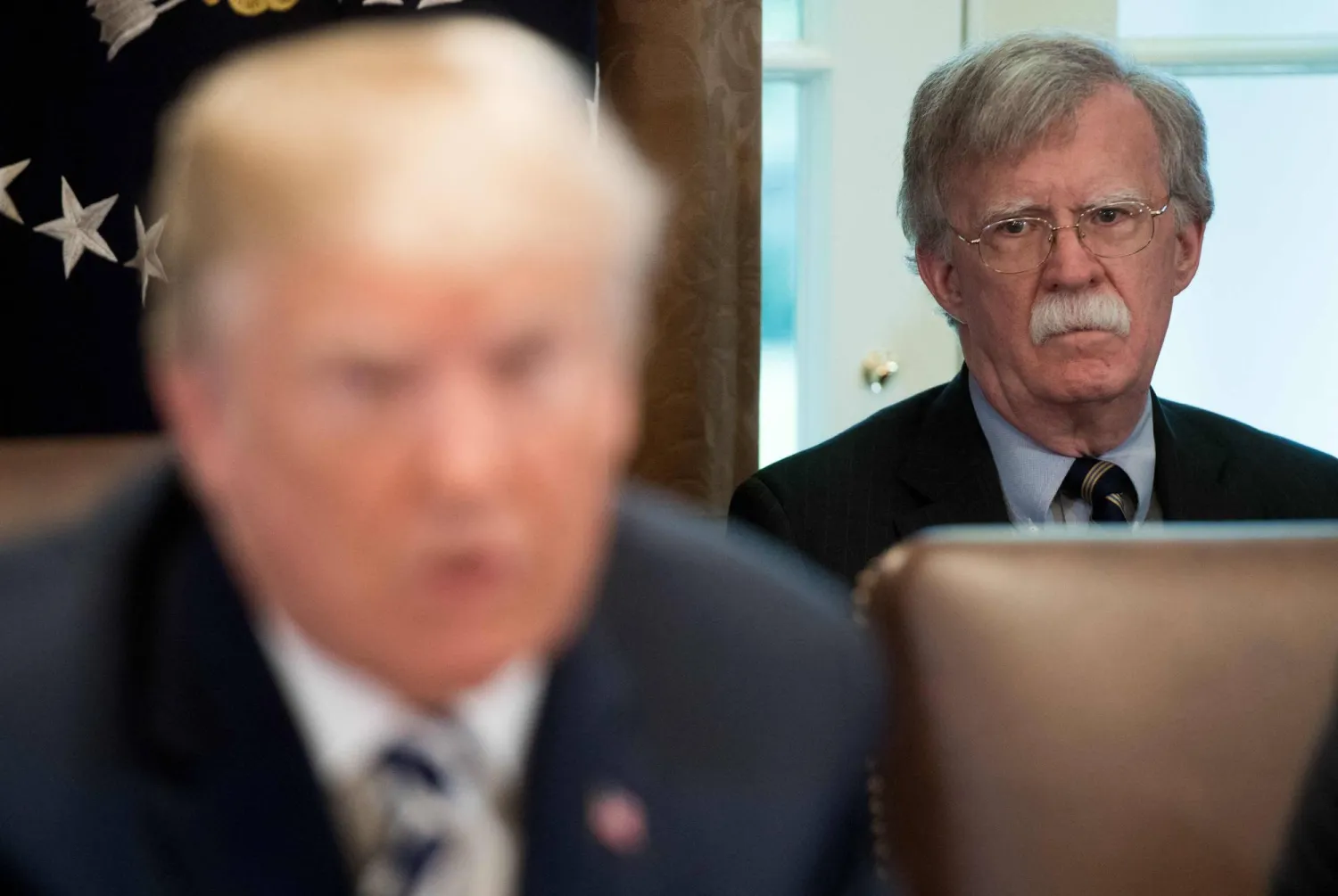
US President Donald Trump speaks alongside National Security Adviser John Bolton (R) during a Cabinet Meeting in the Cabinet Room of the White House in Washington, DC, May 9, 2018. (AFP)
TT

John Bolton, Former Trump Adviser, Charged with Sharing Classified Information 

US President Donald Trump speaks alongside National Security Adviser John Bolton (R) during a Cabinet Meeting in the Cabinet Room of the White House in Washington, DC, May 9, 2018. (AFP)

John Bolton, President Donald Trump's former national security adviser, was charged on Thursday in a sweeping indictment that accuses him of sharing sensitive government information with two of his relatives for possible use in a book he was writing.

The indictment marked the third time in recent weeks the Justice Department has secured criminal charges against one of Trump's critics.

The indictment says the notes Bolton shared with his two relatives in electronic messages included information he gleaned from meetings with senior government officials, discussions with foreign leaders, and intelligence briefings.

In some of the chats, Bolton and his relatives - whom the indictment does not identify - discussed using some of the material for a book. Bolton referred to the two people with whom he shared his daily notes as his "editors," the indictment said.

"Talking with [book publisher] because they have a right of first refusal!" Bolton wrote in one message, according to the indictment.

The two relatives referred to in the indictment are Bolton's wife and daughter, two people familiar with the matter said, reported Reuters.

In a statement, Bolton said, "I look forward to the fight to defend my lawful conduct and to expose his abuse of power."

Bolton's lawyer, Abbe Lowell, said Bolton did not unlawfully share or store any information.

Trump, a Republican who campaigned for the presidency on a vow of retribution after facing a slew of legal woes once his first term in the White House ended in 2021, has dispensed with decades-long norms designed to insulate federal law enforcement from political pressures.

In recent months, he has actively pushed Attorney General Pam Bondi's Justice Department to bring charges against his perceived adversaries including former FBI Director James Comey and New York Attorney General Letitia James, even driving out a prosecutor he deemed to be moving too slowly in doing so.

The investigation of Bolton was opened in 2022, predating the Trump administration. Inside the Justice Department, the case is viewed as stronger than the prosecutions of Comey and James, according to a person familiar with the matter.

The indictment of Bolton, filed in federal court in Maryland, charges him with eight counts of transmission of national defense information and 10 counts of retention of national defense information, all in violation of the Espionage Act.

No court appearance date was listed for Bolton as of Thursday evening.

Each count is punishable by up to 10 years in prison if Bolton is convicted, but any sentence would be determined by a judge based on a range of factors.

Asked by reporters at the White House about the Bolton indictment on Thursday, Trump said: "He's a bad guy."

BOLTON'S EMAIL ALLEGEDLY HACKED

Bolton served as White House national security adviser during Trump's first term before emerging as one of the president's most vocal critics. Bolton, also a former US ambassador to the United Nations, described Trump as unfit to be president in a memoir he released last year.

In the indictment, prosecutors said Bolton shared more than a thousand pages of information about his day-to-day activities as national security adviser, including top-secret information, with the two unauthorized people from April 2018 to August 2025.

The indictment said a "cyber actor" tied to the Iranian government hacked Bolton's personal email after he left government service and accessed classified information. Prosecutors said a representative for Bolton told the government about the hack but did not report that he stored classified information in the email account.

Trump himself was previously indicted on Espionage Act violations for allegedly transporting classified records to his Florida home after departing the White House in 2021 and refusing repeated requests by the government to return them. Trump had pleaded not guilty and that case was dropped after he won reelection in November 2024.

OTHER TRUMP FOES CHARGED

The Justice Department has already indicted Comey, who investigated Trump's 2016 presidential campaign, and James, who previously brought a civil fraud case against Trump and his family real estate company.

Comey, whom Trump fired in 2017, is facing charges of making false statements to Congress and obstruction of Congress. He has pleaded not guilty.

James is facing charges of bank fraud and making false statements to a financial institution. She has denied wrongdoing and is slated to appear in federal court later this month.

In those two cases, the indictments were secured solely by Lindsey Halligan, a Trump loyalist who was appointed US Attorney after her predecessor, Erik Siebert, was ousted for failing to pursue both matters due to a lack of evidence.

The indictment of Bolton was signed by Maryland US Attorney Kelly Hayes, who has been a federal prosecutor since 2013 and has held multiple leadership roles. The indictment also bore the names of several career prosecutors, including Thomas Sullivan, who leads the Maryland office's national security division.

Nevertheless, the Justice Department still runs the risk of being viewed as unfairly selective in its decision to prosecute Bolton for Espionage Act violations.

Earlier this year, US Defense Secretary Pete Hegseth drew scrutiny for sharing details about the imminent attack against Yemen's Iran-aligned Houthis in a Signal message group that included his wife, brother, personal lawyer, as well as a journalist from the Atlantic magazine.

Legal experts suggested that sharing these sensitive details of the Yemen attack appeared to violate the Espionage Act, but the case was quickly closed and the Justice Department took no apparent steps to criminally investigate the incident.

Trump administration officials denied that any classified information was shared.


Death Toll from Russian Strikes in Ukraine Rises to 12

Ukrainian service members of the 260th Zaporizhzhia Separate Territorial Defence Brigade of the Ukrainian Armed Forces load a 152-mm shell for a D‑20 howitzer before firing towards Russian troops at a frontline position, amid Russia’s attack on Ukraine, in the Zaporizhzhia region, Ukraine, April 9, 2026. REUTERS/Stringer
TT

Death Toll from Russian Strikes in Ukraine Rises to 12

Ukrainian service members of the 260th Zaporizhzhia Separate Territorial Defence Brigade of the Ukrainian Armed Forces load a 152-mm shell for a D‑20 howitzer before firing towards Russian troops at a frontline position, amid Russia’s attack on Ukraine, in the Zaporizhzhia region, Ukraine, April 9, 2026. REUTERS/Stringer

Russian strikes killed at least 12 people in Ukraine, local authorities said on Thursday, after Moscow pummeled its neighbor in overnight attacks.

Missile and drone attacks on the southern port city of Odesa killed six people, the head of the city's military administration Sergiy Lysak wrote on Telegram.

Strikes on the capital Kyiv killed at least four people, including a 12-year-old, the State Emergency Service of Ukraine said, while another two people died in the central city of Dnipro, according to Oleksandr Ganzha, head of the regional administration.

Moscow has fired hundreds of drones on its neighbor almost nightly since the beginning of the four-year war, with Kyiv regularly carrying out strikes within Russia in response to its attacks, AFP said.

Russia's overnight attack on Ukraine triggered a missile alert in the capital Kyiv, where the head of the capital's military administration Tymur Tkachenko warned residents to shelter until the warning was lifted.

In Kyiv, rescuers pulled a child from the rubble of a residential building that collapsed in the Podilsky district, Klitschko said.

The attack on the capital wounded at least 10 people, including several medics, he said.

A blaze broke out at a building in the capital's Obolonsky district where missile debris fell, and cars were on fire, he added.

A drone strike on Ukraine's northeastern city of Kharkiv wounded a 77-year-old woman and a 66-year-old man, the head of the regional military administration Oleg Synegubov said on Telegram.

Five people were wounded in an attack in the southern port city of Odesa, the head of the city's military administration Sergiy Lysak said on Telegram.


Pakistani Army Chief Visits Tehran in Bid to Broker Renewed Talks between US and Iran

Image published by the Iranian Foreign Ministry of Araghchi receiving Pakistani Army Chief Asim Munir in Tehran on Wednesday.
TT

Pakistani Army Chief Visits Tehran in Bid to Broker Renewed Talks between US and Iran

Image published by the Iranian Foreign Ministry of Araghchi receiving Pakistani Army Chief Asim Munir in Tehran on Wednesday.

Pakistan’s army chief is set to meet with Iranian officials in Tehran on Thursday in a bid to ease tensions in the Middle East and arrange a second round of negotiations between the United States and Iran after almost seven weeks of war.

The White House said any further talks would likely take place in the Pakistani capital of Islamabad, though no decision had been made on whether to resume negotiations.

The US naval blockade of Iranian ports continued as US Treasury Secretary Scott Bessent said the Trump administration would ramp up economic pain on Iran with new economic sanctions on countries doing business with it, calling the move the “financial equivalent” of a bombing campaign.

Pakistan has emerged as a key mediator after it hosted direct talks between the US and Iran in Islamabad that authorities said helped narrow differences between the two sides. Mediators are seeking a new round before the ceasefire expires next week.

Meanwhile, Trump wrote late Wednesday on Truth Social that leaders from Israel and Lebanon would speak the next day in a renewed effort to broker a ceasefire after the countries' first direct talks in decades ended the previous day in Washington without a deal. It was not clear what leaders Trump was referring to. The Israeli prime minister’s office did not immediately respond for comment, which was posted before dawn in Israel and Lebanon.

The war has jolted markets and rattled the global economy as shipping has been cut off and airstrikes have torn through military and civilian infrastructure across the region. Oil prices have fallen amid hopes for an end to fighting, and US stocks on Wednesday surpassed records set in January.

Officials say US and Iran are making progress

Even as the US blockade on Iranian ports and renewed Iranian threats strained the ceasefire agreement, regional officials reported progress, telling The Associated Press the United States and Iran had an “in principle agreement” to extend it to allow for more diplomacy. They spoke on condition of anonymity to discuss sensitive negotiations.

Iran's foreign minister, Abbas Araghchi, took part in a preliminary meeting Wednesday with Asim Munir, Pakistan's army chief of staff, Iranian state media reported.

But even as mediators worked for peace, tensions simmered.

The commander of Iran’s joint military command, Ali Abdollahi, threatened to halt trade in the region if the US does not lift its naval blockade, and a newly-appointed military adviser to Iranian Supreme Leader Mojtaba Khamenei said he doesn’t support extending the ceasefire.

Mediators seek compromise on sticking points

Mediators are pushing for a compromise on three main sticking points that derailed direct talks last weekend — Iran’s nuclear program, the Strait of Hormuz and compensation for wartime damages, according to a regional official involved in the mediation efforts.

Iranian Foreign Ministry spokesman Esmail Baghaei said Iran is open to discussing the type and level of its uranium enrichment, but his country “based on its needs, must be able to continue enrichment,” Iranian state media reported.

The fighting has killed at least 3,000 people in Iran, more than 2,100 in Lebanon, 23 in Israel and more than a dozen in Gulf Arab states. Thirteen US service members have also been killed.

China calls for Strait of Hormuz to reopen

Chinese Foreign Minister Wang Yi said the window of peace was opening during a phone call with his Iranian counterpart, who briefed him on the latest developments in Iran-US negotiations and Tehran’s considerations on the next step, according to a statement from China’s foreign ministry late Wednesday.

Wang told Araghchi that the situation has reached a critical juncture between war and peace, and said Iran’s sovereignty, security, and legitimate rights should be respected as a littoral state of the Strait of Hormuz, while freedom of navigation and safety through the strait should be ensured.

Since the war began, Iran has curtailed maritime traffic through the Strait of Hormuz, which a fifth of global oil transited through in peacetime. Tehran’s effective closure of the strait sent oil prices skyrocketing, raising the cost of fuel, food and other basic goods far beyond the Middle East, and the US has responded with a blockade on Iranian shipping.

US Central Command said Wednesday that no ships had made it past the blockade since it was imposed two days earlier, while 10 merchant vessels complied with direction from US forces to turn around and reenter Iranian waters.

The blockade is intended to pressure Iran, which has exported millions of barrels of oil, mostly to Asia, since the war began Feb. 28. Much of it has likely been carried by so-called dark transits that evade sanctions and oversight, providing cash that’s been vital to keeping Iran running.

Strikes continue in Lebanon after Washington talks

Meanwhile, Israel pressed ahead with its aerial and ground war in Lebanon. The country's National News Agency reported airstrikes and artillery shelling throughout southern Lebanon on Wednesday, including near Bint Jbeil, where Israeli forces have encircled Hezbollah fighters.

Israeli Prime Minister Benjamin Netanyahu said Israeli troops were about to “eliminate this great stronghold of Hezbollah” and would continue expanding control of areas in southern Lebanon.

Netanyahu said negotiations are continuing, with disarming Hezbollah a key goal.

The Lebanese Health Ministry said Israel struck three teams of paramedics Wednesday in southern Lebanon, first hitting one team and then two more that rushed to help. The attacks killed three paramedics and wounded six others, the ministry said.

The Israeli military did not immediately respond to a request for comment.

Israel and Lebanon have technically been at war since Israel was established in 1948, and Lebanon remains deeply divided over diplomatic engagement with Israel.


Mounting Pressure on Iran Revives the Specter of the 2000 Aden Attack

US Navy aircraft carrier USS George H.W. Bush
TT

Mounting Pressure on Iran Revives the Specter of the 2000 Aden Attack

US Navy aircraft carrier USS George H.W. Bush

US author Anne-Marie Slaughter argues in The Chessboard and the Web: Strategies of Connection in a Networked World that the world no longer operates or interacts according to the logic of a traditional chessboard.

The old model was linear and two-dimensional, centered on a single objective: toppling the king by controlling territory.

That logic no longer defines 21st-century conflict. Today’s world operates across overlapping, interlocking layers that interact and often collide simultaneously, within a continuously evolving network that includes military, economic, political, alliance, and informational dimensions.

As this network evolves, it generates both solutions and complications so rapidly that they outpace the ability of leadership to make timely decisions. Improvisation comes to dominate decision-making, errors multiply and accumulate, feeding back into the system and further deepening its complexity.

On the escalation ladder

Escalation depends on strategic flexibility and the tools available. In practical terms, the greater the flexibility, the greater the ability of actors to climb the escalation ladder, from low-intensity conflict to higher levels, until reaching a peak where one side yields, either on the battlefield or at the negotiating table.

But this climb is inherently a trap. Each step builds on the last. As these steps accumulate over time, the cost compounds, making it increasingly difficult to step back without incurring significant losses.

The US blockade

This is not the first time the US Navy has imposed a maritime blockade. The most notable case was Cuba in the 1960s during the Cuban Missile Crisis, labeled a “quarantine,” a term deliberately used to indicate a measure short of full wartime blockade. Cuba’s geography made it relatively easy to encircle.

A similar approach was later applied to Venezuela. Today, the focus has shifted to Iranian ports, both inside and outside the Gulf.

Direct comparisons are limited by differing contexts. Still, one constant remains: the US Navy possesses the capability to enforce such blockades, particularly given its dominance over global seas and oceans.

In Cuba, Soviet missiles targeted major US cities and the world was divided between two superpowers. In Venezuela, President Donald Trump invoked the Monroe Doctrine and implemented a national security strategy prioritizing the Western Hemisphere and America’s immediate sphere.

The Strait of Hormuz, however, is fundamentally different. Other waterways can be bypassed; Hormuz cannot. It is a closed corridor through which oil, gas, petrochemicals, helium, fertilizers, and other critical goods must pass. There is no alternative route; all shipments must transit Hormuz in both directions.

Iran’s strategy

Since the Shah’s era, aligned with the Nixon Doctrine, Tehran has pursued control over Gulf waters and influence over the Strait of Hormuz. The continued occupation of the UAE islands of Greater Tunb, Lesser Tunb, and Abu Musa since the 1970s underscores this long-standing strategic objective.

More than 30 islands are scattered across the Gulf’s deep waters, precisely along the routes used by oil tankers that require significant depth to pass safely. If linked together as part of a military-security network, they reveal long-term planning for scenarios such as the current one.

Iran’s naval doctrine relies on both the Revolutionary Guards and the regular navy, employing small submarines, torpedoes, fast attack boats, naval mines, drones, and ballistic missiles.

At its core lies an anti-access strategy designed to deny adversaries freedom of movement in Gulf waters.

Centers of gravity

Qeshm Island is critical for controlling access to the Strait of Hormuz. Kharg Island follows, serving as the hub for more than 80 percent of Iran’s oil exports, supplied by the oil fields of Khuzestan.

Beyond the islands, the South Pars gas field in Bushehr province is central to Iran’s energy system, providing more than 70 percent of the country’s domestic electricity needs.

These key sites have already been targeted during the conflict by US or Israeli airpower. To expand the scope of escalation and increase pressure, Trump deployed additional forces, including Marine units and elements of the 82nd Airborne Division, aimed at broadening military options and forcing Iran to soften its negotiating position. After talks in Pakistan failed, he moved to announce the blockade.

The current US approach

By declaring the blockade, Trump effectively altered the existing rules of engagement in the Gulf, imposing an asymmetric approach that avoids Iran’s strengths and prevents it from dictating the battlefield dynamics.

Instead, the US leverages distance, operating from the Arabian Sea, along with its technological superiority and strategic flexibility.

This effectively turns Iran’s own strategy against it. What once constrained US freedom of movement inside the Gulf is now being used to impose external pressure on Iran from the Arabian Sea.

If successful, the strategy could deprive Iran, according to The Wall Street Journal, of roughly $435 million per day, or $13 billion per month, while avoiding the costs of direct military action such as seizing islands like Kharg.

It would also confine Iran’s asymmetric capabilities within the Gulf and strip it of its most effective operational tools.

The central question now is how Iran will respond. How will it adapt its strategy in the face of this pressure? Will escalation continue? And could that escalation take the form of a maritime attack similar to the 2000 strike on the US destroyer USS Cole near Aden?