


Kabul Must Rein in Militants for Ceasefire to Hold, Says Pakistan

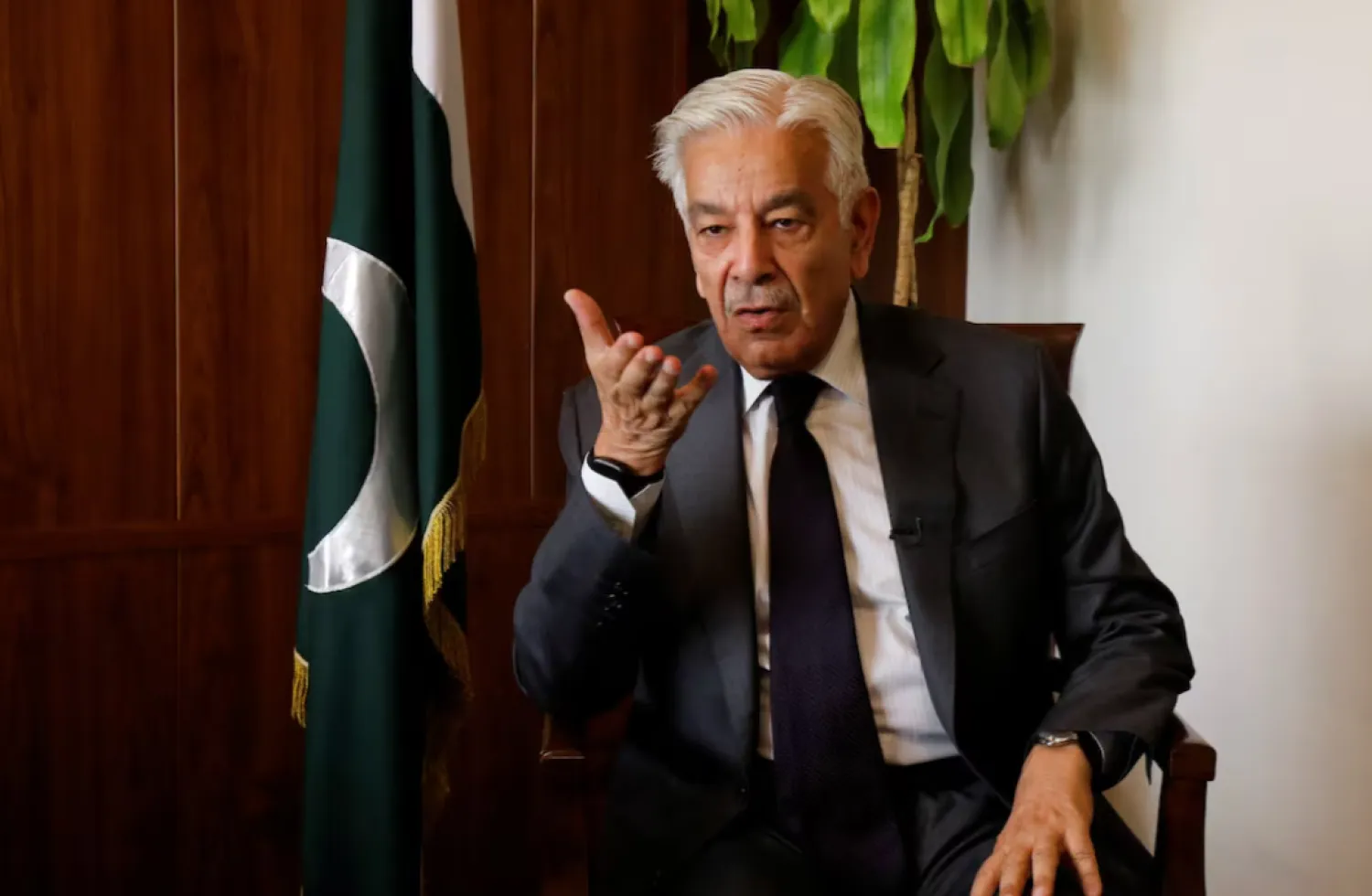
Pakistan's Defense Minister Khawaja Muhammad Asif speaks during an interview with Reuters in Islamabad, Pakistan, October 20, 2025. REUTERS/Salahuddin Purchase Licensing Rights
TT

Kabul Must Rein in Militants for Ceasefire to Hold, Says Pakistan

Pakistan's Defense Minister Khawaja Muhammad Asif speaks during an interview with Reuters in Islamabad, Pakistan, October 20, 2025. REUTERS/Salahuddin Purchase Licensing Rights

A ceasefire agreement between Islamabad and Kabul rests on the ruling Afghan Taliban's ability to rein in militants attacking Pakistan across their shared border, Pakistan's Defense Minister Khawaja Muhammad Asif told Reuters on Monday, underscoring the fragility of the accord.

The South Asian neighbors agreed to a ceasefire in Doha at the weekend after days of border clashes that killed dozens, the worst such violence since the Taliban seized power in Kabul in 2021, Reuters reported.

Ground fighting between the one-time allies and Pakistani airstrikes across their contested 2,600-km (1,600-mile) frontier were triggered after Islamabad demanded that Kabul control militants, saying they operated from havens in Afghanistan.

"Anything coming from Afghanistan will be (a) violation of this agreement," said Asif, who led the talks with his Afghan counterpart Mullah Muhammad Yaqoob. "Everything hinges on this one clause."

The Taliban administration and Afghanistan's defense ministry did not immediately respond to requests for comment.

WRITTEN AGREEMENT SAYS NO INCURSIONS FROM AFGHANISTAN

In the written agreement signed by Pakistan, Afghanistan, Türkiye and Qatar, it was clearly spelled out that there would not be any incursions, the minister said in an interview in his office at Pakistan's parliament in Islamabad.

"We have a ceasefire agreement as long as there is no violation of the agreement which is already in force."

Tehreek-e-Taliban Pakistan, commonly known as the Pakistani Taliban, an umbrella of several Islamist militant groups, operates out of Afghanistan to attack Pakistan "in connivance" with the ruling Taliban, the minister said.

Kabul denies giving haven to militants to attack Pakistan and accuses the Pakistani military of spreading misinformation about Afghanistan and sheltering ISIS-linked militants to undermine its stability and sovereignty.

Islamabad denies the accusations.

Zabihullah Mujahid, the Taliban spokesperson, said on Sunday that at the Doha talks, "It was decided that neither country would take hostile actions against the other, and support will not be provided to groups operating against the government of Pakistan."

In a follow-up post on X, he said it reflected the Taliban's longstanding position that Afghanistan’s territory would not be used against any other country.

The statements made about the agreement did not constitute a joint declaration, he said.

KABUL 'IS NOT A NO-GO AREA', WARNS PAKISTAN

The Pakistani Taliban, who have been waging a war for years against the Pakistani state in a bid to overthrow the government and replace it with their strict brand of Islamic governance, have accelerated attacks in recent months to target Pakistani military.

Pakistan carried out airstrikes on the Afghan capital Kabul, including one on October 9 in an attempt to kill Pakistani Taliban leader Noor Wali Mehsud, Pakistan security officials have said, though he later appeared in a video showing he was alive.

"We were being attacked. Our territory was being attacked. So we just did tit for tat. We were paying them in the same coin," Asif said.

"They are in Kabul. They are everywhere. Wherever they are we will attack them. Kabul is not, you know, a no-go area."

The next round of talks would be held in Istanbul on October 25 to evolve a mechanism on how to enforce the agreement, Asif said.

Qatar's foreign ministry, which mediated Saturday's talks along with Türkiye, said the follow-up meetings were meant "to ensure the sustainability of the ceasefire and verify its implementation in a reliable and sustainable manner".



Russia Says It Hopes for New Round of Ukraine Talks with US as Soon as Conditions Allow

FILE PHOTO: Kremlin spokesman Dmitry Peskov looks on as Russia's President Vladimir Putin (not pictured) and Togo's President of the Council of Ministers Faure Gnassingbe (not pictured) meet at the Kremlin in Moscow, Russia November 19, 2025. REUTERS/Ramil Sitdikov/Pool/File Photo
TT

Russia Says It Hopes for New Round of Ukraine Talks with US as Soon as Conditions Allow

FILE PHOTO: Kremlin spokesman Dmitry Peskov looks on as Russia's President Vladimir Putin (not pictured) and Togo's President of the Council of Ministers Faure Gnassingbe (not pictured) meet at the Kremlin in Moscow, Russia November 19, 2025. REUTERS/Ramil Sitdikov/Pool/File Photo

Russia is in contact with the United States about a new round of talks on a Ukraine peace settlement as soon as conditions allow, the Kremlin said on Thursday.

"We remain open, we are in contact with the Americans, and we are counting on holding the next round of talks as soon ‌as circumstances permit," ‌Kremlin spokesman Dmitry Peskov said.

Peskov rejected ‌the ⁠thesis of a ⁠New York Times opinion piece that said the Iran war had caused President Vladimir Putin to lose interest in negotiating an end to the Ukraine conflict, Reuters reported.

"This is an absolutely false invention that does not correspond to reality. During the rounds of trilateral talks that ⁠have taken place, some progress was made ‌toward a settlement," Peskov told ‌reporters.

Peskov said Russia had not lost interest in peace ‌talks but added that key issues - including territory - had ‌yet to be settled.

The NYT opinion piece, by Russian journalist Mikhail Zygar, said Russia's economy had been faltering earlier this year, prompting Putin at that point to take negotiations on ‌a Ukraine settlement more seriously.

However, Zygar said the Iran war had reversed those dynamics by ⁠boosting ⁠oil prices, easing the economic pressure on Moscow and reducing the US focus on Ukraine, weakening any incentive for the Kremlin to seek a settlement.

Earlier this week, Kremlin aide Yuri Ushakov said the US had briefed Russia about Washington's latest round of talks with a Ukrainian delegation in Florida, which took place last Saturday.

The last three-way peace talks between Russia, Ukraine and the US took place last month, before the Trump administration and Israel began airstrikes against Iran on February 28.


Pentagon Reportedly Weighs Diverting Ukraine Military Aid to the Middle East

FILE - The Pentagon and the surrounding area is seen in this aerial view in Washington, Jan. 26, 2020. (AP Photo/Pablo Martinez Monsivais, File)
TT

Pentagon Reportedly Weighs Diverting Ukraine Military Aid to the Middle East

FILE - The Pentagon and the surrounding area is seen in this aerial view in Washington, Jan. 26, 2020. (AP Photo/Pablo Martinez Monsivais, File)

The Pentagon is weighing whether to redirect weapons originally meant for Ukraine to the Middle East, as the war in Iran strains supplies of some of the US military's most critical munitions, the Washington Post reported Thursday, citing three people familiar with the matter.

The weapons that could be redirected include air defense interceptor missiles purchased through a NATO initiative launched last year, under which ⁠partner countries buy ⁠US arms for Kyiv, the report said.

The consideration comes as US operations in the region intensify. Admiral Brad Cooper, the Central Command chief leading US forces in the Middle East, on Wednesday said the US had hit ⁠over 10,000 targets inside Iran and was on track to limit Iran's ability to project power outside its borders.

A Pentagon spokesperson told the newspaper that the Defense Department would "ensure that US forces and those of our allies and partners have what they need to fight and win."

In response to a query about the report, a NATO official said members of ⁠the ⁠alliance and its partners continue to contribute to its Prioritized Ukraine Requirements List (PURL) program that funds the supply of US arms for Kyiv.

"Equipment is continuously flowing into Ukraine," the official added. "The amount pledged to PURL so far is of several billion US dollars and we expect more contributions to follow."

The Pentagon and the US State Department did not immediately respond to Reuters' requests for comment.


Israel Defense Minister Says Iran Guards Navy Commander Killed in Strike

(FILES) This handout photo provided by Iran's Revolutionary Guard Corps (IRGC) official website Sepah News on February 1, 2025, shows navy commander Admiral Alireza Tangsiri. (Photo by SEPAH NEWS / AFP)
TT

Israel Defense Minister Says Iran Guards Navy Commander Killed in Strike

(FILES) This handout photo provided by Iran's Revolutionary Guard Corps (IRGC) official website Sepah News on February 1, 2025, shows navy commander Admiral Alireza Tangsiri. (Photo by SEPAH NEWS / AFP)

Defense Minister Israel Katz announced on Thursday that an Israeli airstrike had killed Alireza Tangsiri, commander of the Iranian Revolutionary Guards' navy.

"Last night, in a precise and lethal operation, the IDF eliminated the commander of the Revolutionary Guards' navy, Tangsiri, along with senior officers of the naval command," Katz said in a video statement.

"The man who was directly responsible for the terrorist operation of mining and blocking the Strait of Hormuz to shipping was blown up and eliminated."

Since the start of the joint US-Israeli attacks on Iran on February 28, Israel has announced the killing of several top Iranian officials, including supreme leader Ali Khamenei and the security chief, Ali Larijani.

In recent days, Israeli forces have carried out several strikes targeting the naval assets of Iran.

Last week, Israeli airstrikes hit several Iranian naval ships in the Caspian Sea, including ones equipped with missile systems, support vessels and patrol craft.