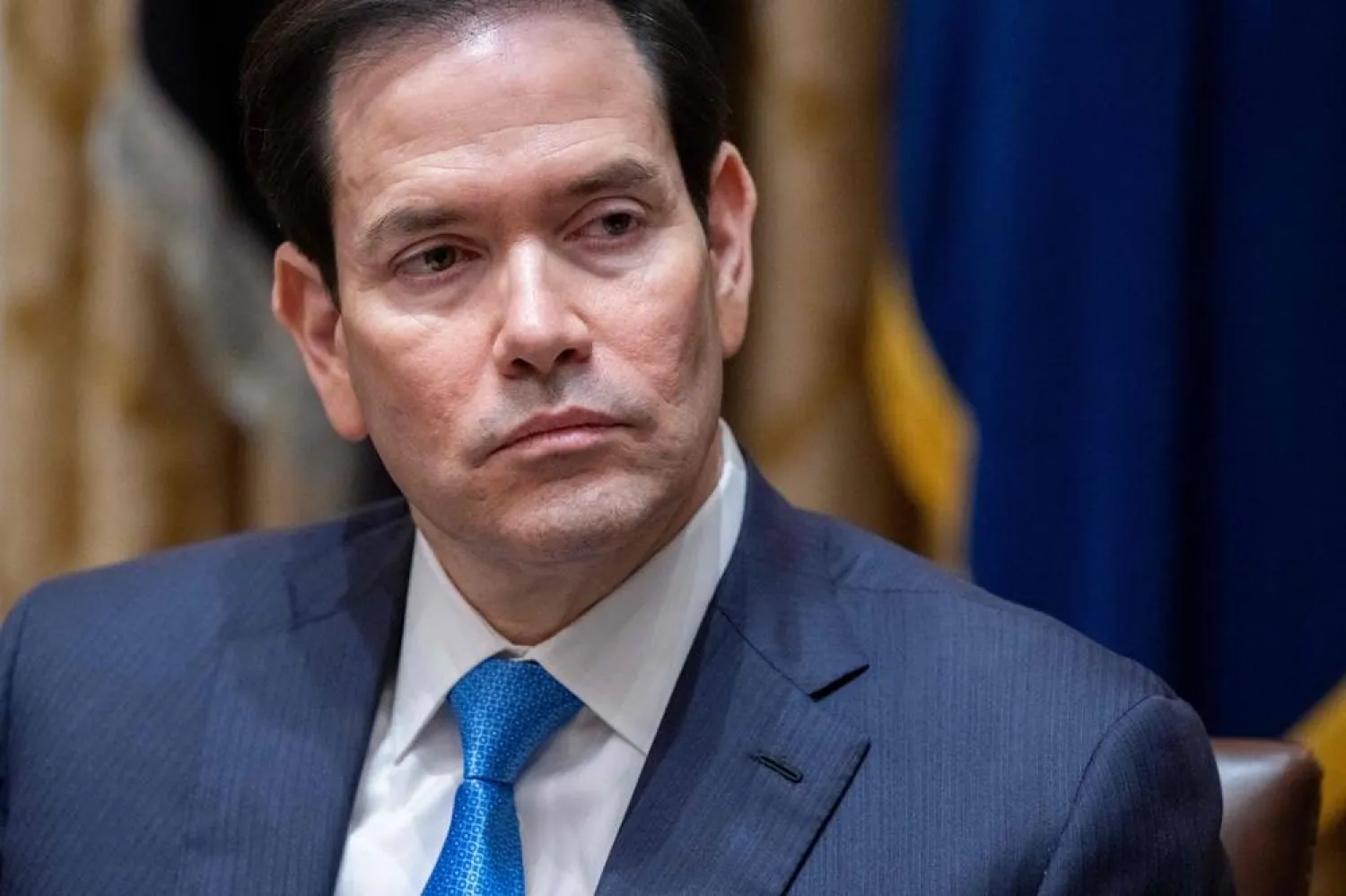
Rubio to Visit Israel from Thursday

US Secretary of State Marco Rubio attends a meeting between Australia's Prime Minister Anthony Albanese and US President Donald Trump in the Cabinet Room at the White House in Washington, DC, on October 20, 2025. (AFP)
TT

Rubio to Visit Israel from Thursday

US Secretary of State Marco Rubio attends a meeting between Australia's Prime Minister Anthony Albanese and US President Donald Trump in the Cabinet Room at the White House in Washington, DC, on October 20, 2025. (AFP)

US Secretary of State Marco Rubio will arrive in Israel on Thursday, an Israeli government spokeswoman said, announcing the third visit by a senior Washington official this week.

Speaking while Vice President JD Vance and special envoy Steve Witkoff were already in the country promoting the plan to end the war in Gaza, Shosh Bedrosian told reporters that Rubio would meet Prime Minister Benjamin Netanyahu on Friday.

"This is the secretary of state third trip to Israel since mid-September which further shows the hand-in-hand relationship that Israel and the United States have as we mark this historic time," she said.


Netanyahu’s Opponents Accuse him of Having Acquiesced to Trump on Issues of National Security

US President and Israeli Prime Minister during a press conference in Florida on December 29, 2025 (Reuters)
TT

Netanyahu’s Opponents Accuse him of Having Acquiesced to Trump on Issues of National Security

US President and Israeli Prime Minister during a press conference in Florida on December 29, 2025 (Reuters)

Israeli Prime Minister Benjamin Netanyahu is under criticism at home after US President Donald Trump declared Israel would halt plans to attack Iran ally Hezbollah in Beirut, highlighting pressure the Israeli leader faces ahead of an election polls show him losing.

Multiple reports on Monday spoke about a tense phone call between Trump and Netanyahu after the US President demanded the Israeli PM to immediately abandon plans to strike Beirut and avoid jeopardizing talks with Iran.

Trump said on Monday that Israel and Hezbollah had agreed to halt attacks on one another, hours after Netanyahu ordered new strikes on Beirut's southern suburbs, prompting a warning from Iran that Israel was jeopardizing Tehran’s talks with the US.

Lebanon's government later announced a new ceasefire between Israel and Hezbollah, under which Israel would halt strikes on southern Beirut and Hezbollah would stop attacks on Israel.

Netanyahu's challengers in elections due by October accused the prime minister of having acquiesced to Trump on issues of national security.

“The location is different, the story is the same,” said Naftali Bennett, a right-wing ⁠security hawk and former premier who also criticizes Netanyahu over Hamas militants' resurgence in Gaza.

“A government that has lost control of Israeli sovereignty,” Bennett said in an X post, according to Reuters.

Bennett and his coalition partner in the upcoming election, centrist Yair Lapid, have pressed for strikes against Hezbollah.

“A full protectorate,” Lapid said in an X post, in effect accusing Netanyahu of allowing the US to dictate Israeli military policy as if Israel was an American client state.

Israel and Hezbollah have continued to trade fire despite an April 16 US-brokered ceasefire. The latest conflict began on March 2 with Hezbollah firing into Israel in support of Iran.

Israel has since deepened its invasion of southern Lebanon, displacing over a million people and killing more than 3,400 as it bombards areas with attacks it says are aimed at rooting out Hezbollah. Hezbollah has not released figures on its war dead.

Also, the criticisms came while the US President lashed out at Netanyahu over Israel's escalation in Lebanon in an expletive-laden call on Monday, two US officials and a third source briefed on the call told Axios.

Earlier on Monday, Iran threatened to abandon the negotiations with the US over Israel's actions in Lebanon. On the call, Trump called Netanyahu “crazy” and accused him of ingratitude, according to two of the sources. He also put the brakes on Israel’s plan to strike Beirut.

One US official said Trump told Netanyahu that following through on his threats to bomb the Lebanese capital would further isolate Israel around the world, Axios said.

Two of the sources said the US President claimed he'd helped keep Netanyahu out of jail — a reference to his support during Netanyahu's corruption trial.

Summarizing Trump's remarks to Netanyahu, the US official said: “You're...crazy. You'd be in prison if it weren't for me. I'm saving your ass. Everybody hates you now. Everybody hates Israel because of this.”

A second source briefed on the call said Trump was “pissed” and at one point yelled at Netanyahu: “What the fuck are you doing?”

The US official said Trump knew Hezbollah had been shooting at Israel and that Israel needed to defend itself, but felt in recent days that Netanyahu was escalating in a disproportionate way.

Another US official said Trump was concerned by the fact that Israel had killed so many civilians in Lebanon, and objected to the Israelis knocking down buildings to take out a single Hezbollah commander.

Also, Israel no longer plans to strike Hezbollah targets in Beirut, an Israeli official told Axios.
Trump and Netanyahu have had several tense calls in the past but have still coordinated closely on Iran and other issues.

One official said this was one of Trump's worst calls with Netanyahu since he returned to office.

Trump's anger appeared to be driven by the fact that Netanyahu's decision to escalate in Lebanon was threatening to implode his negotiations with Iran.

After the call, Trump posted on Truth Social that the Iran talks were “continuing, at a rapid pace.”

The second US official claimed that, in reality, Trump had “steamrolled” Netanyahu on the call. “Bibi said, 'OK, OK, just make sure everything is taken care of,’” according to the official.
Netanyahu's office did not respond to a request for comment.



Facing Uproar, Netanyahu Announces ‘Mega-Plan’ for Israel’s Battered North

People react while attending the funeral of an Israeli soldier Captain Doctor Ori Yosef Silvester, a 30-year-old army doctor for the Givati Brigade's Shaked Battalion, who was killed in southern Lebanon, at the Segula Cemetery in Petah Tikva on June 2, 2026. (AFP)
TT

Facing Uproar, Netanyahu Announces ‘Mega-Plan’ for Israel’s Battered North

People react while attending the funeral of an Israeli soldier Captain Doctor Ori Yosef Silvester, a 30-year-old army doctor for the Givati Brigade's Shaked Battalion, who was killed in southern Lebanon, at the Segula Cemetery in Petah Tikva on June 2, 2026. (AFP)

Israeli Prime Minister Benjamin Netanyahu announced on Tuesday allocations of 13 billion shekels (more than $4.5 billion) to secure and develop northern communities along the Lebanon border, battered by weeks of fire from Iran-backed Hezbollah.

"The government made dramatic decisions today to strengthen the north. We are investing more than 13 billion shekels today, in addition to the seven billion we have already provided -- a total of 20 billion shekels going to the communities of the north," Netanyahu said following the government's approval of the measure.

The package, dubbed a "mega-plan" by Netanyahu's office, consists of three separate decisions.

The first will see the deployment of 1,800 new protective shelters in public spaces such as bus stops, shopping centers and parks, as well as the renovation of around 500 existing shelters, to shield residents from incoming rockets and drones.

The second decision allocates subsidies for the construction of safe rooms inside homes for residents living within nine kilometers (5.6 miles) of the Lebanon border, while the third aims to develop the area in order to attract 100,000 new residents, by improving health, transport, education and tourism infrastructure as well as job opportunities.

"People will flock to the north. I said the same about the south," Netanyahu said, referring to areas close to Gaza that were attacked by Hamas on October 7, 2023.

"Today there is very strong demand there; there is tremendous growth and flourishing -- and that is what will happen here as well."

The government has taken flak from opposition figures who accuse it of neglecting areas along the Lebanon border.

Opposition party leaders Yair Lapid, Gadi Eisenkot and Naftali Bennett took to X on Monday night to point out that only three government ministers attended the cabinet meeting to discuss the situation in the north.

"The residents of the north deserve leadership that will see them and take care of them," Eisenkot wrote on X.


Iraqi National Pleads Not Guilty in 18 Attacks in Europe, Calling Himself a ‘Prisoner of War’

Mohammad Baqer Saad Dawood Al-Saadi, an Iraqi man accused of helping Iran-backed faction's plans for attacks in the United States and Europe, stands with his defense attorney Andrew Dalack before US District Judge Colleen McMahon during his arraignment in Manhattan federal court in New York City, US, June 1, 2026 in a courtroom sketch. (Reuters)
TT

Iraqi National Pleads Not Guilty in 18 Attacks in Europe, Calling Himself a ‘Prisoner of War’

Mohammad Baqer Saad Dawood Al-Saadi, an Iraqi man accused of helping Iran-backed faction's plans for attacks in the United States and Europe, stands with his defense attorney Andrew Dalack before US District Judge Colleen McMahon during his arraignment in Manhattan federal court in New York City, US, June 1, 2026 in a courtroom sketch. (Reuters)

An Iraqi national accused of plotting at least 18 attacks in Europe in retaliation for the US and Israel’s war with Iran pleaded not guilty on Monday before calling himself a “prisoner of war” and telling a judge that children and women were being killed “by your rockets.”

Mohammad Baqer Saad Dawood Al-Saadi finally was persuaded to sit down in Manhattan federal court as two marshals approached him at a judge's urging. One marshal put his hand on his shoulder to guide him into his seat.

Al-Saadi did not appear to be trying to be disruptive as he commented beyond his response to the charges. The charges say he conspired to provide material support to Kataib Hizballah, an Iran-backed Iraqi armed group, and Iran’s Revolutionary Guard Corps.

“I'm not guilty in a war situation,” Al-Saadi responded, before adding through an Arabic translator: “I'm a prisoner of war. I'm not a threat. Children and women are being killed by your rockets.”

Judge Colleen McMahon responded by saying: “The defendant will be seated please,” which prompted the marshals behind Al-Saadi to move up to where he was seated.

Both Kataib Hizballah and the Revolutionary Guard Corps. have been designated by the US government as foreign terrorist organizations. US prosecutors say Al-Saadi was a Kataib Hizballah commander.

But his lawyer, Andrew Dalack, told the judge that his client worked for the Iraqi government, though he did not specify what position.

The lawyer said Al-Saadi was held at an underground Turkish prison for two weeks before he was turned over to the FBI.

“I'm sure it was unpleasant, to say the least,” the judge said.

Dalack said Al-Saadi has been held in solitary confinement at a federal lockup in Brooklyn but was hoping to communicate with a diplomatic counsel from Iraq and his mother and siblings, although he expects the US government to severely limit his communications.

Last month when the charges against Al-Saadi were announced, Dalack told reporters that his client believed he was being persecuted for his relationship with Qasem Soleimani, the Revolutionary Guard leader who was killed in a US drone strike in 2020.

Among the 18 attacks in Europe, Al-Saadi is charged in the firebombing of a bank in Amsterdam and with stabbing Jewish men in London.

Federal authorities also said in court papers that he sought to attack a New York City synagogue last month and provided an undercover law enforcement officer with photos and maps of Jewish centers in Los Angeles and Scottsdale, Arizona, that he planned to target.

Al-Saadi is also accused of involvement in two recent attacks in Canada: an attack on a synagogue and a shooting at the US consulate in Toronto in March. US prosecutors said he directed and urged other people to attack US and Israeli interests, including by killing Americans and Jews.

Al-Saadi posted about the attacks on Snapchat and Telegram and spoke about them in phone calls recorded by an FBI informant whose help he solicited in planning attacks in the US, according to court papers.