


Thailand's Queen Mother Sirikit Has Died at Age 93

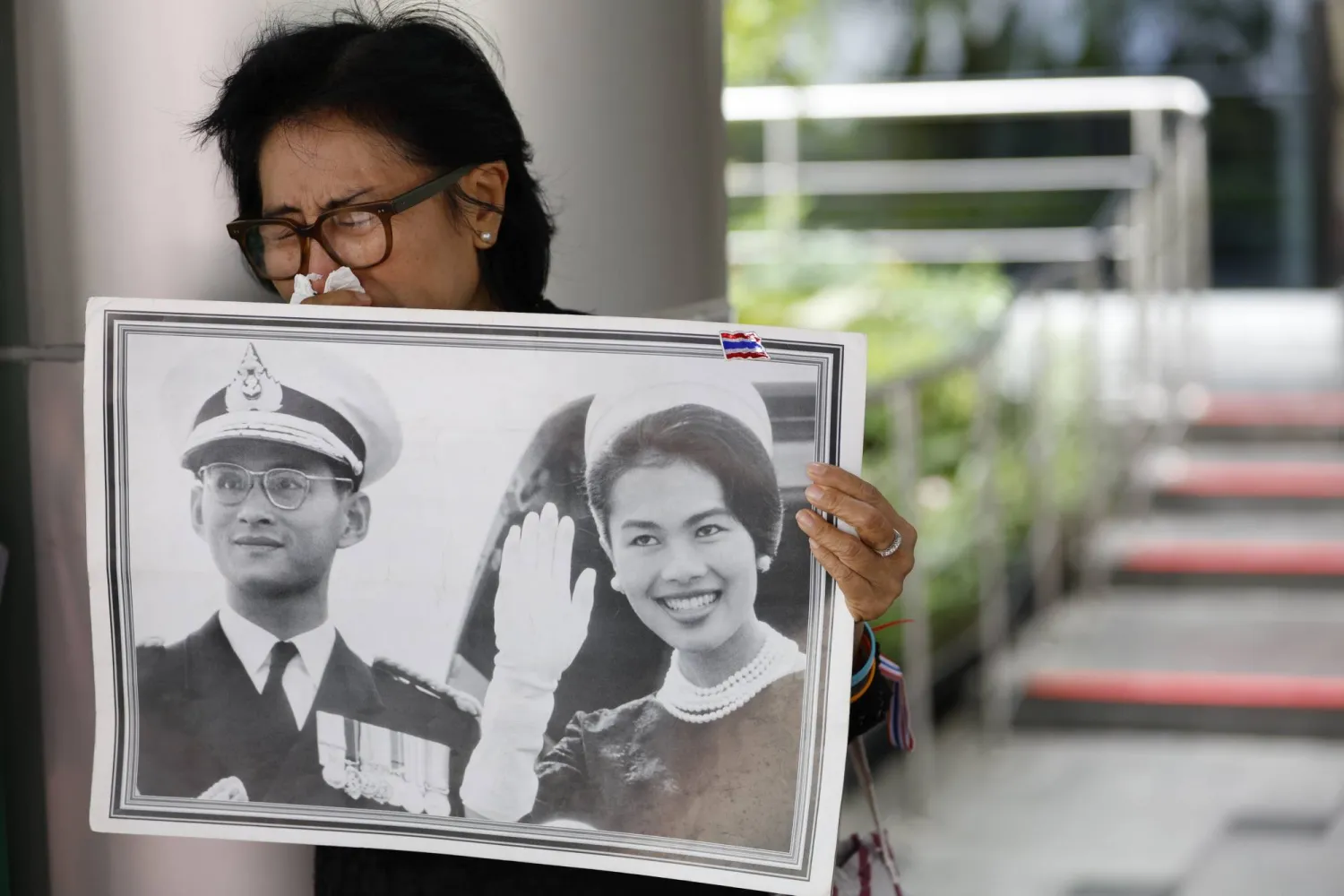
A Thai woman mourns Queen Mother Sirikit after the announcement of her death at King Chulalongkorn Memorial Hospital in Bangkok, Thailand, 25 October 2025. EPA/RUNGROJ YONGRIT
TT

Thailand's Queen Mother Sirikit Has Died at Age 93

A Thai woman mourns Queen Mother Sirikit after the announcement of her death at King Chulalongkorn Memorial Hospital in Bangkok, Thailand, 25 October 2025. EPA/RUNGROJ YONGRIT

Thailand’s Queen Mother Sirikit, who supervised royal projects to help the rural poor, preserve traditional craft-making and protect the environment, died on Friday. She was 93.

The Royal Household Bureau said she died in a hospital in Bangkok, adding that she began suffering from a blood infection on Oct. 17 and despite her medical team’s efforts, her condition did not improve. She suffered a stroke in 2012 and was afterwards largely absent from public life due to declining health. Her husband, King Bhumibol Adulyadej, died in October 2016.

Mourners gathered outside Chulalongkorn Hospital on Saturday morning after hearing the news.

“It is yet again another great loss for the whole nation. I heard about it at 4 a.m. I felt like fainting. The whole world seemed like it had stopped," said 67-year-old Maneerat Laowalert.

Although overshadowed by her late husband and her son, the current king, Sirikit was beloved and influential in her own right. Her portrait was displayed in homes, offices and public spaces across Thailand and her Aug. 12 birthday was celebrated as Mother’s Day. Her activities ranged from helping Cambodian refugees to saving some of the country's once-lush forests from destruction.

The Thai monarchy traditionally has avoided playing an open role in politics, but in recent decades of political upheaval, marked by two military takeovers and several rounds of bloody street protests, speculation grew about Sirikit’s views and her behind the scenes influence. When she publicly attended the 2008 funeral of a protester killed during a clash with police, many saw it as her taking a side in the political schism.

Sirikit met the king while living in Europe Sirikit Kitiyakara was born into a rich, aristocratic family in Bangkok on Aug. 12, 1932, the year absolute monarchy was replaced by a constitutional system. Both of her parents were related to earlier kings of the current Chakri dynasty.

She attended schools in wartime Bangkok, the target of Allied air raids, and after World War II moved with her diplomat father to France where he served as ambassador.

At 16, she met Thailand’s newly crowned king in Paris, where she was studying music and languages. Their friendship blossomed after Bhumibol suffered a near-fatal car accident and she moved to Switzerland, where he was studying, to help care for him. The king courted her with poetry and composed a waltz titled, "I Dream of You."

The pair married in 1950, and at a coronation ceremony later the same year both vowed to "reign with righteousness for the benefit and happiness of the Siamese (Thai) people."

The couple had four children: current King Maha Vajiralongkorn, and princesses Ubolratana, Sirindhorn and Chulabhorn.

During their early married life, the Thai royals crisscrossed the world as goodwill ambassadors and forged personal ties with world leaders.

Malaysian Foreign Minister Mohamad Hasan expressed his “heartfelt condolences” on her death as he opened a meeting with his Southeast Asian counterparts in Kuala Lumpur, Malaysia, The Associated Press reported.

A turn to Thailand's rural areas But by the early 1970s, the king and queen turned most of their energies to Thailand's domestic problems, including rural poverty, opium addiction in hill tribes and a communist insurgency.

Each year, the couple traveled around the countryside while also officiating at more than 500 royal, religious and state ceremonies.

The queen, an impeccable dresser and avid shopper, also relished climbing hills and visiting simple villages where older women called her "daughter."

Thousands raised their problems to her, ranging from marital squabbles to serious diseases, and the queen and her assistants took up many personally.

While some in Bangkok gossiped about her involvement in palace intrigues and her lavish lifestyle, her popularity in the countryside endured.

"Misunderstandings arise between people in rural areas and the rich, so-called civilized people in Bangkok. People in rural Thailand say they are neglected, and we try to fill that gap by staying with them in remote areas," she said in an interview with The Associated Press in 1979.

Royal development projects were set up across Thailand, some of them initiated and directly supervised by the queen.

In 1976, the queen launched a foundation aimed at increasing the income of poor rural families and preserving dying crafts. The foundation, known as SUPPORT, has trained thousands of villagers in silk-weaving, jewelry-making, painting, ceramics and other traditional crafts.

She also set up wildlife breeding centers, "open zoos," and hatcheries to save endangered sea turtles. Her Forest Loves Water and Little House in the Forest projects sought to demonstrate the economic gains of preserving forest cover and water sources.

While royalty elsewhere had only ceremonial or symbolic roles, Queen Sirikit believed the monarchy was a vital institution in Thailand.

"There are some in the universities who think the monarchy is obsolete. But I think Thailand needs an understanding monarch," she said in the 1979 interview. "At the call, ‘The king is coming,’ thousands will gather.

“The mere word king has something magic in it. It is wonderful."


Larijani Calls Trump, Netanyahu ‘Main Killers of People of Iran’ as Russia Slams Threats

Protesters participate in a demonstration supporting protesters in Iran, in front of the US Consulate, Milan, Italy, Tuesday, Jan. 13, 2026. (AP)
TT

Larijani Calls Trump, Netanyahu ‘Main Killers of People of Iran’ as Russia Slams Threats

Protesters participate in a demonstration supporting protesters in Iran, in front of the US Consulate, Milan, Italy, Tuesday, Jan. 13, 2026. (AP)

A senior Iranian official responded Tuesday to US President Donald Trump’s latest threat to intervene in deadly protests, saying that the US and Israel will be the ones responsible for the death of Iranian civilians.

Shortly after Trump’s social media post urging Iranians to “take over” government institutions, Ali Larijani, a former parliament speaker who serves as the secretary of Iran’s Supreme National Security Council, posted on X: “We declare the names of the main killers of the people of Iran: 1- Trump 2- Netanyahu.”

Russia’s Foreign Ministry called Trump's threats “categorically unacceptable.”

The ministry warned in a statement that any such strikes would have “disastrous consequences” for the situation in the Middle East and global security.

It also criticized what it called “brazen attempts to blackmail Iran’s foreign partners by raising trade tariffs.”

The statement noted that the protests in Iran had been triggered by social and economic problems resulting from Western sanctions.

It also denounced “hostile external forces” for trying to “exploit the resulting growing social tension to destabilize and destroy the Iranian state” and charged that “specially trained and armed provocateurs acting on instructions from abroad” sought to provoke violence.

The ministry voiced hope that the situation in Iran will gradually stabilize and advised Russian citizens in the country not to visit crowded places.


Satellite Internet Provider Starlink Now Offering Free Service Inside Iran

Protesters participate in a demonstration supporting protesters in Iran, in front of the US Consulate, Milan, Italy, Tuesday, Jan. 13, 2026. (AP)
TT

Satellite Internet Provider Starlink Now Offering Free Service Inside Iran

Protesters participate in a demonstration supporting protesters in Iran, in front of the US Consulate, Milan, Italy, Tuesday, Jan. 13, 2026. (AP)

The satellite internet provider Starlink now offers free service in Iran, activists said Wednesday.

Mehdi Yahyanejad, a Los Angeles-based activist who has helped get the units into Iran, told The Associated Press that the free service had started. Other activists also confirmed in messages online that the service was free.

Starlink has been the only way for Iranians to communicate with the outside world since authorities shut down the internet Thursday night as nationwide protests swelled and they began a bloody crackdown against demonstrators.

Starlink itself did not immediately acknowledge the decision.


Trump Warns of ‘Very Strong Action’ if Iran Hangs Protesters

 In this photo obtained by The Associated Press, Iranians attend an anti-government protest in Tehran, Iran, Friday, Jan. 9, 2026. (UGC via AP)
In this photo obtained by The Associated Press, Iranians attend an anti-government protest in Tehran, Iran, Friday, Jan. 9, 2026. (UGC via AP)
TT

Trump Warns of ‘Very Strong Action’ if Iran Hangs Protesters

 In this photo obtained by The Associated Press, Iranians attend an anti-government protest in Tehran, Iran, Friday, Jan. 9, 2026. (UGC via AP)
In this photo obtained by The Associated Press, Iranians attend an anti-government protest in Tehran, Iran, Friday, Jan. 9, 2026. (UGC via AP)

US President Donald Trump warned of unspecified "very strong action" if Iranian authorities go ahead with threatened hangings of some protesters, with Tehran calling American warnings a "pretext for military intervention".

International outrage has built over the crackdown that a rights group said has likely killed thousands during protests posing one of the biggest challenges yet to Iran's clerical leadership.

Iran's UN mission posted a statement on X, vowing that Washington's "playbook" would "fail again".

"US fantasies and policy toward Iran are rooted in regime change, with sanctions, threats, engineered unrest, and chaos serving as the modus operandi to manufacture a pretext for military intervention," the post said.

Iranian authorities have insisted they had regained control of the country after successive nights of mass protests nationwide since.

Rights groups accuse the government of fatally shooting protesters and masking the scale of the crackdown with an internet blackout that has now surpassed the five-day mark.

New videos on social media, with locations verified by AFP, showed bodies lined up in the Kahrizak morgue just south of the Iranian capital, with the corpses wrapped in black bags and distraught relatives searching for loved ones.

Trump -- who earlier told the protesters in Iran that "help is on its way" -- said Tuesday in a CBS News interview that the United States would act if Iran began hanging protesters.

Tehran prosecutors have said Iranian authorities would press capital charges of "moharebeh", or "waging war against God", against some suspects arrested over recent demonstrations.

"We will take very strong action if they do such a thing," said the American leader, who has repeatedly threatened Iran with military intervention.

"When they start killing thousands of people -- and now you're telling me about hanging. We'll see how that's going to work out for them," Trump said.

The US State Department on its Farsi language X account said 26-year-old protestor Erfan Soltani had been sentenced to be executed on Wednesday.

"Erfan is the first protester to be sentenced to death, but he won't be the last," the State Department said, adding more than 10,600 Iranians had been arrested.

Rights group Amnesty International called on Iran to immediately halt all executions, including Soltani's.

Trump urged on his Truth Social platform for Iranians to "KEEP PROTESTING", adding: "I have cancelled all meetings with Iranian Officials until the senseless killing of protesters STOPS. HELP IS ON ITS WAY."

It was not immediately clear what meetings he was referring to or what the nature of the help would be.

- 'Rising casualties' -

European nations also signaled their anger over the crackdown, with France, Germany and the United Kingdom among the countries that summoned their Iranian ambassadors, as did the European Union.

"The rising number of casualties in Iran is horrifying," said EU chief Ursula von der Leyen, vowing further sanctions against those responsible.

Norway-based NGO Iran Human Rights said it had confirmed 734 people killed during the protests, including nine minors, but warned the death toll was likely far higher.

"The real number of those killed is likely in the thousands," IHR's director Mahmood Amiry-Moghaddam said.

Iranian state media has said dozens of members of the security forces have been killed, with their funerals turning into large pro-government rallies.

Authorities in Tehran have announced a mass funeral ceremony in the capital on Wednesday for the "martyrs" of recent days.

Amir, an Iraqi computer scientist, returned to Baghdad on Monday and described dramatic scenes in Tehran.

"On Thursday night, my friends and I saw protesters in Tehran's Sarsabz neighborhood amid a heavy military presence. The police were firing rubber bullets," he told AFP in Iraq.

Reza Pahlavi, the US-based son of Iran's ousted shah, called on the military to stop suppressing protests.

"You are the national military of Iran, not the military of the Islamic Republic," he said in a statement.

- 'Serious challenge -

The government on Monday sought to regain control of the streets with mass nationwide rallies that supreme leader Ali Khamenei hailed as proof that the protest movement was defeated, calling them a "warning" to the United States.

In power since 1989 and now aged 86, Khamenei has faced significant challenges, most recently the 12-day war in June against Israel, which forced him to go into hiding.

Analysts have cautioned that it is premature to predict the immediate demise of the theocratic system, pointing to the repressive levers the leadership controls, including the Revolutionary Guard Corps, which is charged with safeguarding the revolution.

Nicole Grajewski, professor at the Sciences Po Center for International Studies, told AFP the protests represented a "serious challenge" to the country, but it was unclear if they would unseat the leadership, pointing to "the sheer depth and resilience of Iran's repressive apparatus".
