

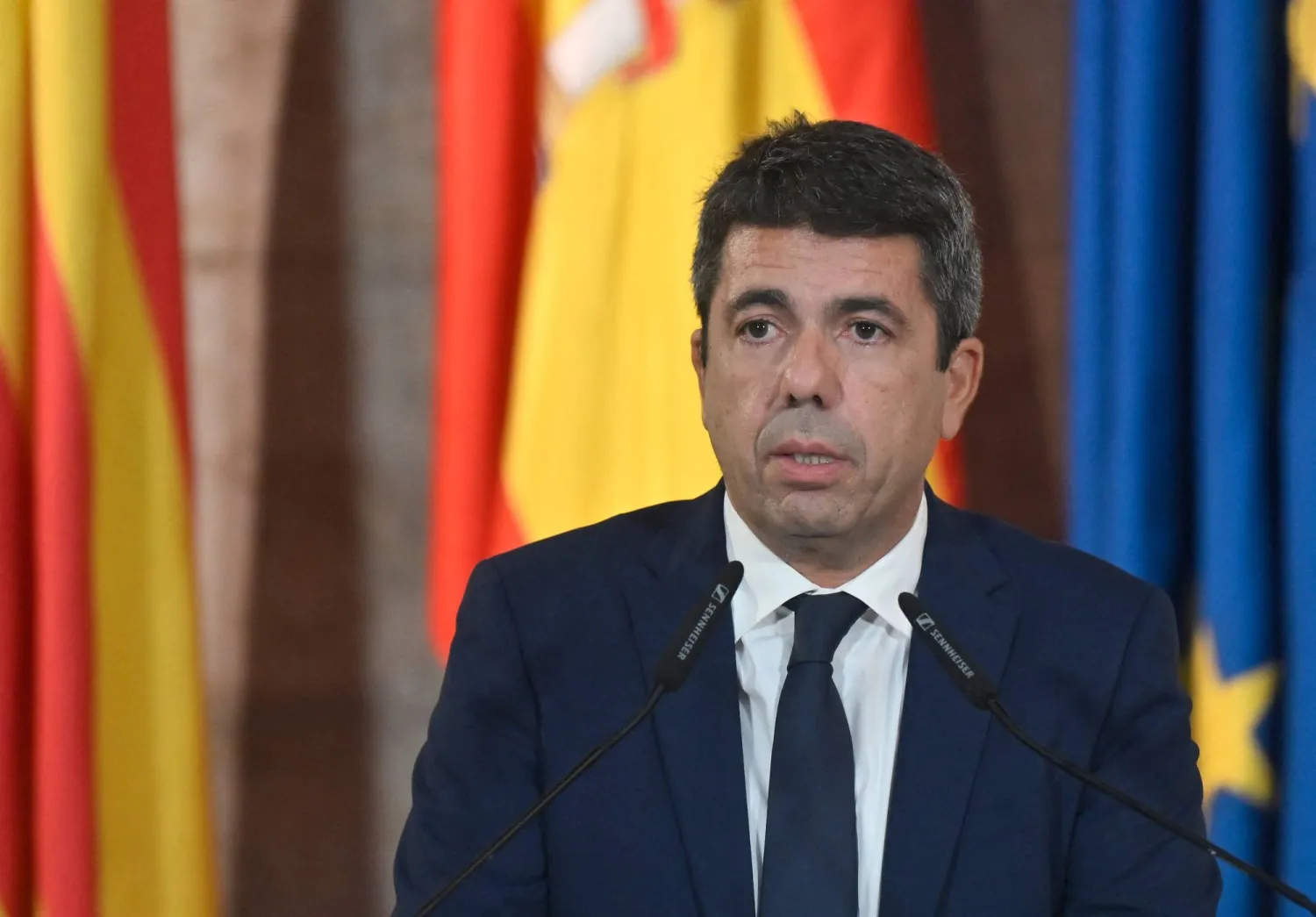

Spanish Regional Leader Steps Down Over His Handling of Last Year’s Valencia Flash Floods 

President of Valencia's Region Carlos Mazón gives a press conference to announce his resignation at Valencia's Palau de la Generalitat on November 3, 2025. (AFP)
TT

Spanish Regional Leader Steps Down Over His Handling of Last Year’s Valencia Flash Floods 

President of Valencia's Region Carlos Mazón gives a press conference to announce his resignation at Valencia's Palau de la Generalitat on November 3, 2025. (AFP)

The leader of Spain's Valencia region said Monday he was stepping down over his government's handling of the devastating flash floods that killed 229 people last year and whose response he is widely seen as having bungled.

Carlos Mazón has faced regular calls to resign since the Oct. 29, 2024 floods, including last week at a state memorial ceremony held on the first anniversary of the disaster where family members of victims jeered and insulted him before the event began.

“I know I made mistakes. I acknowledge them, and I will live with them for the rest of my life. I have apologized, and I apologize again today, but none of them were due to political calculation or bad faith,” Mazón told reporters on Monday in Valencia announcing his resignation.

Mazón has been slammed by citizens and political rivals for his administration’s slow response to the emergency, mainly for issuing a flood alert to people’s cell phones hours after rushing waters were overflowing banks, sweeping away cars and destroying homes.

He was also widely criticized for having a long lunch with a journalist on the day of the floods when emergency officials were meeting to manage the crisis.

The natural disaster was one of Europe’s deadliest in living memory, and also caused billions of euros in damages mainly to the suburbs of Valencia, Spain's third-largest city.

Over the past year, there have been several large street protests in Valencia calling for Mazón to step down, including one a few days before the one-year memorial that drew tens of thousands of demonstrators.

Nevertheless, Mazón clung to power even as his management of the disaster became a drag on the prospects of his center-right Popular Party. He blamed Spain's leftwing national government for failing to adequately respond to the disaster, even though Spain's decentralized system of government tasks regional authorities with handling civil protection.

Regional governments can ask the national government in Madrid, now led by the Socialists, for extra resources, and use information from the national weather forecaster and other agencies.

Mazón didn't specify on Monday whether he was calling a snap election or was quitting his seat in the regional assembly, nor did he name an interim successor.

With his resignation, Mazón said Spain's government “no longer has any excuse to keep dragging its feet,” in reference to Valencia's recovery efforts, and said the past year had brought “unbearable moments” for him and his family.



UK Says New Law Will Crack Down on Hostile States’ Proxies from Next Month

 Britain's Prime Minister Keir Starmer hosts a roundtable meeting for leaders of NHS Trusts, at 10 Downing Street in central London on June 9, 2026. (AFP)
Britain's Prime Minister Keir Starmer hosts a roundtable meeting for leaders of NHS Trusts, at 10 Downing Street in central London on June 9, 2026. (AFP)
TT

UK Says New Law Will Crack Down on Hostile States’ Proxies from Next Month

 Britain's Prime Minister Keir Starmer hosts a roundtable meeting for leaders of NHS Trusts, at 10 Downing Street in central London on June 9, 2026. (AFP)
Britain's Prime Minister Keir Starmer hosts a roundtable meeting for leaders of NHS Trusts, at 10 Downing Street in central London on June 9, 2026. (AFP)

Britain said on Tuesday ‌that a law to crack down on proxies acting for states deemed to be hostile such as Iran was expected to come into force next month, as it steps up powers to counter what it says is a growing threat posed by such groups.

The new powers, promised in the wake of a spate of antisemitic attacks in London, seek to close a gap in legislation to target state-linked organizations paying organized crime groups or low-level felons to carry out surveillance, sabotage, or other activities on ‌their behalf.

In recent ‌months there have been numerous arson ‌attacks ⁠on Jewish sites, with ⁠police saying they were investigating possible Iranian links, while there have been convictions for people accused of spying or acting on behalf of Russian and Chinese organizations.

"Where foreign states are found to be engaging in activity that threatens lives or undermines our democratic institutions, we must ensure that such actions have consequences," Prime Minister ⁠Keir Starmer said in a statement. "We will not ‌tolerate hostile actors paying petty criminals ‌to do their dirty work."

Britain's domestic intelligence agency MI5 has ‌warned of state-threat investigations increasing by 35% last year, including 20 ‌potentially lethal Iranian-backed plots.

Britain has accused China and Russia, as well as Iran, of using proxies. All three dismiss the claims as propaganda.

The legislation would make it illegal to express support for designated proxies ‌or to take money from them, providing for jail terms of up to 14 years.

Last ⁠week, an ⁠Iraqi national denied involvement in multiple attacks against American and Israeli interests in Europe, including some of the recent attacks in Britain, during a US court appearance.

He is accused of directing people to carry out attacks in the name of Harakat Ashab al-Yamin al-Islamiya (HAYI), a component of an Iran-backed faction which the US considers a terrorist organization directed by Iran's Revolutionary Guard Corps (IRGC).

Many British lawmakers have called for the banning of the IRGC, but there was no indication of whether it would be included under the new legislation, with about 10 or fewer designations expected in the first year after it has become law.


Ukraine, Latvia Sign Drone Deal, Zelenskiy Says

 Ukraine's President Volodymyr Zelenskiy attends a press conference during the Nordic-Baltic cooperation (NB8) Prime Ministers' meeting in Tallinn, Estonia, June 9, 2026. (Reuters)
Ukraine's President Volodymyr Zelenskiy attends a press conference during the Nordic-Baltic cooperation (NB8) Prime Ministers' meeting in Tallinn, Estonia, June 9, 2026. (Reuters)
TT

Ukraine, Latvia Sign Drone Deal, Zelenskiy Says

 Ukraine's President Volodymyr Zelenskiy attends a press conference during the Nordic-Baltic cooperation (NB8) Prime Ministers' meeting in Tallinn, Estonia, June 9, 2026. (Reuters)
Ukraine's President Volodymyr Zelenskiy attends a press conference during the Nordic-Baltic cooperation (NB8) Prime Ministers' meeting in Tallinn, Estonia, June 9, 2026. (Reuters)

Ukraine has signed a drone deal with Latvia, President Volodymyr Zelenskiy said on Tuesday as he met with Latvian Prime Minister Andris Kulbergs on the sidelines of a summit between Ukraine and Nordic and Baltic states in the Estonian capital Tallinn.

"These are concrete things to strengthen our joint defense and co-production, and, importantly, this also means Ukraine's expertise and experience helping to strengthen our partners," Zelenskiy said in a post on X.

He gave no ‌details of what ‌the deal entailed.

Kulbergs said the agreement ‌would ⁠give Latvia technological know-how ⁠and co-production opportunities.

"We need to protect our skies, and nobody knows how to do that better than Ukraine," he told a joint press conference with Zelenskiy and other leaders attending the summit, adding that drones were responsible for the vast majority of deaths of Russian troops in the ⁠Ukraine war.

Since the outbreak of the Iran ‌war in late February, Zelenskiy ‌has managed to leverage Ukraine's expertise in drone warfare into a ‌series of successful diplomatic deals during visits to Europe and elsewhere.

Rustem Umerov, the chairman of Ukraine's defense and security council, said Latvia was the sixth country to join Kyiv's drone cooperation initiative.

Last month, Zelenskiy said nearly 20 countries ‌were interested in drone deals with Ukraine.

"Ukraine is interested in ensuring that every region of Europe ⁠has sufficient ⁠protection against Russian threats," Zelenskiy said on X.

The Baltic countries, which are all members of NATO, have seen several instances of drones entering their airspace in recent weeks, as Ukraine has stepped up its long-range attacks on Russian energy facilities. Ukraine has blamed the incidents on Russia affecting the drone paths with electronic warfare.

Responding to a question on such incidents during an earlier joint press conference with his Estonian counterpart Alar Karis, Zelenskiy repeated that Ukraine was sending its experts to help protect the skies of its close partners.


France Bans Israeli Minister Smotrich in Coordinated Sanctions Push

Israel's Finance Minister Bezalel Smotric looks on as he addresses the relatives of Israelis being held hostage by Palestinian group Hamas in the Gaza Strip, during a rally in the center of Jerusalem on June 3, 2024. (AFP)
TT

France Bans Israeli Minister Smotrich in Coordinated Sanctions Push

Israel's Finance Minister Bezalel Smotric looks on as he addresses the relatives of Israelis being held hostage by Palestinian group Hamas in the Gaza Strip, during a rally in the center of Jerusalem on June 3, 2024. (AFP)

France Tuesday banned Israel's far-right Finance Minister Bezalel Smotrich from entering the country, the French foreign minister said, as part of coordinated sanctions with other countries over settler violence against Palestinians.

France's sanctions were in coordination with Britain, Canada, Australia, Norway and New Zealand targeting "those responsible for the escalation of settlement activity and violence in the West Bank", French Foreign Minister Jean-Noel Barrot said on X.

He said Smotrich "actively promotes the annexation of the West Bank, which he openly claims, the creation of new settlements in the West Bank, the re-colonization of Gaza, the economic collapse of the Palestinian Authority and its harmful consequences for the Palestinian population".

"This is a policy that the overwhelming majority of the international community, firmly committed to the two-state solution, cannot accept," Barrot wrote on X.

Smotrich is the second member of the Israeli government to be forbidden from entering France in recent months, after National Security Minister Itamar Ben-Gvir was barred on May 23 for mocking activists detained by Israeli soldiers from a Gaza-bound flotilla carrying aid for the Palestinian territory.

France also banned four leaders of settler organizations and 21 violent settlers.

- 'Scant accountability' -

Norway said it would adopt the same sanctions as those announced by the European Union on May 28, as well as impose an entry ban targeting "20 violent settlers", without naming them.

Along with sanctions against "networks financing and enabling settler attacks against Palestinians in the West Bank", the United Kingdom also urged British businesses and citizens to refrain from conducting financial activities in Israeli settlements deemed illegal under international law.

"We believe that violent settler groups should not be profiting from the land that they have seized from Palestinians," Foreign Secretary Yvette Cooper told parliament.

The Israeli "government has condemned some settler violence, but that rings hollow when there is scant accountability", she added.

Israel's foreign ministry quickly condemned the sanctions as "disgraceful".

"The real essence of these steps is the attempt to impose a political stance regarding the right of Jews to settle in the Land of Israel and concerning the Israeli-Palestinian conflict -- camouflaged as measures against violence," ministry spokesman Oren Marmorstein said.

- Banned ministers -

Ben-Gvir and Smotrich had already been banned by the five other countries in June last year, over accusations of inciting violence against Palestinians, particularly in the occupied West Bank.

The Israeli government at the time condemned the sanctions as "scandalous".

Other countries have also banned the ministers, including Spain, Slovenia and most recently Ireland.

Firebrand Ben-Gvir became a minister in 2022, after an alliance with the far-right Religious Zionist party of Smotrich came third in legislative elections.

Together, Ben-Gvir and Smotrich form a cornerstone of Israeli Prime Minister Benjamin Netanyahu's right-wing coalition government.

Since the war in Gaza broke out in October 2023 with Palestinian group Hamas's attack on Israel, near-daily violence has also rocked the West Bank, which Israel has occupied since 1967.

Israeli soldiers or settlers have killed at least 1,080 Palestinians since then, including both fighters and civilians, according to an AFP tally based on Palestinian health ministry data.

Official Israeli figures show that at least 46 Israelis, both civilians and soldiers, have been killed in Palestinian attacks or during Israeli military operations in the same period.

A United Nations-mandated inquiry on Tuesday said Palestinian civilians are caught between "mass atrocities" of Israeli forces, settlers and the brutal rule of Hamas in war-torn Gaza.