
Hegseth Says US-South Korea Alliance Focused on North Korea but ‘Flexibility’ Needed 

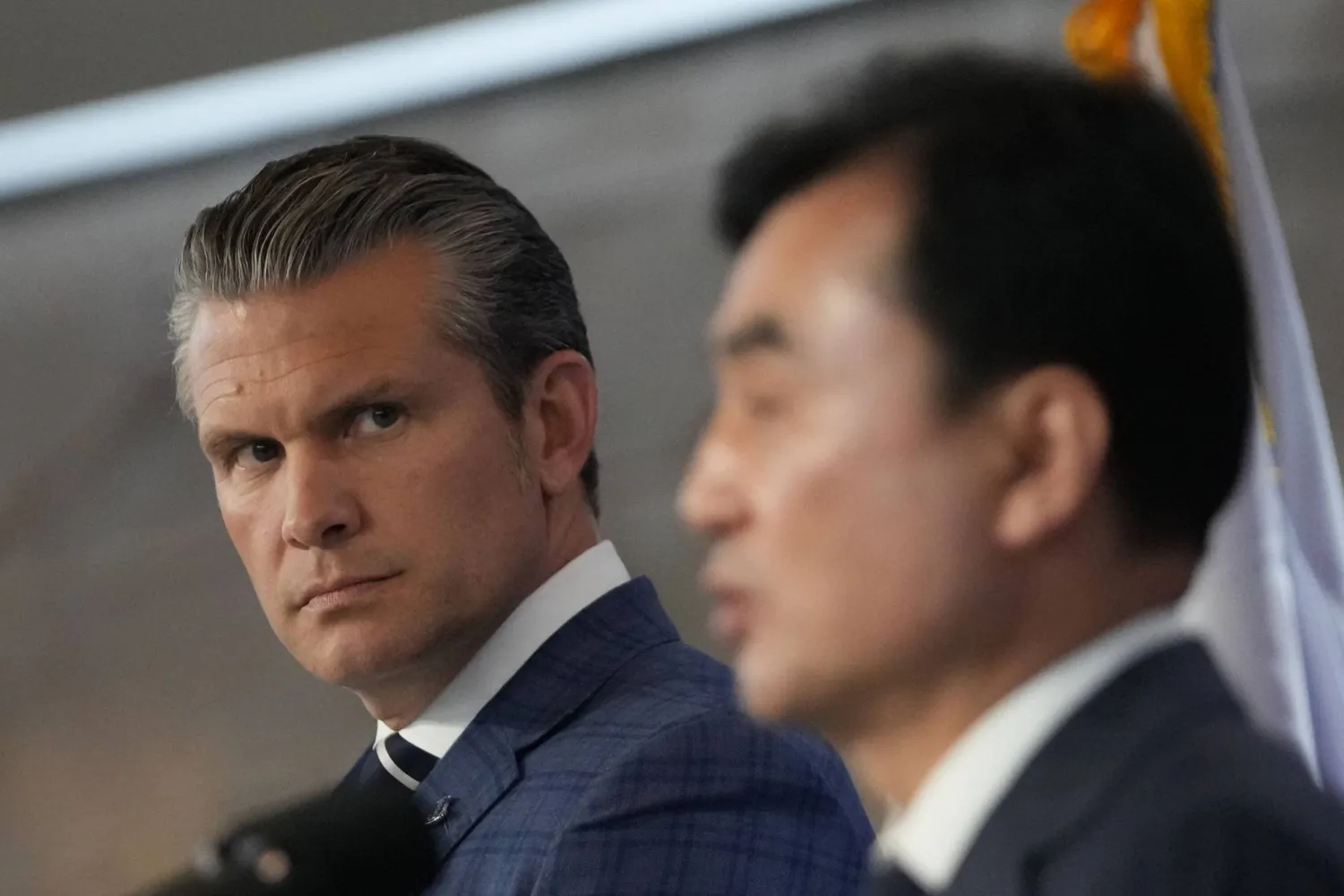
US Defense Secretary Pete Hegseth (L) listens as South Korean Defense Minister Ahn Gyu-back (R) speaks during a joint press conference following the 57th Security Consultative Meeting (SCM) at the Defense Ministry in Seoul on November 4, 2025. (AFP)
TT

Hegseth Says US-South Korea Alliance Focused on North Korea but ‘Flexibility’ Needed 

US Defense Secretary Pete Hegseth (L) listens as South Korean Defense Minister Ahn Gyu-back (R) speaks during a joint press conference following the 57th Security Consultative Meeting (SCM) at the Defense Ministry in Seoul on November 4, 2025. (AFP)

The United States will look at "flexibility" for US troops stationed in South Korea to operate against regional threats, but the core of the alliance with Seoul will remain focused on deterring North Korea, US Defense Secretary Pete Hegseth said on Tuesday.

He spoke alongside his South Korean counterpart during a visit to South Korea that earlier included a trip to the Demilitarized Zone on the border with North Korea.

When asked whether the 28,500 US troops stationed in South Korea might be used in any conflicts beyond the peninsula, including with China, Hegseth told a briefing that protecting against nuclear-armed North Korea is the goal of the alliance.

"But there's no doubt that flexibility for regional contingency is something we would take a look at," he said.

Defense Minister Ahn Gyu-back accompanied Hegseth to the DMZ on Monday and observed combined military displays.

US officials have signaled a plan to make US forces more flexible to potentially operate outside the Korean peninsula in response to a broader range of threats, such as defending Taiwan and checking China's growing military reach.

South Korea has resisted the idea of shifting the role of US troops, but has worked to grow its defense capabilities in the past 20 years, with the goal of being able to take on a wartime command of the combined US-South Korean forces. South Korea has 450,000 troops.

Hegseth said the two sides were still working on a joint communique expected to address talks about defense costs and other issues, adding they had discussed South Korea making greater military investments.

The allies had also agreed to have South Korea maintain and repair US ships, allowing them to stay in the area and be ready if needed, he said.

US President Donald Trump's decision to support South Korea's plans to build nuclear-powered submarines was driven by his desire to have strong allies, Hegseth said.

"He wants our allies to have the best capabilities," the US defense secretary said. "And because Korea has been a model ally, he's open to opportunities like that, that ensure they have the best capabilities in their own defense and alongside us as allies."

Hegseth said he could not comment on details of exactly what Trump approved.

South Korean officials have said they could launch a nuclear-powered submarine by the mid-2030s if provided with fuel from the United States.

When asked about concerns that South Korea could pursue its own nuclear bombs, Ahn noted it was a signatory to the Nuclear Non-Proliferation Treaty.

"Therefore, there will be no development of nuclear weapons in the Republic of Korea," he said.



Iran Guards Chief Says 'Finger on Trigger', Warns US against 'Miscalculations'

Commander of the Iranian Revolutionary Guard Mohammad Pakpour (Archive - Reuters)
TT

Iran Guards Chief Says 'Finger on Trigger', Warns US against 'Miscalculations'

Commander of the Iranian Revolutionary Guard Mohammad Pakpour (Archive - Reuters)

The commander of Iran's Revolutionary Guards on Thursday warned Israel and the US against "miscalculations" in the wake of mass protests, saying the force had its "finger on the trigger".

US President Donald Trump has repeatedly left open the option of new military action against the Iranian republic after Washington backed and joined Israel's 12-day war in June.

A fortnight of protests starting in late December shook the clerical leadership under supreme leader Ali Khamenei, but the movement has petered out in the face of a crackdown that activists say has left thousands dead.

Guards commander General Mohammad Pakpour warned Israel and the United States "to avoid any miscalculations, by learning from historical experiences and what they learned in the 12-day imposed war, so that they do not face a more painful and regrettable fate".

"The Islamic Revolutionary Guard Corps and dear Iran have their finger on the trigger, more prepared than ever, ready to carry out the orders and measures of the supreme commander-in-chief -- a leader dearer than their own lives," he said, referring to Khamenei.

His comments came in a written statement quoted by state television marking the national day in Iran to celebrate the Guards, a force whose mission is to protect the 1979 Iranian revolution from internal and external threats.

Activists accuse the Guards of playing a frontline role in the deadly crackdown on protests. The group is sanctioned as a terrorist entity by countries including Australia, Canada and the United States and campaigners have long urged similar moves from the EU and UK.

Pakpour took over as Guards commander last year after his predecessor Hossein Salami was one of several key military figures killed in an Israeli strike during the 12-day war, losses which revealed Israel's deep intelligence penetration of Iran.

Giving their first official toll from the protests, Iranian authorities on Wednesday said 3,117 people were killed.

The statement from the Iranian republic's foundation for martyrs and veterans sought to draw a distinction between "martyrs", who it said were members of security forces and innocent bystanders, and what it described as "rioters" backed by the US. 

Of its toll of 3,117, it said 2,427 people were martyrs. 

However, rights groups say the heavy toll was caused by security forces firing directly on protesters and that the actual number of those killed could be far higher and even extend to over 20,000. 

Speaking at the World Economic Forum in Davos, Israeli President Isaac Herzog said "the future for the Iranian people can only be in a regime change", adding that the Iranian “regime is in quite a fragile situation". 


Merz Warns Great Power Politics Makes World 'a Dangerous Place'

Germany's Chancellor Friedrich Merz gestures as he speaks during the World Economic Forum (WEF) annual meeting in Davos on January 22, 2026. (Photo by Fabrice COFFRINI / AFP)
TT

Merz Warns Great Power Politics Makes World 'a Dangerous Place'

Germany's Chancellor Friedrich Merz gestures as he speaks during the World Economic Forum (WEF) annual meeting in Davos on January 22, 2026. (Photo by Fabrice COFFRINI / AFP)

German Chancellor Friedrich Merz warned Thursday that the international order is "unravelling at a breathtaking pace" and that "a world where only power counts is a dangerous place".

Speaking at the World Economic Forum in Davos, Merz pointed to Russia's war in Ukraine, a rising China and a United States that is "radically reshaping its foreign and security policy".

"A world where only power counts is a dangerous place," he said. "First for small states and for the middle powers, ultimately for the great ones."

The conservative leader of the top EU economy said Germany went down this road "to its bitter end" during the 20th century, reported AFP.

"It pulled the world into a black abyss," he said.

"So let us bear in mind: our greatest strength remains the ability to build partnerships and alliances among equals based on mutual trust and respect."

Merz called Russia's invasion of Ukraine "the most drastic expression" so far of a global "new era". He added that China, "with strategic foresight, has worked its way into the ranks of the great powers".

"The United States' global pole position is being challenged," Merz said, with Washington responding by "radically reshaping its foreign and security policy".

"We have entered a time of great power politics. The international order of the past three decades anchored in international law has always been imperfect. Today, its very foundations have been shaken."

He said Europe's power rested on three pillars.

"First we must invest massively in our ability to defend ourselves, and we are doing this," he said.

"Second, we must rapidly make our economies competitive, and we are doing this. Third, we must stand closer together among Europeans and among like-minded partners. We are doing this."


Israel President Says Iran's Future 'Can Only Be Regime Change'

Israeli President Isaac Herzog attends the 56th annual World Economic Forum (WEF) meeting in Davos, Switzerland, January 22, 2026. REUTERS/Romina Amato
TT

Israel President Says Iran's Future 'Can Only Be Regime Change'

Israeli President Isaac Herzog attends the 56th annual World Economic Forum (WEF) meeting in Davos, Switzerland, January 22, 2026. REUTERS/Romina Amato

Israel's President Isaac Herzog said on Thursday that "regime change" can be the only future for Iran, where mass protests against the clerical authorities have faced a deadly crackdown.

Demonstrations initially sparked by economic grievances turned into a movement against the theocracy that has ruled Iran since 1979.

People poured into the streets for several days from January 8, but the demonstrations appear for now to have petered out in the face of what activists describe as a crackdown under the cover of a blanket internet shutdown.

"The Iranian people are yearning for change. The Iranian people deserve change," Herzog said in an interview at the World Economic Forum in Davos.

"The future for the Iranian people can only be in a regime change, and that has to be... within the realms of the Iranian people and the international community and its support," he added.

He added saying that the Iranian “regime is in quite a fragile situation."

The Iranian Republic's long-time foe Israel has expressed support for the protesters, without suggesting it would intervene.

Iran accused Israel in early January of trying to undermine its national unity after Prime Minister Benjamin Netanyahu said Israel stood "in solidarity with the struggle of the Iranian people".

Iranian authorities on Wednesday said 3,117 people were killed during the protests that first erupted in late December, but activists said the actual toll risked being many times higher.

Iran and Israel fought a 12-day war last year, after Israel launched a wave of strikes on Iranian nuclear facilities as well as residential areas, saying it aimed to cripple the Iranian republic's atomic research and ballistic missile capabilities.