

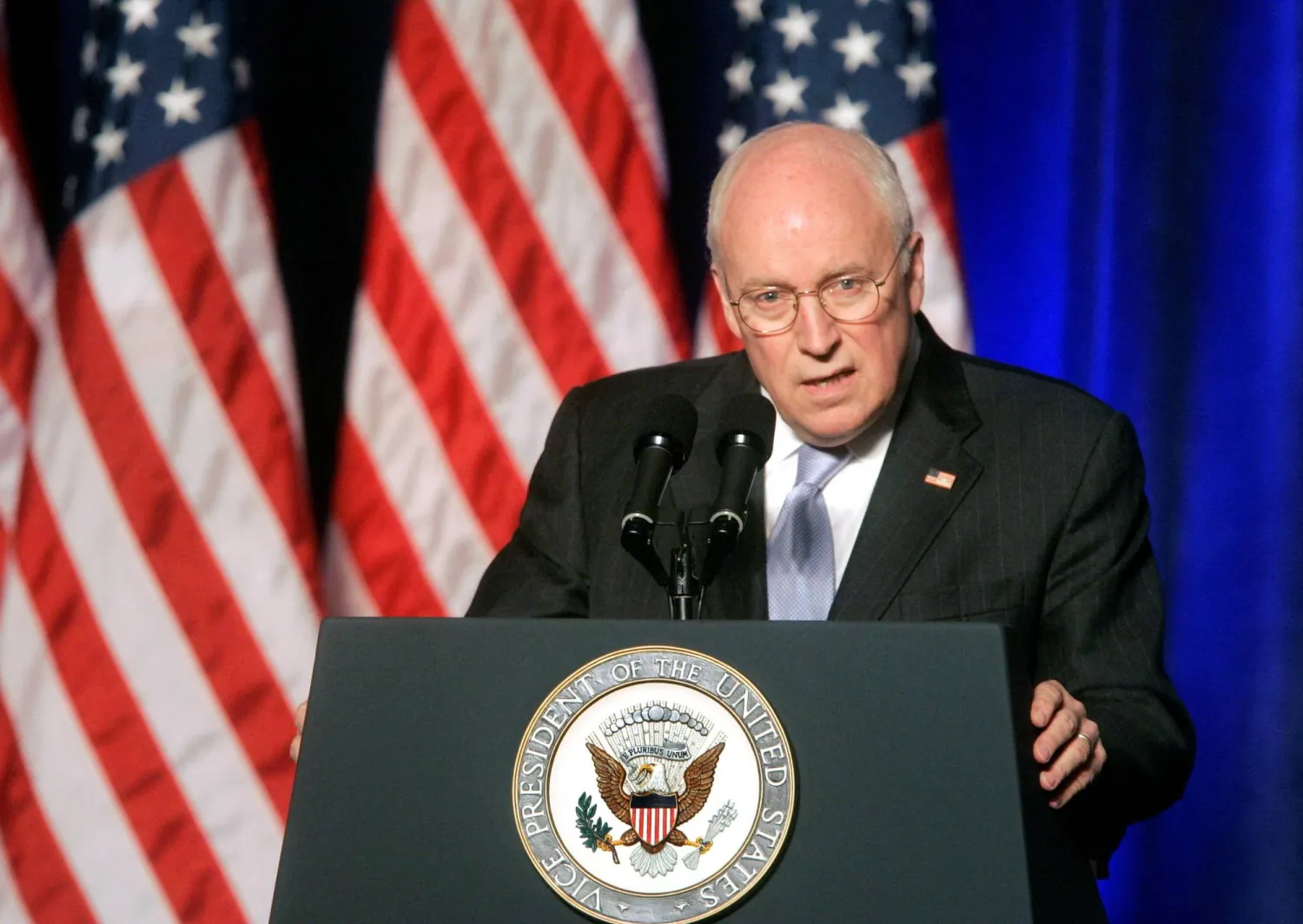

Dick Cheney, Powerful Former US Vice President Who Pushed for Iraq War, Dies at 84 

US Vice President Dick Cheney speaks at the American Conservative Union's 2008 Conservative Political Action Conference at the Omni Shoreham Hotel in Washington, February 7, 2008. (Reuters)
TT

Dick Cheney, Powerful Former US Vice President Who Pushed for Iraq War, Dies at 84 

US Vice President Dick Cheney speaks at the American Conservative Union's 2008 Conservative Political Action Conference at the Omni Shoreham Hotel in Washington, February 7, 2008. (Reuters)

Dick Cheney, a driving force behind the US invasion of Iraq in 2003, was considered by presidential historians as one of the most powerful vice presidents in US history.

He died at age 84 on Monday from complications of pneumonia and cardiac and vascular disease, his family said in a statement on Tuesday.

The Republican - a former Wyoming congressman and secretary of defense - was already a major Washington player when then-Texas governor George W. Bush chose him to be his running mate in the 2000 presidential race that Bush went on to win.

As vice president from 2001 to 2009, Cheney fought vigorously for an expansion of the power of the presidency, having felt that it had been eroding since the Watergate scandal that drove his one-time boss Richard Nixon from office. He also expanded the clout of the vice president's office by putting together a national security team that often served as a power center of its own within the administration.

Cheney was a strong advocate for the 2003 invasion of Iraq and was among the most outspoken of Bush administration officials warning of the danger from Iraq's alleged stockpile of weapons of mass destruction. No such weapons were found.

He clashed with several top Bush aides, including Secretaries of State Colin Powell and Condoleezza Rice, and defended "enhanced" interrogation techniques of terrorism suspects that included waterboarding and sleep deprivation. Others, including the US Senate Select Committee on Intelligence and the UN special rapporteur on counter terrorism and human rights, called these techniques "torture."

His daughter Liz Cheney also became an influential Republican lawmaker, serving in the House of Representatives but losing her seat after opposing Republican President Donald Trump and voting to impeach him in the wake of the January 6, 2021 attack on the Capitol by his supporters. Her father, who agreed with her, said that he would vote for Democratic candidate Kamala Harris in 2024.

"In our nation's 248 year-history, there has never been an individual who is a greater threat to our republic than Donald Trump," said the man who had long been a foe of the left.

Cheney was troubled much of his life by heart problems, suffering the first of a number of heart attacks at age 37. He had a heart transplant in 2012.

TAKING ON IRAQ

Cheney and Defense Secretary Donald Rumsfeld, who had been colleagues in the Nixon White House, were key voices pushing for the March 2003 invasion of Iraq.

In the run-up to the war, Cheney suggested there might be links between Iraq and al-Qaeda and the September 11, 2001, attacks on the United States. A commission on the 9/11 attacks later discredited this theory.

Cheney predicted US forces would be "greeted as liberators" in Iraq and that the troop deployment - which would last around a decade - would "go relatively quickly ... weeks rather than months."

Although no weapons of mass destruction were found, Cheney in later years insisted that the invasion was the right decision based on the intelligence at the time and the removal of Iraqi President Saddam Hussein from power.

More than a decade earlier, as defense secretary under President George H.W. Bush, Cheney had directed the US military operation to expel an Iraqi occupation army from Kuwait in the first Gulf War.

He urged Bush senior to take an uncompromising line against Iraq after Saddam Hussein sent his troops to occupy Kuwait in August 1990. But at that point Cheney did not support an invasion of Iraq, saying the United States would have to act alone and that the situation would become a quagmire.

Because of Cheney's long ties to the Bush family and experience in government, George W. Bush chose him to head his vice presidential search in 2000. Bush then decided the man doing the search was the best candidate for the job.

Upon his re-entry into politics, Cheney received a $35 million retirement package from oil services firm Halliburton, which he had run from 1995 to 2000. Halliburton became a leading government contractor during the Iraq war. Cheney's oil industry links were a subject of frequent criticism by opponents of the war.

THE FIRST REPUBLICAN IN GENERATIONS

Richard Bruce Cheney was born in Lincoln, Nebraska, to Marjorie Lorraine (née Dickey) and Richard Herbert Cheney on January 30, 1941, the day then-President Franklin Roosevelt turned 59. His mother was a waitress turned softball player, his father a federal worker with the Soil Conservation Service.

Both sides of the family were staunch New Deal Democrats, he wrote in his 2011 book "In My Time: A Personal and Political Memoir."

Convinced that the president would want to know that he shared a birthday with the newborn, Cheney's grandfather urged Marjorie and Richard to share the news by telegram with the White House.

In his family he "was the first Republican probably since my great-grandfather who fought in the Civil War on the Union side," he told the PBS documentary "Dick Cheney: A Heartbeat Away."

He moved as a boy to Wyoming with his family, before attending Yale University. "I was a mediocre student, at best," he said. He dropped out.

'A DEADLY ALLERGY TO OLIVE DRAB'

Back in Wyoming in 1962, he worked on building electrical transmission lines and coal-fired power stations, before eventually earning undergraduate and master's degrees in political science from the University of Wyoming.

Of that time he recalled a visit by then President John F. Kennedy, who addressed students on the importance of using what they were learning to build a better nation and a better world. "He had inspired us all, and at a time when I was trying to put my life back together, I was particularly grateful for the sense of elevated possibilities he described," Cheney wrote in his memoir.

In his 20s, Cheney strongly disagreed with the students who shut down campuses in protest against the Vietnam War, he recalled in his memoir. "As a general proposition, I supported our troops in Vietnam and the right of the Kennedy and Johnson administrations to make the decision to be involved there," he wrote. He himself was never drafted.

According to his biographer, John Nichols, Cheney repeatedly applied for deferments and exemptions to avoid conscription. "Cheney reacted to the prospect of wearing his country’s uniform like a man with a deadly allergy to olive drab," Nichols wrote in The Nation magazine in 2011. Cheney stated that he would have been happy to serve.

EMBRACING DARTH VADER

Cheney went to Washington in 1969 as a congressional intern and held various White House jobs during the Republican administrations of Nixon and Gerald Ford. One of his earliest mentors was Rumsfeld, who worked as secretary of defense in both the Ford and George W. Bush administrations. When Cheney became Ford's chief of staff, he succeeded Rumsfeld.

During the 10 years he served as Wyoming's only congressman, Cheney had a highly conservative record, consistently voting against abortion rights. He also voted against the release of imprisoned South African leader Nelson Mandela and against gun control and environmental and education funding measures.

His wife Lynne, who had been his high school sweetheart, became a conservative voice on cultural issues. Liz, the couple's eldest daughter, was elected to the House in 2016 after building a reputation for pushing hawkish foreign policy views similar to her father's.

During his time as vice president, late-night television comedians referred to Cheney as Darth Vader. He shrugged it off by joking that he was honored to be compared to the "Star Wars" villain, even dressing as Vader for an appearance on the "Tonight Show" to promote his memoir.

'THANK YOU TO SATAN'

His daughters Mary and Liz both survive him, as does Lynne. All three were with him as he died, the family said.

In 2006 he made headlines during a hunting trip in Texas when he accidentally wounded his friend, Texas lawyer Harry Wittington, in the face with a spray of birdshot.

Controversy continued to dog Cheney even after he left the Bush administration. He was the subject of a scathing biographical film in 2018 titled "Vice," starring Christian Bale, who gained 40 pounds (18 kg) and shaved his head to mimic the former vice president's paunchiness and baldness.

"Thank you to Satan for giving me inspiration on how to play this role," Bale said in accepting a Golden Globes award for his Cheney portrayal.

During a book tour for his memoir, Cheney seemed to relish raising the ire of critics. Just before its release he gleefully predicted it would leave heads "exploding" all over Washington.

He devoted parts of the book to settling scores with former colleagues such as Rice, whom he depicted as naive. Cheney also took aim at then-President Barack Obama's world view, puzzling over the Democrat's concern that the US military prison at Guantanamo Bay in Cuba was harmful to America's image.



US Envoy Kellogg Says Ukraine Peace Deal Is Really Close

A Ukrainian serviceman walks near apartment buildings damaged by a Russian military strike, amid Russia's attack on Ukraine, in the frontline town of Kostiantynivka in Donetsk region, Ukraine November 15, 2025. (Oleg Petrasiuk/Press Service of the 24th King Danylo Separate Mechanized Brigade of the Ukrainian Armed Forces/Handout via Reuters)
TT

US Envoy Kellogg Says Ukraine Peace Deal Is Really Close

A Ukrainian serviceman walks near apartment buildings damaged by a Russian military strike, amid Russia's attack on Ukraine, in the frontline town of Kostiantynivka in Donetsk region, Ukraine November 15, 2025. (Oleg Petrasiuk/Press Service of the 24th King Danylo Separate Mechanized Brigade of the Ukrainian Armed Forces/Handout via Reuters)

US President Donald Trump's outgoing Ukraine envoy said a deal to end the Ukraine war was "really close" and now depended on resolving two main outstanding issues: the future of Ukraine's Donbas region and the Zaporizhzhia nuclear power plant.

Russia invaded Ukraine in February 2022 after eight years of fighting between Russian-backed separatists and Ukrainian troops in the Donbas, which is made up of the Donetsk and Luhansk regions.

The Ukraine war is the deadliest European conflict since World War Two and has triggered the biggest confrontation between Russia and the West since the depths of the Cold War.

US Special Envoy for Ukraine Keith Kellogg, who is due to step down in January, told the Reagan National Defense Forum that efforts to resolve the conflict were in "the last 10 meters" which he said was always the hardest.

The two main outstanding issues, Kellogg said, were on territory - primarily the future of the Donbas - and the future of Ukraine's Zaporizhzhia nuclear power plant, Europe's largest, which is under Russian control.

"If we get those two issues settled, I think the rest of the things will work out fairly well," Kellogg said on Saturday at the Ronald Reagan Presidential Library and Museum in Simi Valley, California. "We're almost there."

"We're really, really close," said Kellogg.

Kellogg, a retired lieutenant general who served in Vietnam, Panama and Iraq, said the scale of the death and injuries caused by the Ukraine war was "horrific" and unprecedented in terms of a regional war.

He said that, together, Russia and Ukraine have suffered more than 2 million casualties, including dead and wounded since the war began. Neither Russia nor Ukraine disclose credible estimates of their losses.

Moscow says Western and Ukrainian estimates inflate its losses. Kyiv says Moscow inflates estimates of Ukrainian losses.

Russia currently controls 19.2% of Ukraine, including Crimea, which it annexed in 2014, all of Luhansk, more than 80% of Donetsk, about 75% of Kherson and Zaporizhzhia, and slivers of the Kharkiv, Sumy, Mykolaiv and Dnipropetrovsk regions.

A leaked set of 28 US draft peace proposals emerged last month, alarming Ukrainian and European officials who said it bowed to Moscow's main demands on NATO, Russian control of a fifth of Ukraine and restrictions on Ukraine's army.

Those proposals, which Russia now says contain 27 points, have been split up into four different components, according to the Kremlin. The exact contents are not in the public domain.

Under the initial US proposals, the Zaporizhzhia nuclear plant, whose reactors are currently in cold shutdown, would be relaunched under the supervision of the International Atomic Energy Agency, and the electricity produced would be distributed equally between Russia and Ukraine.

Ukrainian President Volodymyr Zelenskiy said on Saturday that he had had a long and "substantive" phone call with Trump's special envoy Steve Witkoff and Trump's son-in-law Jared Kushner.

The Kremlin said on Friday it expected Kushner to be doing the main work on drafting a possible deal.


7.0 Earthquake Hits in Remote Wilderness Along Alaska-Canada Border

 Hubbard Glacier, located near Yakutat, Alaska, is seen on Aug. 1, 2024. (AP)
Hubbard Glacier, located near Yakutat, Alaska, is seen on Aug. 1, 2024. (AP)
TT

7.0 Earthquake Hits in Remote Wilderness Along Alaska-Canada Border

 Hubbard Glacier, located near Yakutat, Alaska, is seen on Aug. 1, 2024. (AP)
Hubbard Glacier, located near Yakutat, Alaska, is seen on Aug. 1, 2024. (AP)

A powerful, magnitude-7.0 earthquake struck in a remote area near the border between Alaska and the Canadian territory of Yukon on Saturday. There was no tsunami warning, and officials said there were no immediate reports of damage or injury.

The US Geological Survey said it struck about 230 miles (370 kilometers) northwest of Juneau, Alaska, and 155 miles (250 kilometers) west of Whitehorse, Yukon.

In Whitehorse, Royal Canadian Mounted Police Sgt. Calista MacLeod said the detachment received two 911 calls about the earthquake.

“It definitely was felt,” MacLeod said. “There are a lot of people on social media, people felt it.”

Alison Bird, a seismologist with Natural Resources Canada, said the part of Yukon most affected by the temblor is mountainous and has few people.

“Mostly people have reported things falling off shelves and walls,” Bird said. “It doesn’t seem like we’ve seen anything in terms of structural damage.”

The Canadian community nearest to the epicenter is Haines Junction, Bird said, about 80 miles (130 kilometers) away. The Yukon Bureau of Statistics lists its population count for 2022 as 1,018.

The quake was also about 56 miles (91 kilometers) from Yakutat, Alaska, which the USGS said has 662 residents.

It struck at a depth of about 6 miles (10 kilometers) and was followed by multiple smaller aftershocks.


Japan and Australia Urge Calm after Chinese Radar Locks on Japanese Jets

Printed Chinese and Japanese flags are seen in this illustration, July 21, 2022. REUTERS/Dado Ruvic/Illustration Purchase Licensing Rights
TT

Japan and Australia Urge Calm after Chinese Radar Locks on Japanese Jets

Printed Chinese and Japanese flags are seen in this illustration, July 21, 2022. REUTERS/Dado Ruvic/Illustration Purchase Licensing Rights

Japan and Australia urged calm on Sunday after Chinese military aircraft locked radar on Japanese fighter jets, a month after the Japanese leader’s recent remarks on Taiwan that stirred tensions between Tokyo and Beijing.

Defense Minister Shinjiro Koizumi said Japan formally protested the incident, calling it “an extremely regrettable” act and “a dangerous" one that "exceeded the scope necessary for safe aircraft operations.”

“We have lodged a strong protest with the Chinese side and demanded strict preventive measures,” Koizumi said.

Japan’s Defense Ministry said China’s military aircraft J-15 took off from the Chinese carrier Liaoning near the southern island of Okinawa on Saturday and “intermittently” latched its radar on Japanese F-15 fighter jets on two occasions Saturday, for about three minutes in the late afternoon and for about 30 minutes in the evening. It was not made clear whether the radar lock incident involved the same Chinese J-15 both times.

Japanese fighter jets that had been scrambled to pursue Chinese jets that were conducting aircraft takeoff and landing exercises in the Pacific. They were pursuing the Chinese aircraft at a safe distance and did not take actions that could be interpreted as provocation, Kyodo News agency said, quoting defense officials, when the radar lock happened. There was no breach of Japanese airspace, and no injury or damage was reported from the incident.

Senior Colonel Wang Xuemeng, spokesperson for the Chinese navy, defended China’s flight training near the Miyako island Saturday, saying Beijing announced the exercises beforehand and accused Japanese aircraft of “harassment.”

“We solemnly asked the Japanese side to immediately stop slandering and smearing, and strictly restrain its frontline actions. The Chinese Navy will take necessary measures in accordance with the law to resolutely safeguard its own security and legitimate rights and interests,” Wang said in a statement posted Sunday on the Chinese Ministry of Defense website.

Relations between Japan and China have worsened after Japan’s Prime Minister Sanae Takaichi said in early November its military could get involved if China were to take action against Taiwan, the self-governing island that Beijing claims as its own.

Japan and Australia, whose defense ministers held their scheduled talks in Tokyo on Sunday, expressed worry over the development.

“We are deeply concerned by the actions of China in the last 24 hours,” Australian Defense Minister Richard Marles told a joint news conference Sunday after holding talks with Koizumi. “We expect those interactions to be safe and professional."

Australia does “not want to see any change to the status quo across the Taiwan Straits,” Marles said, adding that China is his country's largest trade partner and he wants to have productive relations with Beijing.

“We continue to advocate to China about these issues again, in a very calm, sensible and moderate way,” he said.

Japan and Australia, during Sunday talks, agreed to bolster military ties to lead the region’s multilateral defense cooperation. The two ministers agreed to form a comprehensive “framework for strategic defense coordination” and discuss further details.

Tokyo has been accelerating its military buildup while expanding its defense ties beyond its only treaty ally, the United States. It now considers Australia to be a semi-ally.

Marles also visited a Mitsubishi Heavy Industries shipyard in Nagasaki on Saturday to observe production of the upgraded Mogami-class frigate that his country chose in September as a replacement for its aging fleet.

Saturday's radar lock is believed to be the first involving Japanese and Chinese military aircraft. In 2013, a Chinese warship targeted a radar on a Japanese destroyer, Kyodo said.

Fighter jets use radars for search operations or fire control ahead of a missile launch.

Elsewhere in the Pacific, the Philippine coast guard said China fired three flares toward a fisheries bureau plane on patrol in the South China Sea on Saturday. Chinese forces fire flares to warn planes to move away from what they consider their airspace over the disputed waters.