

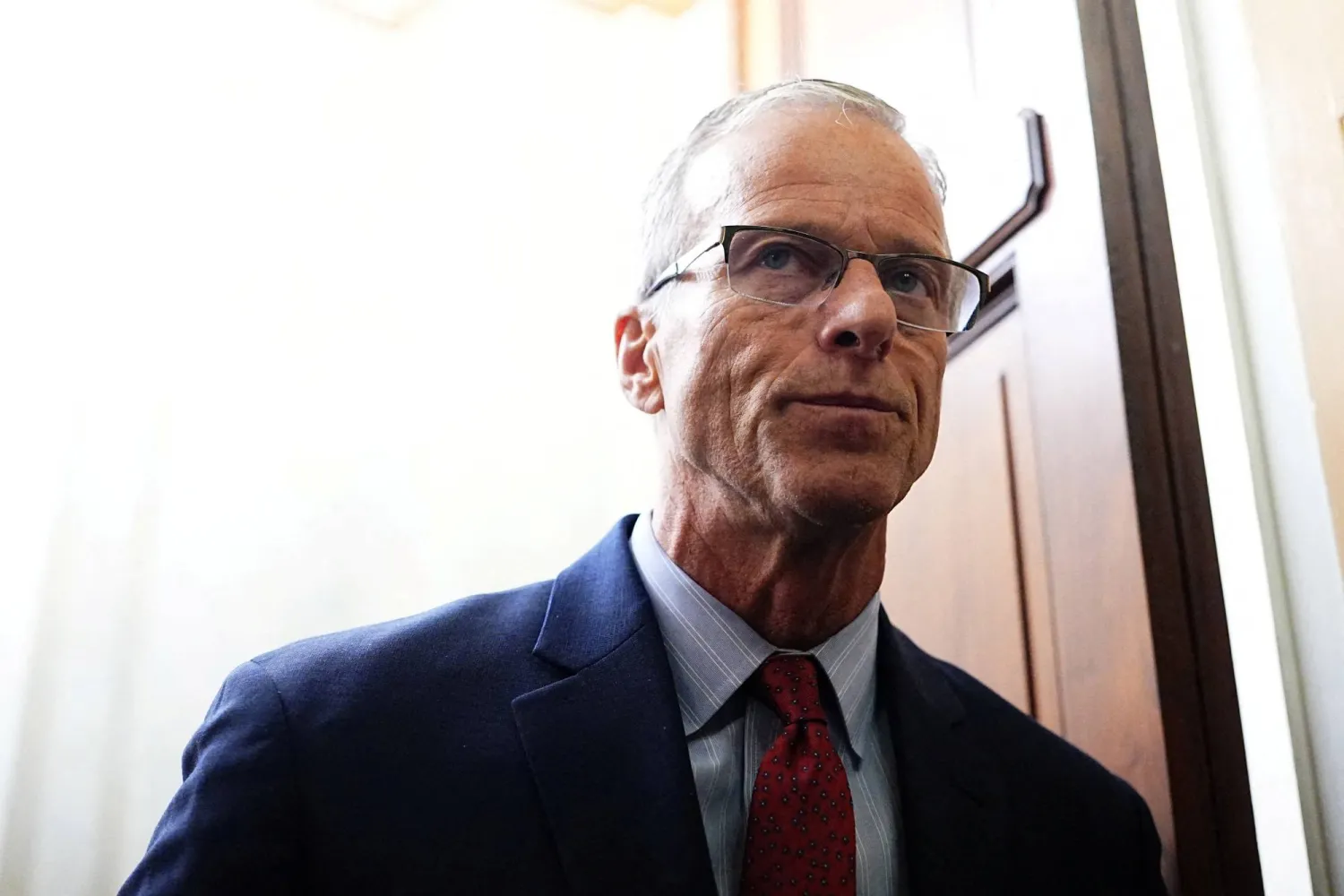

Senate Takes First Step Toward Ending Government Shutdown

US Senate Majority Leader John Thune (R-SD) looks on outside the Senate Chamber after the vote on the 40th day of the partial government shutdown, in Washington, D.C., US, November 9, 2025. REUTERS/Aaron Schwartz
TT

Senate Takes First Step Toward Ending Government Shutdown

US Senate Majority Leader John Thune (R-SD) looks on outside the Senate Chamber after the vote on the 40th day of the partial government shutdown, in Washington, D.C., US, November 9, 2025. REUTERS/Aaron Schwartz

The Senate took the first step to end the government shutdown on Sunday after a group of moderate Democrats agreed to proceed without a guaranteed extension of health care subsidies, angering many in their caucus who say Americans want them to continue the fight.

In a test vote that is the first in a series of required procedural maneuvers, the Senate voted 60-40 to move toward passing compromise legislation to fund the government and hold a later vote on extending Affordable Care Act tax credits that expire Jan. 1.

Final passage could be several days away if Democrats object and delay the process.

The agreement does not guarantee the Affordable Care Act subsidies will be extended, as Democrats have demanded for almost six weeks. Senate Democratic leader Chuck Schumer of New York voted against moving ahead with the package, along with all but eight of his Democratic colleagues.

A group of three former governors — New Hampshire Sen. Jeanne Shaheen, New Hampshire Sen. Maggie Hassan and Independent Sen. Angus King of Maine — broke the six-week stalemate on Sunday when they agreed to vote to advance three bipartisan annual spending bills and extend the rest of government funding until late January in exchange for a mid-December vote on extending the health care tax credits.

The agreement also includes a reversal of the mass firings of federal workers by the Trump administration since the shutdown began on Oct. 1 and would ensure that federal workers receive back pay.

Senate Majority Leader John Thune quickly endorsed the deal and called the immediate vote to begin the process of approving it as the shutdown continued to disrupt flights nationwide, threaten food assistance for millions of Americans and leave federal workers without pay.

“The time to act is now,” The Associated Press quoted Thune as saying.

Returning to the White House on Sunday evening after attending a football game, President Donald Trump did not say whether he endorsed the deal. But he said, “It looks like we’re getting close to the shutdown ending.”

In addition to Shaheen, King and Hassan, Democratic Sen. Tim Kaine of Virginia, home to tens of thousands of federal workers, also voted in favor of moving forward on the agreement. Illinois Sen. Dick Durbin, the No. 2 Democrat, Pennsylvania Sen. John Fetterman and Nevada Sens. Catherine Cortez Masto and Jacky Rosen also voted yes.

The moderates had expected a larger number of Democrats to vote with them as around 10-12 Democratic senators had been part of the negotiations. But in the end, only five Democrats switched their votes — the exact number that Republicans needed.

King, Cortez Masto and Fetterman had already been voting to open the government since Oct. 1.

The vote was temporarily delayed on Sunday evening as three conservatives who often criticize spending bills, Republican Sens. Mike Lee of Utah, Rick Scott of Florida and Ron Johnson of Wisconsin, withheld their votes and huddled with Thune at the back of the chamber. They eventually voted yes after speaking to Trump, Lee said.

Another Republican, Sen John Cornyn of Texas, had to fly back from Texas to deliver the crucial 60th vote.

After Democrats met for over two hours to discuss the proposal, Schumer said he could not “in good faith” support it.

Schumer, who received blowback from his party in March when he voted to keep the government open, said that Democrats have now “sounded the alarm” on health care.
“We will not give up the fight,” he said.

Independent Sen. Bernie Sanders of Vermont, who caucuses with the Democrats, said that giving up the fight was a “horrific mistake.”

Sen. Chris Murphy, D-Conn., agreed, saying that people in last week's elections voted overwhelmingly Democratic “to urge Democrats to hold firm.”

A bipartisan agreement Democrats had voted 14 times not to reopen the government as they demanded the extension of tax credits that make coverage more affordable for health plans offered under the Affordable Care Act. Republicans said they would not negotiate on health care, but GOP leaders have been quietly working with the group of moderates as the contours of an agreement began to emerge.

The agreement includes bipartisan bills worked out by the Senate Appropriations Committee to fund parts of government — food aid, veterans programs and the legislative branch, among other things. All other funding would be extended until the end of January, giving lawmakers more than two months to finish additional spending bills.

The deal would reinstate federal workers who had received reduction in force, or layoff, notices and reimburse states that spent their own funds to keep federal programs running during the shutdown. It would also protect against future reductions in force through January and guarantee federal workers would be paid once the shutdown is over.

House Democrats push back House Democrats swiftly criticized the Senate.

Texas Rep. Greg Casar, the chairman of the Congressional Progressive Caucus, said a deal that doesn't reduce health care costs is a “betrayal” of millions of Americans who are counting on Democrats to fight.

“Accepting nothing but a pinky promise from Republicans isn’t a compromise — it’s capitulation,” Casar said in a post on X. "Millions of families would pay the price.”

Rep. Angie Craig of Minnesota posted that “if people believe this is a ‘deal,’ I have a bridge to sell you.”

House Democratic leader Hakeem Jeffries blamed Republicans and said Democrats will continue to fight.

“Donald Trump and the Republican Party own the toxic mess they have created in our country and the American people know it,” Jeffries said.

Health care debate ahead It's unclear whether the two parties would be able to find any common ground on the health care subsidies before a promised December vote in the Senate. House Speaker Mike Johnson, R-La., has said he will not commit to bring it up in his chamber.

Some Republicans have said they are open to extending the COVID-19-era tax credits as premiums could skyrocket for millions of people, but they also want new limits on who can receive the subsidies and argue that the tax dollars for the plans should be routed through individuals.

Other Republicans, including Trump, have used the debate to renew their yearslong criticism of the law and called for it to be scrapped or overhauled.

“THE WORST HEALTHCARE FOR THE HIGHEST PRICE,” Trump said of the Affordable Care Act in a post Sunday.

Meanwhile, the consequences of the shutdown have been compounding. US airlines canceled more than 2,000 flights on Sunday for the first time since the shutdown began, and there were more than 7,000 flight delays, according to FlightAware, a website that tracks air travel disruptions.

Treasury Secretary Sean Duffy said on CNN’s “State of the Union" that air travel ahead of the Thanksgiving holiday will be “reduced to a trickle” if the government doesn't reopen.

At the same time, food aid was delayed for tens of millions of people as Supplemental Nutrition Assistance Program benefits were caught up in legal battles related to the shutdown.

And in Washington, home to millions of federal workers who have gone unpaid, the Capital Area Food Bank said it is providing 8 million more meals ahead of the holidays than it had prepared to this budget year — a nearly 20% increase.



Trump Reposts Suggestion that Rubio become Next Cuba Leader

Republican presidential nominee and former US President Donald Trump and Senator Marco Rubio (R-FL) react during campaign event at Dorton Arena, in Raleigh, North Carolina, US November 4, 2024. REUTERS/Jonathan Drake/
TT

Trump Reposts Suggestion that Rubio become Next Cuba Leader

Republican presidential nominee and former US President Donald Trump and Senator Marco Rubio (R-FL) react during campaign event at Dorton Arena, in Raleigh, North Carolina, US November 4, 2024. REUTERS/Jonathan Drake/

President Donald Trump reposted a social media message on Sunday suggesting that US Secretary of State Marco Rubio, born to Cuban immigrant parents, would become the next leader of Cuba.

Trump republished on his Truth Social platform a message from X user Cliff Smith on January 8 that read: "Marco Rubio will be president of Cuba," accompanied by a crying laughing emoji, AFP reported.

"Sounds good to me!" Trump commented in his repost.

The largely unknown user, whose bio refers to him as a "conservative Californian," has less than 500 followers on X.

Trump's repost comes a week after US forces seized Venezuela's authoritarian leader Nicolas Maduro in an overnight operation in Caracas that killed dozens of Venezuelan and Cuban security forces.

Cuba's communist government has yet to directly respond to the US president's provocative suggestion that an American citizen could rule the island.

But shortly after Trump's post, Cuban Foreign Minister Bruno Rodriguez insisted "right and justice are on Cuba's side."

The United States "behaves like an out-of-control criminal hegemon that threatens peace and security, not only in Cuba and this hemisphere, but throughout the entire world," Rodriguez posted on X.


UK's Former US Envoy Apologizes to Epstein's Victims, Not for His Own Ties

British Ambassador to the United States Peter Mandelson walks on the day British Prime Minister Keir Starmer holds an emergency Cobra meeting to discuss Israel-Iran conflict, in London, Britain, June 18, 2025. REUTERS/Jaimi Joy/File Photo
TT

UK's Former US Envoy Apologizes to Epstein's Victims, Not for His Own Ties

British Ambassador to the United States Peter Mandelson walks on the day British Prime Minister Keir Starmer holds an emergency Cobra meeting to discuss Israel-Iran conflict, in London, Britain, June 18, 2025. REUTERS/Jaimi Joy/File Photo

Britain's former US ambassador Peter Mandelson, who was dismissed over his links to Jeffrey Epstein last year, apologized on Sunday ​to the victims of the late convicted sex offender but not for his own actions.

Mandelson was fired in September over emails that came to light revealing a much closer relationship than previously acknowledged. The veteran British politician called Epstein "my best pal" and had advised him on seeking early jail release.

"I want to apologize to ‌those women ‌for a system that refused to ‌hear ⁠their ​voices and ‌did not give them the protection they were entitled to expect," Mandelson told the BBC broadcaster when asked if he wanted to say sorry for his links, Reuters reported.

Mandelson said he would only apologize for his own ties if he had known about Epstein's actions or been complicit.

"I was not ⁠culpable, I was not knowledgeable of what he was doing," he said.

"I ‌believed his story and that of ‍his lawyer, who spent ‍a lot of time trying to persuade me of ‍this ... that he had been falsely criminalized in his contact with these young women. Now I wish I had not believed that story."

Britain's government said at the time of Mandelson's dismissal that ​the depth of his ties to Epstein appeared "materially different" from what was known at the ⁠time of his appointment.

It has since named Christian Turner as its next ambassador to the US in a pivotal moment for transatlantic ties.

"Do you really think that if I knew what was going on and what he was doing with and to these vulnerable young women that I'd have just sat back, ignored it and moved on?", Mandelson added in the interview, describing Epstein as an "evil monster".

Mandelson also said he believed that, as a gay man in Epstein's ‌circle, he was "kept separate from what he was doing in the sexual side of his life".


German FM Puts Emphasis on Close Ties before US Trip

German Foreign Minister Johann Wadephul attends a press conference in Beijing, China December 8, 2025. REUTERS/Tingshu Wang/File Photo
TT

German FM Puts Emphasis on Close Ties before US Trip

German Foreign Minister Johann Wadephul attends a press conference in Beijing, China December 8, 2025. REUTERS/Tingshu Wang/File Photo

German Foreign Minister Johann Wadephul emphasized the importance of transatlantic relations on Sunday as he ​left for a trip to Washington that takes place at a delicate time due to tensions over US interests in Greenland and Venezuela.

"Never before has it been so crucial to ‌invest in ‌the transatlantic partnership in ‌order ⁠to ​remain ‌capable of shaping the world order," Wadephul said in Berlin before his departure.

He said he would address what he called "differences of opinions" between Germany and the United States during ⁠a meeting on Monday with US Secretary ‌of State Marco Rubio.

"Where ‍there are ‍differences of opinion, we want ‍to address these differences through dialogue in order to fulfil our shared responsibility for peace and security," Wadephul said.

On ​his way to Washington, Wadephul plans to stop over in Iceland ⁠on Sunday, where a meeting on Arctic security is scheduled with his Icelandic counterpart in Reykjavik.

Later on Monday, he also plans to meet UN Secretary-General Antonio Guterres.

"For Germany, reliability as an international partner clearly includes a commitment to international law and international cooperation," he said, ‌referring to the United Nations.