


Pakistan Investigates Suicide Bombing That Killed 12 Outside an Islamabad Court 

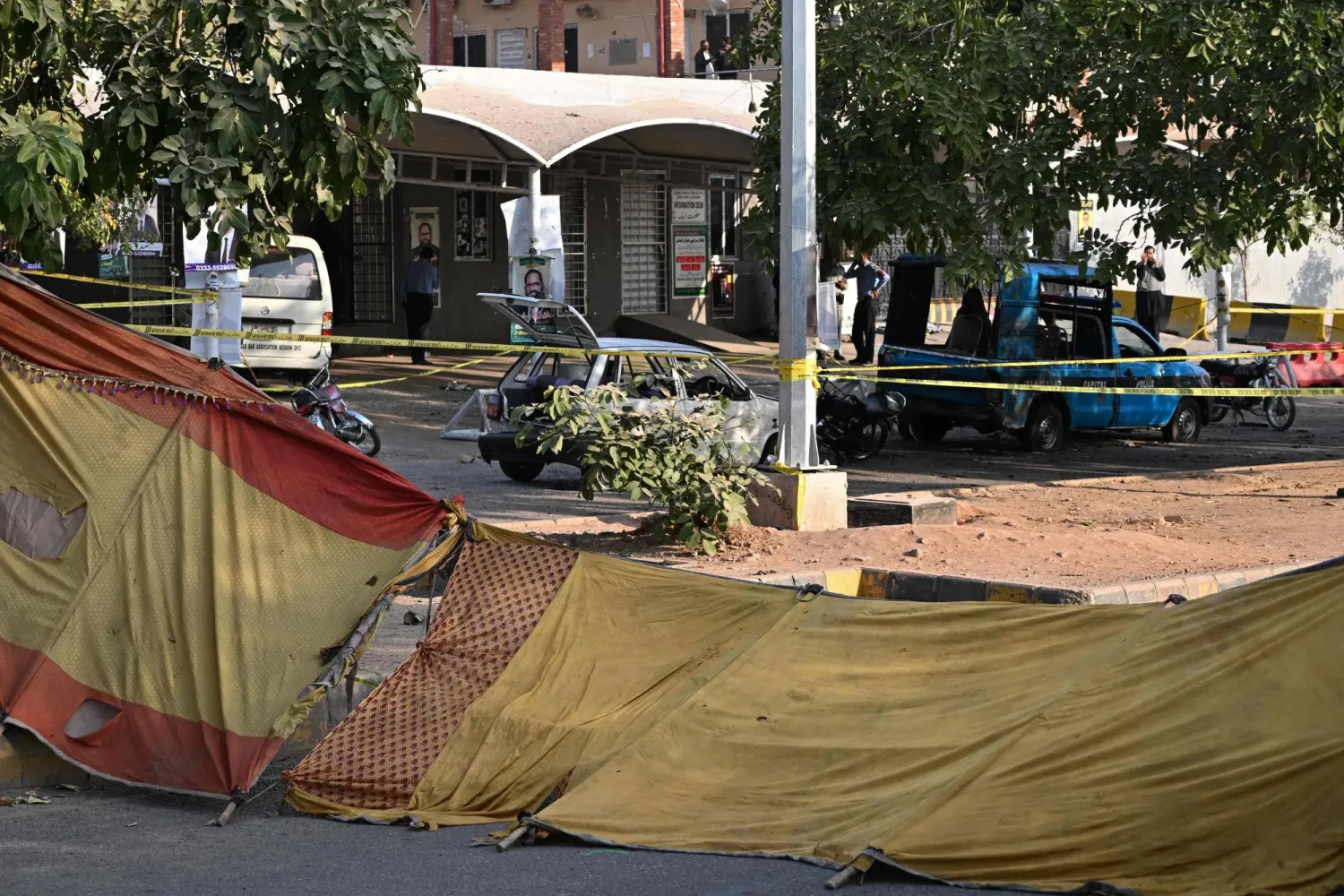
Policemen stand near the wreckage of vehicles at the cordoned-off site, a day after the suicide bombing, in Islamabad on November 12, 2025. (AFP) 
TT

Pakistan Investigates Suicide Bombing That Killed 12 Outside an Islamabad Court 

Policemen stand near the wreckage of vehicles at the cordoned-off site, a day after the suicide bombing, in Islamabad on November 12, 2025. (AFP) 

Pakistan opened a probe Wednesday into the suicide bombing outside an Islamabad district court that left 12 dead the day before, underscoring the challenges facing the government as it struggles with militant attacks, border tensions and a fragile ceasefire with Afghanistan.

The attack at the court, located on the edge of the city and next to a residential area, also raised alarms that despite multiple operations by the security forces to crush the militants, they are still capable of mounting high-profile bombings in the Pakistani capital.

Authorities have struggled with a surge in militant attacks in recent years but until Tuesday's bombing, Islamabad has largely been considered a safer place.

Forensic teams and police were combing through debris Wednesday at the site of the blast, which had been sealed to preserve evidence. Across the city, grief-stricken relatives were receiving the bodies of their slain loved ones at an Islamabad hospital.

Most of the 27 people wounded in the bombing had been released home after treatment.

Pakistan's Interior Minister Mohsin Naqvi alleged in the immediate aftermath of the bombing on Tuesday that the attack was “carried out by Indian-backed elements and Afghan Taliban proxies” linked to the Pakistani Taliban, though he said authorities were “looking into all aspects” of the explosion.

He offered no evidence for his claim and New Delhi rejected it as baseless.

Naqvi blamed the Pakistani Taliban, known as Tehrik-e-Taliban Pakistan or TTP, for the attack.

The TTP denied involvement while a breakaway faction, Jamaat-ul-Ahrar, claimed responsibility only to have one of its commanders later contradict that claim.

Jamaat-ul-Ahrar split from the TTP after its leader was killed in Afghanistan in 2022; some members have since rejoined the TTP while others remain independent, underscoring divisions within Pakistan’s militant networks.

The attack drew widespread condemnation from the international community.

The Islamabad bombing came a day after four militants targeted an army-run college for cadets in the northwestern city of Wana. The police said four of the attackers, including a suicide car bomber, were killed and more than 600 people, including 525 cadets, were safely rescued during the overnight assault.

A suicide bomber had rammed an explosives-laden vehicle into the college gate. Troops quickly fanned out across the campus to prevent the attackers from reaching the buildings where cadets and staff had taken shelter.

Footage aired on Pakistani news channels Wednesday showed soldiers evacuating cadets using wooden ladders and breaking windows to get inside the dormitories. The evacuees were later transported to safety in armored vehicles, officials said.

No one claimed responsibility for the attack.

Information Minister Attaullah Tarar said the attackers appeared to be attempting a repeat of the 2014 Peshawar school massacre — the deadliest assault on a school in the country — when a breakaway TTP faction killed 154 people, mostly children, at an army-run school in Peshawar.

Escalation with Afghanistan Tensions between Pakistan and Afghanistan have risen since last month, when Kabul accused Islamabad of carrying out drone strikes on Oct. 9 that killed several people in the Afghan capital.

The strikes sparked cross-border clashes that left dozens of soldiers, civilians, and militants dead before Qatar brokered a cease-fire on Oct. 19. Two rounds of follow-up peace talks in Istanbul ended without progress after Kabul refused to provide written assurances that militants would not use Afghan soil to stage attacks in Pakistan.

The TTP, which is allied with but separate from the Afghan Taliban, has been emboldened since the Taliban returned to power in Afghanistan in 2021. Many TTP fighters are believed to have taken refuge in Afghanistan and have staged attacks in Pakistan from across the border.



Mexican Army Kills Leader of Jalisco New Generation Cartel

A vehicle sits charred after being set on fire, on a road in Guadalajara, Jalisco state, Mexico, Sunday, Feb. 22, 2026, after the death of the leader of the Jalisco New Generation Cartel, "El Mencho." (AP Photo/Alejandra Leyva)
TT

Mexican Army Kills Leader of Jalisco New Generation Cartel

A vehicle sits charred after being set on fire, on a road in Guadalajara, Jalisco state, Mexico, Sunday, Feb. 22, 2026, after the death of the leader of the Jalisco New Generation Cartel, "El Mencho." (AP Photo/Alejandra Leyva)

The Mexican army killed the leader of the Jalisco New Generation Cartel, Nemesio Rubén Oseguera Cervantes, “El Mencho,” in an operation Sunday, a federal official said.

The official, who requested anonymity because they were not authorized to speak publicly, said it happened during a military operation in the western state of Jalisco.

It followed several hours of roadblocks with burning vehicles in Jalisco and other states, The Associated Press reported. Such tactics are commonly used by the cartels to block military operations.

Videos circulating social media showed plumes of smoke billowing over the city of Puerto Vallarta, a major city in Jalisco, and sprinting through the airport of the state's capital in panic.

The US State Department had offered a reward of up to $15 million for information leading to the arrest of El Mencho. The Jalisco New Generation Cartel is one of the most powerful and fasted growing criminal organizations in Mexico.

In February, the Trump administration designated the cartel as a foreign terrorist organization.

It has been one of the most aggressive cartels in its attacks on the military—including helicopters—and a pioneer in launching explosives from drones and installing mines. In 2020, it carried out a spectacular assassination attempt with grenades and high-powered rifles in the heart of Mexico City against the then head of the capital’s police force and now head of federal security.

The DEA considers this cartel to be as powerful as the Sinaloa cartel, one of Mexico's most infamous criminal groups, with a presence in all 50 US states where it distributes tons of drugs. It is one of the main suppliers of cocaine to the US market and, like the Sinaloa cartel, earns billions from the production of fentanyl and methamphetamines.


Secret Service Kills Armed Man Trying to Access Trump Florida Estate

A Palm Beach County Sheriff Office vehicle patrols a road block near the Mar-a-Lago club in West Palm Beach, Florida, USA, 22 February 2026. EPA/CRISTOBAL HERRERA-ULASHKEVICH
TT

Secret Service Kills Armed Man Trying to Access Trump Florida Estate

A Palm Beach County Sheriff Office vehicle patrols a road block near the Mar-a-Lago club in West Palm Beach, Florida, USA, 22 February 2026. EPA/CRISTOBAL HERRERA-ULASHKEVICH

US Secret Service agents fatally shot a man armed with a shotgun who breached the security perimeter of President Donald Trump's Mar-a-Lago estate in Palm Beach, Florida in the early hours of Sunday morning.

Although the president often spends weekends at his resort, he and first lady Melania Trump were at the White House when the breach occurred.

Officials said the incident happened around 1:30 am (0630 GMT).

The suspect was spotted by the north gate of the Mar-a-Lago property, carrying a shotgun and a fuel can, the Secret Service said.

Agents confronted the man and told him to disarm but he raised his gun.

He was identified as Austin Tucker Martin, 21, of North Carolina.

"The only words that we said to him was 'drop the items,'" Palm Beach County sheriff Ric Bradshaw told reporters.

"At which time he put down the gas can, raised the shotgun to a shooting position," Bradshaw said.

A deputy and two Secret Service agents then shot him. The man was pronounced deceased and no US officers were injured.

The Secret Service said no one under its protection was present in Mar-a-Lago at the time.

White House Press Secretary Karoline Leavitt blamed Democrats for an ongoing partial government shutdown affecting the Department of Homeland Security, which includes the Secret Service.

"It's shameful and reckless that Democrats have chosen to shut down their Department," she wrote on X.

Democrats oppose any new funding for DHS until major changes are implemented in the way the Trump administration conducts its massive and sometimes violent deportation campaign.

Trump has been the target of several assassination plots or attempts.

Earlier this month, Ryan Routh, 59, who plotted to assassinate the president at a Florida golf course in September 2024, two months before the last US election, was sentenced to life in prison.

Routh's planned attack on Trump came two months after an assassination attempt on the Republican leader in Pennsylvania, where 20-year-old Matthew Crooks fired several shots during a rally, one of them grazing Trump's right ear.

That attack, in which a rallygoer was killed, proved to be a turning point in Trump's return to power. It yielded a now famous photo of a bloodied Trump raising his fist to the crowd and urging his followers to "fight, fight."

Crooks was immediately shot and killed by security forces and his motive remains unknown.


Iran Reportedly Agreed Secret Shoulder-fired Missile Deal with Russia

A Russian soldier holds a "Verba" launch unit. Photo: A grab from a Russian army video
TT

Iran Reportedly Agreed Secret Shoulder-fired Missile Deal with Russia

A Russian soldier holds a "Verba" launch unit. Photo: A grab from a Russian army video

Iran agreed a secret 500 million euro ($589 million) arms deal with Russia to acquire thousands of advanced shoulder-fired missiles, the Financial Times reported on Sunday.

The agreement, signed in Moscow in December, commits Russia to deliver 500 man-portable "Verba" launch units and 2,500 "9M336" missiles over three years, the FT said, citing leaked Russian documents seen by the FT and several people familiar with the deal.

Reuters could not immediately verify the report.

Under the ⁠deal the deliveries ⁠are scheduled in three tranches, running from 2027 through 2029, the FT said.

The deal was negotiated between Russian state arms exporter Rosoboronexport and the Moscow representative of Iran's Ministry of Defense and Armed Forces Logistics (MODAFL), the FT said.

Tehran ⁠formally requested the systems last July, according to a contract seen by the FT. In June last year, US forces struck Iran's three main nuclear sites as the country joined Israel's military campaign against Iran.

President Donald Trump said Iran's key nuclear facilities were destroyed in the attack. However, according to a preliminary US intelligence assessment at the time, the US airstrikes did not destroy Iran's ⁠nuclear ⁠capability and only set it back by a few months.

Iranian officials have repeatedly said Tehran had recovered from the damage incurred during the war and that its capabilities are better than ever.