


Iran Warns US, E3 Against New IAEA Resolution

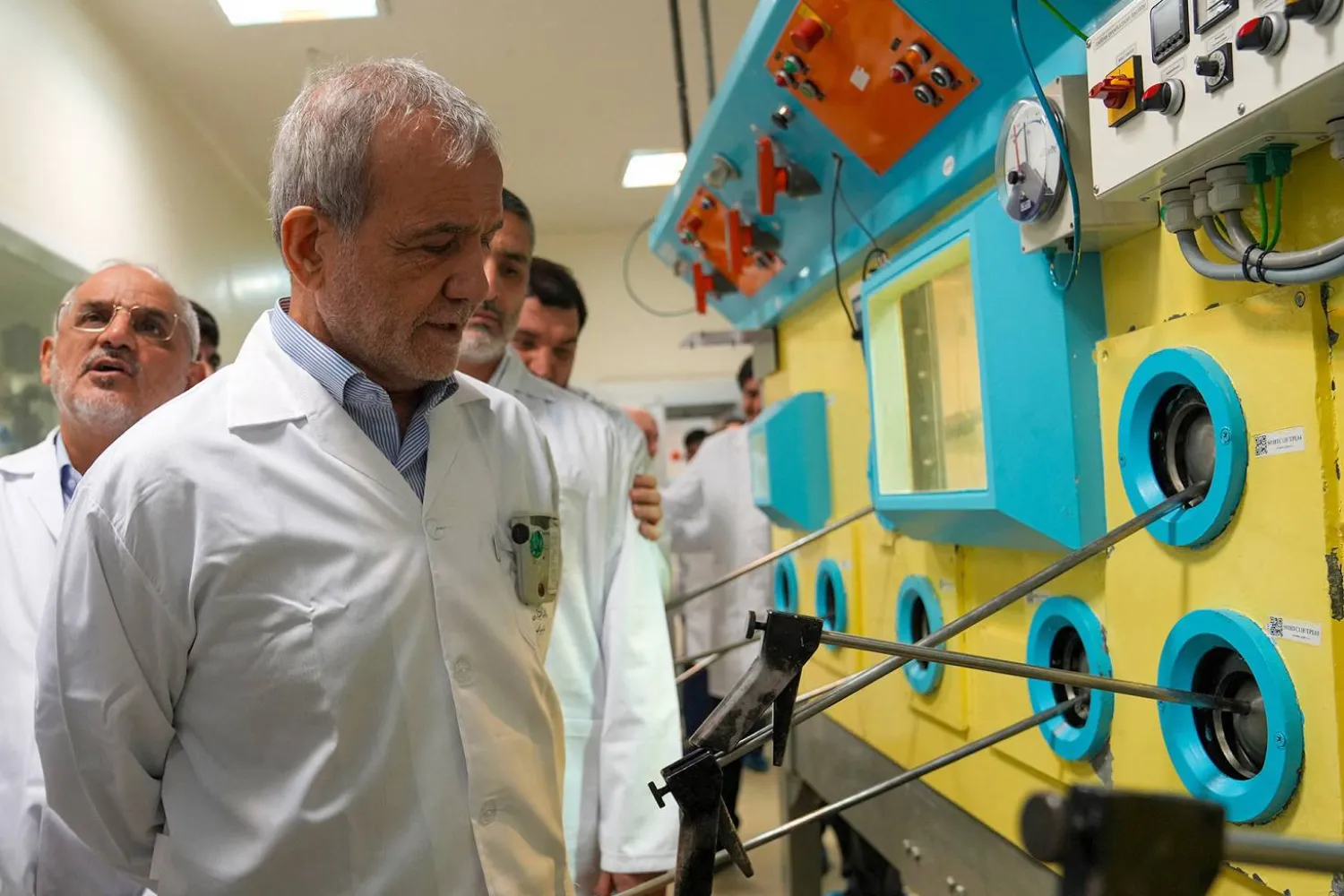
This handout picture made available by the Iranian Atomic Organization (IAEO) office on November 2, 2025, shows the Iranian President Masoud Pezeshkian during a visit to the Atomic Energy Organization of Iran, to meet with senior managers in the nuclear industry in Tehran. (Photo by Handout / Iranian Atomic Organization (IAEO) / AFP)
TT

Iran Warns US, E3 Against New IAEA Resolution

This handout picture made available by the Iranian Atomic Organization (IAEO) office on November 2, 2025, shows the Iranian President Masoud Pezeshkian during a visit to the Atomic Energy Organization of Iran, to meet with senior managers in the nuclear industry in Tehran. (Photo by Handout / Iranian Atomic Organization (IAEO) / AFP)

Iran’s permanent representative to the International Atomic Energy Agency (IAEA) has warned the United States and three European countries against submitting a new draft resolution to the IAEA Board of Governors, saying the move would only complicate the current situation without affecting Iran’s safeguards implementation.

Iran’s IRNA news agency said Tehran’s mission made the remark in a post on X late on Friday, ahead of the Board of Governors (BoG) meeting scheduled for November 19-21.

In a confidential report last Wednesday, the UN atomic watchdog said Iran still has not let inspectors into the nuclear sites Israel and the United States bombed in June, adding that accounting for Iran's enriched uranium stock is “long overdue.”

“It is critical that the Agency is able to verify the inventories of previously declared nuclear material in Iran as soon as possible in order to allay its concerns ... regarding the possible diversion of declared nuclear material from peaceful use,” the Agency said in the report to member states.

On Saturday, Iran’s representative to the IAEA, Reza Najafi, said: “Forcing the (IAEA) Director General to report on the basis of expired UN Security Council resolutions is not only entirely unlawful and unjustified, but in practice, will also add to the existing complexities and deliver yet another blow to diplomacy.”

The Mission accused the United States and Britain, France, and Germany, known as the E3, of intending to table a resolution against Iran at next week’s meeting of the IAEA BoG.

Najafi said that Washington and the E3 are once again attempting to “exploit international mechanisms to impose their illogical and coercive positions on the Iranian people.”

He affirmed that the push by the US and the E3 would not alter the current status of safeguards implementation in Iran, which the envoy said had been affected by the US-Israeli war of aggression against Iran in June this year.

The Iranian envoy called on all member states of the BoG to oppose what he described as destructive unilateral actions of the US and its European partners.
He also reaffirmed Iran’s right to take appropriate measures in response to any “illegal and unjustified” moves.

The IAEA Board of Governors will convene its regular November meeting at the Agency's headquarters in Vienna starting Wednesday to discuss a Western resolution against Iran.

The draft resolution against Iran cites a recent report by IAEA Director General Rafael Grossi, stressing the need for immediate verification of Iran’s declared nuclear material stocks under the Nuclear Non-Proliferation Treaty (NPT).

It requires Iran to suspend enrichment, reprocessing, and heavy water projects, including research and development activities, under UN non proliferation measures reinstated on Sept. 28, 2025.

The draft resolution also calls on Iran to fully implement the Additional Protocol and modified safeguards.

In its latest report, Grossi said the IAEA has now lost so-called continuity of knowledge of Iran’s enriched uranium stocks at the facilities that were damaged during the June airstrikes.

Diplomats said Iran is ignoring international calls to cooperate with the United Nations atomic watchdog and restart nuclear talks with the US, months into a tense stand-off following Israeli-led airstrikes on Iran.

Iran’s nuclear program, including the state and unknown location of its near-bomb-grade uranium stockpile, is the subject of a meeting next week at the International Atomic Energy Agency in Vienna.

Western nations represented there are due to draft new orders for IAEA inspectors to determine the status of Tehran’s nuclear inventory, according to three officials who asked not to be identified in return for discussing restricted information, Bloomberg said on Friday.

The IAEA is prepared to resume inspections of Iran's nuclear sites immediately, but Iran insists they're still too dangerous after airstrikes by Israel and the US five months ago, one senior western diplomat told Bloomberg.

Tehran may be gambling that an information blackout will deter any follow up strikes, the person said, while adding that those countries could equally call the bluff and bomb due to a lack of communication. IAEA Director General Rafael Mariano Grossi said in September that cooperation with his inspectors was crucial to diminish the threat of renewed military strikes.

Consensus is fraying over what to do next, with some western countries seeking to apply additional pressure on Iran by stripping scientists of access to IAEA technical cooperation in areas like nuclear medicine, the diplomats said.

Other nations caution that cutting all Iranian support could backfire and increase the chance of the country withdrawing from the Treaty on the Non-Proliferation of Nuclear weapons.

Iran’s nuclear work has concerned the West for decades and tensions over the nature of its atomic program, which dates back to the 1950s, have frequently shaken oil markets and spurred fits of both conciliation and conflict with the US.

Iran has always denied harboring intentions to develop a nuclear weapon and says it’s accelerated its uranium enrichment in response to US President Donald Trump’s first-term decision to quit the landmark 2015 nuclear deal and heavily sanction its economy.

Iran possessed sufficient highly-enriched uranium reserves to quickly craft about a dozen nuclear warheads before the June attacks. Since then, the IAEA has lost track of the material and Grossi says the lack of knowledge is a serious concern.

Recent satellite imagery shows Iranian activity around the bombed sites in Fordow, Natanz and Isfahan. Agency inspectors aren’t certain whether the activities are restricted to clean-up efforts or potentially include relocating uranium inventories.

A statement issued by Group of Seven nations earlier this week called on Iran to resume full cooperation with the IAEA and engage in direct talks with the Trump administration.

An Iranian foreign ministry spokesman rejected that call because it failed to condemn the Israeli and US attacks on its facilities, the state-backed Mehr News Agency reported.

“No new message has been conveyed to the US,” Iranian Security Council Secretary Ali Larijani said in a statement earlier this week. “The reason no new message has been sent is that previous negotiations had already taken place, and the other side showed no willingness to reach an agreement.”

Even if Iran immediately submitted to inspections and fully cooperated with the IAEA, it could take years to re-establish certainty over the fate of Iran’s nuclear stockpile, a second diplomat said.

Containment vessels where the material is stored may have been destroyed, releasing kilograms-worth of uranium into the environment. The June attacks didn’t end concerns over country’s nuclear program, they just opened a new chapter, the person said.



Iran Arrests Man Accused of Running Starlink Internet Network

 A man leaves a subway train past an image of the late Iranian Supreme Leader Ali Khamenei, in Tehran, Iran, Friday, March 13, 2026. (AP)
A man leaves a subway train past an image of the late Iranian Supreme Leader Ali Khamenei, in Tehran, Iran, Friday, March 13, 2026. (AP)
TT

Iran Arrests Man Accused of Running Starlink Internet Network

 A man leaves a subway train past an image of the late Iranian Supreme Leader Ali Khamenei, in Tehran, Iran, Friday, March 13, 2026. (AP)
A man leaves a subway train past an image of the late Iranian Supreme Leader Ali Khamenei, in Tehran, Iran, Friday, March 13, 2026. (AP)

Iranian authorities have arrested a man accused of leading a network that sold access to the internet via Starlink terminals, a technology that is banned in Iran, the ISNA news agency reported on Friday.

Iran has been digitally sealed off from the rest of the world by a complete internet blackout since the start of the Middle East war.

To get around those restrictions, some Iranians have turned to Starlink terminals from the US company SpaceX, which connect to the internet via satellites.

Doing so is a criminal offence in Iran punishable with prison time.

"A 37-year-old man, who had put in place a network in several provinces of the country to sell access to the unrestricted internet via Starlink, has been arrested" in Shiraz, ISNA reported, citing a deputy police commander for Fars province.

It did not say when the arrest took place.

Iranians were previously placed under an 18-day internet blackout in January, the longest so far, amid anti-government protests during which thousands were killed.

At the time, the authorities managed to disrupt the operation of Starlink terminals.

Under Iranian law, people found guilty of "the use, transportation, purchase or sale of electronic internet communication devices such as Starlink" used to access banned content can be jailed for up to two years in prison.


Middle East War ‘Benefits No One and Harms Many’, Merz

German Chancellor Friedrich Merz in Bardufoss in connection with Cold response 2026, in Bardufoss, Norway, 13 March 2026. (EPA)
TT

Middle East War ‘Benefits No One and Harms Many’, Merz

German Chancellor Friedrich Merz in Bardufoss in connection with Cold response 2026, in Bardufoss, Norway, 13 March 2026. (EPA)

German Chancellor Friedrich Merz said Friday that the Middle East war must end "as soon as possible" as the conflict "benefits no-one and harms many economically, including us".

Asked whether Europeans should make direct contact with Iran to ask for the Strait of Hormuz to be reopened, Merz said: "We are making every effort to end this war... all diplomatic channels are being used."

Speaking at a press conference in Norway alongside his Norwegian and Canadian counterparts Jonas Gahr Store and Mark Carney, Merz stressed that Germany shared the "important goals of the United States and Israel".

"Iran must not threaten Israel and other neighbors," Merz said, adding that Tehran's nuclear and ballistic missile programs must end and that the country "must stop supporting terrorism at home and beyond".

However, Merz added that "with each day of war, more questions arise than answers" and that "a convincing plan is needed" on conducting the war.

"We are witnessing a dangerous escalation. Iran is indiscriminately attacking states in the region, including close partners and allies of our own country, Germany," the chancellor said.

"The Strait of Hormuz has become impassable. We condemn this in the strongest possible terms.

"We have no interest in an endless war," Merz added. "We need a perspective for a peaceful order now."


Iran’s New Supreme Leader Wounded, Likely Disfigured, Hegseth Says

US Secretary of Defense Pete Hegseth speaks during a press conference at CENTCOM headquarters at MacDill Air Force Base in Tampa, Florida, USA, 05 March 2026. (EPA)
TT

Iran’s New Supreme Leader Wounded, Likely Disfigured, Hegseth Says

US Secretary of Defense Pete Hegseth speaks during a press conference at CENTCOM headquarters at MacDill Air Force Base in Tampa, Florida, USA, 05 March 2026. (EPA)

Iran's new Supreme Leader Mojtaba Khamenei is wounded and likely disfigured, US Defense Secretary Pete Hegseth said on Friday, questioning Khamenei's ability to govern after nearly two weeks of US and Israeli attacks on Iran.

No images have been released of Khamenei since an Israeli strike at the start of the war that killed much of his family, including his father and wife. His first comments came in a statement read out by a television presenter on Thursday. In the statement, he vowed to keep the Strait of Hormuz shut and called ‌on neighboring ‌countries to close US bases on their territory or risk Iran targeting ‌them.

"We ⁠know the new ⁠so-called not so supreme leader is wounded and likely disfigured. He put out a statement yesterday. A weak one, actually, but there was no voice and there was no video. It was a written statement," Hegseth told a briefing.

"Iran has plenty of cameras and plenty of voice recorders. Why a written statement? I think you know why. His father - dead. He's scared, he's injured, he's on the run and he lacks legitimacy."

An Iranian official told Reuters on Wednesday that the newly appointed supreme leader was lightly injured, but ⁠was continuing to operate, after state television described him as war-wounded.

Hegseth was joined ‌by General Dan Caine, the chairman of the Joint Chiefs ‌of Staff, at a briefing in which they emphasized US military strikes to knock out Iran's missile and ‌drone capabilities and its navy.

'NO QUARTER'

During the briefing, Hegseth said that the United States would show ‌no mercy in the war.

"We will keep pressing, keep pushing, keep advancing. No quarter, no mercy for our enemy," Hegseth said.

"No quarter" is the refusal to spare the life of someone who has expressed their intention to surrender - something prohibited by law.

"International humanitarian law prohibits the use of this procedure, that is, ordering that there shall ‌be no survivors, threatening the adversary therewith, or conducting hostilities on this basis," according to the International Committee of the Red Cross (ICRC).

Hegseth has moved to ⁠reshape the top ranks ⁠of the military justice system, replacing the judge advocates general for the Army, Navy and Air Force.

The United States has carried out strikes against more than 6,000 targets in Iran over the past 14 days. Almost two weeks of US-Israeli bombings have killed around 2,000 people in Iran.

A US official, speaking on the condition of anonymity, said the Pentagon was sending an additional warship, along with the Marines on board, to the Middle East. The Pentagon has previously said additional troops would be heading to the region.

But despite the US attacks on Iran, more Iranian drones were reported flying into Kuwait, Iraq, the UAE, Bahrain and Oman. Additionally, six US service members were killed on Friday when a US military refueling aircraft crashed in western Iraq, in an incident the US said involved another aircraft but was not the result of hostile or friendly fire.

Since the US and Israel started carrying out strikes against Iran on February 28, 11 US troops have been killed.