


Nearly 200,000 Ukrainians in US Thrown into Legal Limbo by Trump Immigration Crackdown

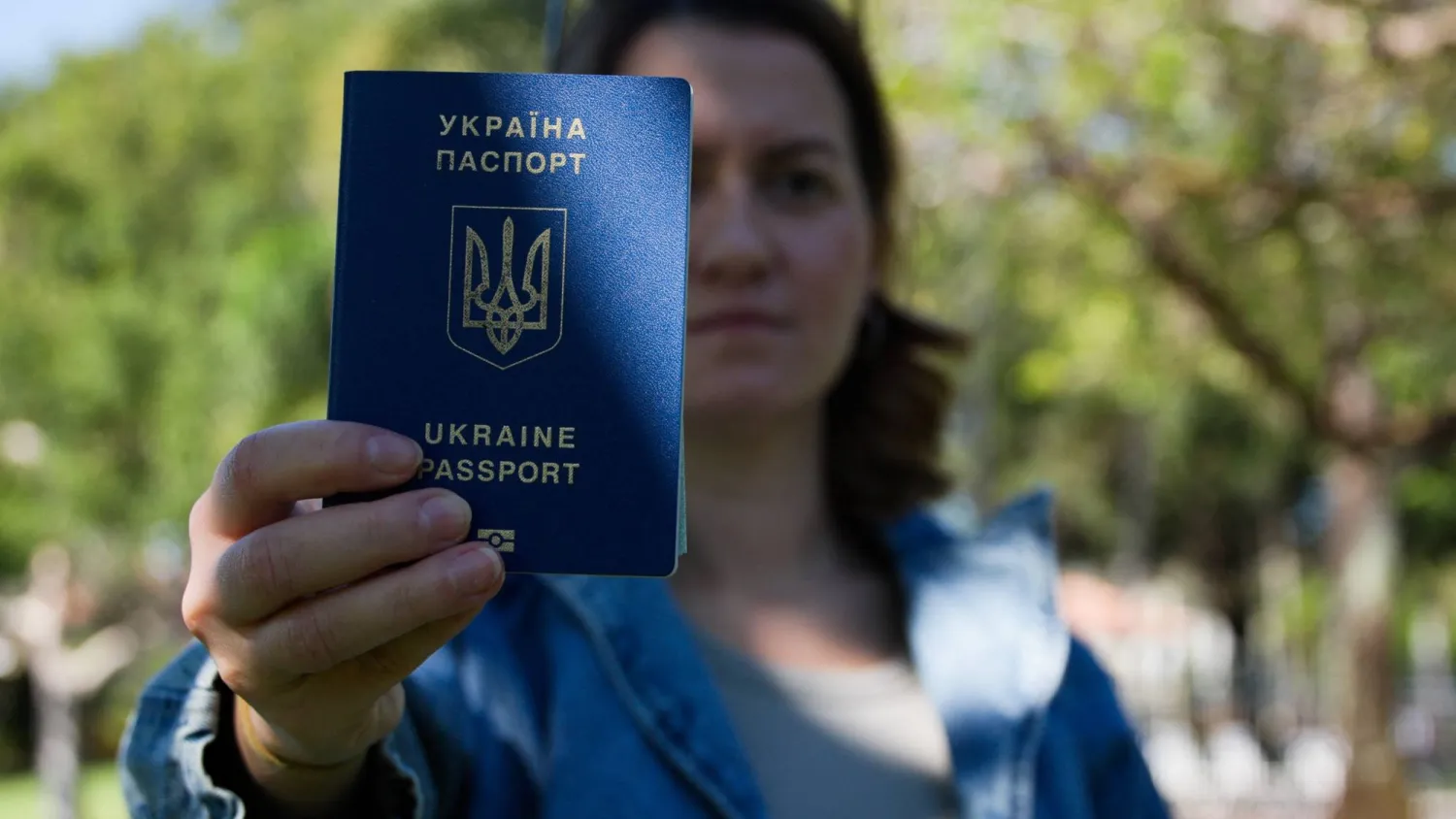
Kateryna Golizdra holds her Ukrainian passport for a photograph outside her home in Margate, Florida, US, November 17, 2025. REUTERS/Maria Alejandra Cardona
TT

Nearly 200,000 Ukrainians in US Thrown into Legal Limbo by Trump Immigration Crackdown

Kateryna Golizdra holds her Ukrainian passport for a photograph outside her home in Margate, Florida, US, November 17, 2025. REUTERS/Maria Alejandra Cardona

Kateryna Golizdra has survived six months in legal limbo - so far. She thinks she can hold out another six months, waiting for Donald Trump's administration to decide the fate of a humanitarian program that allowed some 260,000 people who fled the war in Ukraine to live and work in the United States.

When her legal status lapsed in May, Golizdra, 35, automatically became vulnerable to deportation. She lost her work permit and was forced to leave a job earning over $50,000 a year as a manager at the Ritz-Carlton in Fort Lauderdale. Golizdra also lost the health insurance that she used to cover check-ups for a liver condition. And she can no longer send money to her mother, who was also displaced and lives in Germany, she said.

The Trump administration's processing delays on the humanitarian program for Ukrainians launched by former Democratic President Joe Biden left nearly 200,000 people at risk of losing their legal status as of March 31, according to internal US government data reviewed by Reuters. The number of Ukrainians affected by the delays has not been previously reported.

The humanitarian program, introduced in April 2022, allowed nearly 260,000 Ukrainians into the US for an initial two-year period. That's a small share of the 5.9 million Ukrainian refugees worldwide, 5.3 million of whom are in Europe, according to United Nations refugee figures.

Golizdra said she has no idea when - or if - her permission to stay in the United States might be renewed, threatening her short-lived sense of security in America.

While she waits for an update on her application, she could potentially be arrested by federal immigration authorities, three former immigration officials said.

'CONSTANT STRESS'

The last six months have felt like she is on a “hamster wheel," Golizdra said.

“It’s a constant stress, anxiety,” she said. “If I will need to leave the States, then I will have to build something again.” Reuters spoke with two dozen Ukrainians who lost their work permits - and their jobs - due to delays in processing renewals, including tech workers, a preschool teacher, a financial planner, an interior designer and a college student. They described digging into their savings, seeking out community support and taking on debt to support themselves while they wait for a decision on their status.

Some of the people interviewed by Reuters said they were worried they could be arrested by US immigration authorities. Others said they were staying indoors, or had left the US for Canada, Europe and South America. Returning to Ukraine is not an option. Golizdra's home in Bucha, a Kyiv suburb, was set ablaze in March 2022 when Russian troops stormed the city. After Ukrainian forces retook the town, they found hundreds of bodies, including of civilians who were victims of extrajudicial killings.

TRUMP'S SHIFTING UKRAINE POLICY

The Trump administration paused processing applications and renewals of the Ukrainian humanitarian program in January, citing security reasons.

After a contentious Oval Office meeting with Ukrainian President Volodymyr Zelenskiy, Trump said in March that he was weighing whether to revoke the Ukrainians' legal status entirely - a plan first reported by Reuters. Trump ultimately did not end the program and in May, a federal judge ordered officials to resume processing renewals.

But US immigration officials have processed only 1,900 renewal applications for Ukrainians and other nationalities since then, a fraction of those with expiring status, according to US government data released last week as part of a lawsuit.

Meanwhile, a spending package Trump signed into law in July added a $1,000 fee to such humanitarian applications - on top of a fee of $1,325 per individual.

The White House referred questions about the Ukrainian humanitarian program to the US Department of Homeland Security, which did not respond to requests for comment.

US Representative Mike Quigley, a Democrat in the Chicago area, said his office has received requests for assistance from more than 200 Ukrainians in limbo.

“There's a fear that if they haven't completed their application, if they haven't gone through the whole process, they're vulnerable for deportation,” Quigley said.

Anne Smith, the executive director and regulatory counsel of the Ukraine Immigration Task Force, a legal coalition formed to aid those who fled the war to the US, said her attorney network was receiving multiple calls per week from Ukrainians saying they have family members detained by immigration authorities.

She said Ukrainians have been arrested at construction sites, while doing food delivery or working as Uber or truck drivers, as well as in broader sweeps in Chicago and greater Cleveland.

Brian Snyder, a product marketing manager in Raleigh, North Carolina,who has sponsored three Ukrainian families, said people who followed the rules are being treated unfairly.

One Ukrainian woman recently asked if he would serve as her emergency contact if she was picked up by immigration officers, he said. He knew of another family where a teenage son's parole was renewed while the parents and two younger children were left waiting, he said.

“All of this dysfunction and uncertainty is just introducing a tremendous amount of stress in these families’ lives,” he said.

SOME UKRAINIANS 'SELF DEPORT'

Six of 24 Ukrainians interviewed by Reuters have left the US rather than risk ending up in immigration jail or being sent to Latin America or Africa, as the Trump administration has done with other hard-to-deport immigrants.

Yevhenii Padafa, a 31-year-old software engineer who moved to Brooklyn in September 2023, applied to renew his status in March. His application sat pending until it expired in September. Worried that he could be barred from the US in the future if he remained without legal status, he tried to "self deport" using a government app known as CBP One. The Trump administration in May promised a free outbound plane ticket and $1,000 “exit bonus” for those using the app.

Padafa decided to go to Argentina, which has a lower cost of living than other countries and offers a humanitarian program for Ukrainians. But the app would not book him a ticket there. A US border official told him the flight would need to be booked to Ukraine, he said.

He was counting on the free flight and $1,000 bonus. Arriving in Buenos Aires in mid-November with little money, he planned to sell a laptop to cover initial rent for an apartment.

“If I return to Ukraine, I’ll just go to the frontline," he said. “I’d rather be homeless somewhere than go to Ukraine.”


Trump to Travel to China Next Month, with US Trade Policy in Focus

US President Donald Trump arrives at Joint Base Andrews in Maryland, US, February 19, 2026. (Reuters)
TT

Trump to Travel to China Next Month, with US Trade Policy in Focus

US President Donald Trump arrives at Joint Base Andrews in Maryland, US, February 19, 2026. (Reuters)

US President Donald Trump will travel to China from March 31 to April 2 for a highly anticipated meeting between the world's two biggest economies, following the Supreme Court's decision to overturn Trump's sweeping tariffs against imported goods.

A White House official confirmed the trip on Friday, just before the highest US court struck down many of the tariffs Trump has used to manage sometimes-tense relations with China.

Trump is expected to visit Beijing and meet Chinese President Xi Jinping as part of a lavish, extended visit. Trump was last in China in 2017, ‌the most ‌recent trip by a US president.

A key topic had been whether ‌to ⁠extend a trade ⁠truce that kept both countries from further hiking tariffs. After Friday's ruling, however, it was not immediately clear whether - and under what legal authority - Trump would restore tariffs on imports from China.

TRUMP SEES TRADE IMBALANCE AS NATIONAL EMERGENCY

The administration has said the tariffs were necessary because of national emergencies related to trade imbalances and China's role in producing illicit fentanyl-related chemicals.

"That's going to be a wild one," Trump told foreign leaders visiting Washington on Thursday ⁠about the trip. "We have to put on the biggest display you've ‌ever had in the history of China."

The Chinese ‌embassy in Washington did not immediately respond to a request for comment. Beijing has not ‌confirmed the trip.

The visit would be the leaders' first talks since February and their first ‌in-person visit since an October meeting in South Korea. At that October meeting, Trump agreed to trim tariffs on China in exchange for Beijing cracking down on the fentanyl trade, resuming US soybean purchases and keeping rare earth minerals flowing.

While the October meeting largely sidestepped the sensitive issue of ‌Taiwan, Xi raised US arms sales to the island in February.

Washington announced its largest-ever arms sales deal with Taiwan in December, ⁠including $11.1 billion in ⁠weapons that could ostensibly be used to defend against a Chinese attack. Taiwan expects more such sales.

China views Taiwan as its own territory, a position Taipei rejects. The United States has formal diplomatic ties with China, but it maintains unofficial ties with Taiwan and is the island's most important arms supplier. The United States is bound by law to provide Taiwan with the means to defend itself.

Xi also said during the February call that he would consider further increasing soybean purchases, according to Trump.

Struggling US farmers are a major political constituency for Trump, and China is the top soybean consumer.

Although Trump has justified several hawkish policy steps from Canada to Greenland and Venezuela as necessary to thwart China, he has eased policy toward Beijing in the past several months in key areas, from tariffs to advanced computer chips and drones.


Diplomacy Is Still the Only Viable Path to Peace in Ukraine, UN Refugee Chief Barham Salih Says

UNCHR High Commissioner Barham Salih talks during an interview with The Associated Press in Kyiv, Ukraine, Friday, Feb. 20, 2026. (AP)
TT

Diplomacy Is Still the Only Viable Path to Peace in Ukraine, UN Refugee Chief Barham Salih Says

UNCHR High Commissioner Barham Salih talks during an interview with The Associated Press in Kyiv, Ukraine, Friday, Feb. 20, 2026. (AP)

There are many obstacles to a peace deal in Ukraine, but a diplomatic solution remains the only viable option, the newly appointed head of the UN refugee agency said Friday, warning that humanitarian operations are increasingly overstretched because of multiple global crises.

Barham Salih, Iraq’s former president who was elected UNHCR high commissioner in December, made his first visit to Ukraine since taking office.

After traveling to Ukraine’s front-line cities, including Kharkiv and Zaporizhzhia, he met with President Volodymyr Zelenskyy and discussed the latest in efforts to secure a peace deal. He also discussed the future of UNHCR operations as Ukraine endures Russian attacks on its energy grid during a harsh winter.

“You have to be hopeful, but I do understand the difficulties in the situation, and it’s clear, of course, there are many, many impediments along the way, but at the end of the day, there is no military solution. There needs to be peace, a durable and just peace so that people can go back to their lives,” he said, speaking to The Associated Press in an interview in Kyiv.

“Things are not necessarily easy, definitely not easy, but let’s redouble the effort to make sure that diplomacy has a chance and really bring about a durable and just peace to this war that has been going on for far too long,” he added.

Of the agency’s $470 million appeal for Ukraine, only $150 million has been pledged. The shortfall reflects deep cuts across the humanitarian sector, making it increasingly difficult to deliver aid across multiple crises.

There are 3.7 million Ukrainians displaced within the country and nearly 6 million Ukrainians outside the country who have become refugees in Europe and elsewhere, he said.

“This tells you the gap between what is needed and what is available,” he said. “My appeal to the international community is, really, this is not the moment to walk away, this is not a moment to look the other way round. These vulnerable populations need support. We should deliver this help to them.”

The UN agency in Ukraine predicts 10.8 million Ukrainians will require humanitarian assistance in 2026, according to a report from the agency. The most critical needs are concentrated along the war’s front lines in the eastern and southern parts of Ukraine, as well as in the northern border region. Intensified hostilities produce fresh waves of displacement.

The agency’s Ukraine appeal competes with large-scale conflicts in Sudan and Gaza. Since his appointment, Salih has spent only one week in his Geneva office, traveling to Kenya, Chad, Türkiye and Jordan before visiting Ukraine.

Drastic cuts to US humanitarian funding under President Donald Trump has accelerated the erosion of global humanitarian infrastructure and severely undermined the ability of organizations to deliver aid.

There are 117 million displaced people worldwide, including at least 42 million refugees, Salih said. Two-thirds face protracted displacement and remain dependent on humanitarian assistance.

Deciding where to prioritize given shrinking resources is “difficult” he said.

“It’s really very difficult to prioritize given the scale of the problem. I was in Kenya and I was in Chad recently and I was in Türkiye and in Jordan talking to refugees from Syria. And of course, now in Ukraine, these are all pressing issues, pressing requirements,” he said.

“We need to be there to help people, but also I have to say we really need to look at durable solutions too as well. It’s not a matter of sustaining dependency or humanitarian assistance,” he added.

In his meeting with Zelenskyy, Salih said they discussed the need to focus on the “recovery phase and sustainable solutions and self reliance as we go forward,” he said.


Israel Army Says on ‘Defensive Alert’ Regarding Iran but No Change to Public Guidelines

Israeli air defense system fires to intercept missiles during an Iranian attack over Tel Aviv, Israel, Thursday, June 19, 2025. (AP)
TT

Israel Army Says on ‘Defensive Alert’ Regarding Iran but No Change to Public Guidelines

Israeli air defense system fires to intercept missiles during an Iranian attack over Tel Aviv, Israel, Thursday, June 19, 2025. (AP)

The Israeli army said it was on "defensive alert" as the United States threatens potential military action against Iran, but insisted there were no changes in its guidelines for the public.

"We are closely monitoring regional developments and are aware of the public discourse concerning Iran. The (Israeli military) is on defensive alert," army spokesman Brigadier General Effie Defrin said in a video statement published Friday.

"Our eyes are wide open in all directions, and our finger is more than ever on the trigger in response to any change in the operational reality," he added, but emphasized "there is no change in the instructions".
