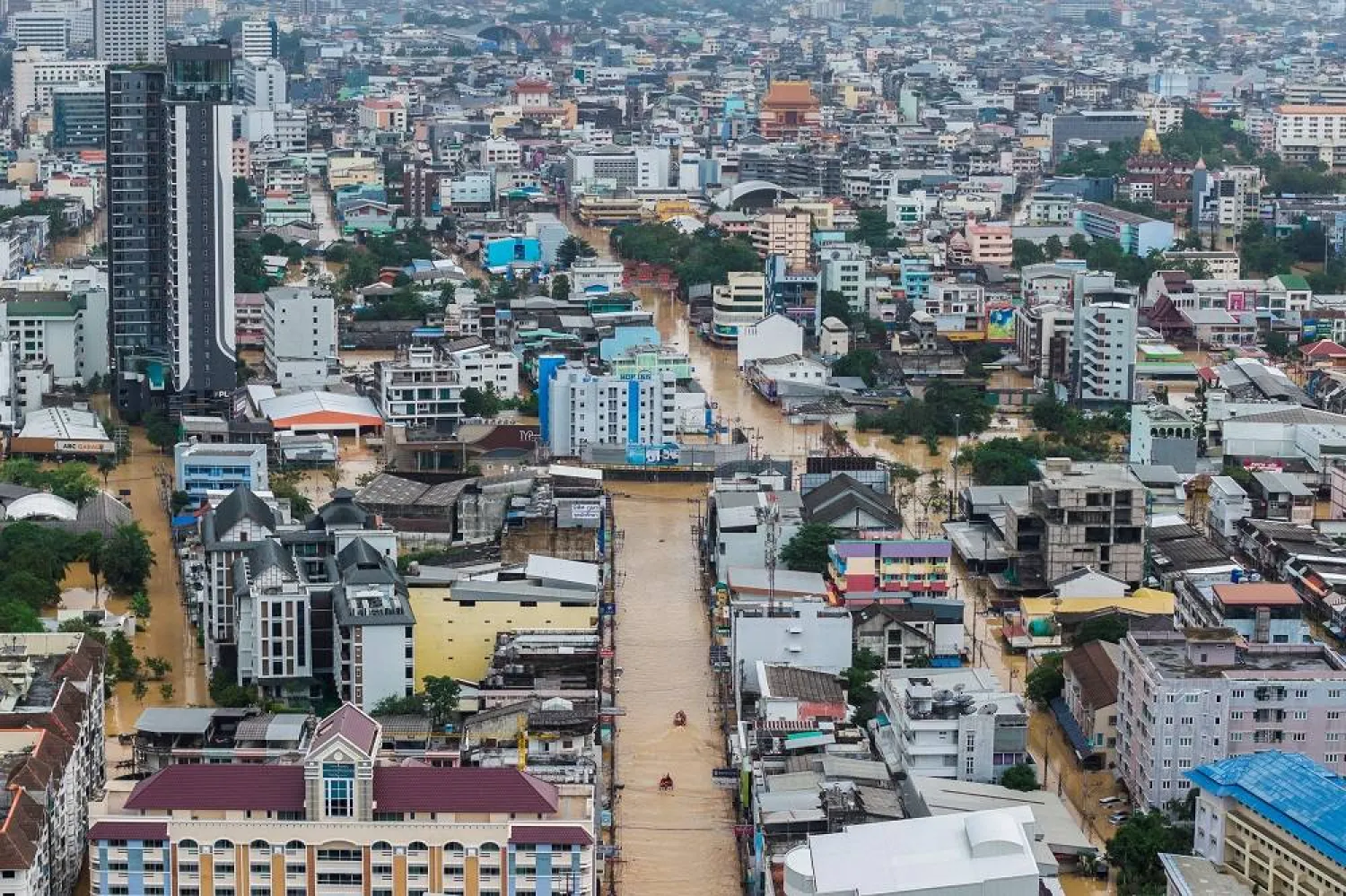
Families in Southern Thailand Perch on Rooftops to Escape Flooding That Has Killed Dozens 

A drone view shows rescuers navigating in their boats along a flooded street in Hat Yai district, affected by heavy rainfall which has impacted several provinces in southern of Thailand and has killed several people, in Songkhla province, Thailand, November 26, 2025. (Reuters)
TT

Families in Southern Thailand Perch on Rooftops to Escape Flooding That Has Killed Dozens 

A drone view shows rescuers navigating in their boats along a flooded street in Hat Yai district, affected by heavy rainfall which has impacted several provinces in southern of Thailand and has killed several people, in Songkhla province, Thailand, November 26, 2025. (Reuters)

Severe flooding in southern Thailand has caused at least 33 deaths since the weekend, officials said, as dramatic video footage showed people whose homes were virtually engulfed by water awaiting help on rooftops. 

About 1 million households and more than 2.7 million people have been impacted by floods in 12 southern provinces triggered by heavy rains, the Department of Disaster Prevention and Mitigation said Wednesday. 

The accumulated rainfall began to decrease Wednesday and authorities were hopeful water levels would start to recede, but the Meteorological Department issued a warning for heavy rains and flash flooding in the country's southern region through Wednesday. 

Prime Minister Anutin Charnvirakul on Tuesday declared a state of emergency for Songkhla province, which includes southern Thailand’s biggest city, Hat Yai, citing the “unprecedented severity” of the flooding that has caused widespread damage. 

Streets in Hat Yai were impassable and low-rise buildings and cars nearly submerged by rising water, trapping thousands of people. Some residents on higher floors were given food baskets, hoisted up from rescue teams in flat-bottom boats. 

Footage from a camera drone broadcast by Thai PBS showed a family of five in Hat Yai being rescued Tuesday from the rooftop of their house, which was nearly submerged.  

The family, including an older woman, appeared in the video as colorful specks in a landscape of flat, brown water. They had smashed through the large, grey roof and were spotted by emergency workers, who loaded them onto a lifeboat at the edge of the slanted roof. 

The situation at Hat Yai Hospital is especially critical, Public Health Minister Pattana Promphat said Wednesday, explaining that the facility's electricity could be cut off because of the high water.  

About 50 patients requiring intubation were airlifted out by army helicopters to other hospitals and some 600 other patients are likely to be evacuated along with hospital personnel, he said. 

The Public Health Ministry said it would deploy a mental health team to assist medical personnel and members of the public dealing with stress. 

The Thai navy’s sole aircraft carrier, the HTMS Chakri Naruebet, sailed from its berth in eastern Thailand to serve as an offshore command center for relief operations. The air force base at Bangkok's Don Mueang airport will serve as a staging area for flying relief supplies to affected areas, the government said. 


Alireza Tangsiri… The Supreme Leader’s Man in the Shipping Lanes

Tangsiri on the sidelines of a field tour along the shores of Bandar Abbas in 2019 (Islamic Revolutionary Guard Corps website) 
TT

Alireza Tangsiri… The Supreme Leader’s Man in the Shipping Lanes

Tangsiri on the sidelines of a field tour along the shores of Bandar Abbas in 2019 (Islamic Revolutionary Guard Corps website) 

When Alireza Tangsiri took command of the naval arm of Iran’s Revolutionary Guard Corps (IRGC) in 2018, he appeared to fit squarely into the role envisioned by Supreme Leader Ali Khamenei: an ideological and confrontational force operating at the frontline of daily tensions with the United States, particularly in the Gulf.

Rather than presenting himself as a conventional naval officer, Tangsiri cast his role in strategic terms, as an enforcer of IRGC plans in the Strait of Hormuz and a key architect of a doctrine that treats waterways, islands and energy routes as tools of both sovereignty and leverage.

His trajectory was shaped by three overlapping arenas: the Iran-Iraq War, which forged a generation of IRGC commanders; the Gulf’s contested waters as a constant zone of friction with US forces; and more recent conflicts that pushed the IRGC Navy into the center of regional escalation.

After the brief but intense war of June 2025, and during the ongoing conflict that erupted on February 28, 2026, Tangsiri emerged as one of Iran’s most prominent field commanders. Israeli media have since reported that he was killed in a strike on Bandar Abbas, although there has been no official confirmation from Tehran.

Son of the coast

Born in 1962 in Tangestan in Bushehr province, Tangsiri grew up in a coastal environment that would define both his outlook and career. His family later moved to Ahvaz, but his southern background remained central to his identity within the military.

Unlike many officers trained in conventional naval academies, Tangsiri belonged to a generation shaped in the field. He joined the IRGC during the Iran-Iraq War and built his experience in maritime units operating in coastal and riverine environments.

His formative years unfolded not on open seas, but in narrow waterways and strategic chokepoints — terrain that would later underpin Iran’s asymmetric naval strategy.

A different navy

The IRGC Navy operates alongside Iran’s regular navy, but with a distinct mission. Rather than projecting power across oceans, it was built to operate in confined, strategically sensitive waters where global trade routes, energy flows, islands and foreign military presence converge.

Since its establishment in 1985, it has developed capabilities tailored to asymmetric warfare: fleets of fast attack boats, coastal missile systems, naval mines, and commando units deployed across key maritime corridors and islands.

Tangsiri rose through this structure, holding early command roles in Bandar Abbas, near the Strait of Hormuz, one of the most sensitive flashpoints between Iran and US forces. He later served as deputy commander under Ali Fadavi from 2010 to 2018.

Hostility as a path to power

His appointment in August 2018 came as Washington, under then President Donald Trump, moved to tighten sanctions after withdrawing from the 2015 nuclear deal, while Tehran signaled it could use the Strait of Hormuz as leverage. The choice of Tangsiri reflected both military and political calculations: a commander closely aligned with escalation and unambiguous in his hostility toward the United States.

Under his leadership, the IRGC Navy emphasized mobility, coordination and intelligence capabilities. Tangsiri himself adopted a blunt tone, repeatedly asserting Iran’s ability to track, challenge and even block US naval movements.

He frequently spoke of tactics involving swarms of fast attack boats and did not shy away from invoking the possibility of suicide-style operations. His tenure was also marked by incidents involving the detention or interception of foreign vessels and crews in Gulf waters.

In the context of Iran’s political discourse, where opposition to the United States is central, such rhetoric reinforced his standing.

After 2019

From 2019 onward, Tangsiri became one of the most visible figures associated with rising maritime tensions in the Gulf. As US sanctions intensified and encounters at sea increased, the IRGC Navy played a growing role in signaling Iran’s strategic posture. Tangsiri himself was placed under US sanctions alongside other commanders, accused of involvement in activities affecting international shipping.

He increasingly moved into the public spotlight, repeatedly warning that Iran could close the Strait of Hormuz if its oil exports were targeted, while promoting the idea that maritime traffic should fall under Iranian oversight.

At the same time, Iran expanded its narrative of deterrence: unveiling underground naval facilities, coastal missile bases and long-range strike capabilities. The message was that the Gulf had become a heavily militarized and contested space.

From deterrence to rule enforcement

Over time, Tangsiri’s rhetoric evolved from deterrence to the assertion of control. He stated that all vessels passing through the Strait of Hormuz should provide detailed information and went further by suggesting that such communication be conducted in Persian, an apparent challenge to established international maritime norms.

He also underscored Iran’s position on disputed Gulf islands, including Abu Musa and the Greater and Lesser Tunb islands, presenting them as forward lines of sovereignty and integral to the security of the strait.

During his tenure, the IRGC expanded its presence on these islands, establishing new bases and infrastructure, including a military airstrip. In doing so, Tangsiri helped redefine the IRGC Navy as more than a patrol force, portraying it instead as a power controlling a continuous arc linking coastline, islands and vital shipping routes.

“June 2025 War”

During the June 2025 conflict, the IRGC Navy did not play the central combat role seen in missile or air defense units. Instead, the maritime domain remained a latent lever of pressure.

The Strait of Hormuz, shipping lanes and energy routes were held in reserve as tools of strategic deterrence rather than active theatres of confrontation. Tangsiri maintained at the time that Iran did not seek to close the strait but retained the option if its exports were threatened.

The war that began in February 2026 altered that dynamic.

The maritime arena moved to the forefront, with the IRGC Navy directly involved in pressuring shipping routes and shaping regional calculations. Tangsiri emerged as one of the clearest voices of this shift, framing Hormuz as a sovereign space requiring coordination with Iranian authorities.

He reported turning back vessels that did not comply with Iranian procedures and broadened his rhetoric to include potential targeting of energy infrastructure linked to US interests.

The death of the Supreme Leader’s man in the strait

On the 26th day of the war, Israeli and US media reported that Tangsiri had been killed in a strike on Bandar Abbas, alongside several aides, in what was described as an attempt to weaken Iran’s grip on the Strait of Hormuz.

There has been no confirmation from Iran. Even so, the attention surrounding his reported death underscores his importance. Tangsiri had become more than a naval commander. He was seen as a key figure in enforcing Iran’s posture in the strait and raising the stakes of confrontation.

If confirmed, his death would carry both operational and symbolic weight, potentially affecting command at a critical moment while removing a central figure in Iran’s maritime strategy.

In the end, Tangsiri’s significance lies less in his rank than in the role he played. A product of the Iran-Iraq War generation, he helped shift Iran’s strategic focus from land to sea. In doing so, he became one of the clearest embodiments of a doctrine that views maritime geography not merely as territory, but as a tool of political, military, and economic power.


Pope Leo XIV Makes a Rare 1-day Visit to Glitzy Monaco

Pope Leo XIV speaks during his pastoral visit to the Parish of the Parish of 'Sacred Heart of Jesus' in Rome, Italy, 15 March 2026. EPA/ANGELO CARCONI
TT

Pope Leo XIV Makes a Rare 1-day Visit to Glitzy Monaco

Pope Leo XIV speaks during his pastoral visit to the Parish of the Parish of 'Sacred Heart of Jesus' in Rome, Italy, 15 March 2026. EPA/ANGELO CARCONI

Pope Leo XIV travels Saturday to the principality of Monaco, becoming the first pope in nearly five centuries to visit the glitzy Mediterranean enclave and highlighting how small states can punch above their weight on the global stage.

Vatican spokesperson Matteo Bruni said the visit would provide the American pope with his first real chance to speak to all of Europe.

“In the Bible, it is precisely the small ones who play a significant role,” Bruni said.

Monaco is also one of the few European countries where Catholicism is the official state religion. And Prince Albert recently refused a proposal to legalize abortion, citing the important role Catholicism plays in Monaco society.

The decision was largely symbolic, since abortion is a constitutional right in France, which surrounds the coastal principality of 2.2 square kilometers (about 1 square mile).

In refusing to allow it in Monaco, Albert joined other European Catholic royals who have taken a similar stand over the years to uphold Catholic doctrine on an increasingly secular continent. When Pope Francis visited Belgium in 2024, he announced he was putting the late King Baudouin on the path to possible sainthood because he abdicated for a day in 1990 rather than approve legislation to legalize abortion.

Bruni said the “defense of life” would be one of the themes of Leo’s one-day visit Saturday. But he stressed that Leo’s vision would be in the larger context of defending all life, including in wars and conflicts.

An unexpected destination

The visit includes a private meeting with Albert and Princess Charlene at the palace, a meeting with Monaco’s Catholic community in the cathedral and Mass in the sports stadium.

A coastal playground for the rich and famous, Monaco is renowned as much for its tax-friendly incentives and Formula 1 Grand Prix as its glamorous royal family. The son of the late American actress Grace Kelly, Albert spoke in perfect, unaccented English when he visited the Chicago-born Leo at the Vatican on Jan. 17 and invited him to visit.

The trip came together quickly after that, and raised eyebrows about why Leo had chosen Monaco, a hereditary and constitutional monarchy, as his first foreign trip in Europe. Pope Francis also liked to travel to small countries, but Monaco’s glitz factor likely would have turned him off.

“It does raise questions,” conceded Abbe Christian Venard, spokesperson for the diocese of Monaco. “Is it really the place for a pope to go to a principality better known — somewhat caricatured — as a haven for billionaires, even if that is part of Monaco’s reality? I think it reflects some inner freedom from the pope,” he told The Associated Press.

In fact, there are good reasons for Leo to visit, not least because there hasn’t been a pope who visited in 488 years, since Pope Paul III in 1538.

Monaco's population of 38,000 is heavily Catholic and also multinational, with only a fifth of the population actually citizens of the principality.

Short but symbolic trip Leo will be in Monaco for just under nine hours, and the principality is so close to home that he can get there and back to the Vatican by helicopter. But the visit is rich in symbolic significance, since it represents the leaders of the world’s two smallest states coming together to talk about some of the world’s biggest problems.

With Russia’s war in Ukraine raging and the US-Israeli war in Iran spreading, Leo will likely want to repeat his appeal for peace and dialogue to prevail.

"Much like the principality’s role in fostering dialogue and mediation, serving as a laboratory for peace, social friendship, and the responsible use of influence and wealth,” Bruni said.

That is a reference to Monaco's financial support of initiatives to help Christians in the Middle East, including its participation in the Aliph Foundation, which works in particular to rebuild and restore churches and other sites of cultural importance that get damaged or destroyed by conflict.

The government has also been a longtime supporter of church projects in Lebanon organized by l’Œuvre d’Orient, a French-based group that supports bishops, priests and religious orders working in 23 countries.

Albert is also a well-known environmental campaigner, and Monaco hosts regular international conferences, especially on the plight of the Mediterranean. Leo has strongly carried on Francis’ legacy of ecological stewardship, and the environment is expected to be a topic of discussion.

“The fact that Monaco hosts environmental forums, scientific conferences, and thematic summits makes sense and effectively counterbalances the somewhat ‘glitzy’ image that the event might initially convey,” noted François Mabille, director of the Geopolitical Observatory of Religion at the French Institute for International and Strategic Affairs.

Mabille said it is precisely on issues such as the environment where two small states with similar values can work together on the global stage, especially when the Holy See has a tradition of diplomatic neutrality and only enjoys observer status at the United Nations and other international organizations.

“What’s interesting is to realize that there is indeed a Monaco foreign policy that can, in a way, enable or allow the Vatican to go further,’’ Mabille said. “And here, the Vatican’s soft power can find ... a sort of continuity and, in any case, a convergence with another small state — one that, this time, votes and participates."


Japan to Boost Coal-Fired Power as Middle East War Causes Energy Turmoil

This photo taken on March 13, 2026 shows Noshiro Thermal Power Station, a coal-fired thermal power station operated by Tohoku Electric Power in the city of Noshiro, Akita Prefecture. (Jiji Press/AFP)
TT

Japan to Boost Coal-Fired Power as Middle East War Causes Energy Turmoil

This photo taken on March 13, 2026 shows Noshiro Thermal Power Station, a coal-fired thermal power station operated by Tohoku Electric Power in the city of Noshiro, Akita Prefecture. (Jiji Press/AFP)

Japan's government plans to temporarily lift restrictions on coal-fired power plants as it seeks to ease an energy crunch caused by the Middle East war, officials said on Friday.

Officials presented the plan at a meeting of a panel of experts, who approved the proposal, the industry ministry said on its website.

"Given the current situation in the Middle East affecting fuel prices, we believe that uncertainty regarding future LNG procurement is increasing," an industry ministry official said at the meeting, which was broadcast online.

"We think it will be necessary, by increasing the operation of coal-fired power plants, to...ensure the reliability of stable supply," he said.

Power suppliers have previously been required to keep the operating rate of coal-fired thermal power stations that emit large amounts of carbon dioxide at or below 50 percent.

But the government now intends to allow the full operation of older, less efficient coal-fired plants, for a year from the new fiscal year starting April, according to the plan presented at the meeting.

Japan relies on thermal power plants to generate around 70 percent of its electricity needs, with coal constituting 30 percent of their fuel.

Liquified natural gas (LNG) accounts for another 30 percent, and oil comprises seven percent.

The emergency measure to boost reliance on coal is estimated to "result in an LNG savings effect of approximately 500,000 tons," the official added.

The initiative follows many Asian nations' pivot towards coal to power their economies since the Middle East war that began late last month prompted Iran to partially close the crucial Strait of Hormuz trade route and target energy facilities in the Gulf.

South Korea plans to lift a cap on coal-powered generation capacity, while also increasing nuclear plant operations.

The Philippines also intended to boost the output of its coal-fired power plants to keep electricity costs down as the war wreaks havoc with gas shipments.

Japan is the fifth-biggest importer of oil with more than 90 percent of it coming from the Middle East.

Around 10 percent of its LNG imports are also from the region.

Tokyo purchases nearly 80 percent of its coal imports from Australia and Indonesia, according to the Agency for Natural Resources and Energy.

Japan on Thursday said it had also started to release another part of its strategic oil reserves, as it faced supply challenges to its oil imports.