


Fighting between Thailand and Cambodia Spreads along Contested Border

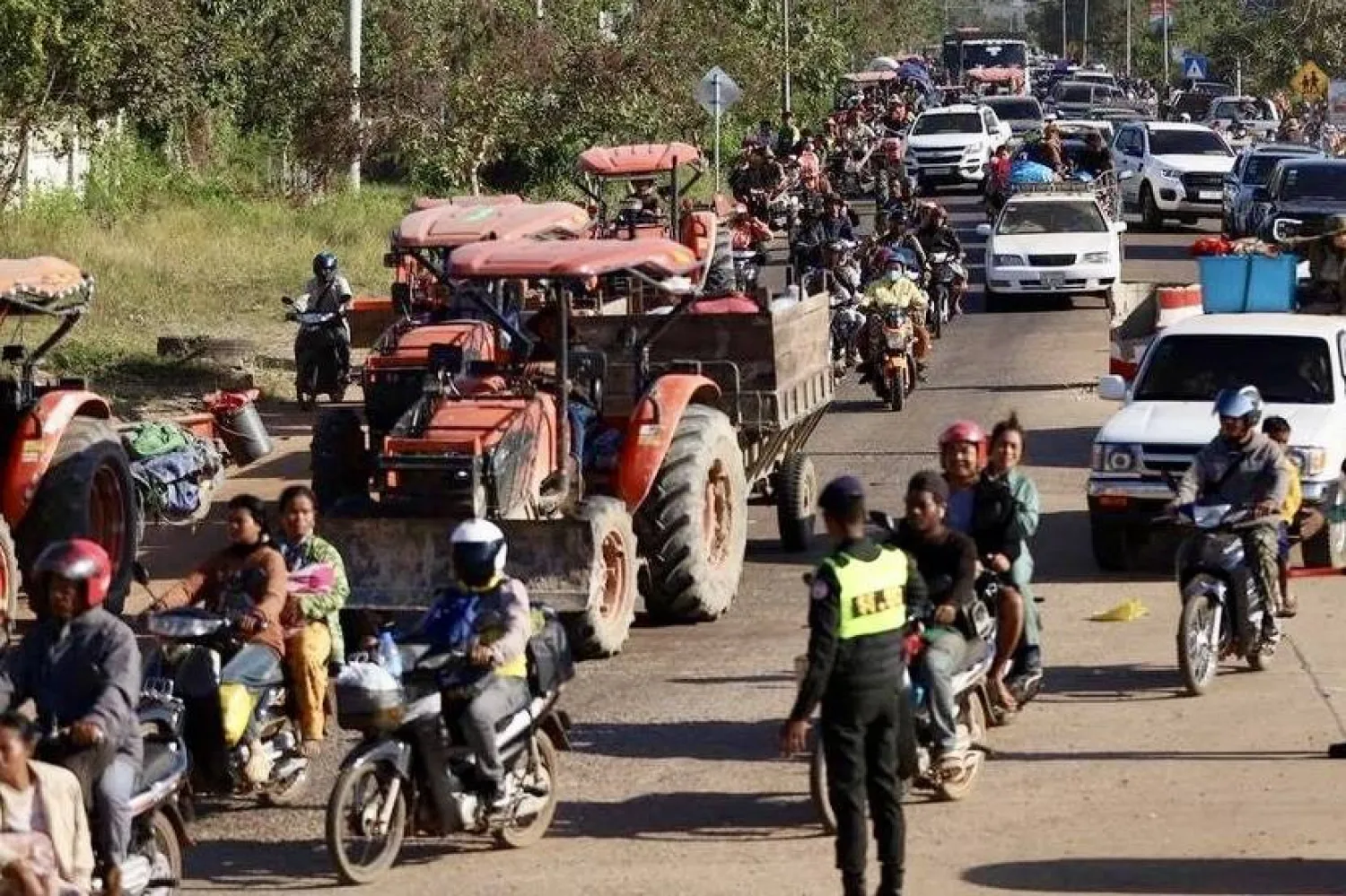
A handout photo made available by Agence Kampuchea Presse (AKP) shows people fleeing from a disputed area along a street in Oddar Meanchey Province, Cambodia, 08 December 2025. EPA/Agence Kampuchea Presse (AKP)
TT

Fighting between Thailand and Cambodia Spreads along Contested Border

A handout photo made available by Agence Kampuchea Presse (AKP) shows people fleeing from a disputed area along a street in Oddar Meanchey Province, Cambodia, 08 December 2025. EPA/Agence Kampuchea Presse (AKP)

Fighting between Cambodia and Thailand escalated along their contested border on Tuesday, as the Southeast Asian neighbors both said they would not back down in defending their sovereignty. With each side blaming the other for starting Monday's renewed clashes, it was unclear how or if a fragile ceasefire brokered by US President Donald Trump in July could be salvaged.

Cambodia's influential former leader Hun Sen said his country waited 24 hours to honor the ceasefire and allow for evacuations before launching counterattacks overnight against Thai forces.

"Cambodia needs peace, but Cambodia is compelled to counterattack to defend our territory," he said in a Facebook post, saying strong bunkers and weapons gave Cambodian forces the advantage in defending against an "invading enemy". In Thailand, military officials said there were clashes in five border provinces, and a Navy-led operation in its Trat Province to expel Cambodian soldiers was expected to end soon. They said Cambodia was using artillery, rocket launchers, and bomb-dropping drones to attack Thai forces.

"Thailand is determined to defend its sovereignty and territorial integrity and therefore military measures must be taken as necessary," Defense Ministry spokesperson Rear Admiral Surasant Kongsiri told the media briefing where other military officials also spoke. Cambodia's Defense Ministry accused Thailand of "brutal and unlawful actions", saying nine civilians were killed since Monday and 20 seriously injured. Thai officials said three soldiers had died in the fighting and 29 people had been injured, Reuters reported.

Cambodian Prime Minister Hun Manet, Hun Sen's son, said late on Monday that Thailand "must not use military force to attack civilian villages under the pretext of reclaiming its sovereignty". Both countries said they had evacuated hundreds of thousands of people from border areas. Tensions have simmered since Thailand last month suspended de-escalation measures that were agreed at a summit overseen by Trump, after a Thai soldier was maimed by a landmine that Bangkok said Cambodia had recently laid. Monday's clashes were the fiercest since a five-day exchange of rockets and heavy artillery in July, when at least 48 people were killed and 300,000 displaced, before Trump intervened to broker a ceasefire.

In May, tensions rose following the killing of a Cambodian soldier during a skirmish, which led to a major troop buildup at the border and escalated into diplomatic breakdowns and armed clashes. Thailand has superior military capabilities, with armed forces that dwarf its neighbor in terms of personnel, budget and weaponry, and fighter jets that have been carrying out air strikes to support its ground forces. Thailand and Cambodia have for more than a century contested sovereignty at undemarcated points along their 817-km (508-mile) land border, with disputes over ancient temples stirring nationalist fervor and occasional armed flare-ups, including a deadly week-long artillery exchange in 2011.



Iran Vows to Fight ‘As Long as Needed’ as Trump Says War Will End ‘Soon’

 Smoke rises following an explosion, amid the US-Israeli conflict with Iran, in Tehran, Iran, March 8, 2026. Majid Asgaripour/WANA (West Asia News Agency) via Reuters
Smoke rises following an explosion, amid the US-Israeli conflict with Iran, in Tehran, Iran, March 8, 2026. Majid Asgaripour/WANA (West Asia News Agency) via Reuters
TT

Iran Vows to Fight ‘As Long as Needed’ as Trump Says War Will End ‘Soon’

 Smoke rises following an explosion, amid the US-Israeli conflict with Iran, in Tehran, Iran, March 8, 2026. Majid Asgaripour/WANA (West Asia News Agency) via Reuters
Smoke rises following an explosion, amid the US-Israeli conflict with Iran, in Tehran, Iran, March 8, 2026. Majid Asgaripour/WANA (West Asia News Agency) via Reuters

Iran's Foreign Minister Abbas Araghchi said Tuesday his country would keep fighting as long as necessary, casting doubt on US President Donald Trump's insistence that the conflict would be over "soon."

The remarks from one of Iran's top leaders, who also ruled out negotiations with Washington, came as Tehran launched a new wave of attacks on Gulf nations hours after Trump's assurances of a swift end to the rapidly widening conflict.

Trump's comments helped reverse the stock market slumps and oil price jumps of a day earlier, with markets in Tokyo and Seoul opening strongly, and oil prices down as much as five percent, a day after benchmark crude rocketed past $100 a barrel.

"It's going to be ended soon, and if it starts up again they'll be hit even harder," Trump told a news conference in Florida on Monday, after telling lawmakers that the campaign would be a "short-term excursion."

"We've already won in many ways, but we haven't won enough," Trump said.

He threatened an attack of "incalculable" size if Tehran blocks oil supplies.

"We will hit them so hard that it will not be possible for them or anybody else helping them to ever recover that section of the world, if they do anything."

However, in an interview Araghchi told PBS News "the firings continues, and we are prepared. We are well prepared to continue attacking them with our missiles as long as needed and as long as it takes."

Iran's Revolutionary Guards also responded to Trump that they would "determine the end of the war".

And Araghchi effectively ruled out negotiations with Washington, saying Tehran had "a very bitter experience of talking with Americans."

Recalling previous US attacks during earlier negotiations, he said: "I don't think talking with Americans anymore would be on our agenda."

- Some oil sanctions waived -

Early Tuesday, Iranian attacks again targeted Gulf nations.

The United Arab Emirates said it was "currently responding to incoming missile and drone threats from Iran," while in Bahrain citizens were told to take shelter as sirens sounded.

Both Saudi Arabia and Kuwait also said they had intercepted and destroyed drones.

In Iran, local media reported fresh attacks in the capital and Khomein, and Israel said it had struck an Iranian missile launcher shortly after an Iranian barrage that triggered warnings in several parts of Israel.

The ongoing fire laid bare the uncertainty that has roiled markets globally, prompting fuel shortages and raising the specter of inflation.

In a bid to calm prices, Trump announced he would waive some sanctions on oil, following talks with Russian President Vladimir Putin.

Iran has targeted vessels traveling through the Strait of Hormuz, through which nearly 20 percent of the world's crude oil usually transits.

French President Emmanuel Macron said Monday his country and its allies were working on a "purely defensive" mission to reopen the strait, aiming to escort ships "after the end of the hottest phase of the conflict".

But it was far from clear when that might come.

Iran's new supreme leader is hardliner Mojtaba Khamenei, who replaces his father who was killed in the first day of US-Israeli strikes. Trump has called Khamenei a "lightweight" and said he should be involved in choosing Iran's leader.

The appointment was welcomed by some in Iran however, with state media carrying images of tens of thousands of people celebrating in central Tehran on Monday, many carrying the new leader's picture.

- 'Just a bit of bread' -

The war has spiraled far beyond Iran's borders, dragging in not only its Gulf neighbors but also Lebanon, where Israel carried out fresh strikes on Tuesday.

Lebanese authorities said Monday that Israeli attacks since March 2 have killed at least 486 people and wounded at least 1,313.

AFP has not been able to carry out a detailed breakdown of the figures.

Lebanon was drawn into the Middle East war when Iran-backed Hezbollah attacked Israel after the killing of Iranian supreme leader Ali Khamenei.

Lebanese President Joseph Aoun has accused Hezbollah of working to "collapse" the state, while the head of the group's parliamentary bloc said it had "no other option... than the option of resistance."

Syria too criticized the group, saying it had fired artillery shells into its territory from Lebanon overnight, and warning its army "will not tolerate any aggression."

Israeli strikes and ground incursions have pushed hundreds of thousands of Lebanese from their homes, with more than 660,000 registered as displaced, according to government figures.

Among them is Zainab El Masry, 40, who was sleeping with her husband and children on the grimy pavement of a Beirut square.

"We have nothing to eat or drink, just a bit of bread," she told AFP.

The conflict comes as Muslims mark the holy fasting month of Ramadan, and in Iran residents said they were grappling with the war and its impact on prices.

"What amazes me the most is that people insist on sitting out on the terrace to watch the bombardments, as if it were a show," said cafe manager Reza, 36, in the northeastern city of Boukan.

"The real problem is money: banks no longer distribute cash and many bank cards are blocked," he said.

"So in my cafe, I made a simple decision: for those who can't pay for their coffee, it's on the house."


EU Ready to ‘Enhance’ Operations Protecting Middle East Shipping

Greek Prime Minister Kyriakos Mitsotakis speaks during a joint press conference with Cyprus' and France's presidents at Paphos military airport, in Paphos, Cyprus, 09 March 2026, (EPA)
TT

EU Ready to ‘Enhance’ Operations Protecting Middle East Shipping

Greek Prime Minister Kyriakos Mitsotakis speaks during a joint press conference with Cyprus' and France's presidents at Paphos military airport, in Paphos, Cyprus, 09 March 2026, (EPA)

The European Union said on Monday it was ready to bolster its maritime operations in the Middle East to protect shipping routes, after holding talks with regional leaders.

The EU has been discussing reinforcing its naval mission in the Red Sea after US-Israeli attacks on Iran triggered a broader regional war, causing maritime traffic in the Strait of Hormuz to all but halt.

European Council President Antonio Costa and European Commission President Ursula von der Leyen "expressed their openness to further tailor and enhance these operations in order to better respond to the situation", the bloc said in a statement.

They held video talks with leaders from countries in the region including Saudi Arabia, Bahrain, Iraq, Jordan, Lebanon, Qatar, Syria, Türkiye and the United Arab Emirates.

A fifth of global crude passes through the Strait of Hormuz.

The EU has two maritime defensive operations in the region -- anti-piracy naval force Atalanta and Aspides.

The latter was launched in the Red Sea in 2024 to prevent attacks on trade vessels by Iran-backed Houthi militants.

Aspides is based in Greece but under Italy's operational military command. It currently has three warships -- one French, one Greek and one Italian.

Operation Atalanta has two ships, one in Oman and the other in Djibouti.

Greek Prime Minister Kyriakos Mitsotakis urged his European counterparts "to strengthen this operation (Aspides) with more naval assets".

"Few of us are participating at present but we must demonstrate European solidarity on a concrete level," he said.

He was speaking alongside French President Emmanuel Macron during a visit to Cyprus on Monday.

Macron said France would contribute to Aspides "over the long term" with two additional frigates.


Israel Says Iran’s New Supreme Leader a ‘Tyrant’ Who Will Continue ‘Regime’s Brutality’

A person holds a picture of the new Iranian Supreme Leader Mojtaba Khamenei during a gathering in support of him in Tehran, Iran, 09 March 2026. (EPA)
TT

Israel Says Iran’s New Supreme Leader a ‘Tyrant’ Who Will Continue ‘Regime’s Brutality’

A person holds a picture of the new Iranian Supreme Leader Mojtaba Khamenei during a gathering in support of him in Tehran, Iran, 09 March 2026. (EPA)

Israel's foreign ministry said Monday that Iran's new supreme leader Mojtaba Khamenei was a "tyrant" like his slain father, and would continue what it described as the Iranian "regime's brutality". 

In a post on X featuring a picture of Mojtaba Khamenei and his father Ali Khamenei, holding guns, the ministry wrote: "Mojtaba Khamenei. Like Father Like Son". 

"Mojtaba Khamenei's hands are already stained with the bloodshed that defined his father's rule. Another tyrant to continue the Iranian regime's brutality," the ministry said, in Israel's first reaction to Mojtaba Khamenei's selection as supreme leader following the killing of his father on February 28 in Israeli strikes. 

Earlier, Israel's UN ambassador Danny Danon said Mojtaba Khamenei has the same radical ideas as in the past and Israel will target anyone who promotes radical ideas against it.

"Changing the man at the top does not change the regime," Danon told reporters at the United Nations when asked about Iran's naming of Khamenei to replace his ‌father.

"The new leader, unfortunately, is more of the same ideology, the same radical ideas, and ... anyone who will promote those radical ideas against us, we will target them, we will ⁠find them," Danon said.

He said the ‌people of Iran ‌should rise up to choose their next leader and added: "We ‌will have to create the conditions for them, ‌and that is what we are doing now."

Asked about the threat to crucial energy traffic in the Strait of Hormuz and Iran's attacks against neighboring countries, Danon ‌said Israel and the US were hunting Iran's missile launchers and degrading its ⁠capabilities.

"So it's ⁠going to be harder for them to attack vessels in the Strait of Hormuz. It doesn't mean it will be 100% guaranteed, but it will be harder for them to do that.

"So I'm optimistic about that. Every day we see the numbers of attacks, going down," Danon said.

The war has effectively shut the Strait of Hormuz, where a fifth of global oil and liquefied natural gas is shipped along Iran's coast.