


Why Japan Issued an Advisory for a Possible Megaquake in the Country’s North 

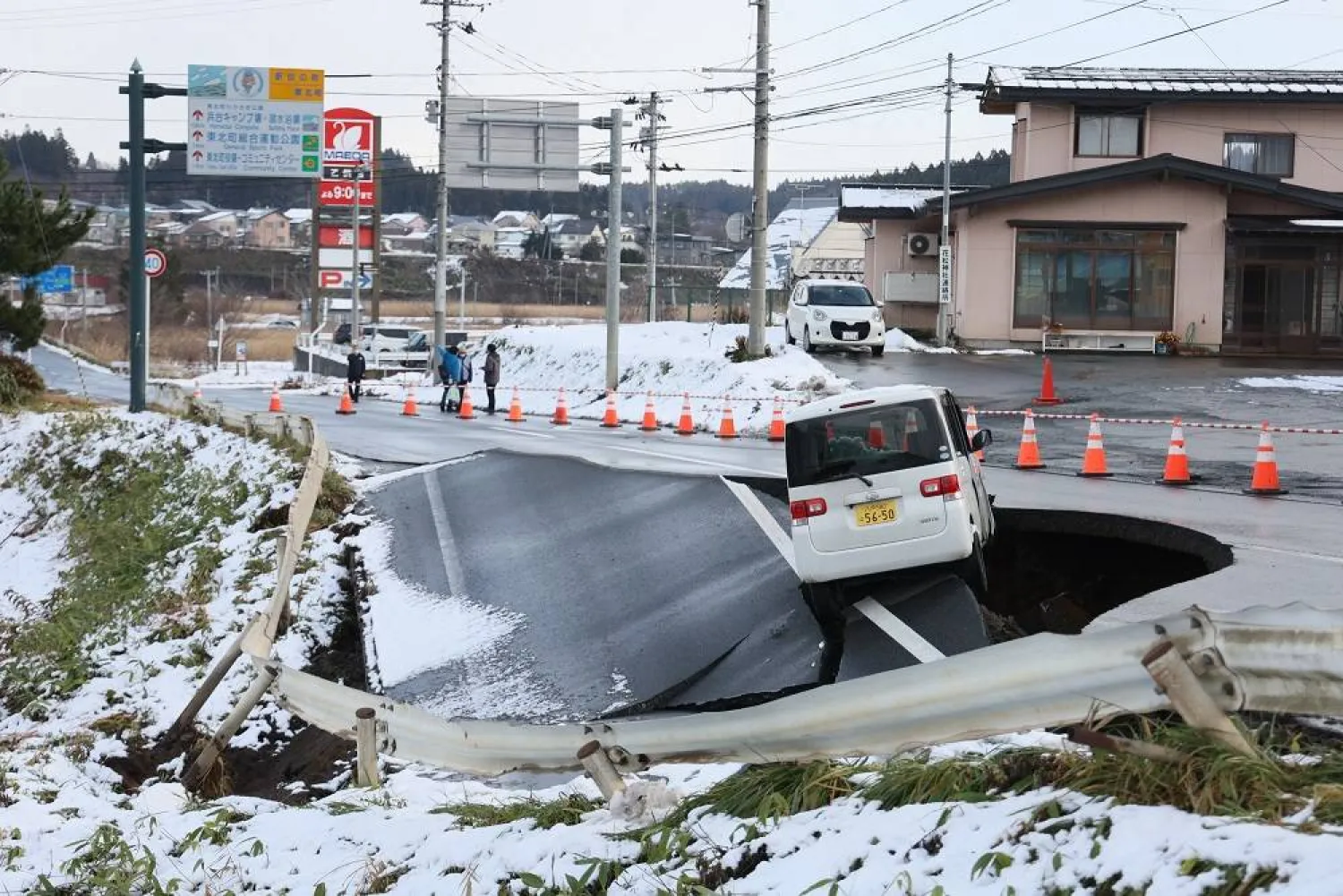
A car is stranded on a collapsed road in Tohoku, Aomori prefecture, northeastern Japan, 09 December 2025. (EPA/Jiji Press)
TT

Why Japan Issued an Advisory for a Possible Megaquake in the Country’s North 

A car is stranded on a collapsed road in Tohoku, Aomori prefecture, northeastern Japan, 09 December 2025. (EPA/Jiji Press)

Japan issued a megaquake advisory Tuesday after a magnitude 7.5 earthquake struck off the eastern coast of Aomori, the northernmost prefecture of Japan's main island of Honshu, and just south of the northern island of Hokkaido. Damage from this quake was modest — 34 mostly mild injuries and some damage to roads and buildings.

Officials said the advisory is not a prediction and the probability of a magnitude 8 or larger quake is only about 1%. But there’s hope the advisory will serve as a wake-up call for a quake that could have the devastation of the 2011 disaster that killed nearly 20,000 people and destroyed a nuclear plant.

There's said to be an increased risk of a subsequent, magnitude-8 or larger quake within the next week. Officials are urging residents, especially along coastal areas, to be well prepared so they can grab an emergency bag and run as soon as possible if a bigger quake hits.

This advisory seemed mindful compared with another advisory last year. The southern half of Japan's Pacific coastline received a "Nankai Trough" megaquake advisory in the summer of 2024, but the ambiguity of that warning led to panic buying of emergency food, event cancellations and business closures.

A megaquake advisory for Japan's northeastern coast

The Japan Meteorological Agency says Monday's powerful quake temporarily increased potential risks in the regions of Hokkaido and the Sanriku coast. That's where the Pacific Plate beneath Japan forms the two trenches — the Japan Trench and Chishima Trench — that have caused many large quakes in the past.

Experts say the deadly quake and tsunami in 2011 was caused by movement associated with the Japan Trench. It spans from off the eastern coast of Chiba to Aomori, and the Chishima Trench goes from the eastern coast of Hokkaido to the northern islands and the Kurils.

In explaining the advisory, the JMA said the magnitude 9.0 quake on March 11, 2011, that devastated large swaths of Japan's northern coast occurred two days after a magnitude 7.3 temblor that occurred at the Japan Trench off the eastern coast of Iwate, one of the hardest-hit areas in that disaster as well as in Monday's quake.

The 2011 quake caused a tsunami that battered northern coastal towns in Iwate, Miyagi and Fukushima prefectures. The tsunami, which topped 15 meters (50 feet) in some areas, slammed into and destroyed the Fukushima Daiichi nuclear power plant. That created deep fears of radiation that linger to this day.

A megaquake could cause a 98-foot tsunami and kill nearly 200,000

Another offshore megaquake in the Hokkaido-Sanriku area could cause up to a 30-meter (98-foot) tsunami in the region, kill as many as 199,000 people, destroy up to 220,000 houses and buildings, and cause estimated economic damages of up to 31 trillion yen ($198 billion), according to an estimate by the government. It says as many as 42,000 people could suffer from hypothermia in the winter.

The areas covered by the advisory extend across 182 municipalities from Hokkaido to Chiba prefecture.

Japan's separate advisory for an even more damaging megaquake stemming from the Nankai Trough, which affects the southern half of Japan's Pacific coast, was activated for the first time last August after a magnitude 7.1 quake occurred off the eastern coast of Miyazaki.

In a 2013 damage estimate for a possible Nankai Trough megaquake, the government said a magnitude 9.1 quake could generate a tsunami exceeding 10 meters (33 feet) within minutes, killing as many as 323,000 people, destroying more than 2 million buildings and causing economic damage exceeding 200 trillion yen ($1.28 trillion) in the region.

Officials call on people to be calm and prepared

Officials are stressing that the latest advisory has no prediction for any megaquake happening at any specific time or location, a Cabinet official for disaster prevention, Tsukasa Morikubo, told a news conference early Tuesday. He called on residents to be cautious and prepared while continuing their daily activity and work.

Officials urge people to keep an emergency bag containing a few days' worth of daily necessities along with shoes and helmets. People in the region are also advised to discuss evacuation procedures with family members and sleep in day clothes, not in pajamas, so they can flee immediately. Furniture should also be fixed to the floor or the wall.

The designated municipalities explained the advisory on their websites and started inspecting stocks of relief goods and equipment to be used at evacuation centers.

Iwaki City in Fukushima urged residents to register for emergency emails, while officials in the town of Oarai in Ibaraki prefecture, northeast of Tokyo, inspected wireless communication devices.

Japan's first megaquake advisory in August of last year contained a lot of scientific jargon. It worried and baffled many across the country. Some towns closed beaches and canceled annual events, disappointing many travelers during local holidays.

Many people postponed planned trips and rushed to stock up on rice, dried noodles, bottled water and portable toilets, leaving shelves empty at many supermarkets in western Japan and even Tokyo, which is outside of the at-risk area.



US Judge Blocks Deportation of Columbia University Palestinian Activist

Mohsen Mahdawi at a press conference in Vermont last year - Photo by Alex Driehaus/AP
TT

US Judge Blocks Deportation of Columbia University Palestinian Activist

Mohsen Mahdawi at a press conference in Vermont last year - Photo by Alex Driehaus/AP

A US immigration judge has blocked the deportation of a Palestinian graduate student who helped organize protests at Columbia University against Israel's war in Gaza, according to US media reports.

Mohsen Mahdawi was arrested by immigration agents last year as he was attending an interview to become a US citizen.

Mahdawi had been involved in a wave of demonstrations that gripped several major US university campuses since Israel began a massive military campaign in the Gaza Strip.

A Palestinian born in the occupied West Bank, Mahdawi has been a legal US permanent resident since 2015 and graduated from the prestigious New York university in May. He has been free from federal custody since April.

In an order made public on Tuesday, Judge Nina Froes said that President Donald Trump's administration did not provide sufficient evidence that Mahdawi could be legally removed from the United States, multiple media outlets reported.

Froes reportedly questioned the authenticity of a copy of a document purportedly signed by Secretary of State Marco Rubio that said Mahdawi's activism "could undermine the Middle East peace process by reinforcing antisemitic sentiment," according to the New York Times.

Rubio has argued that federal law grants him the authority to summarily revoke visas and deport migrants who pose threats to US foreign policy.

The Trump administration can still appeal the decision, which marked a setback in the Republican president's efforts to crack down on pro-Palestinian campus activists.

The administration has also attempted to deport Mahmoud Khalil, another student activist who co-founded a Palestinian student group at Columbia, alongside Mahdawi.

"I am grateful to the court for honoring the rule of law and holding the line against the government's attempts to trample on due process," Mahdawi said in a statement released by his attorneys and published Tuesday by several media outlets.

"This decision is an important step towards upholding what fear tried to destroy: the right to speak for peace and justice."


Fire Breaks out Near Iran's Capital Tehran, State Media Says

Smoke rises from a fire caused by an explosion in Tehran (File photo - Reuters)
TT

Fire Breaks out Near Iran's Capital Tehran, State Media Says

Smoke rises from a fire caused by an explosion in Tehran (File photo - Reuters)

A fire broke out in Iran's Parand near the capital city Tehran, state media reported on Wednesday, publishing videos of smoke rising over the area which is close to several military and strategic sites in the country's Tehran province, Reuters reported.

"The black smoke seen near the city of Parand is the result of a fire in the reeds around the Parand river bank... fire fighters are on site and the fire extinguishing operation is underway", state media cited the Parand fire department as saying.


Pakistan PM Sharif to Seek Clarity on Troops for Gaza in US Visit

US President Donald Trump looks at Pakistan's Prime Minister Shehbaz Sharif speaking following the official signing of the first phase of the Gaza ceasefire agreement between Israel and Hamas, during a world leaders' summit on ending the Gaza war, in Sharm El-Sheikh, Egypt, October 13, 2025. REUTERS/Evelyn Hockstein/File Photo
TT

Pakistan PM Sharif to Seek Clarity on Troops for Gaza in US Visit

US President Donald Trump looks at Pakistan's Prime Minister Shehbaz Sharif speaking following the official signing of the first phase of the Gaza ceasefire agreement between Israel and Hamas, during a world leaders' summit on ending the Gaza war, in Sharm El-Sheikh, Egypt, October 13, 2025. REUTERS/Evelyn Hockstein/File Photo

Before Pakistan commits to sending troops to Gaza as part of the International Stabilization Force it wants assurances from the United States that it will be a peacekeeping mission rather than tasked with disarming Hamas, three sources told Reuters.

Pakistan's Prime Minister Shehbaz Sharif is set to attend the first formal meeting of President Donald Trump's Board of Peace in Washington on Thursday, alongside delegations from at least 20 countries.

Trump, who will chair the meeting, is expected to announce a multi-billion dollar reconstruction plan for Gaza and detail plans for a UN-authorized stabilization force for the Palestinian enclave.

Three government sources said during the Washington visit Sharif wanted to better understand the goal of the ISF, what authority they were operating under and what the chain of command was before making a decision on deploying troops.

"We are ready to send troops. Let me make it clear that our troops could only be part of a peace mission in Gaza," said one of the sources, a close aide of Sharif.

"We will not be part of any other role, such as disarming Hamas. It is out of the question," he said.

Analysts say Pakistan would be an asset to the multinational force, with its experienced military that has gone to war with arch-rival India and tackled insurgencies.

"We can send initially a couple of thousand troops anytime, but we need to know what role they are going to play," the source added.

Two of the sources said it was likely Sharif, who has met Trump earlier this year in Davos and late last year at the White House, would either have an audience with him on the sidelines of the meeting or the following day at the White House.

Initially designed to cement Gaza's ceasefire, Trump sees the Board of Peace, launched in late January, taking a wider role in resolving global conflicts. Some countries have reacted cautiously, fearing it could become a rival to the United Nations.

While Pakistan has supported the establishment of the board, it has voiced concerns against the mission to demilitarize Gaza's militant group Hamas.