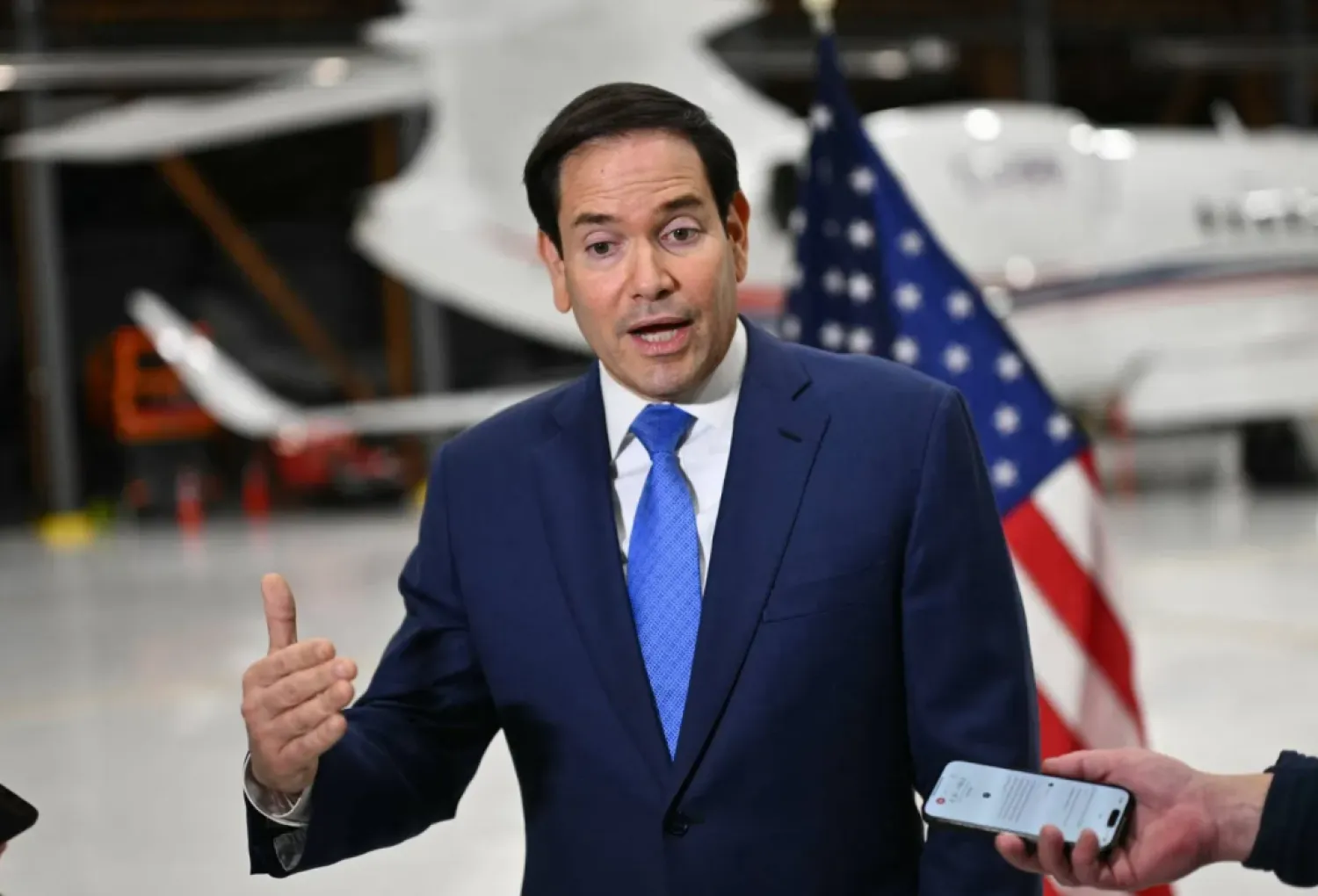
Rubio Says US Sanctioning ICC Judges for Targeting Israel

US Secretary of State Marco Rubio speaks to traveling journalists at the John C. Munro Hamilton International Airport in Hamilton, Ontario, on November 12, 2025 after the G7 foreign ministers meeting. (Photo by Mandel NGAN / POOL / AFP)
TT

Rubio Says US Sanctioning ICC Judges for Targeting Israel

US Secretary of State Marco Rubio speaks to traveling journalists at the John C. Munro Hamilton International Airport in Hamilton, Ontario, on November 12, 2025 after the G7 foreign ministers meeting. (Photo by Mandel NGAN / POOL / AFP)

US Secretary of State Marco Rubio said on Thursday that the US was sanctioning two judges of the International Criminal Court for targeting Israel.

"Today, I am designating two International Criminal Court (ICC) judges, Gocha Lordkipanidze of Georgia and Erdenebalsuren Damdin of Mongolia, pursuant to Executive Order 14203," Rubio said in a statement, referring to the order President Donald Trump signed in February sanctioning the ICC, Reuters reported.

"These individuals have directly engaged in efforts by the ICC to investigate, arrest, detain, or prosecute Israeli nationals, without Israel's consent," he said.

The United States and Israel are not members of the ICC.

The US sanctions in February include freezing any US assets of those designated and barring them and their families from visiting the United States.


CNN, MS Now, Politico Sue Donald Trump over White House Ban

President Donald Trump speaks to reporters at Charlotte Douglas International Airport, Wednesday, Sept. 16, 2026, in Charlotte, N.C. (AP Photo/Alex Brandon)
TT

CNN, MS Now, Politico Sue Donald Trump over White House Ban

President Donald Trump speaks to reporters at Charlotte Douglas International Airport, Wednesday, Sept. 16, 2026, in Charlotte, N.C. (AP Photo/Alex Brandon)

CNN, MS NOW and Politico sued President Donald Trump on Monday for banning them from White House grounds, saying it violated their rights under the US Constitution to cover him.

In a complaint filed in the Washington, D.C., federal court, the media outlets said Trump can't ban them solely because he dislikes what he calls their "negative" coverage, and reserve coverage for media who offer praise. They also said the public deserves "current and complete information" about their government.

"This ban could not be a more direct assault on the First Amendment nor a more blatant violation of our most fundamental constitutional principles," the media outlets said.

According to AFP, leading US broadcasters suspended the TV "pool" coverage in solidarity with CNN.

"The public has a vital interest in receiving accurate, independent information about its government. No administration should restrict a news organization because it objects to its reporting," ABC, CBS, CNN, Fox and NBC said in a statement.

TV broadcasters rotate responsibility for filming the president at some events.


US Refuses Visas for Iran UN Delegation Members

Iranian President Masoud Pezeshkian delivers a speech in the United Nations General Assembly Hall in New York (File photo/UN)
TT

US Refuses Visas for Iran UN Delegation Members

Iranian President Masoud Pezeshkian delivers a speech in the United Nations General Assembly Hall in New York (File photo/UN)

The United States has refused to issue visas for members of Iranian President Masoud Pezeshkian's delegation, including his communications team, for this week's trip to the UN General Assembly, Iranian state media reported Monday.

Pezeshkian will be the highest-ranking Iranian official to enter the United States since the Middle East war began with US-Israeli strikes on Iran in February.

"In an unprecedented hostile move by the US government, (US President Donald) Trump has denied US visas to certain members of the president's high-level delegation, including members of his communications team," state news agency IRNA reported.

The Mehr news agency also carried the story, citing a spokesperson for the Iranian presidency, and added that Pezeshkian will address the UN General Assembly on Wednesday.

The US has authorized the Iranian delegation to travel for the UN General Assembly but will, like last year, put restrictions in place.

Iran's delegation will not, for instance, be allowed to purchase luxury goods or other items, the State Department said on Thursday.

Iranian Foreign Minister Abbas Araghchi, part of the delegation to the UN, left Iran on Sunday evening for a stopover in Qatar.

Iran says it has conveyed to the US, via Qatar as mediator, conditions for reopening the strategic Strait of Hormuz oil and gas shipping route, which it has choked off since the war began.

The United States, in turn, is imposing a counterblockade of Iranian ports.


100 Leading Israeli Thinkers Warn of ‘Internal Collapse’

An Israeli boy holds a toy gun in the occupied West Bank city of Hebron in March 2024 (AFP) 
TT

100 Leading Israeli Thinkers Warn of ‘Internal Collapse’

An Israeli boy holds a toy gun in the occupied West Bank city of Hebron in March 2024 (AFP) 

One hundred prominent Israeli thinkers, researchers and former officials have warned that Israel faces a critical choice: become a major power or risk collapse, arguing that while the country has the potential to achieve greater regional influence, its “foundations are rusting.”

The warning emerged from an in-depth study by MIND Israel, a nonpartisan organization specializing in foreign and security strategy. Maariv reported Sunday that the research identified another type of danger alongside external security threats: an existential threat from within.

“If we do not address these foundations, not only will we fail to become a major power, but the entire structure will collapse,” warned Dr. Avner Golov, MIND Israel’s vice president.

The study, involving 100 experts, identified six critical issues requiring urgent decisions: Israel’s regional standing, the quality of its human capital, the relationship between the economy and security, governance and national resilience, demographic changes, and relations with the United States.

MIND Israel President Maj. Gen. (res.) Amos Yadlin noted that the organization intends to present the issues to the public ahead of elections in late October and encourage voters to question party leaders about them.

Presenting the research, Golov explained that the researchers’ review of history found that civilizations tend not to be destroyed from outside while they remain strong internally.

“Internal processes dismantle them,” he added, citing declining social cohesion, erosion of trust in state institutions, the prioritization of short-term political gains over long-term national interests and an inability to adapt.

Contrasting views

Golov outlined two opposing assessments encountered by the researchers. One held that Israel had survived a global pandemic, social upheaval, the Oct. 7 attack and its aftermath while maintaining a resilient economy, technological leadership and strong security capabilities — evidence, in that view, that the country was moving toward becoming a major power.

The other argued that a process of collapse had already begun, driven by an identity crisis, declining governance and a political emergency.

“We believe both sides are right,” Golov concluded, arguing that Israel simultaneously faces historic opportunities and serious internal vulnerabilities.

Asked what the public should do with the questions raised by the study, Golov urged voters to look beyond questions of governing coalitions and demand concrete plans from political leaders. Key measures, he maintained, should be taken during a new government’s first 100 days.

Turning to security policy, Golov called for an updated version of Israel’s traditional “Iron Wall” doctrine following Oct. 7.

He argued that Israel could no longer rely solely on containing enemies behind defensive barriers but must seek to shape developments beyond them.

“The wall still needs to be strong, but we cannot rely only on that,” he stressed.

Golov also urged Israel not to depend exclusively on the United States and to strengthen regional relationships.

“Alongside the walls, we need bridges,” he concluded.