


Fresh Clashes Kill Six in Iran Cost-of-Living Protests

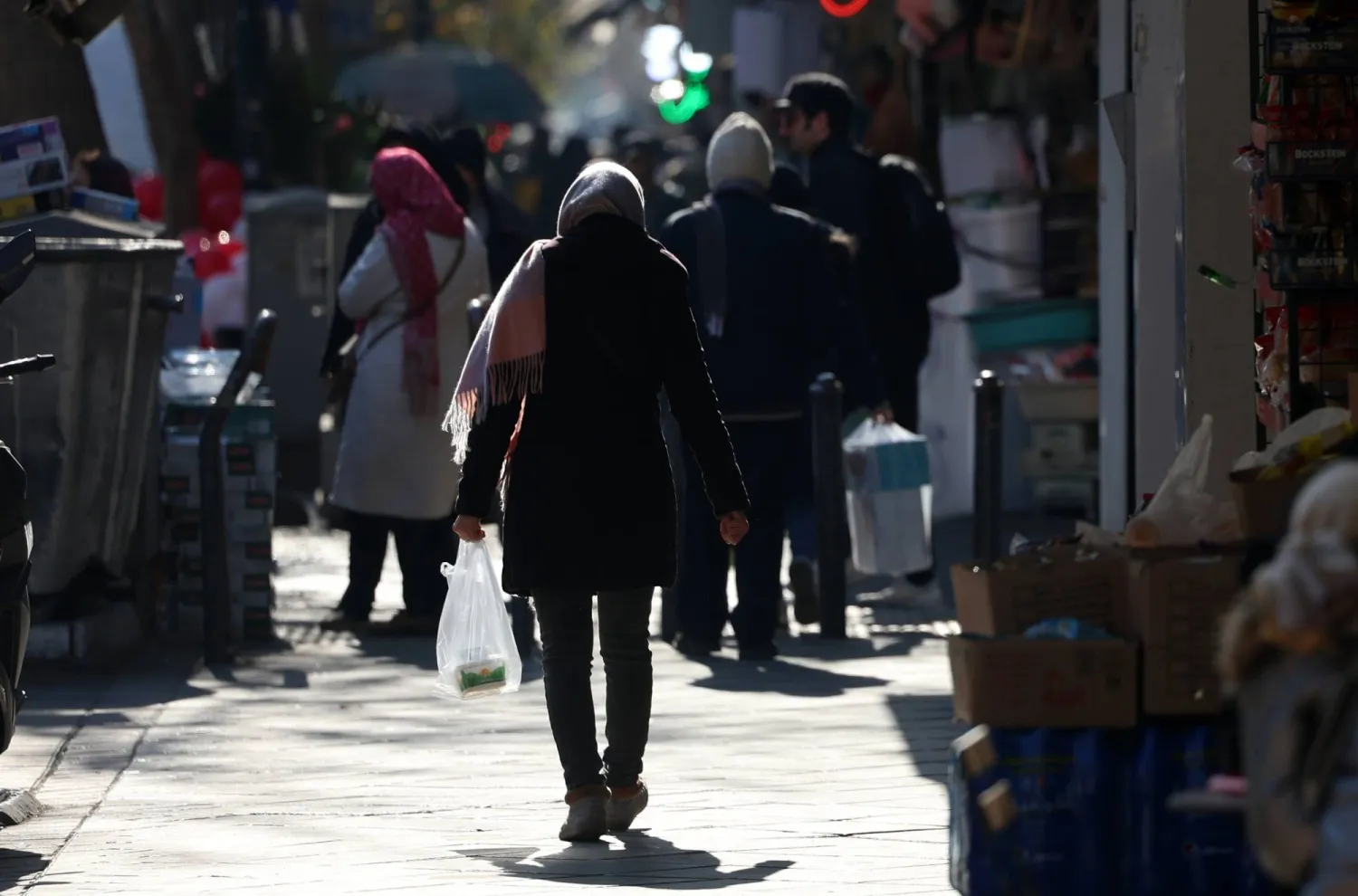
An Iranian woman walks with her shopping bag in a street in Tehran, Iran, 31 December 2025. EPA/ABEDIN TAHERKENAREH
TT

Fresh Clashes Kill Six in Iran Cost-of-Living Protests

An Iranian woman walks with her shopping bag in a street in Tehran, Iran, 31 December 2025. EPA/ABEDIN TAHERKENAREH

Protesters and security forces clashed in three Iranian cities on Thursday, with six people reported killed, the first deaths since the cost-of-living demonstrations broke out. 

The protests began on Sunday in Tehran, where shopkeepers went on strike over high prices and economic stagnation, and have since spread to other parts of the country. 

On Thursday, Iran's Fars news agency reported two people killed in clashes between security forces and protesters in the city of Lordegan, in the province of Chaharmahal and Bakhtiari, and three in Azna, in neighboring Lorestan province. 

"Some protesters began throwing stones at the city's administrative buildings, including the provincial governor's office, the mosque, the Martyrs' Foundation, the town hall and banks," Fars said of Lordegan, adding police responded with tear gas. 

Fars reported that the buildings were "severely damaged" and that police arrested several people described as "ringleaders". 

In Azna, Fars said "rioters took advantage of a protest gathering... to attack a police commissariat". 

During previous protest movements, state media has labelled demonstrators "rioters". 

Earlier Thursday, state television reported that a member of Iran's security forces was killed overnight during protests in the western city of Kouhdasht. 

"A 21-year-old member of the Basij from the city of Kouhdasht was killed last night by rioters while defending public order," the channel said, citing Said Pourali, the deputy governor of Lorestan Province. 

The Basij are a volunteer paramilitary force linked to Iran's Revolutionary Guards, the ideological arm of the country. 

Pourali said that "during the demonstrations in Kouhdasht, 13 police officers and Basij members were injured by stone throwing". 

- 'End up in hell' - 

The demonstrations are smaller than the last major outbreak of unrest in 2022, triggered by the death in custody of Mahsa Amini, who was arrested for allegedly violating Iran's strict dress code for women. 

Her death sparked a nationwide wave of anger that left several hundred people dead, including dozens of members of the security forces. 

The latest protests began peacefully in the capital and spread after students from at least 10 universities joined in on Tuesday. 

Iranian President Masoud Pezeshkian has sought to calm tensions, acknowledging protesters' "legitimate demands", and called on the government Thursday to take action to improve the economic situation. 

"From an Islamic perspective... if we do not resolve the issue of people's livelihoods, we will end up in hell," Pezeshkian said at an event broadcast on state television. 

Authorities, however, have also promised to take a "firm" stance, and have warned against exploiting the situation to sow chaos. 

Local media coverage of the demonstrations has varied, with some outlets focusing on economic difficulties, and others on incidents caused by "troublemakers". 

Iran is in the middle of an extended weekend, with the authorities declaring Wednesday a bank holiday at the last minute, citing the need to save energy during the cold weather. 

They made no official link to the protests. 

The weekend in Iran begins on Thursday, and Saturday is a long-standing national holiday. 

Iran's prosecutor general said on Wednesday that peaceful economic protests were legitimate, but any attempt to create insecurity would be met with a "decisive response". 

"Any attempt to turn economic protests into a tool of insecurity, destruction of public property, or implementation of externally designed scenarios will inevitably be met with a legal, proportionate and decisive response." 

Earlier this week, a video showing a person sitting in the middle of a Tehran street facing down motorcycle police went viral on social media, with some seeing it as a "Tiananmen moment" -- a reference to a famous image of a Chinese protester defying a column of tanks during 1989 anti-government protests in Beijing. 

On Thursday, state television alleged the footage had been staged to "create a symbol" and aired another video purportedly shot from another angle by a police officer's camera. 

Sitting cross-legged, the protester remains impassive, head bowed, before covering his head with his jacket as behind him a crowd flees clouds of tear gas. 

On Wednesday evening, the Tasnim news agency reported the arrest of seven people it described as being affiliated with "groups hostile to the republic based in the United States and Europe". 

It said they had been "tasked with turning the demonstrations into violence". Tasnim did not say when they were arrested. 

The national currency, the rial, has lost more than a third of its value against the US dollar over the past year, while double-digit hyperinflation has been undermining Iranians' purchasing power for years. 

The inflation rate in December was 52 percent year-on-year, according to the Statistical Center of Iran, an official body. 


Iran Guards Chief Says 'Finger on Trigger', Warns US against 'Miscalculations'

Commander of the Iranian Revolutionary Guard Mohammad Pakpour (Archive - Reuters)
TT

Iran Guards Chief Says 'Finger on Trigger', Warns US against 'Miscalculations'

Commander of the Iranian Revolutionary Guard Mohammad Pakpour (Archive - Reuters)

The commander of Iran's Revolutionary Guards on Thursday warned Israel and the US against "miscalculations" in the wake of mass protests, saying the force had its "finger on the trigger".

US President Donald Trump has repeatedly left open the option of new military action against the Iranian republic after Washington backed and joined Israel's 12-day war in June.

A fortnight of protests starting in late December shook the clerical leadership under supreme leader Ali Khamenei, but the movement has petered out in the face of a crackdown that activists say has left thousands dead.

Guards commander General Mohammad Pakpour warned Israel and the United States "to avoid any miscalculations, by learning from historical experiences and what they learned in the 12-day imposed war, so that they do not face a more painful and regrettable fate".

"The Islamic Revolutionary Guard Corps and dear Iran have their finger on the trigger, more prepared than ever, ready to carry out the orders and measures of the supreme commander-in-chief -- a leader dearer than their own lives," he said, referring to Khamenei.

His comments came in a written statement quoted by state television marking the national day in Iran to celebrate the Guards, a force whose mission is to protect the 1979 Iranian revolution from internal and external threats.

Activists accuse the Guards of playing a frontline role in the deadly crackdown on protests. The group is sanctioned as a terrorist entity by countries including Australia, Canada and the United States and campaigners have long urged similar moves from the EU and UK.

Pakpour took over as Guards commander last year after his predecessor Hossein Salami was one of several key military figures killed in an Israeli strike during the 12-day war, losses which revealed Israel's deep intelligence penetration of Iran.

Giving their first official toll from the protests, Iranian authorities on Wednesday said 3,117 people were killed.

The statement from the Iranian republic's foundation for martyrs and veterans sought to draw a distinction between "martyrs", who it said were members of security forces and innocent bystanders, and what it described as "rioters" backed by the US. 

Of its toll of 3,117, it said 2,427 people were martyrs. 

However, rights groups say the heavy toll was caused by security forces firing directly on protesters and that the actual number of those killed could be far higher and even extend to over 20,000. 

Speaking at the World Economic Forum in Davos, Israeli President Isaac Herzog said "the future for the Iranian people can only be in a regime change", adding that the Iranian “regime is in quite a fragile situation". 


Merz Warns Great Power Politics Makes World 'a Dangerous Place'

Germany's Chancellor Friedrich Merz gestures as he speaks during the World Economic Forum (WEF) annual meeting in Davos on January 22, 2026. (Photo by Fabrice COFFRINI / AFP)
TT

Merz Warns Great Power Politics Makes World 'a Dangerous Place'

Germany's Chancellor Friedrich Merz gestures as he speaks during the World Economic Forum (WEF) annual meeting in Davos on January 22, 2026. (Photo by Fabrice COFFRINI / AFP)

German Chancellor Friedrich Merz warned Thursday that the international order is "unravelling at a breathtaking pace" and that "a world where only power counts is a dangerous place".

Speaking at the World Economic Forum in Davos, Merz pointed to Russia's war in Ukraine, a rising China and a United States that is "radically reshaping its foreign and security policy".

"A world where only power counts is a dangerous place," he said. "First for small states and for the middle powers, ultimately for the great ones."

The conservative leader of the top EU economy said Germany went down this road "to its bitter end" during the 20th century, reported AFP.

"It pulled the world into a black abyss," he said.

"So let us bear in mind: our greatest strength remains the ability to build partnerships and alliances among equals based on mutual trust and respect."

Merz called Russia's invasion of Ukraine "the most drastic expression" so far of a global "new era". He added that China, "with strategic foresight, has worked its way into the ranks of the great powers".

"The United States' global pole position is being challenged," Merz said, with Washington responding by "radically reshaping its foreign and security policy".

"We have entered a time of great power politics. The international order of the past three decades anchored in international law has always been imperfect. Today, its very foundations have been shaken."

He said Europe's power rested on three pillars.

"First we must invest massively in our ability to defend ourselves, and we are doing this," he said.

"Second, we must rapidly make our economies competitive, and we are doing this. Third, we must stand closer together among Europeans and among like-minded partners. We are doing this."


Israel President Says Iran's Future 'Can Only Be Regime Change'

Israeli President Isaac Herzog attends the 56th annual World Economic Forum (WEF) meeting in Davos, Switzerland, January 22, 2026. REUTERS/Romina Amato
TT

Israel President Says Iran's Future 'Can Only Be Regime Change'

Israeli President Isaac Herzog attends the 56th annual World Economic Forum (WEF) meeting in Davos, Switzerland, January 22, 2026. REUTERS/Romina Amato

Israel's President Isaac Herzog said on Thursday that "regime change" can be the only future for Iran, where mass protests against the clerical authorities have faced a deadly crackdown.

Demonstrations initially sparked by economic grievances turned into a movement against the theocracy that has ruled Iran since 1979.

People poured into the streets for several days from January 8, but the demonstrations appear for now to have petered out in the face of what activists describe as a crackdown under the cover of a blanket internet shutdown.

"The Iranian people are yearning for change. The Iranian people deserve change," Herzog said in an interview at the World Economic Forum in Davos.

"The future for the Iranian people can only be in a regime change, and that has to be... within the realms of the Iranian people and the international community and its support," he added.

He added saying that the Iranian “regime is in quite a fragile situation."

The Iranian Republic's long-time foe Israel has expressed support for the protesters, without suggesting it would intervene.

Iran accused Israel in early January of trying to undermine its national unity after Prime Minister Benjamin Netanyahu said Israel stood "in solidarity with the struggle of the Iranian people".

Iranian authorities on Wednesday said 3,117 people were killed during the protests that first erupted in late December, but activists said the actual toll risked being many times higher.

Iran and Israel fought a 12-day war last year, after Israel launched a wave of strikes on Iranian nuclear facilities as well as residential areas, saying it aimed to cripple the Iranian republic's atomic research and ballistic missile capabilities.
