

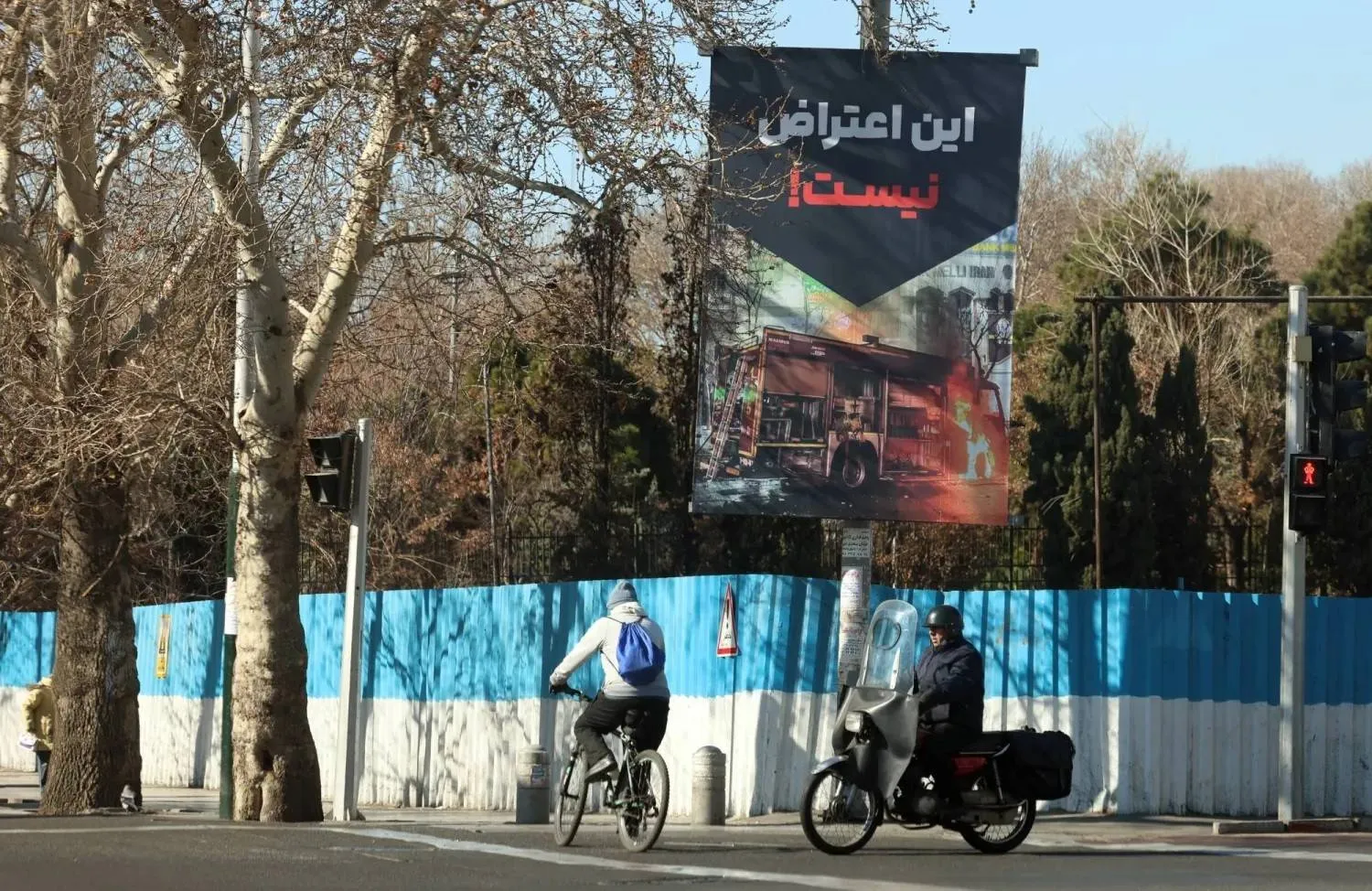

Cautious Calm in Iran Amid Heightened Security Measures

Iranians walk past a sign reading in Persian “This is not a protest” on a street in Tehran (EPA) 
TT

Cautious Calm in Iran Amid Heightened Security Measures

Iranians walk past a sign reading in Persian “This is not a protest” on a street in Tehran (EPA) 

Iran is facing a sweeping security crackdown after a wave of arrests and the heavy deployment of forces in Tehran and other cities, as residents and a rights group said protests have largely abated under the weight of the clampdown.

Accounts from residents in the capital described a cautious calm since Sunday, with drones circling overhead and patrols stationed at major intersections and squares, amid a sharp curtailment of information flows because of internet outages and restricted communications.

Videos circulating online pointed to what were described as “maximum security” conditions in cities, including Mashhad, where security personnel in dark uniforms and special vehicles were seen on the streets, alongside a complete internet blackout that has lasted for eight days.

Despite the broader lull, videos showed a group of residents in Zahedan marching through the city’s streets on Friday after weekly prayers, even as reports spoke of tight security and extensive measures around the prayers. Independent rights sources, including the Baloch Activists Campaign, said Zahedan had seen a heavy security presence.

Protests erupted on Dec. 28 after a surge in inflation and worsening economic conditions in Iran, whose economy is weighed down by sanctions, before escalating into one of the biggest challenges to the ruling establishment since 1979.

While residents said streets appeared calm, many asked not to be named for safety reasons. A resident in a northern city on the Caspian Sea said conditions there were also quiet, with security overshadowing daily life. An elderly woman in a northwestern town that was an early flashpoint said sporadic protests were still occurring but with less intensity, adding she had never seen scenes like those that accompanied the earlier escalation in violence.

Iran’s education ministry said it would decide on Saturday whether Tehran’s schools would return to in-person classes or continue remote learning, as they did last week, a sign of broader disruption to public life.

On the ground, a woman in Tehran told Reuters by phone that her daughter was killed on Friday after taking part in a protest near their home. She said the girl was 15 and rejected descriptions of her as a “terrorist” or “rioter,” adding that her daughter was chased by Basij forces as she tried to return home.

The Iranian Kurdish rights group Hengaw, based in Norway, said no protest gatherings had been recorded since Sunday, adding that “security conditions remain extremely tight” with a dense military and security presence in several areas.

Hengaw said its independent sources confirmed a significant security and military deployment in cities and towns that had seen earlier protests, as well as in places that had not witnessed large demonstrations, reflecting the breadth of precautionary measures.

In Isfahan, Tasnim, which is affiliated with the Iranian Revolutionary Guard Corps, said “rioters” had set fire to a local education office in the Falavarjan district.

New videos from last week showed protests in the Piroozi area in eastern Tehran, with sustained gunfire audible. A voice in one video is heard telling people, “They are shooting at us. One of us has been killed.”

Official narrative

In an effort to reinforce the security agencies’ account, state-owned Press TV quoted Iran’s police chief as saying calm had returned nationwide, while state television aired footage of traffic flowing through major Tehran intersections.

Alongside that narrative, state television aired a report on disturbing images from a forensic medicine center in southern Tehran, presenting them as evidence of what authorities described as the “organized and violent nature” of the unrest, insisting armed elements and “terrorist attacks” were involved.

Videos circulating in recent days showed scenes of panic inside the center, with dozens of bodies lying on floors and stretchers, most in body bags and some uncovered.

A security expert interviewed on state television said forensic facilities had been overwhelmed by the number of bodies, leading to overcrowding in halls, which the report framed as a sign of a “non-spontaneous killing wave.”

The expert said forensic examinations showed the use of weapons and ammunition “not in circulation in Iran,” alongside hunting rifles and bladed weapons. He pointed to knives, sharp tools, and injuries he said were caused by “prepared” gunfire.

He described repeated strikes carried out by more than one attacker and killings he called “brutal,” including broken necks, arguing that the nature of the injuries pointed to “organized terrorist attacks” rather than spontaneous clashes, according to Tasnim.

State television also aired footage it said showed the arrest of armed suspects in security operations linked to the unrest, while official media broadcast videos of pursuits and weapons seizures.

Tasnim published clips it said showed confrontations between security forces and “rioters,” including what it described as a surprise arrest of armed men by police.

Tasnim said “rioters” broke into a public parking garage and destroyed all vehicles inside, part of an official narrative that blames opponents of the state for organized sabotage.

Arrests and casualties

Casualty figures reported by the rights agency HRANA showed little change since Wednesday, standing at 2,677 dead, including 2,478 protesters and 163 people identified as government-affiliated, according to the group.

An Iranian official told Reuters this week that about 2,000 people had been killed in the unrest, a lower figure than HRANA’s tally, which is based on a network of sources inside the country.

The differing numbers come amid the absence of comprehensive official data.

HRANA said more than 19,000 people had been arrested, while Tasnim put the number at 3,000.

Tasnim said many leaders of what it called “riots” had been detained in Kermanshah in western Iran, adding that five suspects were arrested over the vandalism of a fuel station and a Basij base in the southeastern city of Kerman.

In a parallel display of deterrence, state television broadcast funerals for security personnel in Semnan in northern Iran and Semirom in central Iran, highlighting state losses and framing them within a narrative of “defending security.”

“Await severe retaliation”

Abdolrahim Mousavi, chief of staff of Iran’s armed forces, said, “If our young men wanted to confront the instigators with weapons, they would have resolved the matter and rounded them all up within two hours,” in a direct threat.

He said protesters had used “human shields,” while “our young men defended this country and its people with their lives alone,” remarks that sought to justify the use of force and underscore readiness to escalate.

For his part, Ahmad Khatami, Tehran’s Friday prayer imam, called for the execution of detained protesters and for the arrest of anyone who supported the protests “in any form.”

He described protesters as “servants of Netanyahu” and “soldiers of Trump.”

Khatami said in his sermon that Netanyahu and Trump should “await severe retaliation,” and that Americans and “Zionists” should not expect peace.

He cited figures he said showed damage to 350 mosques, 126 prayer halls, and 20 religious sites, as well as 80 homes of Friday prayer leaders.

International dimension

The internal developments came as fears of a US attack eased from Wednesday, when President Donald Trump said he had received information indicating that killings had declined.

The White House said warnings of “severe consequences” remained in place.

White House spokeswoman Karoline Leavitt said Trump and his team had warned Tehran of consequences if killings continued, adding that Trump was aware of a halt to 800 executions while keeping “all options” on the table.

A US official, speaking on condition of anonymity, said the US military was expected to send additional defensive and offensive capabilities to the region, without detailing their nature or timing. US Central Command declined to comment.

A source familiar with the matter said David Barnea, head of Israel’s Mossad, was visiting the United States for talks on Iran and was expected to meet US envoy Steve Witkoff, with no immediate comment from the office of Israeli Prime Minister Benjamin Netanyahu.

In contrast, the Kremlin said President Vladimir Putin discussed the situation in Iran in separate calls with Netanyahu and Iranian President Masoud Pezeshkian, expressing Moscow’s readiness to mediate and ease tensions.

Iranian state media said Pezeshkian told Putin that the United States and Israel had played a direct role in the unrest.

“Key figures of the system”

At home, the office of Supreme Leader Ali Khamenei urged what it called the system’s “key figures” to act publicly and break their silence, addressing prominent political figures across factions, including former reformist president Mohammad Khatami, his ally Hassan Rouhani, hardliner Mahmoud Ahmadinejad, and former parliament speaker Ali Akbar Nategh-Nuri.

The weekly magazine “Voice of Iran,” affiliated with the leader’s office, said responsibility lay with elites to counter what it called “the enemies’ nonsense” and stand with “the facts,” adding there was “no longer room for doubt or silence” because the issue “concerns Iran itself.”

In a swift response, Mohammad Khatami described the protests as a “major, premeditated conspiracy,” saying he did not doubt the role of Israel and the United States.

He said the entry of “naked violence” had quickly altered acceptance of the right to protest.

Khatami added that Israeli officials’ statements and US support left no doubt about the “formation of a major conspiracy,” while also saying the protests stemmed from “existing policies and structural imbalances,” as well as sanctions and external pressure.

He called the failure to draw lessons from past events regrettable, but said the conduct of Pezeshkian’s government in the early days of the protests had been “civil.”

Pahlavi calls for international help

In Washington, Reza Pahlavi, son of Iran’s last shah, urged the international community to intensify political, economic, and military pressure to help protesters overthrow the ruling system.

Speaking at a news conference, Pahlavi said “large segments” of the army and security forces had pledged loyalty to him “in secret,” and that the time had come for the international community to join fully. Pahlavi has lived outside Iran since before 1979.

“The Iranian people are taking decisive action on the ground. Now is the time for the international community to join them fully,” he said, according to Reuters.

He said he was uniquely positioned to ensure a stable transition, although the US president expressed skepticism this week about Pahlavi’s ability to mobilize support inside Iran.

The opposition remains fragmented among competing groups and rival ideological factions.


US Plans to Deploy More Missile Launchers to the Philippines Despite China’s Alarm 

A US M142 High Mobility Artillery Rocket System (HIMARS) fires a missile during a Combined Joint Littoral Live Fire Exercise at the joint military exercise called "Balikatan", Tagalog for shoulder-to-shoulder in a Naval station in Zambales province, northern Philippines on Wednesday, April 26, 2023. (AP)
TT

US Plans to Deploy More Missile Launchers to the Philippines Despite China’s Alarm 

A US M142 High Mobility Artillery Rocket System (HIMARS) fires a missile during a Combined Joint Littoral Live Fire Exercise at the joint military exercise called "Balikatan", Tagalog for shoulder-to-shoulder in a Naval station in Zambales province, northern Philippines on Wednesday, April 26, 2023. (AP)

The United States plans to deploy more high-tech missile systems to the Philippines to help deter aggression in the South China Sea, where the treaty allies on Tuesday condemned what they called China’s "illegal, coercive, aggressive, and deceptive activities."

Beijing has repeatedly expressed alarm over the installation in the northern Philippines of a US mid-range missile system called the Typhon in 2024 and of an anti-ship missile launcher last year. It said the US weapons were aimed at containing China’s rise and warned that these were a threat to regional stability.

China has asked the Philippines to withdraw the missile launchers from its territory, but officials led by President Ferdinand Marcos Jr. have rejected the demand.

US and Philippine officials held annual talks Monday in Manila on broadening security, political and economic engagements and boosting collaboration with regional security allies.

The US and the Philippines outlined in a joint statement Tuesday specific defense and security plans for this year, including joint military exercises, Washington's support to help modernize the Philippine military and efforts "to increase deployments of US cutting-edge missile and unmanned systems to the Philippines."

The longtime allies "underscored their support for preserving freedom of navigation and overflight, unimpeded lawful commerce and other lawful uses of the sea for all nations," the statement said.

"Both sides condemned China’s illegal, coercive, aggressive and deceptive activities in the South China Sea, recognizing their adverse effects on regional peace and stability and the economies of the Indo-Pacific and beyond," it added.

Confrontations between Chinese and Philippine coast guard forces have spiked in the disputed waters in recent years. Vietnam, Malaysia, Brunei and Taiwan are also involved in the territorial standoffs.

Neither side elaborated on the planned missile deployments but Philippine ambassador to Washington, Jose Manuel Romualdez, who took part in Monday’s talks, said US and Filipino defense officials discussed the possible deployment this year of "upgraded" types of US missile launchers that the Philippines may eventually decide to purchase.

"It’s a kind of system that’s really very sophisticated and will be deployed here in the hope that, down the road, we will be able to get our own," Romualdez told The Associated Press.

The Typhon missile system that the US Army deployed to the main northern Philippine region of Luzon in April 2024 and an anti-missile launcher called the Navy Marine Expeditionary Ship Interdiction System that was deployed in April last year also to Luzon have remained in the Philippines, Romualdez said.

During joint drills, US forces have exhibited the missile systems to batches of Filipino forces to familiarize them with the weapons’ capabilities and usage, military officials said.

Romualdez said the US missile deployments to the Philippines did not aim to antagonize any country.

"It’s purely for deterrence," he said. "Every time the Chinese show any kind of aggression, it only strengthens our resolve to have these types."

The Typhon missile launchers, a land-based weapon, can fire the Standard Missile-6 and the Tomahawk Land Attack Missile. Tomahawk missiles can travel over 1,000 miles (1,600 kilometers), which places China within their target range, from the northern Philippine region of Luzon.

Last year, the US Marines deployed the anti-ship missile launcher, the Navy Marine Expeditionary Ship Interdiction System, to Batan island in the northernmost Philippine province of Batanes, which faces the Bashi Channel just south of Taiwan.

The sea passage is a critical trade and military route that the US and Chinese militaries have tried to gain strategic control of.


France's Macron Eyes Fighter Jet Deal in India

France's President Emmanuel Macron (C-R) and his wife Brigitte Macron (C) are welcomed by India's officials upon their arrival in Mumbai on February 17, 2026. (Photo by Ludovic MARIN / AFP)
TT

France's Macron Eyes Fighter Jet Deal in India

France's President Emmanuel Macron (C-R) and his wife Brigitte Macron (C) are welcomed by India's officials upon their arrival in Mumbai on February 17, 2026. (Photo by Ludovic MARIN / AFP)

French President Emmanuel Macron will meet Indian Prime Minister Narendra Modi in Mumbai on Tuesday, as he begins a three-day visit to India focused on artificial intelligence cooperation and a potential multibillion dollar fighter jet deal.

France is seeking to expand its military partnership with New Delhi, with discussions expected on a possible contract for 114 additional French Dassault Rafale fighter jets, said AFP.

Modi, in a statement on social media addressed to his "dear friend" Macron, after he began his trip with his wife Brigitte in India's financial capital, said he looked forward to "advancing our bilateral ties to new heights".

Modi, who will meet Macron later on Tuesday afternoon, said he was "confident that our discussions will further strengthen cooperation".

Macron, on his fourth visit to India since taking office in 2017, began on Tuesday with a program including honoring the victims of the 2008 Mumbai attacks, and meeting Bollywood film stars, including Shabana Azmi and Manoj Bajpayee.

He also called Modi his "dear friend", in post on X, saying they will "go even further" in cooperation.

The visit follows New Delhi's confirmation last week that it intends to place a major order for Rafale jets, as well as the signing of a landmark free trade agreement between India and the European Union in January.

Macron will travel to New Delhi for an artificial intelligence summit on Wednesday and Thursday.

- 'Contract of the century' -

New Delhi has sought over the past decade to reduce its dependence on Russia, its traditional main supplier of military equipment, turning to other countries while also pushing for more domestic production.

An Indian defense ministry statement last week said the proposed purchase of Rafale jets had been cleared -- with "the majority" of them to be manufactured in India.

Christophe Jaffrelot, an India specialist at Sciences Po Center for International Studies in Paris, described the potential EUR30 billion ($35 billion) deal for 114 Rafales as the "contract of the century".

If finalized, the jets would add to the 62 Rafales that India has already purchased.

The French presidency has voiced optimism that what it calls a "historic" agreement could be reached.

- 'Good chemistry' -

Modi and Macron will also inaugurate on Tuesday, via videoconference, India's first helicopter final assembly line, a joint venture between India's Tata Group and Airbus.

The facility in Vemagal, in the southern state of Karnataka near the tech hub of Bengaluru, will manufacture the Airbus H125, the company's best-selling single-engine helicopter.

France has emerged as one of India's most important defense and economic partners in the last decade.

"Through this visit, we seek to further strengthen cooperation" with India, and to "diversify" France's economic and trade partnerships, Macron's office said.

India, the world's most populous country with 1.4 billion people, is on track to become the fourth-largest economy globally.

This week's talks are also expected to address global economic uncertainty triggered by tariff policies under US President Donald Trump, as well as China's influence in the region.

Bilateral trade between France and India, driven largely by defense and aerospace -- India's commercial fleet includes a substantial number of Airbus aircraft -- stands at around EUR15 billion ($18 billion) annually.

French foreign direct investment in India totals nearly EUR13 billion ($15 billion).

The two leaders will also be keen to nurture close personal ties.

"There is apparently a good chemistry, a good personal rapport," Jaffrelot said.

One sensitive issue remains Ukraine: India has not condemned Russia's 2022 invasion and has continued buying oil from Moscow.

US President Donald Trump has said India had committed to halting the purchases, though that has not been formally confirmed by New Delhi.

"If the Indians stop buying Russian oil, they won't be blamed for abstaining at the UN," Jaffrelot added.


New Mexico Approves Comprehensive Probe of Epstein’s Zorro Ranch 

This undated photograph in an unidentified location released by the US Justice Department on December 19, 2025, shows Jeffrey Epstein, a wealthy US financier who died in jail in 2019 while awaiting trial for sex trafficking underage girls. (Handout / US Department of Justice / AFP)
TT

New Mexico Approves Comprehensive Probe of Epstein’s Zorro Ranch 

This undated photograph in an unidentified location released by the US Justice Department on December 19, 2025, shows Jeffrey Epstein, a wealthy US financier who died in jail in 2019 while awaiting trial for sex trafficking underage girls. (Handout / US Department of Justice / AFP)

New Mexico lawmakers on Monday passed legislation to launch what they said was the first full investigation into what happened at Zorro Ranch, where the late US sex offender Jeffrey Epstein is accused of trafficking and sexually assaulting girls and women.

A bipartisan committee will seek testimony from survivors of alleged sexual abuse at the ranch, located about 30 miles south of Santa Fe, the state capital. Legislators are also urging local residents to testify.

Epstein died in what was ruled a suicide in a New York jail in 2019 while facing federal sex trafficking charges.

The so-called truth commission, comprising four lawmakers, seeks to identify ranch guests and state officials who may have known what was going on at the 7,600-acre property, or taken part in alleged sexual abuse in its hacienda-style mansion and guest houses.

The Democratic-led investigation adds to political pressure to uncover Epstein's crimes that has become a major challenge for President Donald Trump, weeks after the Justice Department released millions of Epstein-related files that shed new light on activities at the ranch.

The files reveal ties between Epstein and two former Democratic governors and an attorney general of New Mexico.

The legislation, which passed New Mexico's House of Representatives by a unanimous vote, could pose risks to any additional politicians linked to Epstein in the Democratic-run state, as well as scientists, investors and other high-profile individuals who visited the ranch.

The $2.5 million investigation, which has subpoena power, aims to close gaps in New Mexico law that may have allowed Epstein to operate ‌in the state. The ‌committee starts work on Tuesday, and will deliver interim findings in July and a final report by year-end.

"He was basically doing ‌anything he ⁠wanted in this ⁠state without any accountability whatsoever," said New Mexico state Representative Andrea Romero, a Democrat, who co-sponsored the initiative.

Testimony to the committee could be used for future prosecutions, she said.

Victim advocates applauded the move, saying Zorro Ranch had been overlooked by federal investigations that focused on Epstein's Caribbean island and New York townhouse.

"Many of the survivors had experiences in New Mexico, and as we've learned, you know, there were local politicians and other people that were aware of what was happening in New Mexico," said attorney Sigrid McCawley, whose law firm has represented hundreds of Epstein survivors.

They include the late Virginia Giuffre, who was abused many times at the ranch, she said.

The US Department of Justice passed a request for comment to the FBI. The FBI declined comment.

EPSTEIN OPERATED AT THE RANCH FOR DECADES

Several civil suits accuse Epstein of sexually assaulting girls at Zorro Ranch. He was never charged for the alleged offenses.

Romero said there was no record of federal law enforcement searching what was known locally as "the playboy ranch" where Epstein is accused of sexually abusing ⁠a 16-year-old girl as early as 1996.

Former New Mexico Attorney General Hector Balderas launched a probe in 2019 that was put on hold ‌at the request of federal prosecutors to avoid "parallel investigation," he said in a statement.

New Mexico Attorney General Raul Torrez has assigned ‌a special agent to probe allegations that may come through the truth commission, spokesperson Lauren Rodriguez said.

A state house committee rejected accompanying legislation to extend New Mexico's statute of limitations for childhood sexual assault to allow ‌civil actions by Epstein survivors, said state Representative Marianna Anaya, who co-sponsored the legislation to create the truth commission. The legislation raised concerns about increased insurance costs for public institutions facing abuse ‌lawsuits, Anaya said.

Epstein bought the ranch in 1993 from Bruce King, a three-time New Mexico Democratic governor who died in 2009. Epstein's estate sold the property in 2023 to Texas businessman and politician Don Huffines, according to the Santa Fe New Mexican. Huffines is prepared to cooperate with any law enforcement investigation of the ranch, the newspaper reported on Monday, citing his spokesperson.

Epstein flew in guests and "masseuses" to the ranch, and hired local massage therapists to work there, ranch manager Brice Gordon told the FBI in 2007, according to a report in the Epstein files.

In an unsealed 2016 court deposition, Giuffre testified Epstein's partner Ghislaine Maxwell told her to give ‌the late former New Mexico Governor Bill Richardson a "massage" at the ranch. In Giuffre's memoir, she said an instruction from Maxwell to provide a "massage" meant a victim should provide a sexual encounter to an abuser.

Richardson's representative Madeleine Mahoney in a 2019 statement said Giuffre's allegations ⁠were "completely false."

Gordon told the FBI that most of ⁠the masseuses Epstein used at the ranch were hired locally through the spa Ten Thousand Waves, a Santa Fe institution, or by referrals.

Spa spokesperson Sara Bean said in a phone interview last Tuesday that Ten Thousand Waves neither provided nor referred masseuses to Zorro Ranch.

In the documentary "Surviving Jeffrey Epstein," former Santa Fe massage therapist Rachel Benavidez accused Epstein of sexual abuse when she was hired to work at the ranch.

Investment consultant Joshua Ramo said on Sunday he visited the ranch once for a 2014 lunch on behalf of professors from the Massachusetts Institute of Technology and Harvard University, who were present.

Ramo, at the time CEO of consulting firm Kissinger Associates, said he and Epstein met with business figures and scientists around 14 times in New York between 2013 and 2016.

"I deferred to the due diligence of the institutions involved, assuming that his presence signaled he had been appropriately vetted," Ramo, in a statement, said of his ranch visit and other meetings with Epstein. "I feel a deep sense of grief for the survivors of his crimes."

Emails show Epstein contacted Ramo in 2015 to tell him he was going to Ten Thousand Waves, suggesting they meet for lunch in Santa Fe. Ramo responded, "I assumed we were meeting at the pink bottom ranch." Ramo, who is currently CEO of consulting firm Sornay LLC, said he had no recollection of that comment, or whether the two met that day.

Over the years, Epstein contributed to the political campaigns of New Mexico Democrats such as Richardson and King's son Gary King, a former New Mexico attorney general. When contributions were reported in the press, the men pledged to either return the money, or give it to charity.

Gary King flew on a plane chartered by Epstein when he was running for New Mexico governor in 2014, according to emails in the Epstein files. Epstein said he would cover around half the cost of the $22,000 charter and King would pay the rest. King did not respond to a request for comment.
