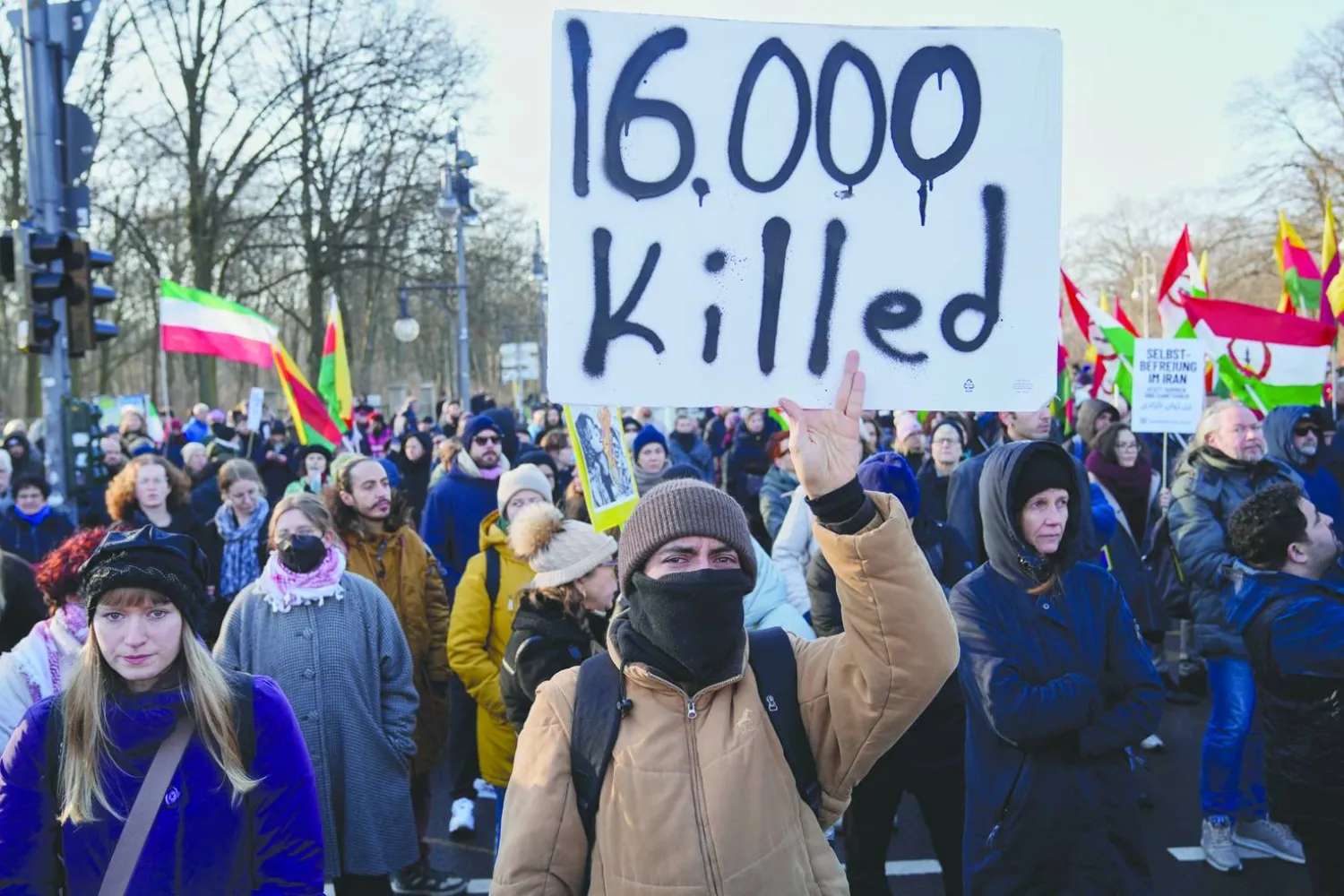
Thousands March in US to Back Iranian Anti-government Protesters

Protesters participate in a demonstration in support of the nationwide mass protests in Iran against the government, in Berlin, Germany, Sunday, Jan. 18, 2026. (AP Photo/Ebrahim Noroozi)
TT

Thousands March in US to Back Iranian Anti-government Protesters

Protesters participate in a demonstration in support of the nationwide mass protests in Iran against the government, in Berlin, Germany, Sunday, Jan. 18, 2026. (AP Photo/Ebrahim Noroozi)

Thousands in the United States staged large demonstrations Sunday denouncing the Iranian government's deadly crackdown on anti-government protesters in Iran.

Several thousand people marched in Los Angeles, home to the world's largest Iranian diaspora, while several hundred others gathered in New York, AFP journalist's in both cities reported.

US protesters could be seen carrying signs condemning a "New Holocaust," a "genocide in the making," and the "terror" of the Iranian government.

"My heart is heavy and my soul is crushed, I'm at loss for words to describe how angry I am," said Perry Faraz at the demonstration in Los Angeles, the second-largest city in the US.

The 62-year-old payroll manager, who fled Iran in 2006, learned this week that one of her young cousins had been killed during the overseas rallies held in her native country.

"He wasn't even 10 years old, that's horrible," she said.

Demonstrations sparked by anger over economic hardship exploded into protests late December in what has been widely seen as the biggest challenge to the Iranian leadership in recent years.

The rallies subsided after a government crackdown in Iran that rights groups have called a "massacre" carried out by security forces under the cover of a communications blackout that started on January 8.

Norway-based Iran Human Rights says it has verified the deaths of 3,428 protesters killed by security forces, confirming cases through sources within Iran’s health and medical system, witnesses and independent sources.

The NGO warned that the true toll is likely to be far higher. Media cannot independently confirm the figure and Iranian officials have not given an exact death toll.

- Calls for US intervention -

"This mass murdering of the population is terribly upsetting," Ali Parvaneh, a 65-year-old lawyer protesting in LA said.

Like many protesters, Parvaneh carried a "Make Iran Great Again" sign and said he wanted US President Donald Trump to intervene by targeting the country's powerful Iranian Revolutionary Guard Corps (IRGC).

Some in the crowd in LA went as far as to call for the assassination of Iranian Supreme Leader Ali Khamenei, who has been in power for more than 25 years.

After having attacked Iranian nuclear sites in June, Trump sent mixed signals on possible US intervention this week.

The Republican first threatened to intervene if Iranian protesters were killed, but then said he was satisfied by Iranian assurances that demonstrators would not be executed.

"I really hope that Trump will go one step beyond just voicing support," Parvaneh said.

Many protesting in the Californian city chanted slogans in support of the US president and Reza Pahlavi, the son of the former Shah of Iran who was deposed by the popular uprising in 1979.

- 'Don't need a puppet' -

Parvaneh echoed Pahlavi's popularity among some segments of Iran's exiled and expatriate population.

"Had the monarchy stayed in place, it would be much different and Iran would be in a much better situation," he said.

Pahlavi's support base is concentrated abroad while his political sway within Iran is limited.

The former Shah's son, who lives in exile near Washington, said this week he would be ready to return to Iran -- but it is unclear if most Iranians want this.

The Iranian opposition remains divided, and memories of the Shah's brutal repression of his left-wing opponents remain vivid.

Last week, a man caused minor injuries when he drove a truck into a demonstration held by Iranians in Los Angeles, carrying a sign that read: "No Shah. No Regime. USA: Don't Repeat 1953. No Mullah."

The sign was referring to the 1953 coup that saw Iran's government overthrown in a US- and UK-backed operation that had seen Pahlavi installed as the country's leader.

In Los Angeles's Westwood neighborhood, nicknamed "Tehrangeles," Roozbeh Farahanipour believes the diaspora must support Iranians without infringing on their "right to decide their own future."

"They don't need a puppet implanted by the West," said the 54-year-old restaurant owner.

Others in California also share that view.

"Trump is playing the Iranian people," said poet Karim Farsis, a resident of the San Francisco Bay area.

Farsis, an academic, stresses that it is US sanctions -- including those imposed by Trump -- and the Republican's ripping up of a nuclear deal that have contributed in large part to the suffering of the Iranian people.

She also criticized the almost complete ban on Iranians entering the US since June.

"We're living in a really twisted moment," she said. "Trump is saying to Iranians: 'Keep protesting, take over your institutions.'

"But if they find themselves in danger, they can't even find refuge in the United States."


France Criticizes ‘Demagogic’ Move by Israel to Ban Hard-Left Leader Melenchon

 09 November 2026, France, Paris: France's Foreign Minister Jean-Noel Barrot, speaks during a G7 foreign ministers' meeting in Paris. (dpa)
09 November 2026, France, Paris: France's Foreign Minister Jean-Noel Barrot, speaks during a G7 foreign ministers' meeting in Paris. (dpa)
TT

France Criticizes ‘Demagogic’ Move by Israel to Ban Hard-Left Leader Melenchon

 09 November 2026, France, Paris: France's Foreign Minister Jean-Noel Barrot, speaks during a G7 foreign ministers' meeting in Paris. (dpa)
09 November 2026, France, Paris: France's Foreign Minister Jean-Noel Barrot, speaks during a G7 foreign ministers' meeting in Paris. (dpa)

France has ‌criticized as "demagogic" a decision by Israel to ban French hard-left presidential candidate Jean-Luc Melenchonand another leading figure in his France Unbowed (La France Insoumise) party from entering the country.

Israel's Foreign Ministry said on Thursday it would bar Melenchon and Mathilde Panot, the party’s parliamentary group chair, over "the extreme anti-Israel stance of La France Insoumise party and the outrageous statements made by ‌its leaders."

"This demagogic ‌decision, coming from a ‌government ⁠that has repeatedly violated international ⁠law, plays into the hands of those who, like La France Insoumise, thrive on exploiting the Israeli-Palestinian conflict," Foreign Minister Jean-Noel Barrot said on X.

"France will continue to work tirelessly toward a two-state solution and the ⁠peaceful coexistence of the Israeli and ‌Palestinian peoples,” he ‌said.

The Israeli Foreign Ministry said in a ‌statement on Thursday that both Melenchon and ‌Panot had made statements spreading "blood libels" against Israel, and that Melenchon had called for French ships to escort illegal flotillas to Gaza.

"Israel will respond ‌firmly to those who seek to harm it and will not allow ⁠individuals ⁠who act against Israel and incite against its citizens to enter the country," it said.

Melenchon told Franceinfo radio: "I am banned from entering a territory I did not ask to enter...I regret that the Israeli government is pursuing me like this."

In a campaign speech last Saturday, Melenchon made clear that, if he were elected president, French vessels would accompany activists hoping to force aid into the Gaza Strip.


UN Hails Progress in Ebola Response, Cites Insecurity as Biggest Challenge

Congolese workers wearing personal protective equipment (PPE) walk outside the Ebola Treatment Center at the Bunia General Referral Hospital following a resurgence of Ebola involving the Bundibugyo strain, in Bunia, Ituri province, the Democratic Republic of Congo, November 2, 2026. (Reuters)
TT

UN Hails Progress in Ebola Response, Cites Insecurity as Biggest Challenge

Congolese workers wearing personal protective equipment (PPE) walk outside the Ebola Treatment Center at the Bunia General Referral Hospital following a resurgence of Ebola involving the Bundibugyo strain, in Bunia, Ituri province, the Democratic Republic of Congo, November 2, 2026. (Reuters)

UN health officials on Friday hailed progress in the Ebola response six months after the outbreak first prompted global concerns, but cautioned that the disease continues to spread to more remote and dangerous parts of Congo.

With the number of confirmed cases now surpassing 11,000, the outbreak is the second-worst for Ebola on record and ‌has spread to parts ‌of east, central and ‌west ⁠Africa.

Flagged by health ⁠authorities in mid-May, the outbreak is driven by the rare Bundibugyo species of the virus, for which there are no approved treatments or vaccines.

"We do see encouraging signs," said Chikwe Ihekweazu, head of ⁠the World Health Organization's Health Emergencies Program, ‌citing falling ‌cases in former hotspots like Bunia in eastern Democratic ‌Republic of Congo.

“But what we have ‌seen now is the emergence of cases in more rural and more difficult-to-reach areas ... The biggest challenge the response faces right now ‌is the rising insecurity," he said, citing WHO data showing 80 attacks ⁠on health ⁠sites and workers so far.

French medical charity Médecins Sans Frontières has been more downbeat on the Ebola response, saying that supplies are missing and the virus is still spreading out of control.

Julien Harneis, the UN's special Ebola coordinator, said in response to the criticism: "The area of operation is vast, just unimaginable vast...But 80% of the time, and across this vast area, we're able to operate."


Five Facts About APEC with Trump, Putin and Xi Set to Attend

Workers install signage for the upcoming Asia-Pacific Economic Cooperation (APEC) China 2026 summit on the wall of a building in Shenzhen, China's Guangdong province on November 12, 2026. (AFP)
TT

Five Facts About APEC with Trump, Putin and Xi Set to Attend

Workers install signage for the upcoming Asia-Pacific Economic Cooperation (APEC) China 2026 summit on the wall of a building in Shenzhen, China's Guangdong province on November 12, 2026. (AFP)

Attention will focus next week ‌on a summit of US, Chinese and Russian leaders set for the 21-member gathering of the Asia-Pacific Economic Cooperation (APEC) forum in China's southern technology hub of Shenzhen.

WHAT IS APEC?

Founded as an informal 12-member dialogue effort in 1989 in the Australian capital of Canberra, it has become the region's premier economic forum to foster ties on advancing growth, trade and investment.

Accounting for about 62% of global GDP and roughly half of global trade, the grouping of "member economies" rather than nations allows participation by Chinese-ruled Hong Kong and democratically governed Taiwan, which Beijing claims as its own territory.

It does not include India, the world's most populous nation, however.

APEC operates on non-binding commitments reached strictly by consensus, with commitments undertaken on a voluntary basis.

The APEC Economic Leaders' Meeting is set for November 18 and 19, preceded by an annual summit of CEOs on November 17-18.

WHY SHENZHEN?

China is ‌hosting the summit ‌for the third time, after events in the commercial hub of Shanghai ‌in ⁠2001 and the ⁠capital, Beijing, in 2014.

Both domestic and international reasons govern the choice of Shenzhen, adjacent to the financial center of Hong Kong, said Chim Lee, senior analyst at the Economist Intelligence Unit.

As part of China's Greater Bay Area home to Hong Kong and Macau, which Beijing seeks to establish as a global hub for technology and innovation, the city offers a platform to showcase China's vision for development and trade.

It also highlights Shenzhen's resilience to geopolitical turbulence, Lee added.

The city is the base of several leading Chinese auto and tech giants, such as BYD, ⁠Huawei and Tencent .

WHO WILL BE THERE?

China has said President Xi Jinping ‌will chair the leaders' meeting and deliver remarks. US President Donald ‌Trump, Russian President Vladimir Putin and Philippine President Ferdinand Marcos Jr. are among those expected.

The leaders of Canada, Australia, Mexico ‌and Indonesia are also due to attend, along with those of Malaysia, South Korea and Vietnam among ‌Asia-Pacific nations.

Taiwan has designated Stan Shih, founder of Acer, as its envoy.

WHAT TO WATCH AND KEY STICKING POINTS

Middle East Instability: The economic ripple effects of conflict, such as risks to energy security, trade flows, supply chains and inflation are ‌major concerns expected to figure in talks.

Tripartite Dynamics: All eyes are on the possible meeting of Chinese, Russian and US leaders. China is hesitant to ⁠engage in talks on nuclear ⁠disarmament, as it has fewer such weapons than the other two, analysts said.

The US and Russia will also be keen to discuss the Ukraine war, but not necessarily China, they said.

China-US Relations: A key focus to see if ties can stay stable. Both sides are falling short on commitments to an extended trade truce, analysts said. Rare earth supplies, artificial intelligence and tariffs are also likely to figure on the agenda, with US arms sales to Taiwan closely watched.

China's ties with Japan and the Philippines: Strains in Japan and China ties have persisted since Prime Minister Sanae Takaichi angered Beijing in November 2025 by suggesting that Japan could deploy its military if a Chinese move against neighboring Taiwan also threatened its territory.

China-Philippines relations will likewise be closely watched amid continuing tension in the disputed waterway of the South China Sea.

WHO ARE APEC'S MEMBERS?

These are Australia, Brunei, Canada, Chile, China, Hong Kong, Indonesia, Japan, South Korea, Malaysia, Mexico, New Zealand, Papua New Guinea, Peru, the Philippines, Russia, Singapore, Taiwan, Thailand, the United States and Vietnam.