


Trump Rules Out ‘Force’ Against Greenland but Demands Talks

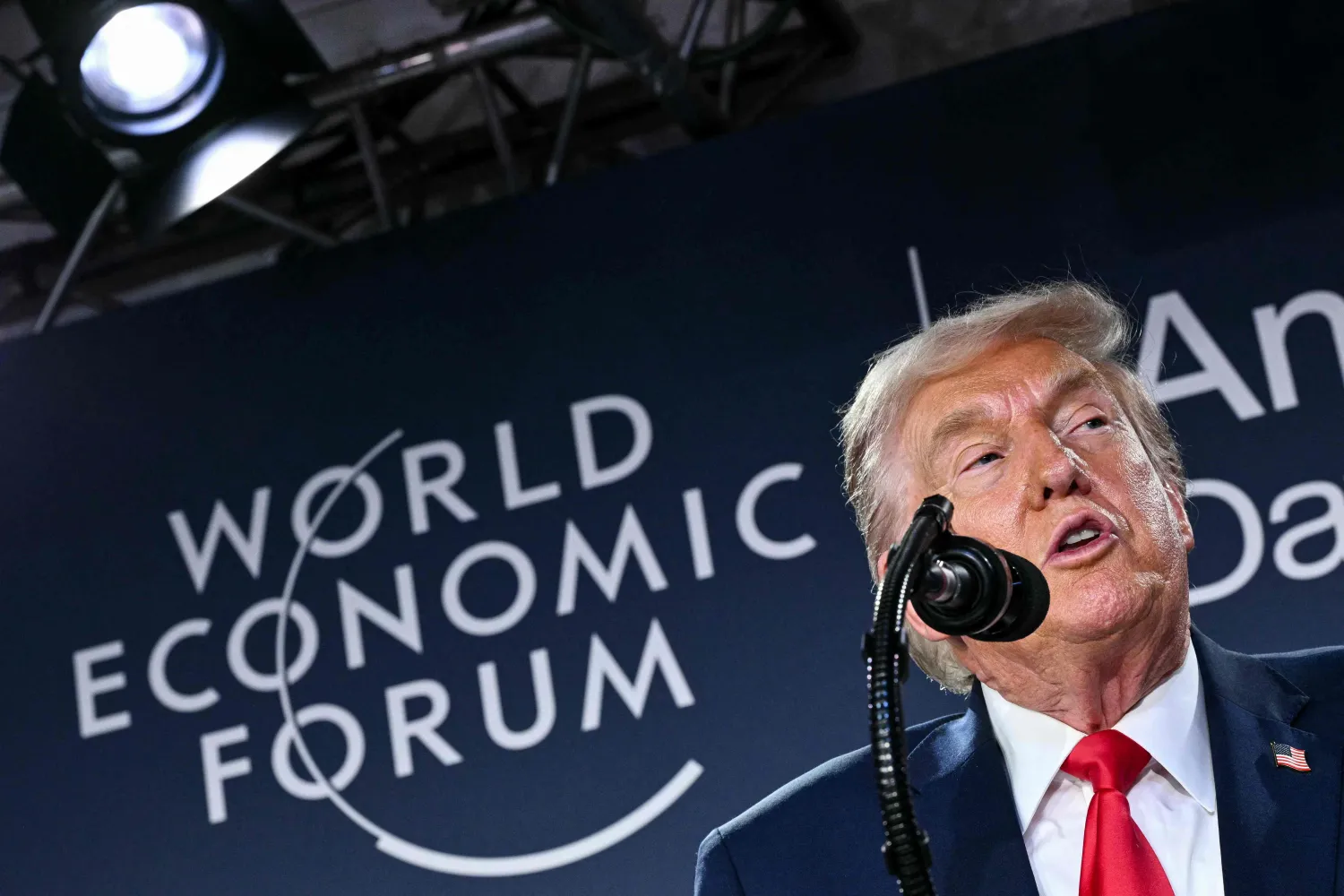
US President Donald Trump speaks during a reception with business leaders on the sidelines of the World Economic Forum (WEF) annual meeting in Davos on January 21, 2026. (AFP)
TT

Trump Rules Out ‘Force’ Against Greenland but Demands Talks

US President Donald Trump speaks during a reception with business leaders on the sidelines of the World Economic Forum (WEF) annual meeting in Davos on January 21, 2026. (AFP)

US President Donald Trump for the first time ruled out using force to take Greenland as he addressed world leaders in Davos Wednesday, but demanded "immediate negotiations" to acquire the island from Denmark. 

Trump's quest to take control of Greenland from a NATO ally has deeply shaken the global order and the markets, and it dominated his first address to the World Economic Forum in six years. 

In a speech lasting more than an hour in the Swiss ski resort, Trump slammed "ungrateful" Denmark for refusing to give up Greenland, and said the United States alone could guarantee the security of the "giant piece of ice". 

But Trump appeared to take the threat of military action off the table, in a dramatic turnaround from his previous threats that the US could use force to take control of the mineral-rich Arctic island. 

"We probably won't get anything unless I decide to use excessive strength and force where we would be, frankly, unstoppable -- but I won't do that," Trump said. 

"I don't have to use force. I don't want to use force. I won't use force. All the United States is asking for is a place called Greenland." 

Wall Street stocks opened higher Wednesday after Trump's comments. 

Denmark said it was a "positive" sign that Trump had said he wanted to avoid military force -- but stressed that the US president had not backed away from his push to acquire Greenland. 

"What is quite clear after this speech is that the president's ambition remains intact," Foreign Minister Lars Lokke Rasmussen said. 

Greenland's government meanwhile unveiled a new brochure on Wednesday offering advice to the population in the event of a "crisis" in the territory, saying it was an "insurance policy". 

- 'Immediate negotiations' - 

Trump repeatedly pushed his claims to Greenland -- which he mistakenly called Iceland several times -- during lengthy remarks on the deepest crisis in transatlantic relations for decades. 

He said he was "seeking immediate negotiations to once again discuss the acquisition of Greenland by the United States" and added that Washington would "remember" if Denmark said no. 

Trump says Greenland is under threat from Russia and China. 

The US president also lambasted Europe on a number of fronts from security to tariffs and the economy, saying it was "not heading in the right direction". 

Trump flew into Davos by helicopter, stepping onto a red carpet laid in the snow -- but he flew into a growing international storm over Greenland. 

He arrived some two hours behind schedule, after an electrical issue earlier forced Air Force One to turn back to Washington and the president to switch planes. 

Europe and Canada had earlier closed ranks against what they view as a threat to the US-led global order from Trump's territorial ambitions. 

Canada's Prime Minister Mark Carney won a standing ovation at Davos on Tuesday when he warned of a "rupture" to the US-led system. French President Emmanuel Macron meanwhile said Europe would not be bullied. 

But Trump, who was due to meet a number of leaders in Davos, renewed his attacks on the two leaders, mocking Macron in particular for wearing sunglasses at Davos, which the French president said was because of an eye condition. 

- 'Thoughtful diplomacy' - 

Trump also repeatedly expressed doubts on NATO during his speech, saying Washington was treated "so unfairly" and questioning whether the alliance would defend the United States if asked. 

NATO chief Mark Rutte, whom Trump was due to meet in Davos, said Wednesday that "thoughtful diplomacy" was needed to resolve the crisis. 

The Greenland row has also soured relations with the European Union, which has threatened countermeasures after Trump vowed tariffs of up to 25 percent on eight European countries for backing Denmark. 

But Polish President Karol Nawrocki, a Trump ally, told AFP after the "very important" speech: "I think the situation will be calm." He said he understood the US leader's stance amid Russian pressure at EU borders. 

In a speech that veered from topic to topic, Trump also expressed hope of ending the Ukraine war soon, saying he expected to meet President Volodymyr Zelensky in Davos on Thursday. 

Also on Thursday, meanwhile, Trump is set to formally announce the first charter of his so-called "Board of Peace", a body for resolving international conflicts. 


Iran Warns UN Security Council against 'Provocative Action' on Hormuz

09 September 2025, Egypt, Cairo: Iranian Foreign Minister Abbas Araghchi attends a joint press conference in Cairo. (dpa)
TT

Iran Warns UN Security Council against 'Provocative Action' on Hormuz

09 September 2025, Egypt, Cairo: Iranian Foreign Minister Abbas Araghchi attends a joint press conference in Cairo. (dpa)

Iran warned the UN Security Council against any "provocative action", ahead of a scheduled vote on a draft resolution on the Strait of Hormuz that ended up being postponed.

"Any provocative action by the aggressors and their supporters, including in the UN Security Council regarding the situation in the Strait of Hormuz, will only complicate the situation," Iranian Foreign Minister Abbas Araghchi said.

Araghchi was speaking ahead of a scheduled Security Council vote on a draft resolution mandating a force to protect shipping through the Strait of Hormuz Friday.

It was later announced that the vote was postponed, with no new date scheduled.

The Strait of Hormuz, a shipping lane vital to global energy flows, has been all but shut since the United States and Israel launched strikes against Iran on February 28.

The 15-member body was set to vote on a draft resolution brought by Bahrain on authorizing the use of "defensive" force to protect shipping in Hormuz from Iranian attacks, according to the official program.

The draft resolution was backed by the US and the countries hardest hit by the virtual blockade, but member states including Russia, China and France had objected to earlier drafts.


UN Security Council Delays Vote on Authorizing Force to Protect Hormuz

With oil and gas shipments severely restricted due to the US-Israeli war against Iran, the UN Security Council is meeting to consider authorizing the use of 'defensive' force as a way to open the vital Strait of Hormuz. FADEL SENNA / AFP/File
TT

UN Security Council Delays Vote on Authorizing Force to Protect Hormuz

With oil and gas shipments severely restricted due to the US-Israeli war against Iran, the UN Security Council is meeting to consider authorizing the use of 'defensive' force as a way to open the vital Strait of Hormuz. FADEL SENNA / AFP/File

The UN Security Council has postponed a vote scheduled for Friday on authorizing the use of "defensive" force to protect shipping in the Strait of Hormuz from Iranian attacks, according to the official program.

The 15-member body was set to vote Friday morning on a draft resolution brought by Bahrain, but by Thursday night the schedule shifted.

The reason given was that the United Nations observes Good Friday as a public holiday, according to diplomatic sources -- despite this fact being known when the vote was first announced.

No new date has been given for voting on the draft.

Iran has placed a stranglehold on the key shipping lane -- threatening fuel supplies and roiling the global economy -- in retaliation for US-Israeli strikes that triggered the month-old Middle East war.

"We cannot accept economic terrorism affecting our region and the world, the whole world is being affected by the developments," Bahrain's United Nations ambassador Jamal Alrowaiei said this week.

He said the text, which has gone through several amendments and is supported by the United States, "comes at a critical juncture."

President Donald Trump on Wednesday called for countries struggling with fuel shortages to "go get your own oil" in the Strait of Hormuz, adding that US forces would not help them.

A sixth and final draft, seen by AFP, greenlights member states -- either unilaterally or as "voluntary multinational naval partnerships" -- to use "all defensive means necessary and commensurate with the circumstances."

It applies to the strait and adjacent waters to "secure transit passage and to deter attempts to close, obstruct or otherwise interfere with international navigation through the Strait of Hormuz."

The measure would last for a period of at least six months.

The draft resolution has been molded in a bid to rally several countries that have appeared skeptical, including Russia, China and France.

Revised wording no longer explicitly invokes Chapter 7 of the UN Charter, which allows the Security Council to authorize armed force to restore peace.

The latest version, which was scheduled to be voted on at 11:00 am (1500 GMT) Friday before the postponement, also emphasizes the defensive nature of any intervention -- a stipulation that seems to have alleviated French concerns.

'Tall odds'

Jerome Bonnafont, France's UN ambassador, said Thursday that "it is up to the Council to quickly devise the necessary defensive response" after members voted in March to condemn Iran's blocking of the Strait of Hormuz.

President Emmanuel Macron earlier said a military operation to free the waterway is "unrealistic."

It is not certain that Russia and China -- who both wield veto powers -- will back the draft resolution.

"Authorizing member states to use force would amount to legitimizing the unlawful and indiscriminate use of force, which would inevitably lead to further escalation of the situation and lead to serious consequences," said Chinese ambassador Fu Cong.

Russia, a long-time ally of Tehran, has denounced what it calls one-sided measures.

Considering the possible Russian and Chinese vetos, the text "faces tall odds to make it through the Security Council," Daniel Forti, an analyst at International Crisis Group, told AFP.

"It is hard to see them supporting a resolution that treats stability in the strait exclusively as a security issue, instead of one that also grapples with the need for a durable political end to the hostilities," he said.

Normally, around a fifth of the world's oil and liquefied natural gas passes through the Strait of Hormuz.

Its near-total closure is impacting global supplies of important commodities including oil, liquefied natural gas and fertilizer and leading to sharp rises in energy prices.

Security Council mandates authorizing member states to use force are relatively rare.


Man Arrested After Setting off Pyrotechnics on German Train, Injuring 12

A police officer stands on a platform at Siegburg station where a Deutsche Bahn ICE train is parked, in Siegburg, Germany, early Friday, April 3, 2026, after a man was arrested on Thursday after threatening an attack on a high-speed train. (Roberto Pfeil/dpa via AP)
TT

Man Arrested After Setting off Pyrotechnics on German Train, Injuring 12

A police officer stands on a platform at Siegburg station where a Deutsche Bahn ICE train is parked, in Siegburg, Germany, early Friday, April 3, 2026, after a man was arrested on Thursday after threatening an attack on a high-speed train. (Roberto Pfeil/dpa via AP)

A man armed with knives was arrested after setting off pyrotechnics on a high-speed train in Germany, injuring 12 people, police said Friday.

The incident occurred late Thursday on an Intercity Express train, the German equivalent of France's TGV, bound for Frankfurt in western Germany, with around 180 passengers evacuated.

The suspect was locked in a bathroom by passengers after setting off the pyrotechnics, police said in a statement, adding that the man was carrying two knives.

Police said they were investigating the suspect's motives, but German media reported he allegedly threatened to carry out an attack and said he wanted to kill people.

Public radio station Deutschlandfunk reported, citing witness statements, that the man threw pyrotechnic devices filled with plastic pellets.

At least 12 passengers were slightly injured, including one who was taken to hospital but was released after treatment, police said.

Police said they searched the train for dangerous objects, but did not find anything.
